
Trans-Am Rally
"AT THE 'GO' SIGNAL you will start your engine, take off, and be on your way."
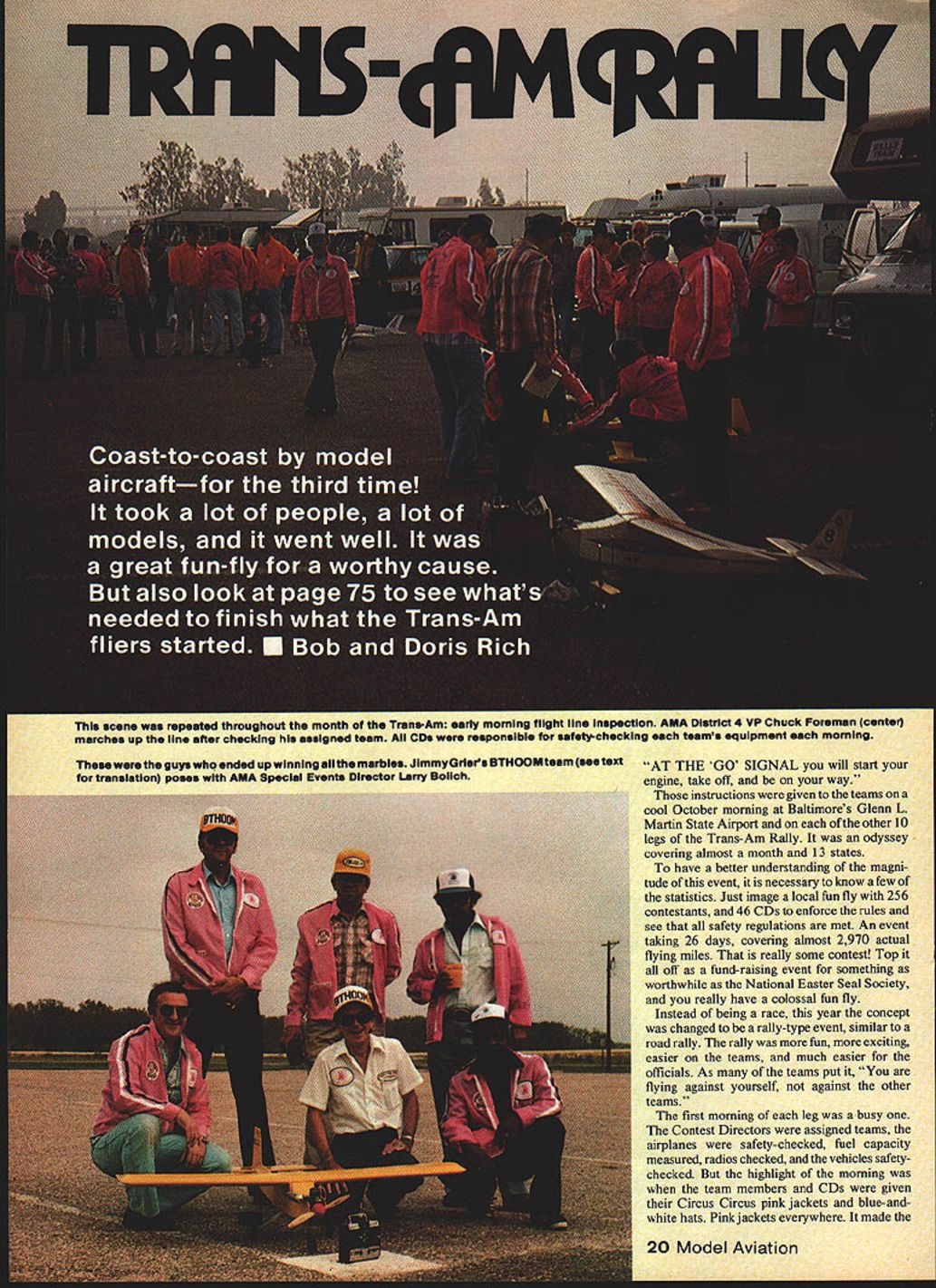
Those instructions were given to the teams on a cool October morning at Baltimore's Glenn L. Martin State Airport and on each of the other 10 legs of the Trans‑Am Rally. The odyssey covered almost a month and 13 states.
Overview
- 26 days
- Almost 2,970 actual flying miles
- 256 contestants
- 46 Contest Directors (CDs)
- Fund-raising event for the National Easter Seal Society
Instead of being a straight race, the event was run as a rally — similar to a road rally. The rally format proved more fun, more exciting, easier on the teams, and much easier for the officials. As many teams said, "You are flying against yourself, not against the other teams."
Format and rules
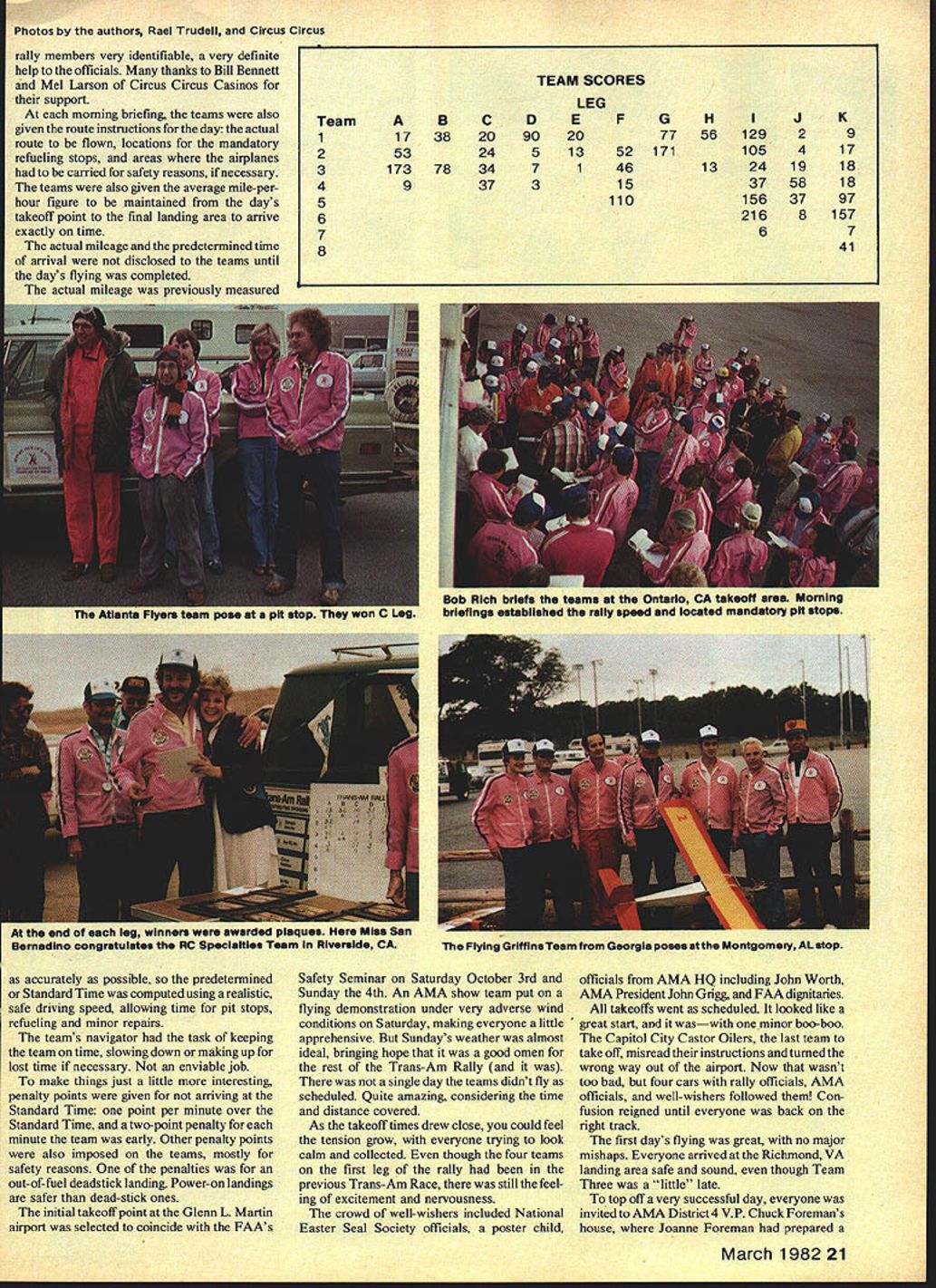
- The actual mileage and the predetermined time of arrival (Standard Time) were not disclosed to teams until the day's flying was completed. Actual mileage was measured beforehand and Standard Time was computed using a realistic, safe driving speed, allowing for pit stops, refueling, and minor repairs.
- Penalties:
- 1 point per minute over Standard Time
- 2 points per minute early
- Other penalties for safety violations (for example, penalty assessed for out-of-fuel deadstick landings since power-on landings are safer)
- Each team had a Contest Director (CD) assigned to enforce rules, assess penalties, and ensure safety. CDs also kept complete logs of team activities.
Daily routine
Each first morning of a leg was busy:
- Teams were assigned to CDs.
- Airplanes and vehicles were safety-checked.
- Fuel capacity and radios were checked.
- Team members and CDs received Circus Circus pink jackets and blue-and-white hats.
As takeoff times drew near, tension increased. Well-wishers included National Easter Seal Society officials, the poster child, AMA HQ representatives (including John Worth and AMA President John Grigg), and FAA dignitaries. All takeoffs went as scheduled on the first day with only minor boo-boos. For example, the Capitol City Castor Oilers, the last team to take off, misread instructions and turned the wrong way out of the airport — rally officials, AMA officials, and well‑wishers followed until everyone was back on track.
At the end of the day's flying, teams gathered at the overnight stop. Stories were told, repairs were made, and equipment was rebuilt with "a little effort and lots of glue." On the first night of each leg the teams and officials shared food, stories, and camaraderie.
Contest Director logs and anecdotes
CD logs read like adventure novels — full of thrills and mishaps. Sample entries and comments:
- "Top of tree, then the ground."
- "Team worried about breaking last prop, broke airplane instead."
- "Needed air traffic control tower; three teams arrived at pit stop area within two minutes, aircraft stampeded a herd of horses in next field."
- "Everything routine, plane chased road guard on takeoff."
- "Good takeoff, good landing, good pit, good takeoff, good flight."
- "Team left starter and fuel behind, had to go back for equipment. Pilot kept his cool, but driver of pilot vehicle was frosted."
- "Have run into very strong headwinds, had to slow down vehicle. Pilot got very excited, thought we would pass the plane and was stomping his feet on the cab of the truck yelling, SLOWER!"
- "More headwinds at the summit, speed down to 58 mph."
- One CD, caught up in the spirit of the rally, simply wrote: "We broke a prop."
Mishaps, repairs, and ingenuity
- There were the usual tree strikes, crosswinds on final approach, and last-minute obstacles.
- Overnight repairs and complete rebuilds demonstrated what can be accomplished with determination and glue.
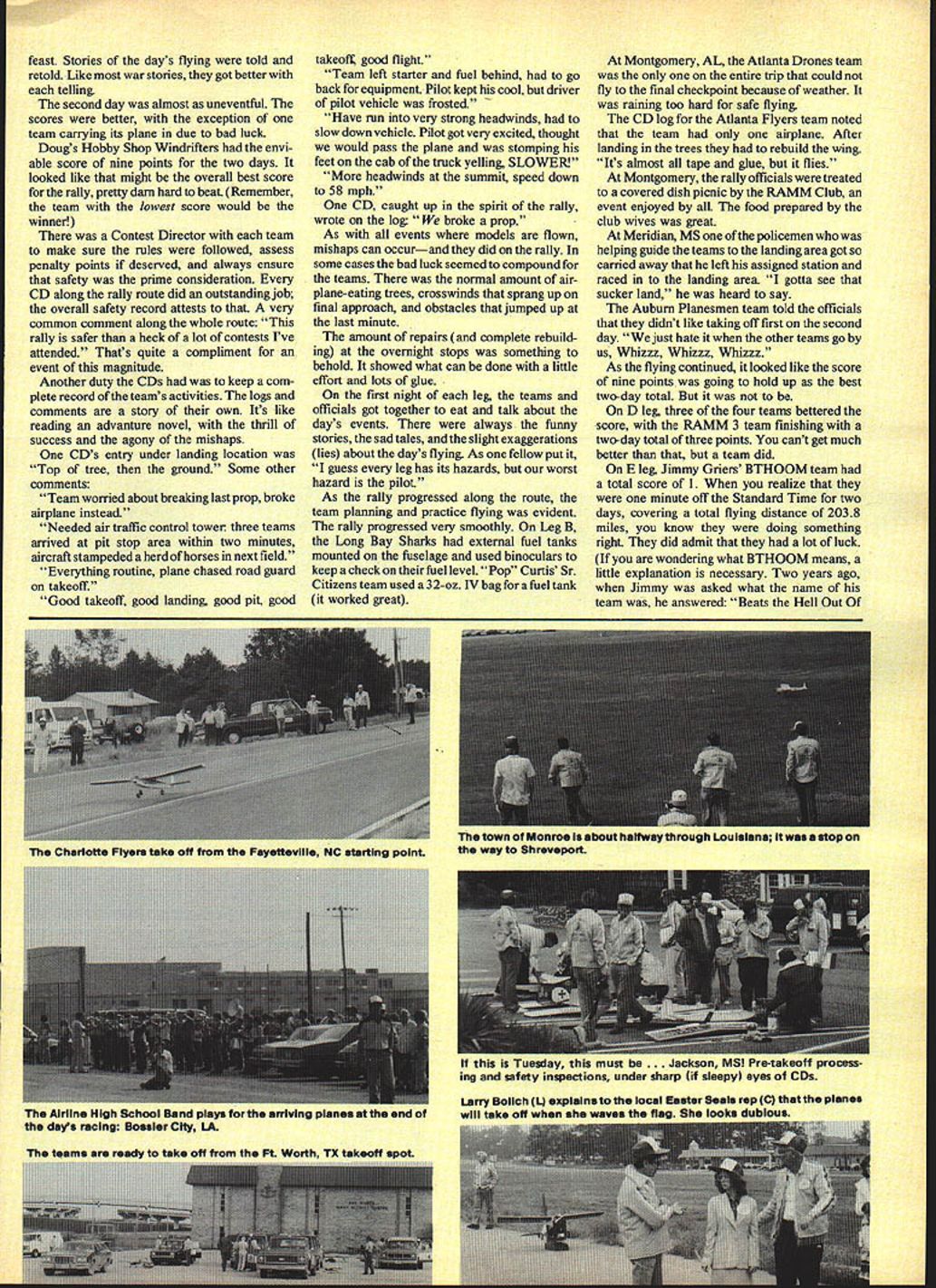
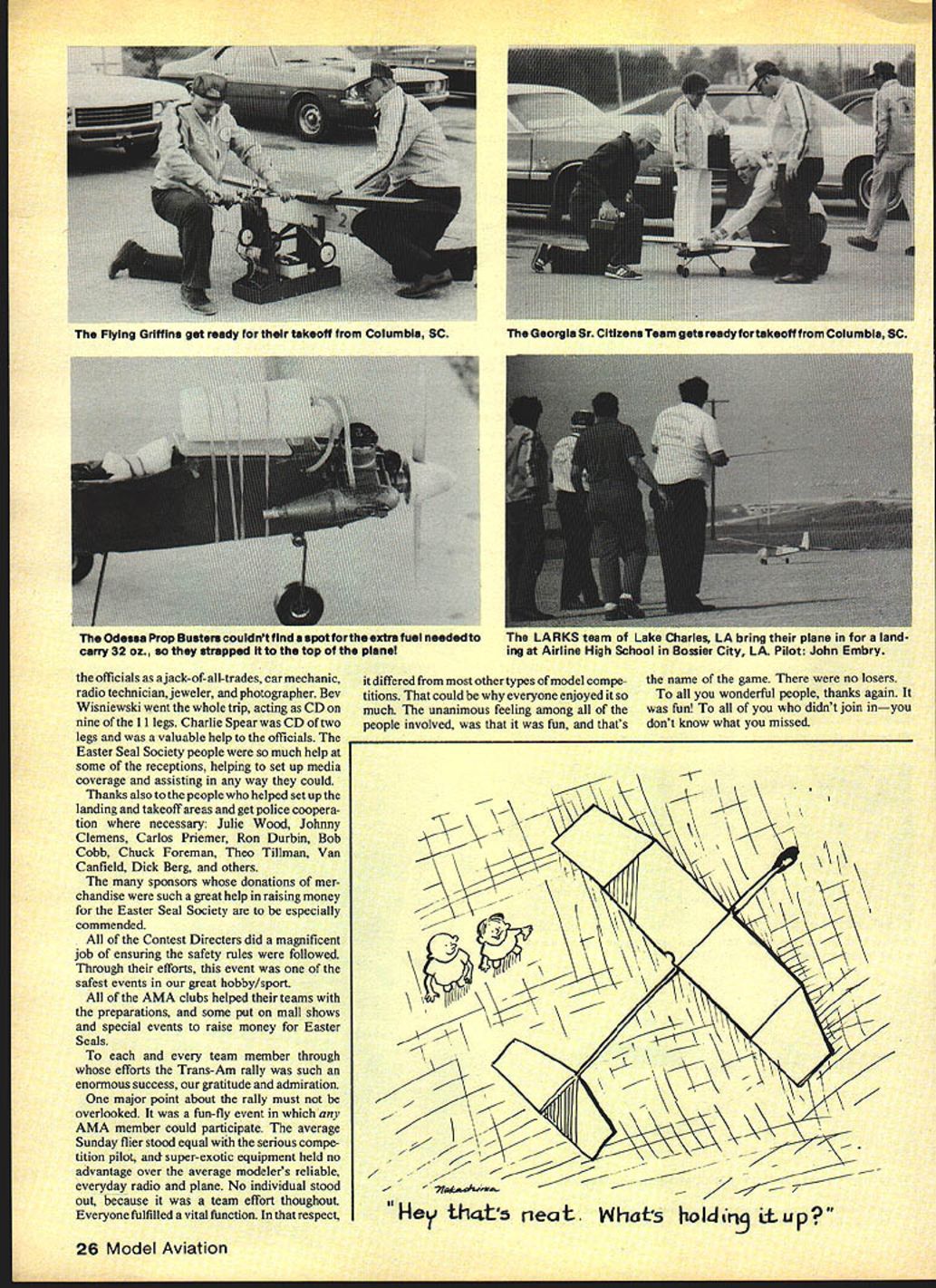
- Creative solutions included external fuselage fuel tanks and using binoculars to monitor fuel; one team used a 32-oz IV bag as a fuel tank.
- The Atlanta Drones were the only team unable to fly to a final checkpoint because of heavy rain.
- The Atlanta Flyers arrived with a plane that had been rebuilt from tree damage: "It's almost all tape and glue, but it flies."
- At Meridian, MS, police helping guide teams got so excited they left their posts to watch landings: "I gotta see that sucker land," one officer said.
- The Auburn Planesmen joked about disliking taking off first on the second day because they hated being passed by other teams.
Notable legs and incidents
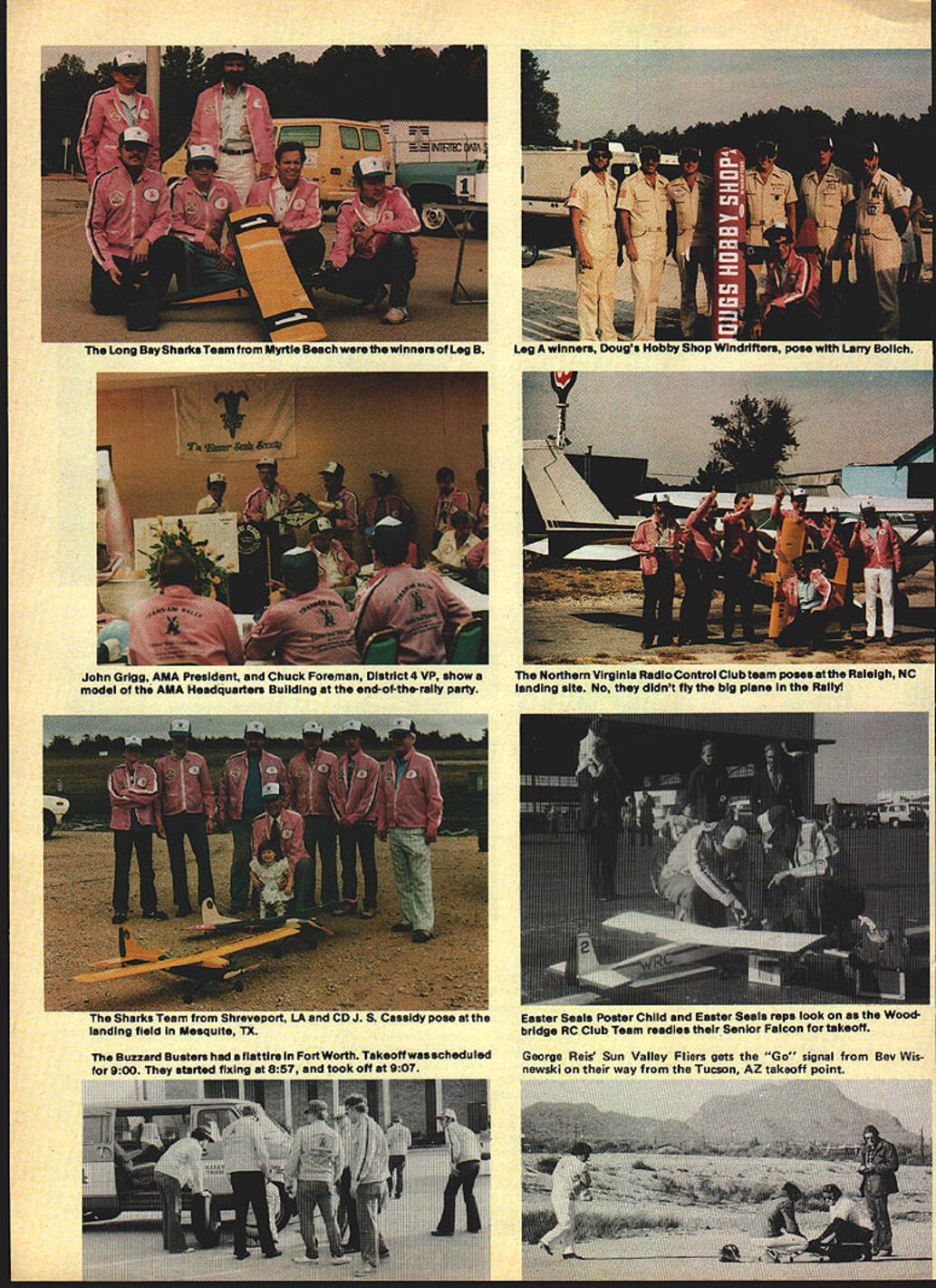
- Leg A winners: Doug's Hobby Shop Windrifters (photo note: they posed with Larry Bolich).
- Leg B winners: Long Bay Sharks Team from Myrtle Beach.
- On D leg, RAMM 3 finished with a two-day total of 3 points.
- On E leg, Jimmy Grier's BTHOOM team scored a total of 1 point (they were one minute off Standard Time for two days covering 203.8 miles). The team name BTHOOM came from Jimmy's reply two years earlier when asked his team name: "Beats the Hell Out Of Me."
- At Shreveport, teams were greeted by the Airline High School Band led by Larry Stanley.
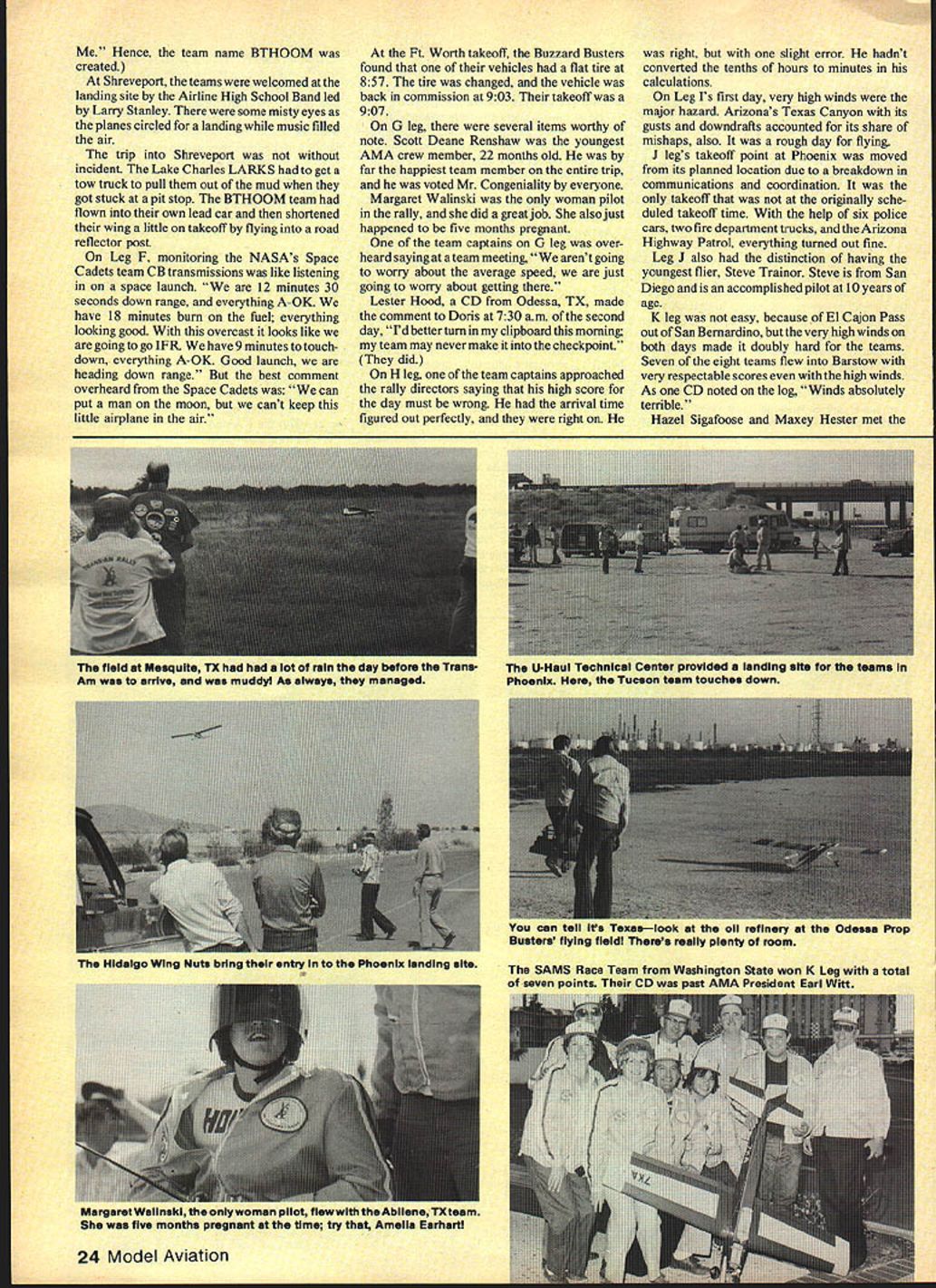
- Lake Charles LARKS needed a tow truck after getting stuck in mud at a pit stop.
- BTHOOM once flew into their own lead car and later shortened a wing by flying into a road reflector post.
- Leg F: NASA's Space Cadets' CB transmissions sounded like a space launch; memorable quote: "We can put a man on the moon, but we can't keep this little airplane in the air."
- Ft. Worth takeoff: the Buzzard Busters had a flat tire at 8:57, changed it, and took off at 9:07.
- G leg:
- Scott Deane Renshaw (22 months old) was the youngest AMA crew member and was voted Mr. Congeniality.
- Margaret Walinski was the only woman pilot and flew while five months pregnant.
- H leg: a team captain miscalculated because he forgot to convert tenths of hours to minutes.
- I leg: very high winds, including gusts and downdrafts at Texas Canyon, Arizona — a rough day.
- J leg: Phoenix takeoff point moved due to communications issues; with local police and fire assistance, everything proceeded safely. Youngest flier on J leg: Steve Trainor, age 10, from San Diego.
- K leg: El Cajon Pass out of San Bernardino and very high winds made the leg difficult; seven of eight teams flew into Barstow with respectable scores.
Hazel Sigafoose and Maxey Hester met the teams in Barstow, CA, and traveled with them to the final landing in Las Vegas.
Final landing and awards
The Las Vegas landing was the climax. Each team received a bottle of champagne after landing. The teams then formed a procession to the Circus Circus RC Park Clubhouse for final festivities: refreshments, speeches, awards, and a merchandise prize drawing. Hazel Sigafoose conducted the drawing for radios, engines, airplane kits, and other items. The Riches donated an original Liberty Bell model for auction (proceeds to Easter Seals); the high bidder was the SAMS race team from Bellevue, WA.
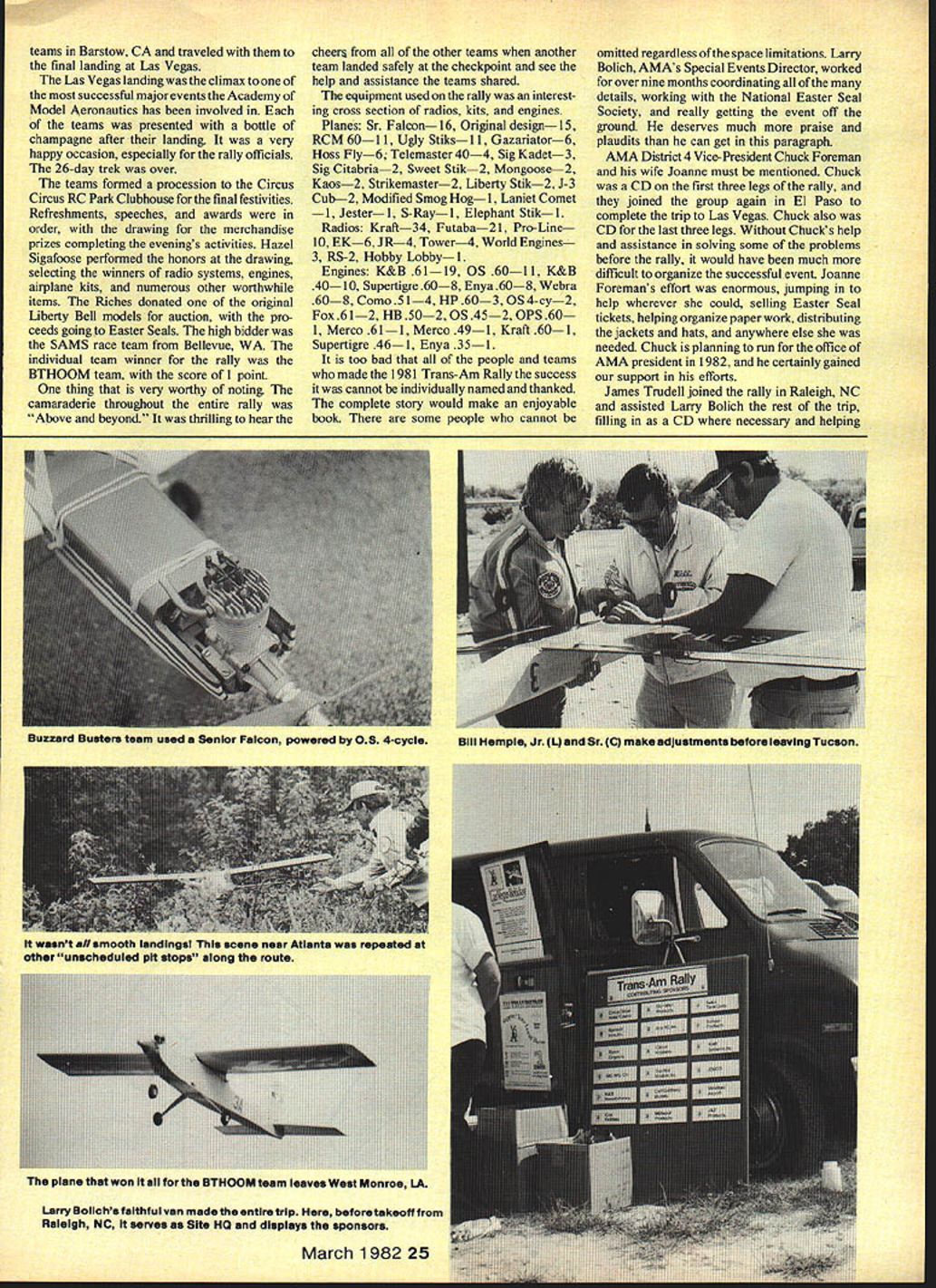
- Individual team winner for the rally: BTHOOM team with 1 point.
Camaraderie was repeatedly noted as "above and beyond." Teams cheered other teams' safe landings and offered help throughout the route.
Equipment used
Planes (type — count)
- Sr. Falcon — 16
- Original design — 15
- RCM 60 — 11
- Ugly Stik — 11
- Gazariator — 6
- Moss Fly — 6
- Telemaster 40 — 4
- Sig Kadet — 3
- Sig Citabria — 2
- Sweet Stik — 2
- Mongoose — 2
- Kaos — 2
- Strikemaster — 2
- Liberty Stik — 2
- J-3 Cub — 2
- Modified Smog Hog — 1
- Laniet Comet — 1
- Jester — 1
- S-Ray — 1
- Elephant Stik — 1
Radios (make — count)
- Kraft — 34
- Futaba — 21
- Pro-Line — 10
- EK — 6
- JR — 4
- Tower — 4
- World Engines — 3
- RS-2, Hobby Lobby — 1
Engines (make — count)
- K&B .61 — 19
- OS .60 — 11
- K&B .40 — 10
- Super Tiger .60 — 8
- Enya .60 — 8
- Webra .60 — 8
- Comet .51 — 4
- HP .60 — 3
- OS .4 — 2
- Fox .61 — 2
- HB .50 — 2
- OS .45 — 2
- OPS .60 — 1
- Merco .61 — 1
- Merco .49 — 1
- Kraft .60 — 1
- Supertigre .46 — 1
- Enya .35 — 1
Acknowledgments
Many people and teams contributed to the success of the 1981 Trans‑Am Rally. Notable mentions:
- Larry Bolich, AMA Special Events Director — coordinated details, worked with the National Easter Seal Society, and helped get the event off the ground.
- Chuck Foreman, AMA District 4 Vice‑President — served as CD on several legs and helped solve many pre-rally problems.
- Joanne Foreman — organized paperwork, distributed jackets and hats, sold Easter Seal tickets, and helped wherever needed.
- James Trudell — joined in Raleigh, NC, and assisted Larry Bolich as CD, mechanic, radio technician, jeweler, photographer, and jack-of-all-trades.
- Bev Wisniewski — served as CD on nine of the 11 legs.
- Charlie Spear — CD of two legs.
- Hazel Sigafoose and Maxey Hester — met teams at Barstow and accompanied them to Las Vegas.
Thanks also to the Easter Seal Society for reception assistance and media coverage; to people who helped set up landing and takeoff areas and secure police cooperation (Julie Wood, Johnny Clemens, Carlos Priemer, Ron Durbin, Bob Cobb, Theo Tillman, Van Canfield, Dick Berg, and others); and to the many sponsors whose merchandise donations raised money for Easter Seals.
All Contest Directors and AMA clubs contributed to safety and preparation. Many clubs ran mall shows and special events to raise funds.
Conclusion
The Trans‑Am Rally emphasized fun and teamwork. It was a fun-fly event in which any AMA member could participate. The average Sunday flier stood equal with the serious competitor; exotic equipment held no advantage over reliable, everyday radios and planes. The unanimous feeling among participants was that it was fun — and that was the point. There were no losers.
To all who took part and helped make the Trans‑Am Rally an enormous success: thank you. It was fun. To those who didn't join in — you don't know what you missed.
Transcribed from original scans by AI. Minor OCR errors may remain.

