
Trans-America R/C Relay Race
During October 1975 Bob and Doris Rich flew their "Liberty Bell" model of a Carl Goldberg Falcon from Kitty Hawk, NC to Oceanside, CA. They did it in 23 days, with 118 separate flights. Their achievement inspired much subsequent thinking on cross-country flying and culminated in the development of a Trans‑AM Relay Race. The idea is to have teams of modelers fly relatively short legs across the country, each team flying only a part of the total distance that Bob and Doris did, thus enabling many more to participate than would otherwise be possible. The project has been adopted by the Academy of Model Aeronautics (AMA) as a major PR effort for 1979 and is expected to be tied in with the Muscular Dystrophy campaign. The first takeoffs were slated to be announced as part of the Jerry Lewis Telethon in September 1979.
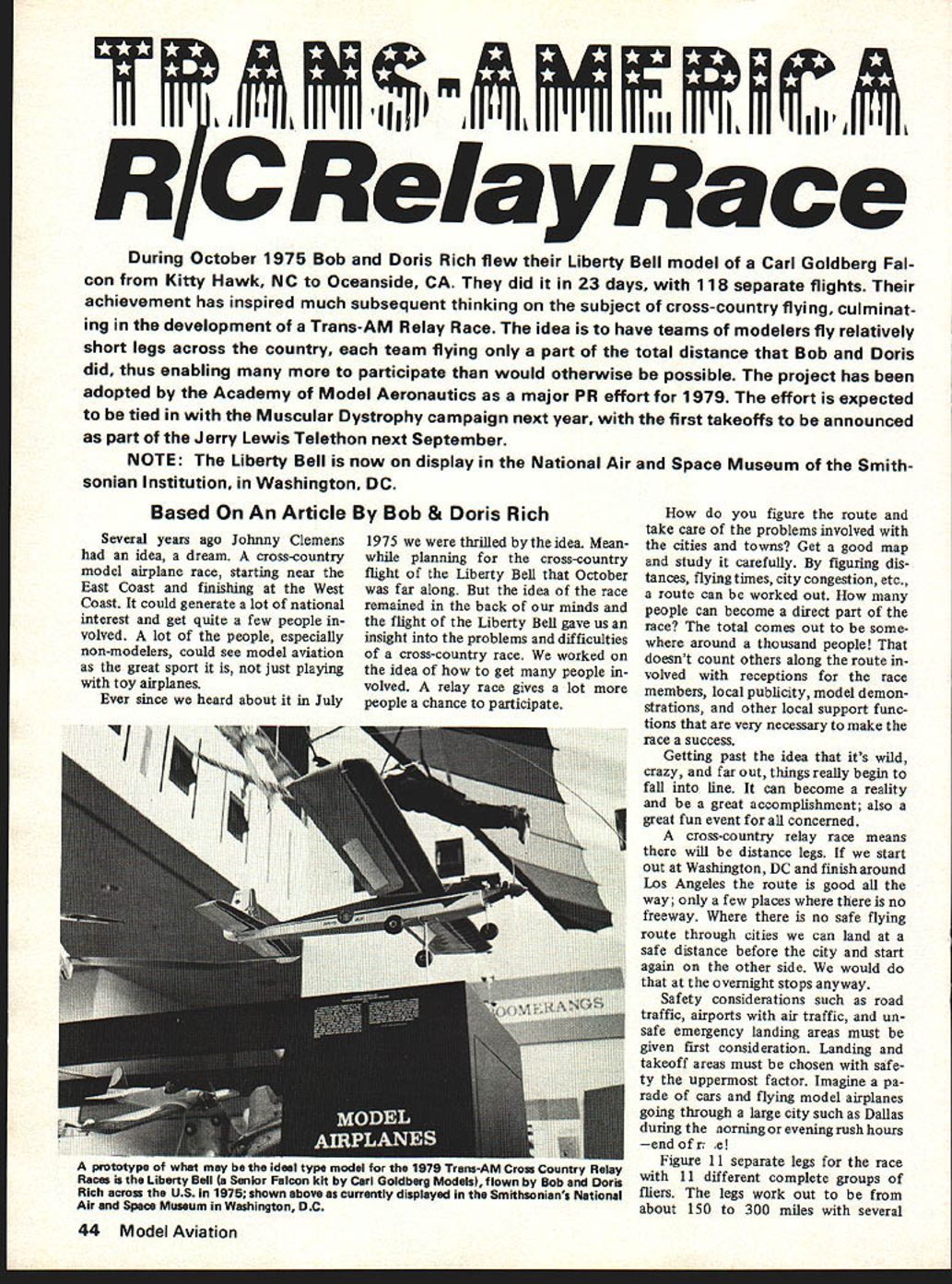
Note: The Liberty Bell is now on display in the National Air and Space Museum of the Smithsonian Institution, in Washington, DC.
Based on an article by Bob & Doris Rich
Several years ago Johnny Clemens had an idea — a cross‑country model airplane race starting near the East Coast and finishing at the West Coast. It could generate a lot of national interest and get many people involved. Non‑modelers could see model aviation as the great sport it is, not just playing with toy airplanes.
After hearing about the idea in July 1975, we were thrilled. Planning for the Liberty Bell cross‑country flight that October was far along, but the flight gave us insight into the problems of a cross‑country race. We worked on how to involve many people. A relay race gives a lot more people a chance to participate.
How do you figure the route and handle city issues? Get a good map and study it carefully. By calculating distances, flying times, city congestion, etc., a route can be worked out. How many people can become a direct part of the race? It comes out to be around a thousand people — not counting others along the route involved with receptions, local publicity, model demonstrations, and support functions necessary to make the race a success.
Once you get past the idea that it's wild or far‑fetched, things begin to fall into place. It can become a reality, a great accomplishment, and a lot of fun.
A cross‑country relay race means there will be distance legs. If we start in Washington, DC and finish around Los Angeles the route is good all the way, with only a few places lacking a freeway. Where there is no safe flying route through cities we can land at a safe distance before the city and continue on the other side — this is done at the overnight stops anyway.
Safety — road traffic, airports with air traffic, and unsafe emergency landing areas — must be the first consideration. Landing and takeoff areas must be chosen with safety as the uppermost factor. Imagine a parade of cars and flying model airplanes going through a large city such as Dallas during rush hour — not acceptable.
Figure 11 separate legs for the race, with 11 different complete groups of fliers. The legs work out to be roughly from about 150 to 300 miles, with several landings and takeoffs per leg and two flying days for all legs.
Think of the excitement at the checkpoint locations waiting for the planes to arrive: who is first, who has the shortest time for the day, who has had a problem?
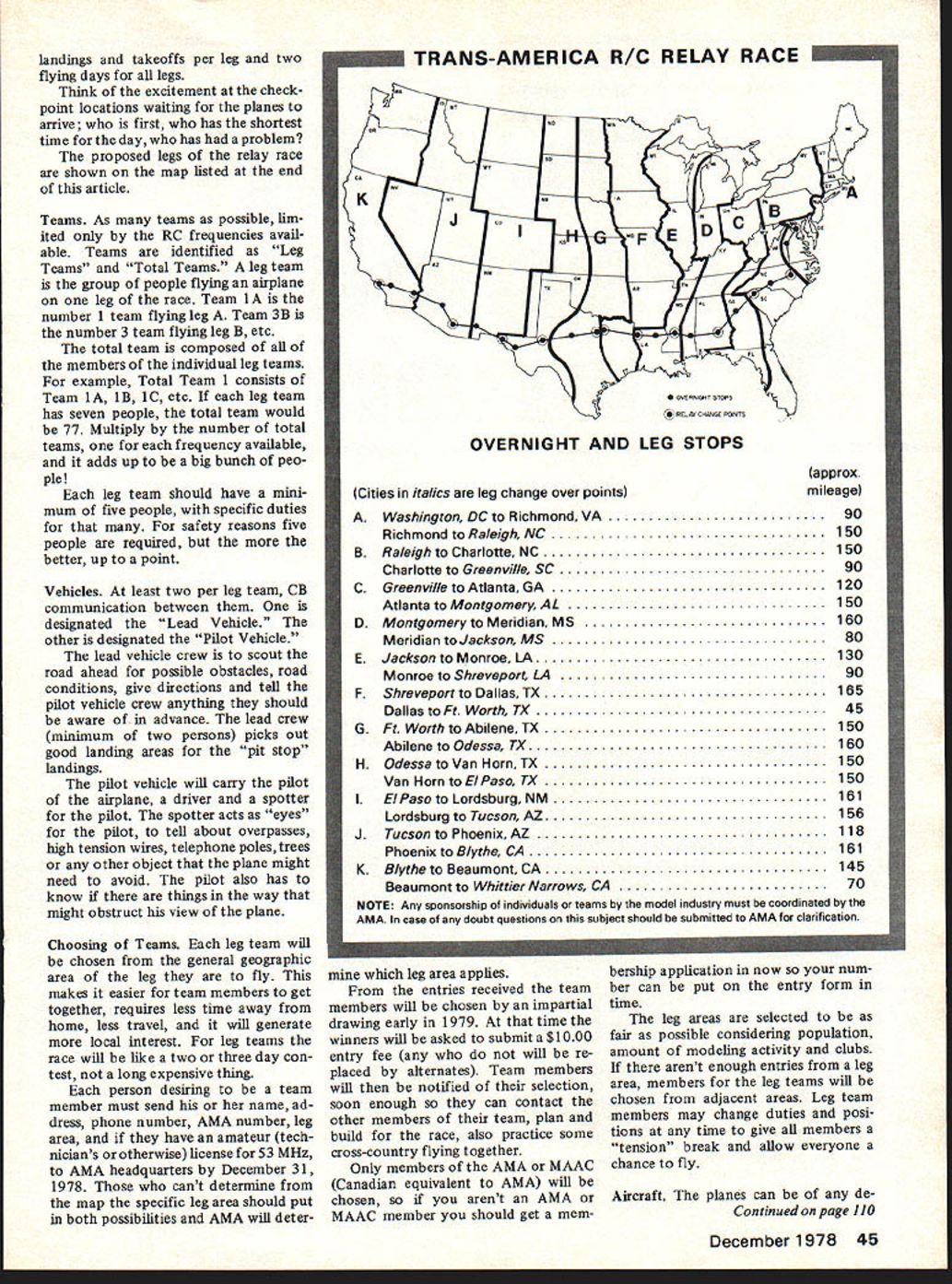
The proposed legs of the relay race are shown on the map listed at the end of this article.
Teams
- As many teams as possible, limited only by the RC frequencies available.
- Teams are identified as "Leg Teams" and "Total Teams."
- A leg team is the group of people flying an airplane on one leg of the race (e.g., Team 1A is the number 1 team flying leg A; Team 3B is the number 3 team flying leg B).
- The total team is composed of all members of the individual leg teams. For example, Total Team 1 consists of Team 1A, 1B, 1C, etc. If each leg team has seven people, the total team would be 77. Multiply by the number of total teams (one for each frequency available) and it becomes a very large group.
- Each leg team should have a minimum of five people, with specific duties assigned. For safety reasons five people are required; more members are better up to a practical limit.
Vehicles
- Each leg team should have at least two vehicles with CB communication between them:
- Lead Vehicle
- Pilot Vehicle
- Lead vehicle crew duties:
- Scout the road ahead for obstacles and road conditions.
- Give directions and warn the pilot vehicle crew of issues in advance.
- Pick out good landing areas for "pit stop" landings.
- Minimum crew: two persons.
- Pilot vehicle duties:
- Carry the pilot of the airplane, a driver, and a spotter for the pilot.
- The spotter acts as the pilot's "eyes" — advising about overpasses, high‑tension wires, telephone poles, trees, or other objects the plane must avoid and alerting the pilot to visual obstructions.
Choosing of Teams
- Each leg team will be chosen from the general geographic area of the leg they are to fly to minimize travel, time away from home, and to generate local interest.
- For leg teams the race will be like a two‑ or three‑day contest, not a long expensive trip.
- Entry requirements:
- Each person desiring to be a team member must send name, address, phone number, AMA number, leg area, and whether they have an amateur (technician's or otherwise) license for 53 MHz to AMA Headquarters by December 31, 1978.
- If unsure of the specific leg area, entrants should list both possibilities; AMA will determine the appropriate leg.
- Selection:
- Team members will be chosen by impartial drawing early in 1979.
- Winners will be asked to submit a $10 entry fee (those who do not will be replaced by alternates).
- Team members will be notified in time to contact other members, plan, build, and practice cross‑country flying together.
- Only AMA or MAAC (Canadian equivalent) members will be chosen. Nonmembers should join so their number can be on the entry form.
- Leg areas are selected to be as fair as possible considering population and modeling activity. If there aren't enough entries from a leg area, members will be chosen from adjacent areas.
- Leg team members may change duties and positions at any time to give everyone a chance to fly and to provide rest breaks.
Overnight and Leg Stops
(Cities in italics are leg changeover points) (approx. mileage)
A.
- Washington, DC to Richmond, VA .................................. 90
- *Richmond* to Raleigh, NC ............................................ 150
B.
- Raleigh to Charlotte, NC ........................................... 150
- *Charlotte* to Greenville, SC ........................................ 90
C.
- Greenville to Atlanta, GA ......................................... 120
- *Atlanta* to Montgomery, AL ........................................ 150
D.
- Montgomery to Meridian, MS ..................................... 160
- *Meridian* to Jackson, MS ............................................ 80
E.
- Jackson to Monroe, LA .............................................. 130
- *Monroe* to Shreveport, LA .......................................... 90
F.
- Shreveport to Dallas, TX .......................................... 165
- *Dallas* to Ft. Worth, TX .............................................. 45
G.
- Ft. Worth to Abilene, TX .......................................... 150
- *Abilene* to Odessa, TX ............................................... 160
H.
- Odessa to Van Horn, TX ........................................... 150
- *Van Horn* to El Paso, TX ............................................ 150
I.
- El Paso to Lordsburg, NM ......................................... 161
- *Lordsburg* to Tucson, AZ .......................................... 156
J.
- Tucson to Phoenix, AZ ............................................. 118
- *Phoenix* to Blythe, CA .............................................. 161
K.
- Blythe to Beaumont, CA .......................................... 145
- *Beaumont* to Whittier Narrows, CA .............................. 70
Note: Any sponsorship of individuals or teams by the model industry must be coordinated by the AMA. In case of doubt, submit questions to the AMA for clarification.
Aircraft
- Plane design is unrestricted except for the following limitations:
- Wingspan not over 72 inches.
- Glow plug engine, size .35 to .61 cu. in.
- Total fuel capacity not more than 32 oz.
- No inflight refueling capability.
- These requirements are designed to equalize teams. Pit stops are also an equalizer — hence the fuel limit. The size limit keeps planes roughly comparable and avoids large, lumbering, potentially unsafe designs.
- Each leg team is allowed two aircraft, not necessarily the same design. Two of the same design allow interchangeable parts.
- In the event of a crash or damage to the primary plane, the backup plane or parts may be used.
- If both planes are damaged and unflyable, the team will attempt fast repairs; if both cannot be repaired in reasonable time to reach the next checkpoint, the planes will be carried to the checkpoint and a time penalty assigned.
- Aircraft marking:
- The aircraft will have the team number plainly visible on the side of the fuselage.
- The backup airplane will be designated by an "A" beside the team number.
- With two airplanes, a wipeout of one plane will not disqualify the leg team or the total team. Lost time can be made up by remaining leg teams along the way. If both planes cannot be repaired in reasonable time, the team remains in the race but receives a penalty.
The Race
- Race winners will be the total team with the shortest accrued time. Time between checkpoints is what counts — not only actual flight time.
- Checkpoints are the places of the first takeoff of the day and the final landing of the day. The clock runs for accidents, pit stops, comfort stops, etc.
- Takeoffs from the initial starting point will be at five‑minute intervals; the order is chosen by drawing.
- At the race director's "go" the team will start the engine, take off, and be on their way. Timing for each plane starts at the "go" signal and continues until the plane lands at the checkpoint for the overnight stop or leg change. Timing stops at touchdown within the designated landing area.
- The next morning's takeoffs will be in first‑in, first‑out order based on the previous day's landing.
Transcribed from original scans by AI. Minor OCR errors may remain.

