
Trans-America: RC Relay Race
They did it! From the Washington, D.C. area to Las Vegas, Nevada — twelve legs with five teams per leg and over 600 participants. Along the way the project raised money for the Muscular Dystrophy Association, kicked off by the Jerry Lewis Telethon the previous September.
IT IS now history — model aviation history. The first Trans-Am RC Relay Race takes its rightful place among the milestones of modeling. The greatest fun-fly event ever attempted was successfully completed as planned at Las Vegas, Nevada, October 2, 1979. All five teams completed the last flight from Barstow, California to Las Vegas.
Overview
- Date range: began September 4; completed October 2, 1979.
- Route: Washington, D.C. area to Las Vegas, NV.
- Structure: 12 relay legs, five teams per leg.
- Participation: over 600 participants.
Start and Early Legs
September 4 was the culmination of over 19 months of planning and preparation. The first five teams were ready, with airplanes and equipment checked and rechecked.
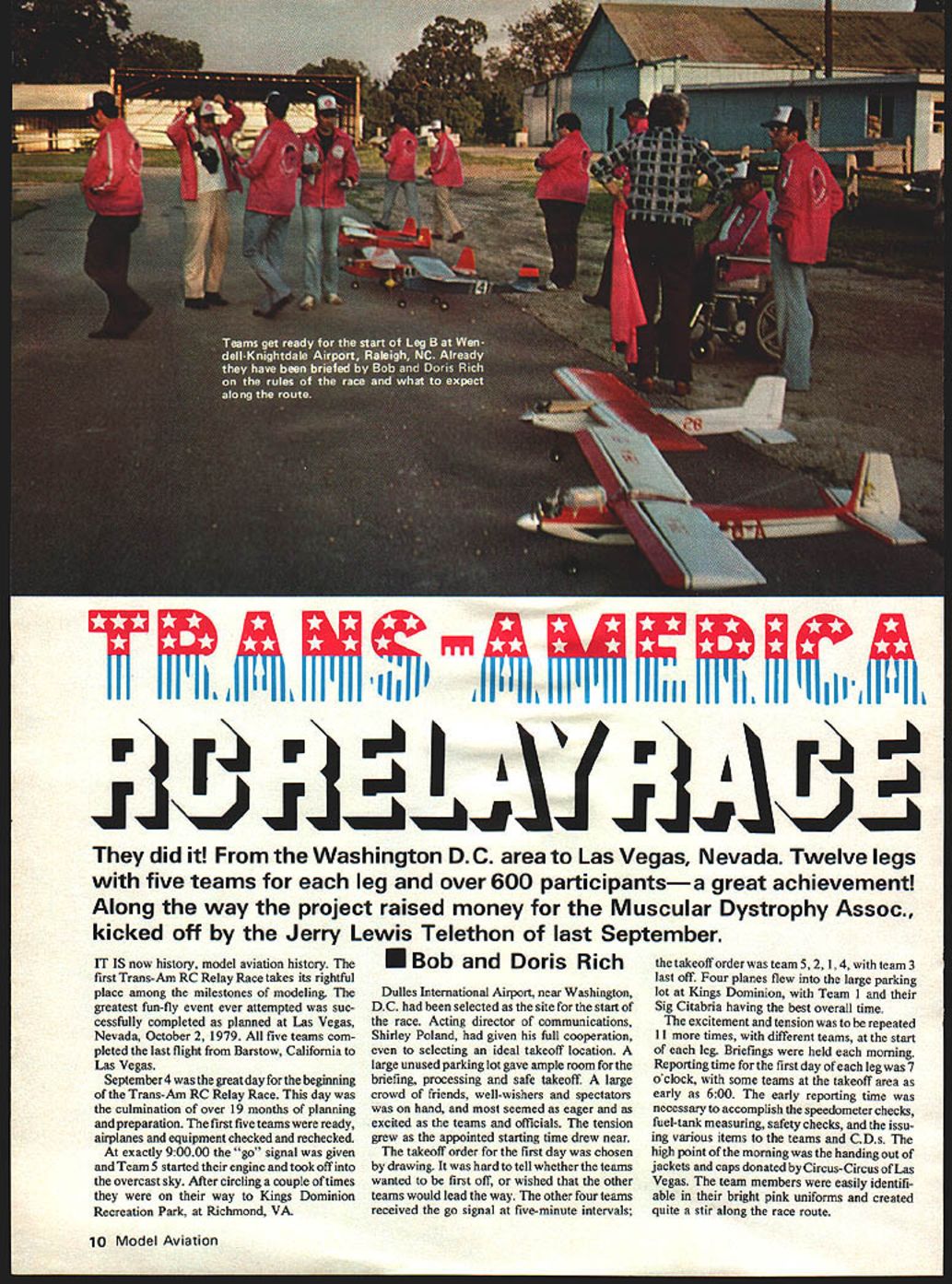
Dulles International Airport, near Washington, D.C., was selected as the start site. Shirley Poland, acting director of communications, gave full cooperation and helped select an ideal takeoff location: a large unused parking lot that provided ample room for briefing, processing, and safe takeoff. A large crowd of friends, well-wishers, and spectators attended.
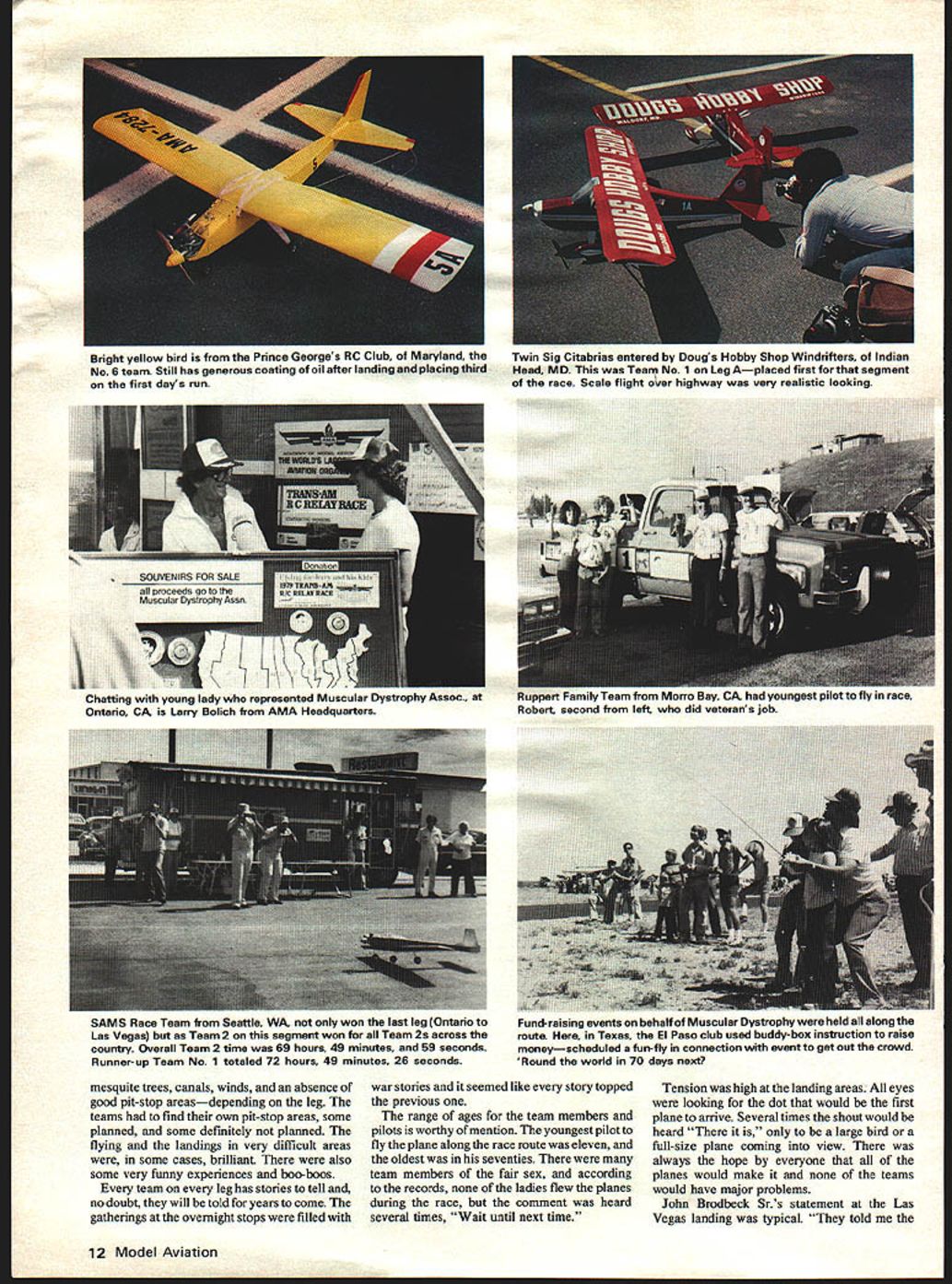
At exactly 9:00 the "go" signal was given and Team 5 started their engine and took off into the overcast sky. After circling a couple of times they were on their way to Kings Dominion Recreation Park at Richmond, VA. The takeoff order for the first day was chosen by drawing. The other four teams received go signals at five-minute intervals; the day’s order was Team 5, 2, 1, 4, with Team 3 last off. Four planes flew into the large parking lot at Kings Dominion, with Team 1 and their Sig Citabria having the best overall time.
Briefings were held each morning for the remaining legs. Reporting time was 7:00 a.m., with some teams at the takeoff area as early as 6:00 a.m. Early arrival was necessary for speedometer checks, fuel-tank measuring, safety checks, and issuing items to teams and contest directors (CDs). Jackets and caps donated by Circus-Circus of Las Vegas were handed out, and the bright pink uniforms made the teams easily identifiable along the route.
Social and Support Events
- The first evening featured an open house hosted by AMA Vice President District IV Chuck Foreman and his wife Joanne. Team 3 helped members of other teams rebuild damaged planes at Foreman’s workshop.
- Overnight stops were filled with war stories and camaraderie; gatherings often featured plane repairs, advice, and plenty of laughter.
Weather and Delays
Weather impacted several legs:
- Hurricane David (around September 5) brought high winds and rain, forcing cancellation of flying and leading organizers to assign average flying times for the day. An awards presentation in a motel recreation room followed, with team members receiving a trophy plaque for participation.
- Hurricane Frederick caused cancellation of flying days in Meridian and Jackson.
- Outer fringes of Henri created problems on another Wednesday.
- In Fort Worth, TX, rain and low ceilings required moving the takeoff area further west to avoid weather.
News Coverage and Public Response
News coverage was excellent. Newspapers and TV crews were often present at takeoffs and landings. Smaller towns along the route welcomed the participants warmly. Paul Harvey provided continuing coverage on his radio program. People along the highway waved and wished teams well; several truckers donated to Muscular Dystrophy.
Pit Stops, Contest Directors, and Safety
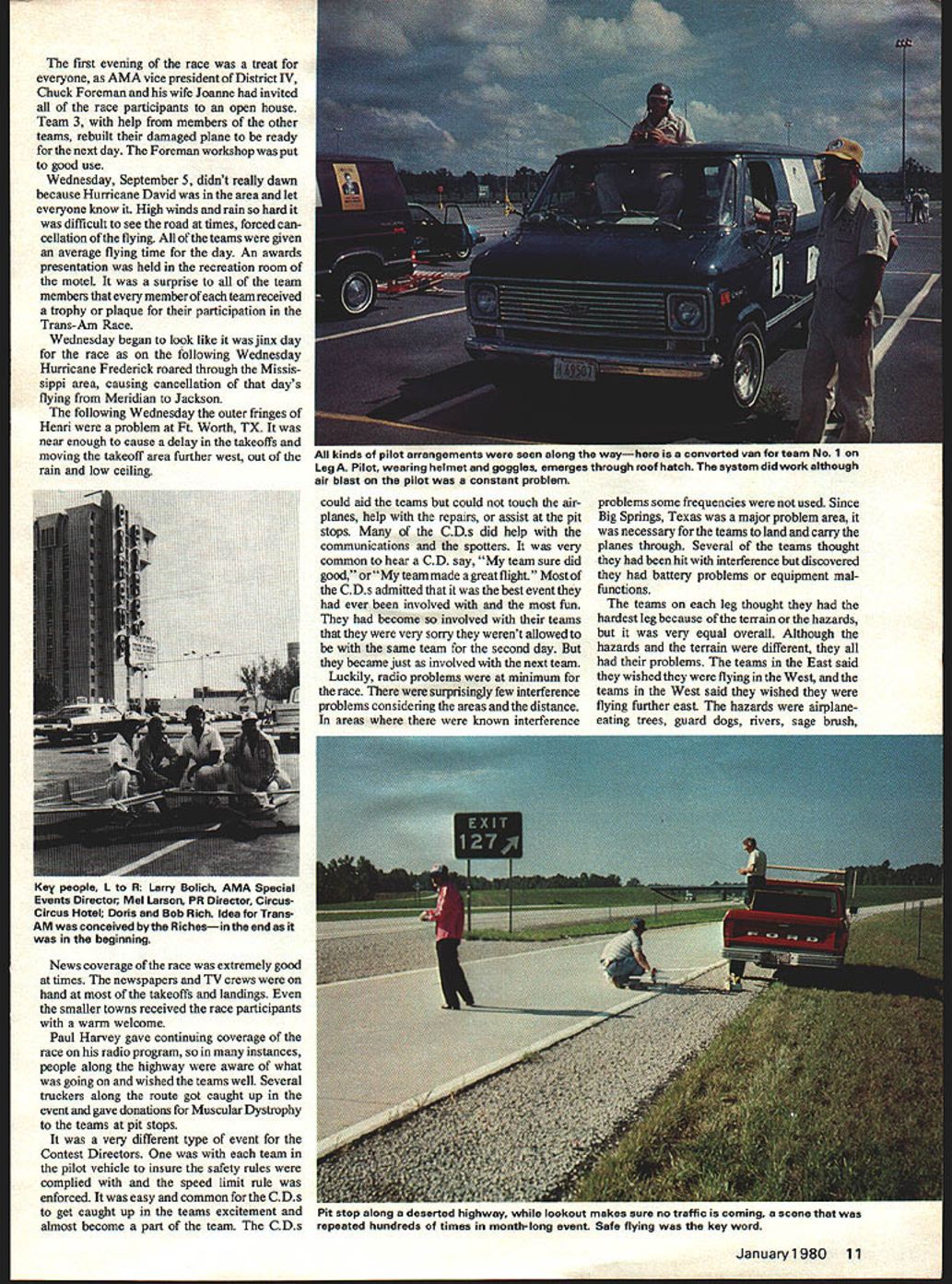
Pit stops were tightly managed. Contest directors, team pilots, and vehicle crews enforced safety rules and speed limits. CDs often became personally involved — helping repairs, assisting pit stops, aiding communications, and acting as spotters. Many CDs later said it was the best event they had been involved with and regretted not being allowed to fly with the teams the next day.
Radio Interference and Technical Problems
Radio problems were minimal overall but did occur in known trouble spots:
- Big Spring, Texas, was a major interference area; teams had to land and carry planes through the interference zone.
- In areas with known interference, some frequencies were not used.
- Some suspected interference incidents turned out to be battery or equipment malfunctions.
Hazards and Challenges
Each leg presented different hazards. Examples included:
- Airplane-eating trees
- Guard dogs
- Rivers and canals
- Sagebrush and mesquite
- High winds
- Lack of good pit-stop areas
Teams had to find pit-stop locations — some planned, some improvised. The flying and landings in difficult areas were often brilliant, and there were many funny experiences and mishaps that became legendary among participants.
Participants
- Youngest pilot: 11 years old.
- Oldest pilot: in his seventies.
- The event included many female team members; records show none of the women flew planes during the race, though several said, "Wait until next time."
Tension was high at landing areas as everyone watched for the first plane to arrive. Shouts of "There it is!" were sometimes for birds or full-size planes, but mostly for the model aircraft arriving safely.
John Brodbeck Sr. commented at the Las Vegas landing: "They told me the first plane would be here about 12:00, and by then it was."
Camaraderie and Sportsmanship
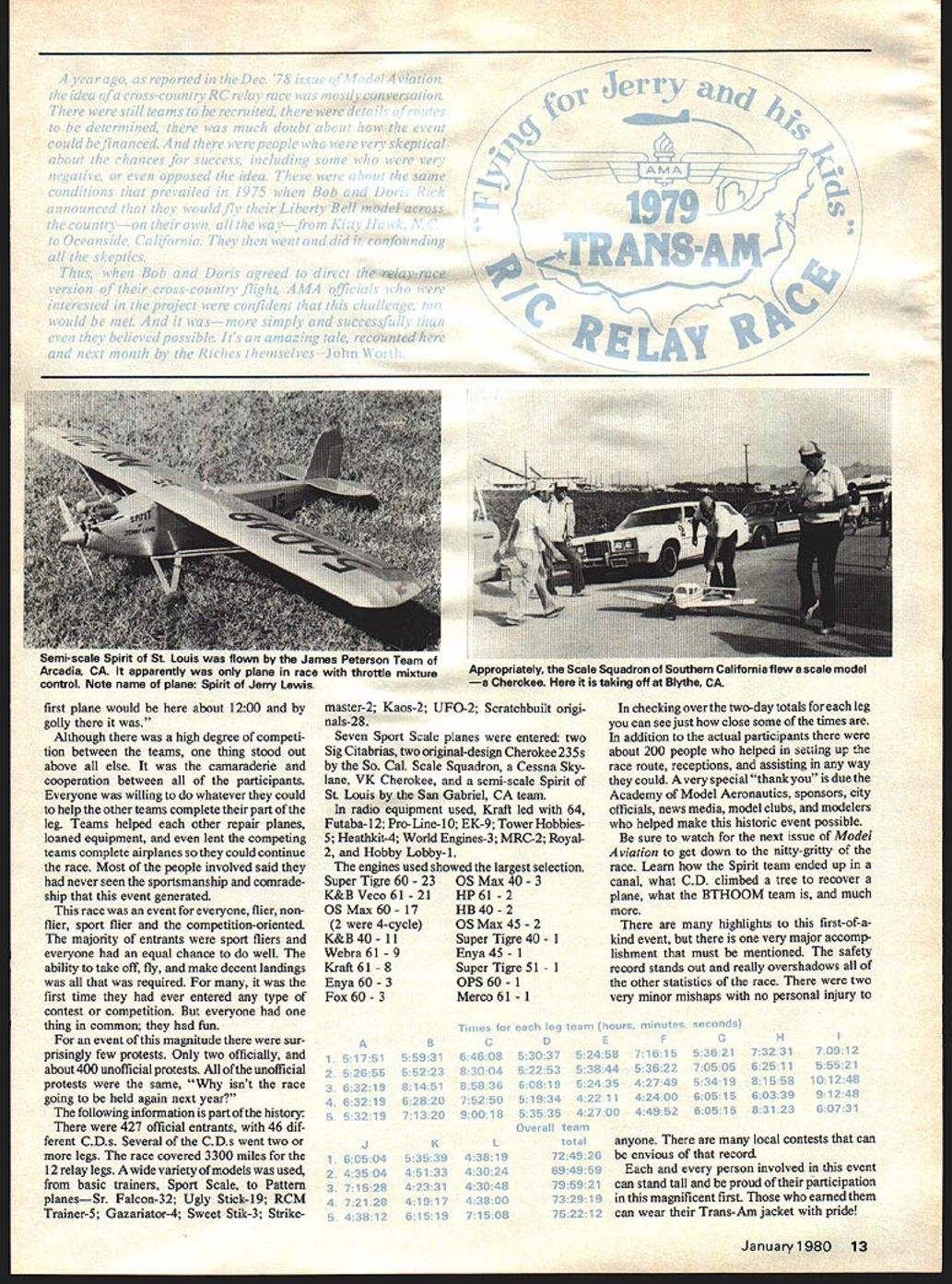
Although competition was strong, camaraderie and cooperation stood out. Participants helped one another with repairs, loaned equipment, and even lent entire airplanes so rivals could continue the race. Many said they had never seen the level of sportsmanship this event generated.
The race welcomed fliers and non-fliers alike: sport fliers and competition-oriented pilots. For many it was their first contest experience. The primary requirements were the ability to take off, fly, and make decent landings — and to have fun.
Protests and Feedback
- Official protests: 2
- Unofficial protests (mainly joking): about 400 — most asking, "Why isn't the race going to be held again next year?"
Event Statistics and History
- Official entrants: 427
- Different contest directors (CDs): 46 (several served multiple legs)
- Race distance: 3,300 miles over 12 relay legs
- Additional support: about 200 people helped set up the route, receptions, and logistics
Models used (by type and count):
- Sr. Falcon: 32
- Ugly Stick: 19
- RCM Trainer: 5
- Gazarator: 4
- Sweet Stik: 3
- Strike-master: 2
- Kaos: 2
- UFO: 2
- Scratchbuilt originals: 28
Sport Scale planes (7 entered):
- 2 Sig Citabrias
- 2 original-design Cherokee 235s (So. Cal. Scale Squadron)
- Cessna Skylane
- VK Cherokee
- Semi-scale Spirit of St. Louis (San Gabriel, CA team)
Radio equipment (by make and count):
- Kraft: 64
- Futaba: 12
- Pro-Line: 10
- EK: 9
- Tower Hobbies: 5
- Heathkit: 4
- World Engines: 3
- MRC: 2
- Royale: 2
- Hobby Lobby: 1
Engines (by make/model and count):
- Super Tigre 60: 23
- K&B Veco 61: 21
- OS Max 60: 17
- K&B 40: 11
- Webera 61: 9
- Kraft 61: 8
- Enya 60: 3
- Fox 60: 3
- OS Max 40: 3
- HP 61: 2
- HB 40: 2 (two were 4-cycle)
- OS Max 45: 2
- Super Tigre 40: 1
- Enya 45: 1
- Super Tigre 51: 1
- OPS 60: 1
- Merco 61: 1
Acknowledgements
A very special thank you to the Academy of Model Aeronautics, sponsors, city officials, news media, model clubs, and modelers who helped make this historic event possible.
Be sure to watch for the next issue of Model Aviation for more details: how the Spirit team ended up in a canal, which CD climbed a tree to recover a plane, what the BTHOOM team is, and much more.
Safety Record and Conclusion
The major accomplishment of this first-of-a-kind event is its safety record. There were two very minor mishaps and no personal injuries. For an event of this magnitude, that safety record is outstanding.
Each person involved can stand tall and be proud of their participation in this magnificent first. Those who earned them can wear their Trans-Am jackets with pride!
Transcribed from original scans by AI. Minor OCR errors may remain.

