
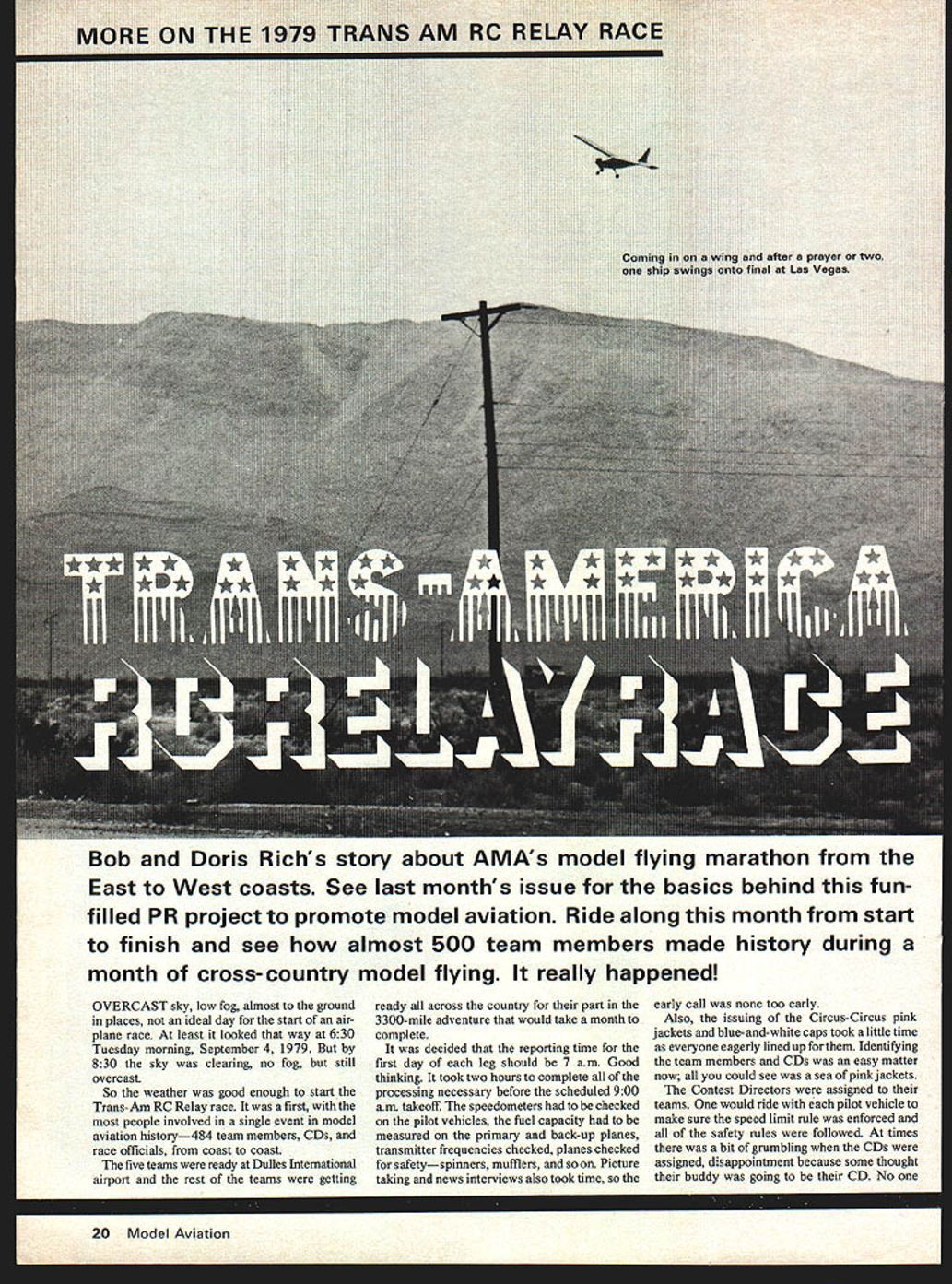
Trans-America: RC Relay Race
Bob and Doris Rich tell the story of AMA's model flying marathon from the East to West coasts. See last month's issue for the basics behind this fun-filled PR project to promote model aviation. Ride along here from start to finish and see how almost 500 team members made history during a month of cross-country model flying.
Start at Dulles (September 4, 1979)
An overcast sky and low fog made for a questionable morning at 6:30 a.m., but by 8:30 the sky was clearing enough to proceed. The Trans-Am RC Relay race was a first of its kind, involving 484 team members, contest directors (CDs), and race officials from coast to coast on a 3,300-mile, month-long adventure.
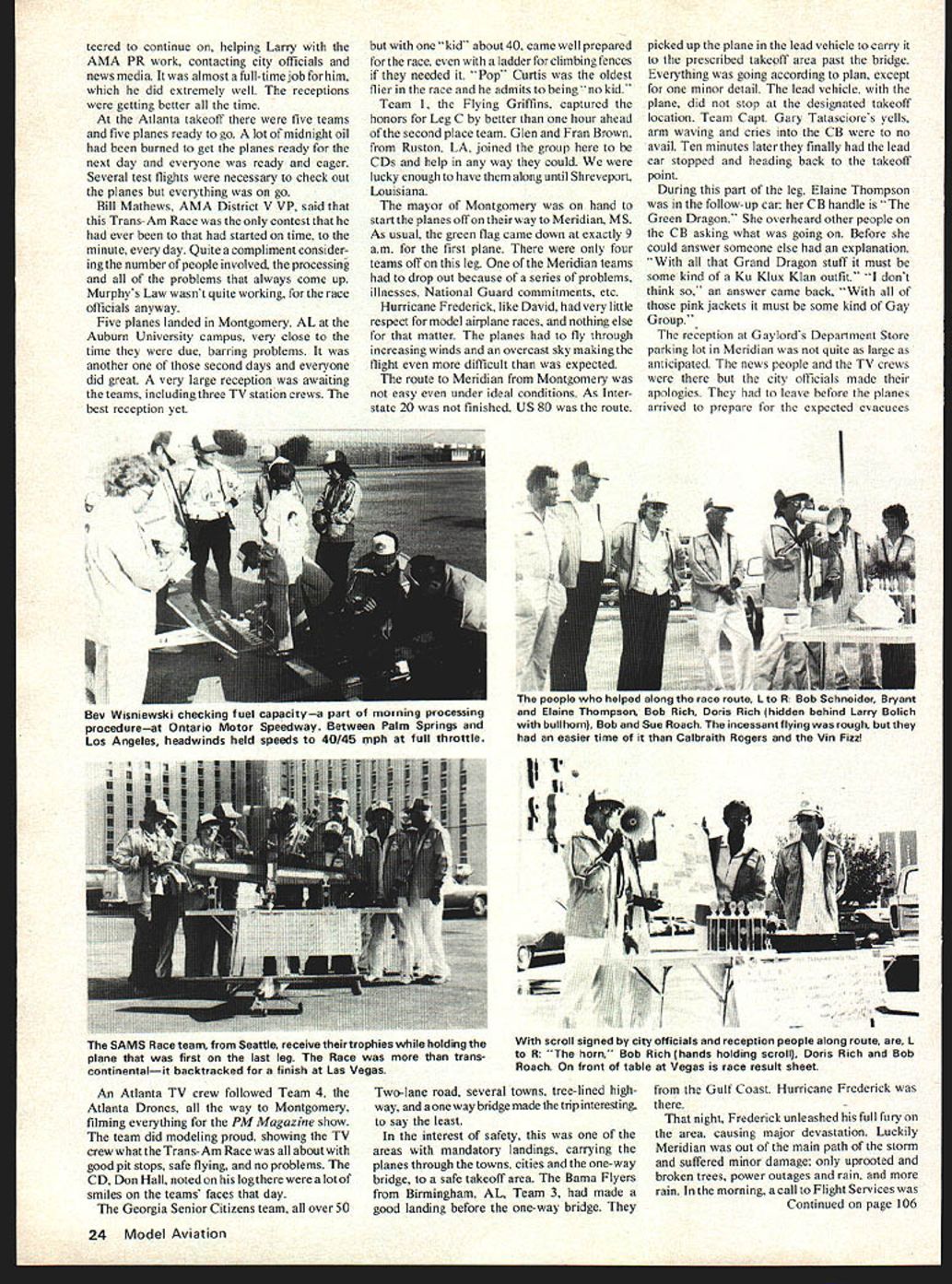
Reporting time for the first day of each leg was set for 7:00 a.m. It took two hours to complete necessary processing before the scheduled 9:00 a.m. takeoff: speedometers on pilot vehicles were checked, fuel capacity on primary and back-up planes was measured, transmitter frequencies verified, airframes and safety items (spinners, mufflers, etc.) inspected. Photo and news interviews added to the preflight work. Pink Circus-Circus jackets and blue-and-white caps were distributed, turning the crowd into a sea of pink and making team identification easy.
CDs were assigned to teams, with one CD riding in each pilot vehicle to enforce speed-limit and safety rules. Assignments were revealed just before takeoff, which caused some grumbling when buddies were not paired together.
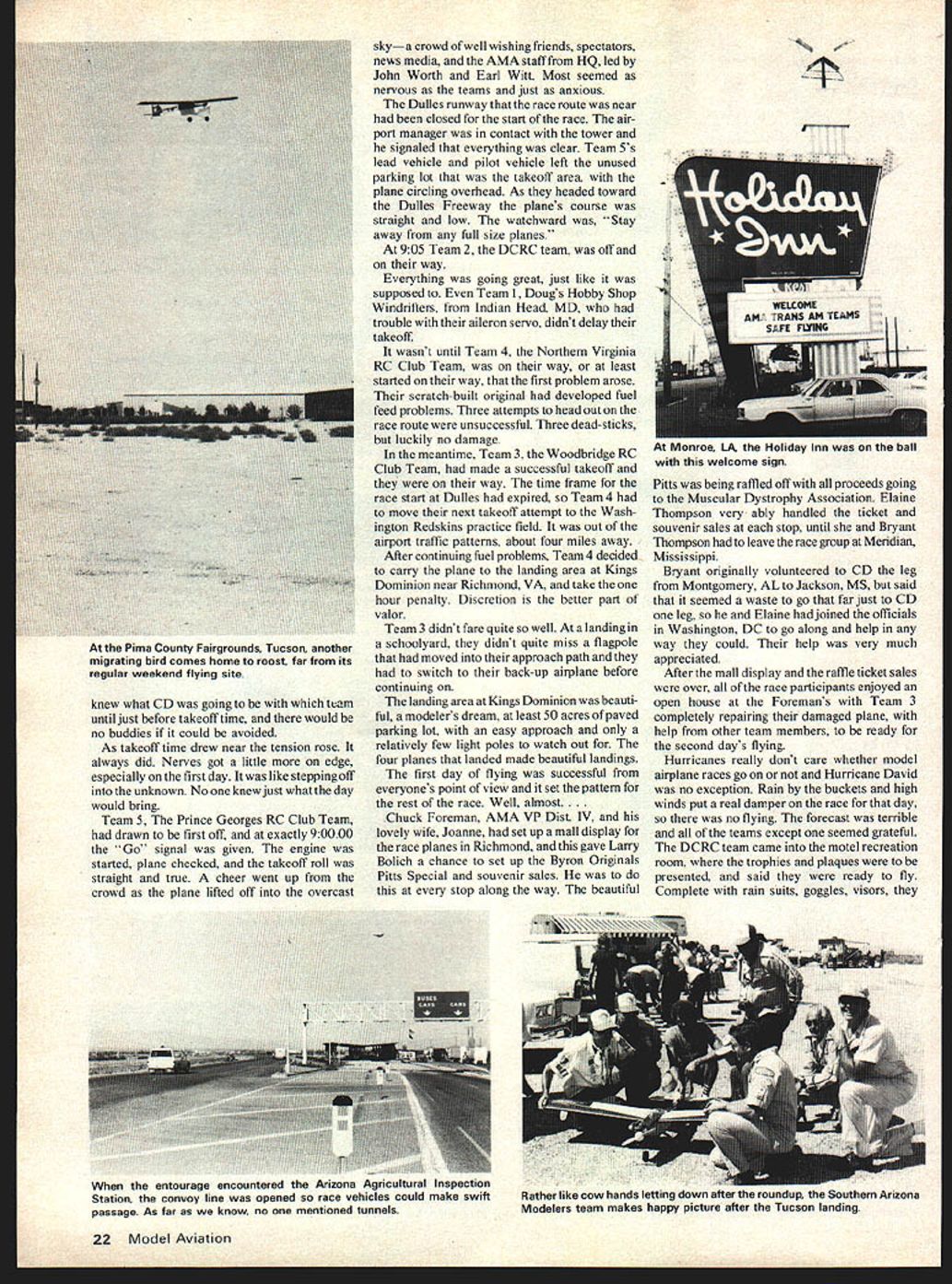
Team 5, Prince George's RC Club, drew first and took off exactly at 9:00 a.m. The takeoff roll was straight and true and the plane lifted into the overcast sky to cheers. The Dulles runway area was nearly closed; the airport manager coordinated with the tower and cleared the route. Team 5's lead vehicle left the unused parking-lot takeoff area with the plane circling overhead and headed toward the Dulles Freeway. The watchword was: stay away from full-size aircraft.
Takeoffs and early problems:
- Team 2 (DCRC) departed at 9:05 and was off smoothly.
- Team 1 (Doug's Hobby Shop Windrifters of Indian Head, MD) had an aileron servo that later proved troublesome but did not delay their initial takeoff.
- Team 4 (Northern Virginia RC Club) experienced fuel-feed problems on a scratch-built original—three attempted departures resulted in dead-sticks (no damage). Team 4 moved to the Washington Redskins practice field (about four miles away) to attempt takeoff; after continuing fuel issues they carried the plane in for landing and accepted a one-hour penalty.
- Team 3 (Woodbridge RC Club) made a successful on-time takeoff, though later they had to switch to their back-up plane after a schoolyard landing that nearly struck a flagpole.
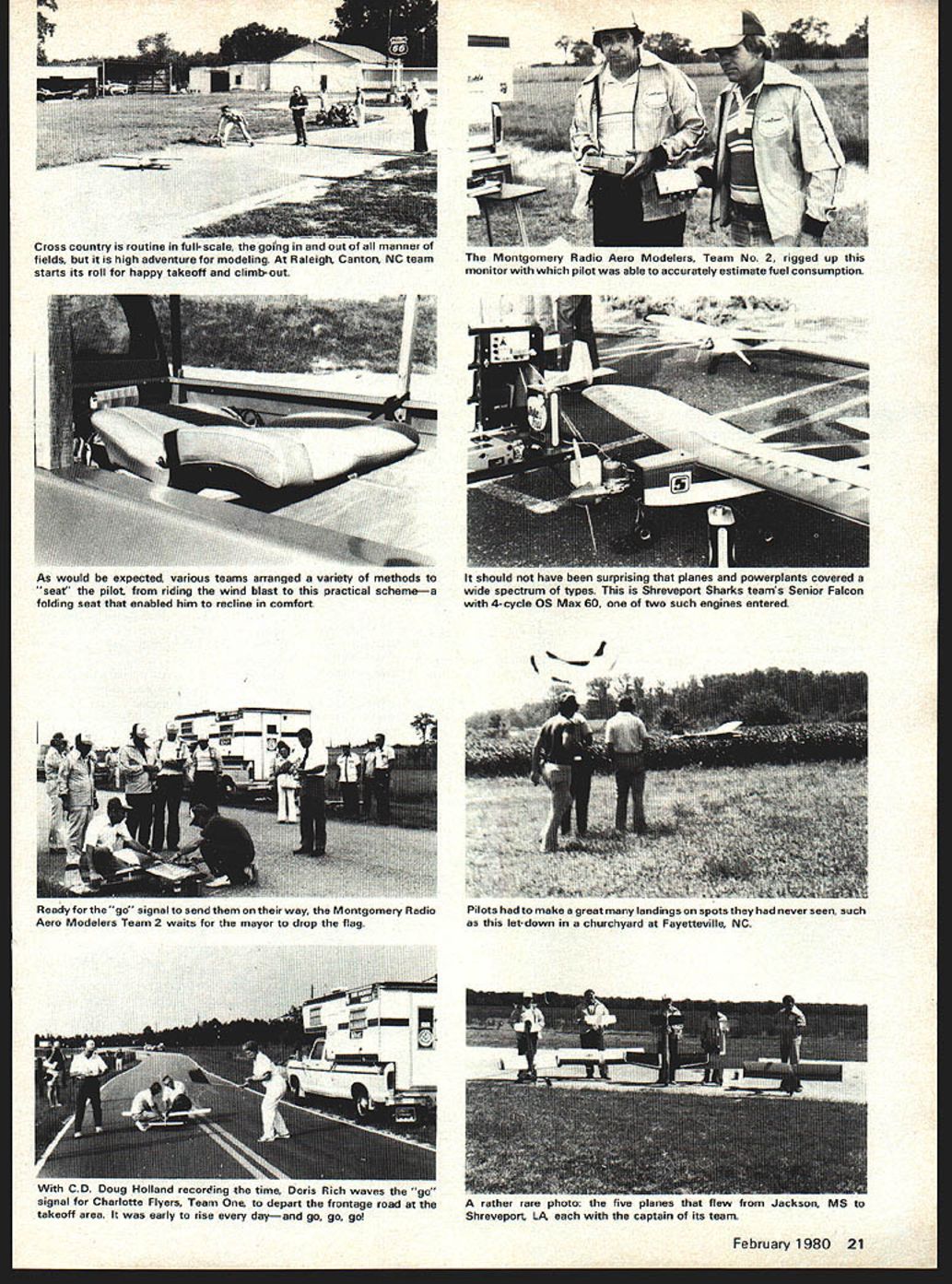
Photographs from the start show pilots at unconventional let-downs (churchyards, parking lots), monitors and improvised seats used by pilots to estimate fuel and ride comfortably, and a variety of model types and engines—evidence of the wide spectrum of equipment entered.
Officials, support, and PR
Key officials and volunteers who ran and supported the event:
- Bob and Doris Rich (race organizers)
- John Worth and Earl Witt (AMA HQ leadership at the start)
- Larry Bolich (AMA Special Events Director)
- Bob Roach (Larry Bolich’s right-hand man and AMA motorhome driver)
- Jim Pichon (volunteer from Lake Tahoe, NV)
- Chuck Foreman (AMA VP Dist. IV; volunteered to CD three legs)
- Bob Schneider (DCRC CD who filled gaps)
- Elaine and Bryant Thompson (ticket and souvenir sales; helped through Meridian)
- Glen and Fran Brown (joined as CDs through Shreveport)
- John Embry (AMA VP Dist. VIII) and Bob Kinch (Lake Charles club; joined at Shreveport)
PR activities included mall displays and a raffle of a Byron Originals Pitts Special, with proceeds to the Muscular Dystrophy Association. Sales of raffle tickets and souvenirs were handled at each stop.
Weather interruptions: Hurricanes David and Frederick
Hurricanes affected the schedule. Hurricane David brought heavy rain and high winds that grounded flying for a day; most teams were relieved, though one team (DCRC) was prepared to fly in rain gear. Officials drove through wind and rain to reach the next starts.
Hurricane Frederick later forced cancellations and evacuations along parts of the route. At Meridian, city officials left to prepare for evacuations; flights were grounded again when conditions were unsafe. Two Wednesdays in a row were lost to storms.
Raleigh and the B leg
The Raleigh (Wendell-Knightdale) start was clear and cool. A young team member offered Doris Pepto-Bismol for nerves; the anecdote spread—teams joked about "buying Pepto by the case."
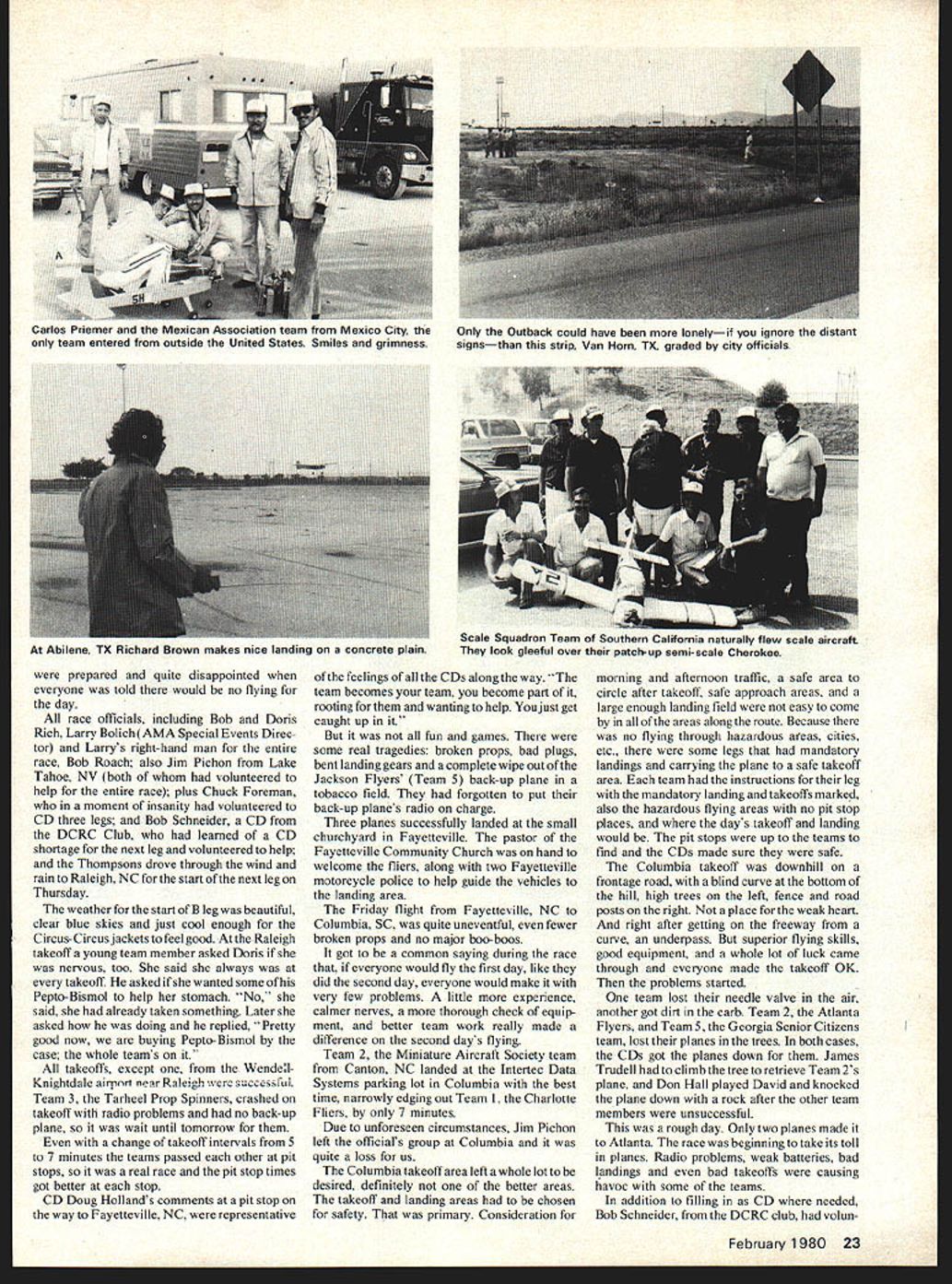
- Most takeoffs were successful; Team 3 (Tarheel Prop Spinners) crashed on takeoff due to radio problems and had no back-up plane, so they waited until the next day.
- Takeoff intervals were changed from 5 to 7 minutes; teams still passed each other at pit stops, so it remained a real race. Pit-stop times improved as teams gained experience.
- CD Doug Holland summarized the spirit: "The team becomes your team, you become part of it, rooting for them and wanting to help. You just get caught up in it."
Common problems during the leg: broken props, bad plugs, bent landing gear, and the Jackson Flyers' back-up plane being wrecked in a tobacco field after they forgot to charge its radio.
Columbia to Atlanta
The Columbia takeoff area (an Intertec Data Systems parking lot) was chosen for safety but had difficult features: a downhill frontage road, a blind curve, trees, fence posts, and an underpass immediately after getting on the freeway. Despite the hazards, superior flying skills and luck got teams airborne.
Problems on this day:
- One team lost a needle valve in flight; another had dirt in the carburetor.
- Team 2 (Atlanta Flyers) and Team 5 (Georgia Senior Citizens) lost planes in trees; CDs rescued both. James Trudell climbed a tree to retrieve a plane, and Don Hall knocked another down with a rock after attempts by others failed.
Only two planes made it to Atlanta that day; radios, batteries, landings, and takeoffs were taking a toll. Bob Schneider also helped with AMA PR follow-up, contacting city officials and news media to improve receptions.
Montgomery (Leg C) and the route to Meridian
Five planes landed at Auburn University in Montgomery close to schedule. The reception, including TV crews, was the best so far. Team 1 (Flying Griffins) won Leg C by more than an hour.
The leg to Meridian (via US 80) was challenging: unfinished interstate, two-lane stretches, tree-lined highways, towns, and a one-way bridge. For safety, mandatory landings were required in some towns; teams carried planes through those towns to avoid hazardous flying areas.
A notable incident: the Bama Flyers (Team 3) landed before a one-way bridge and picked up their plane in the lead vehicle to carry it to the prescribed takeoff area, but the lead vehicle failed to stop at the designated point. After ten minutes of shouting and CB radio calls from Team Captain Gary Tascione, the lead car returned.
CB radio humor: Elaine Thompson (CB handle "The Green Dragon") overheard people speculating about the race group. Jokes included references to the Ku Klux Klan and a "Gay Group" because of the Green Dragon handle and pink jackets.
At Meridian (Gaylord's Department Store parking lot) the city had a modest reception; officials had to attend to hurricane preparations. Hurricane Frederick later struck the area; the following day's flying was canceled. After a brief awards presentation in the motel (Meridian team first by three minutes over Montgomery), officials drove to Jackson for the next leg.
Jackson, delays, and the BTHOOM team
The AMA motorhome (called the "Sagin' Wagon" because of a bad left rear spring) and other vehicles battled high winds. In Jackson, some team members and planes were delayed by the hurricane.
The BTHOOM team: Jimmy Grier and Doc Edwards arrived early at the takeoff area while the rest of their team and planes were delayed in Chicago. "BTHOOM" was humorously explained by Jimmy as "Beats The Hell Out Of Me." When the delayed pilots arrived, there was a frantic rush to get planes airborne under TV crew coverage.
Teams ran close on this leg, passing each other at pit stops. Three planes crashed on this part of the route, but teamwork and quick repairs kept most teams moving.
West Monroe, Shreveport, and later legs
Takeoffs in West Monroe included the mayor and police escorts through traffic lights; local fire departments offered coffee. Hot receptions and barbecues greeted teams in Shreveport. Team 5 (Shreveport Sharks) took the first-in champagne and top honors for that leg.
New CDs John Embry (AMA VP Dist. VIII) and Bob Kinch joined at Shreveport and helped fill last-minute vacancies; one volunteer continued on to Abilene to support the next leg.
The flight from Shreveport to Dallas included multiple pit stops and a typical mix of problems: broken props, bent landing gears, deadsticks, lost hatches, and a crash or two. A practical note was added to briefings: tie down race hats in the back of pilot vehicles to avoid accidental losses—many blue-and-white hats marked the race route.
From Mesquite Model Field to Fort Worth (about a 10-mile flight), teams were sent off with a proclamation read by AMA past president Johnny Clemens and the mayor pro tem of Mesquite. Jim Simpson's Southwest Modelers RC Club team finished first for that leg, narrowly beating John Kiker's NASA Flyers of Houston by three and a half minutes. The Fort Worth takeoff occurred on a Wednesday.
Race character, teamwork, and recurring issues
The Trans-Am race showed how quickly teams improved:
- First-day nerves and equipment checks often led to problems; by the second day calmer nerves, better checks, and teamwork reduced failures.
- Common mechanical and operational issues included broken props, fouled plugs, fuel-feed problems, bent gear, radio failures, weak batteries, and lost hatches.
- CDs became part of their teams, helping with rescues, repairs, and logistics.
PR and fundraising:
- A Pitts Special was raffled at stops to benefit the Muscular Dystrophy Association.
- Elaine Thompson and others handled ticket and souvenir sales until they had to leave at Meridian; Sue Roach later continued sales.
Bill Mathews (AMA District V VP) praised the Trans-Am as the only contest he'd attended that started on time to the minute every day, a tribute to planning and teamwork.
Notable incidents and rescues
- Team 4 (Northern Virginia RC Club) suffered three dead-stick attempts at Dulles due to fuel-feed issues and took the plane in for landing.
- Team 3 (Woodbridge/Tarheel Prop Spinners) switched to a back-up plane after a schoolyard landing nearly struck a flagpole; in Raleigh they crashed on takeoff with no back-up.
- The Jackson Flyers forgot to charge their backup plane's radio and later wiped it out in a tobacco field.
- Several planes were lost in trees; CDs and volunteers (e.g., James Trudell, Don Hall) retrieved them—one by climbing and another by knocking the plane down with a rock.
- Inclement weather grounded flying on multiple days (Hurricanes David and Frederick), forcing schedule adjustments.
- CB radio exchanges provided comic relief and occasional confusion on the route.
Conclusion
The Trans-America RC Relay Race was a historic cooperative effort in model aviation—nearly 500 people, dozens of towns, multiple hazards, and many memorable moments. The combination of meticulous planning, volunteer spirit, quick thinking by CDs and teams, and strong local support made it a successful cross-country showcase for model flying despite storms and mechanical setbacks.
Transcribed from original scans by AI. Minor OCR errors may remain.

