
Transmitter
Have you noticed at most contests and fly-in events that the participants are surrounded by their lawn chairs, ice chests, and toolboxes — all arranged under tents? The airplanes are either in a shady area under the tents or covered with a light-colored cloth to keep the summer sun away from the heat-sensitive radio components. Sounds great, doesn't it? Almost!
Watch what happens when it's time to go flying. The flight crews gather up airplanes and starter kits, and then head for the transmitter impound area. From personal observation, the impound is the usual weak link in an otherwise well-run event. It does not seem reasonable to protect the airplanes and flight systems and not protect the transmitters.
Many so-called transmitter impound areas are no more than a tabletop, a blanket on the ground, or the trunk of someone's car. Besides the inconvenience of trying to retrieve a transmitter from one of these makeshift impound areas, there is the possibility that trim or variable-rate buttons can be moved from their preset positions.
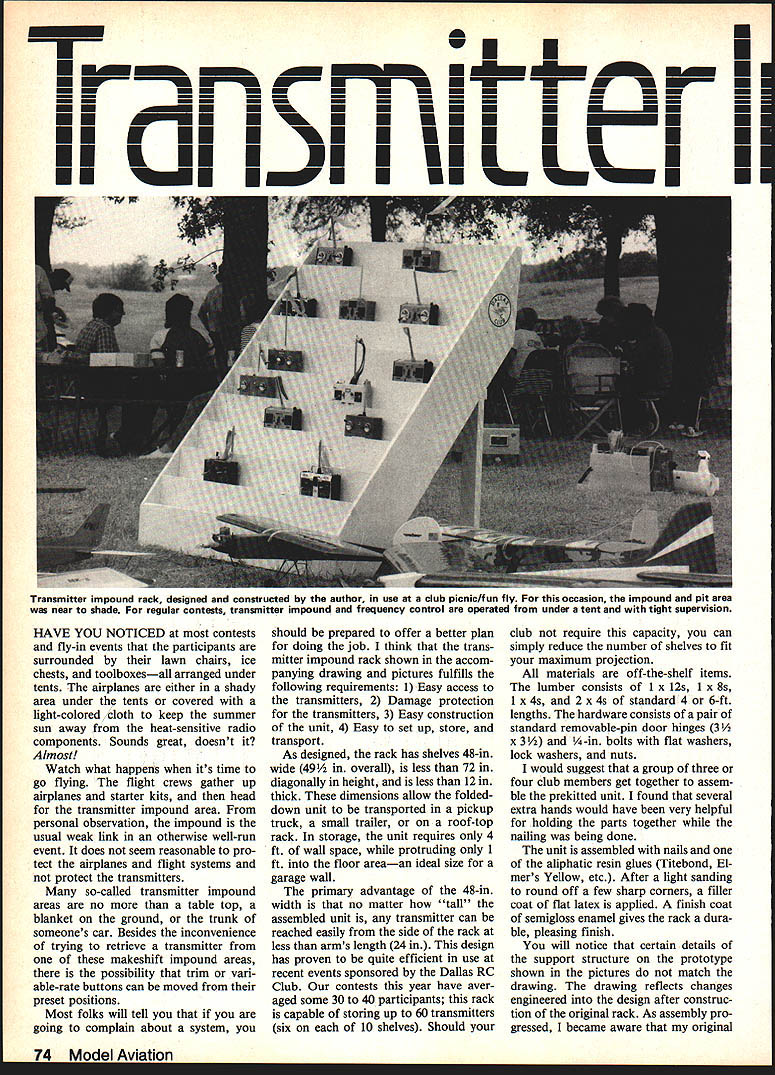
Most folks will tell you that if you are going to complain about a system, you should be prepared to offer a better plan for doing the job. The transmitter impound rack described here fulfills the following requirements:
- Easy access to the transmitters.
- Damage protection for the transmitters.
- Easy construction of the unit.
- Easy to set up, store, and transport.
Dimensions and capacity
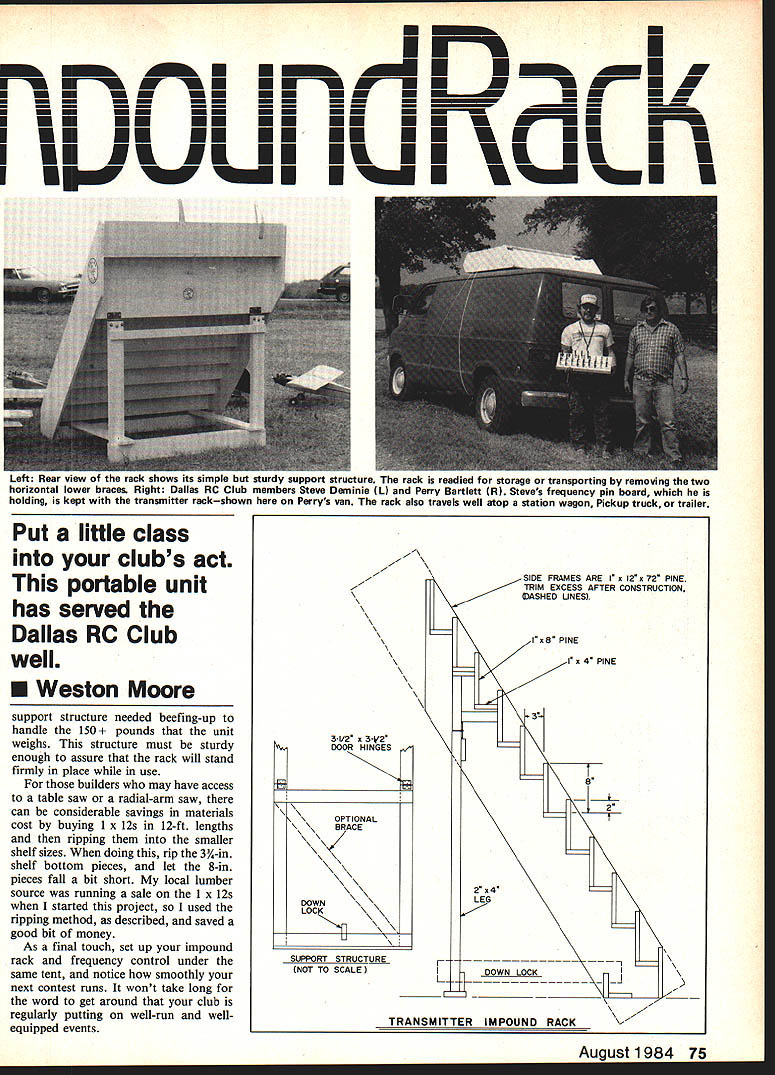
As designed, the rack has shelves 48 in. wide (49-1/2 in. overall), is less than 72 in. diagonally in height, and is less than 12 in. thick. These dimensions allow the folded-down unit to be transported in a pickup truck, a small trailer, or on a roof-top rack. In storage, the unit requires only 4 ft. of wall space, while protruding only 1 ft. into the floor area — an ideal size for a garage wall.
The primary advantage of the 48-in. width is that no matter how "tall" the assembled unit is, any transmitter can be reached easily from the side of the rack at less than arm's length (24 in.). This design has proven efficient in use at recent events sponsored by the Dallas RC Club. Our contests this year have averaged some 30 to 40 participants; this rack is capable of storing up to 60 transmitters (six on each of 10 shelves). If your club does not require this capacity, you can simply reduce the number of shelves.
Materials and hardware
All materials are off-the-shelf items. Lumber consists of 1 x 12s, 1 x 8s, 1 x 4s, and 2 x 4s in standard 4- or 6-ft. lengths. Hardware consists of:
- A pair of standard removable-pin door hinges (3-1/2 x 3-1/2 in.).
- 1/4-in. bolts with flat washers, lock washers, and nuts.
Construction
I suggest a group of three or four club members get together to assemble the pre-kitted unit. Several extra hands are helpful for holding parts together while nailing.
The unit is assembled with nails and an aliphatic resin glue (Titebond, Elmer's Yellow, etc.). After a light sanding to round off a few sharp corners, apply a filler coat of flat latex, then a finish coat of semigloss enamel for a durable, pleasing surface.
You will notice that certain details of the support structure on the prototype do not match the original drawing. The drawing reflects changes made after construction of the original rack. As assembly progressed, it became clear that the original support structure needed beefing up; the roughly 150 lb unit is heavy, and the structure must be sturdy enough to assure the rack will stand firmly in place during use.
Material savings
Builders who have access to a table saw or radial-arm saw can save materially by buying 1 x 12s in 12-ft. lengths and ripping them to the smaller shelf sizes. Using such ripping methods on the material used in the project saved a good bit of money. When ripping, cut the 3-1/4-in. shelf bottom pieces and let the 8-in. pieces fall a bit short as needed.
Setup tip
As a final touch, set up the impound rack and frequency control under the same tent. When this was done at the next contest, operations ran smoothly. It won't take long for word to get around the club about regularly putting on well-run, well-equipped events.
Put a little class into your club's act.
This portable unit has served the Dallas RC Club well.
- Weston Moore
Notes:
- Ensure the support structure is beefed up to handle the roughly 150 lb weight so the rack stands firmly in place while in use.
- If possible, rip 12-ft 1 x 12s to save on material costs, cutting shelf-bottom pieces to 3-1/4 in. and adjusting the 8-in. pieces as required.
- Co-locate the impound rack and frequency control under one tent for smoother contest operations.
Transcribed from original scans by AI. Minor OCR errors may remain.

