
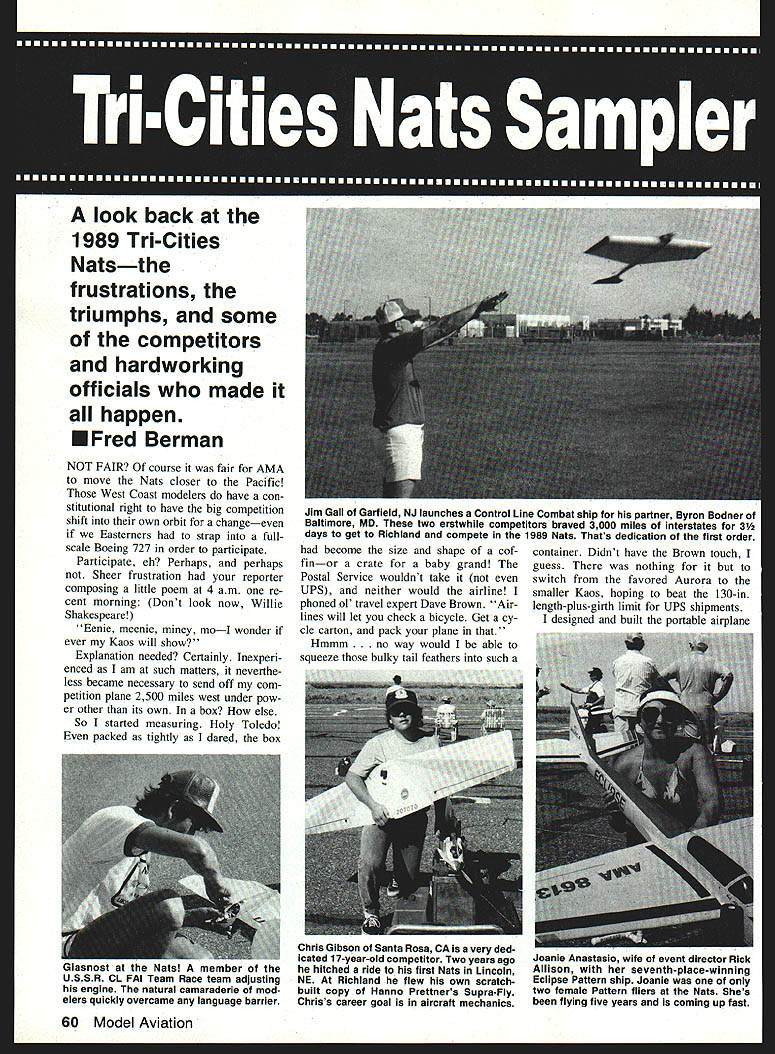

Tri-Cities Nats Sampler
Fred Berman
A look back at the 1989 Tri-Cities Nats—the frustrations, the triumphs, and some of the competitors and hardworking officials who made it all happen.
Getting the plane there
NOT FAIR? Of course it was fair for AMA to move the Nats closer to the Pacific! Those West Coast modelers do have a constitutional right to have the big competition shift into their own orbit for a change—even if we Easterners had to strap into a full-scale Boeing 727 in order to participate.
Participate, eh? Perhaps, and perhaps not. Sheer frustration had your reporter composing a little poem at 4 a.m. one recent morning. (Don't look now, Willie Shakespeare!)
"Eenie, meenie, miney, mo—I wonder if ever Kaos will show?"
Explanation needed? Certainly. Inexperienced as I am in such matters, it became necessary to send my competition plane 2,500 miles west under power other than its own. In a box—how else?
I started measuring. Holy Toledo! Even packed as tightly as I dared, the box had become the size and shape of a coffin—or a crate for a baby grand. Postal Service wouldn't take it (not even UPS), and neither would the airline. I phoned travel expert Dave Brown. "Airlines will let you check a bicycle. Get a cycle carton, and pack your plane in that." Hmmm... no way would I be able to squeeze those bulky tail feathers into such a carton. There was nothing for it but to switch from the favored Aurora to the smaller Kaos, hoping to beat the 130-inch length-plus-girth limit for UPS shipments. I designed and built the portable airplane.
Packed it, hauled it to UPS; the agent gave the OK. I packed the model, screwed down the box lid and delivered the whole business to the shipper. Fifty-five pounds, $26—not bad. It was done two weeks before the Nats; promised eight days transit time. Worries over—or so I thought.
Exactly one week later, an early morning phone call shattered tranquility. "Sorry," the voice at the other end informed. "UPS refused the shipment. It's oversize—brought back. Please come pick it up; your money will be refunded." Oh great. Six days left, counting. I'd bought airline tickets whether used or not. Dog rescue maybe advised Greyhound; diesel engine inside might accept consignment and get to Richland in three days for a fee—$45. Did I have a choice? So off I trundled the robust box to the Greyhound station.
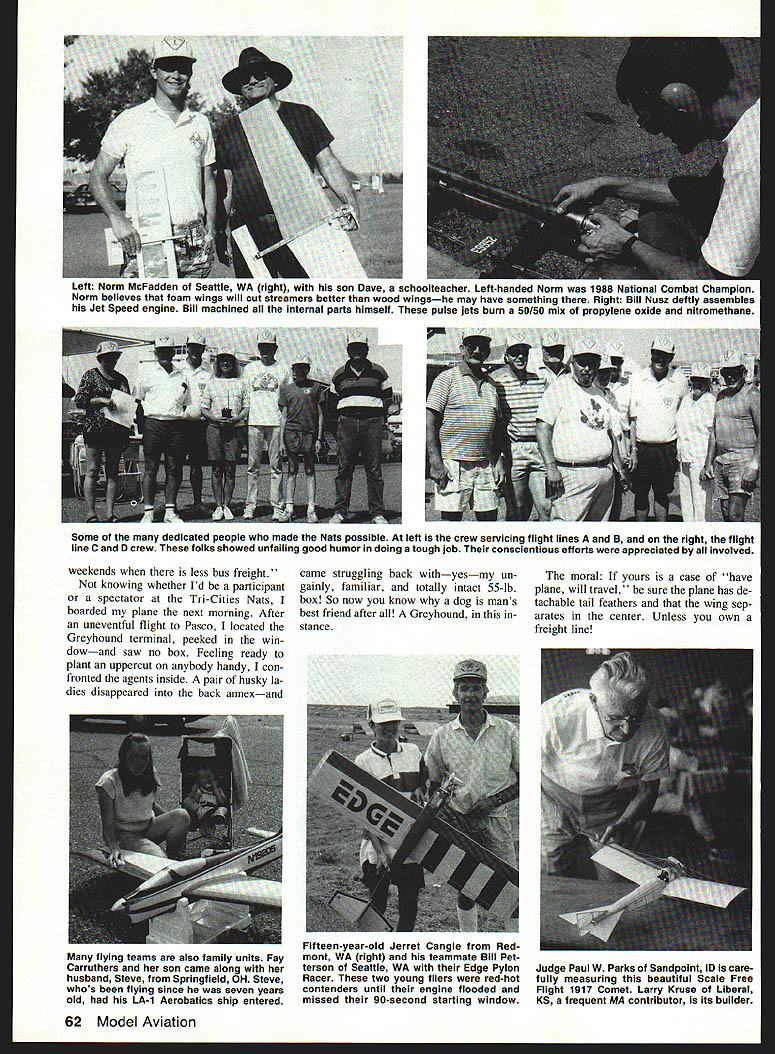
After heaving 55 lb to its destiny, I gave a second sigh of relief when I got the name, address and phone number of the Greyhound freight agent in Richland. I hurried home to give him a call about pickup arrangements. Back came a recorded message: the number I had called was out of service. Long-distance information merely confirmed that statement. Placing a call to the local terminal I was told the old directory number had been erroneously consulted—there was no longer a freight agent in Richland; the box was already on its way in the belly of the buses. What a revolting turn of events! Churning the old noodle, I remembered the Tri-Cities planned to rent a car anyway—maybe Pasco or Kennewick. Sure enough, Pasco registered positive on an up-to-date Greyhound directory. The Pasco agent said she would catch the bus en route and arrange to change shippers (re-destination). Lucky one more time—maybe.
I waited four days (the eve of my own departure), and dialed the Pasco freight agent. "No box yet," she said, not at all surprised. "They often hold large items till the bus is full." I told her I would be there the next day. She called later to say, "We've got it. It's in our freight room and looks fine." I gave her instructions to hold it until I got there.
When I arrived and opened the box, the model had suffered only a few scuffs. The motor and controls checked out fine. I reassembled and preflighted the ship, then set off for the Nats with a deep sense of relief and a renewed appreciation for the dedication of many competitors who go to extraordinary lengths to be at the meet.
The moral: If yours is a case of "have plane, will travel," be sure the plane has detachable tail feathers and that the wing separates in the center. Unless you own a freight line!
At the Nats
The Nats themselves were a marvelous mixture of frustration and triumph, of hard-working competitors and officials making things happen. There were the aristocrats of speed with bicycle pumpers and ear-muffed launch teams; there were the delicate indoor scale fliers who seemed to just float in the air; there were dedicated young men who hauled their huge Kaos across the country to compete; and there were veteran modelers who attended their first Nats with spouses in tow.
Camaraderie and mutual assistance were everywhere. Teams helped adjust engines, swapped parts, and shared tools—patterns of helpfulness that make the Nats a truly national event. For many, competing at the Nats is not just about winning but about being part of a community that celebrates the craft, skill, and joy of modeling.
Logistics and contest briefing
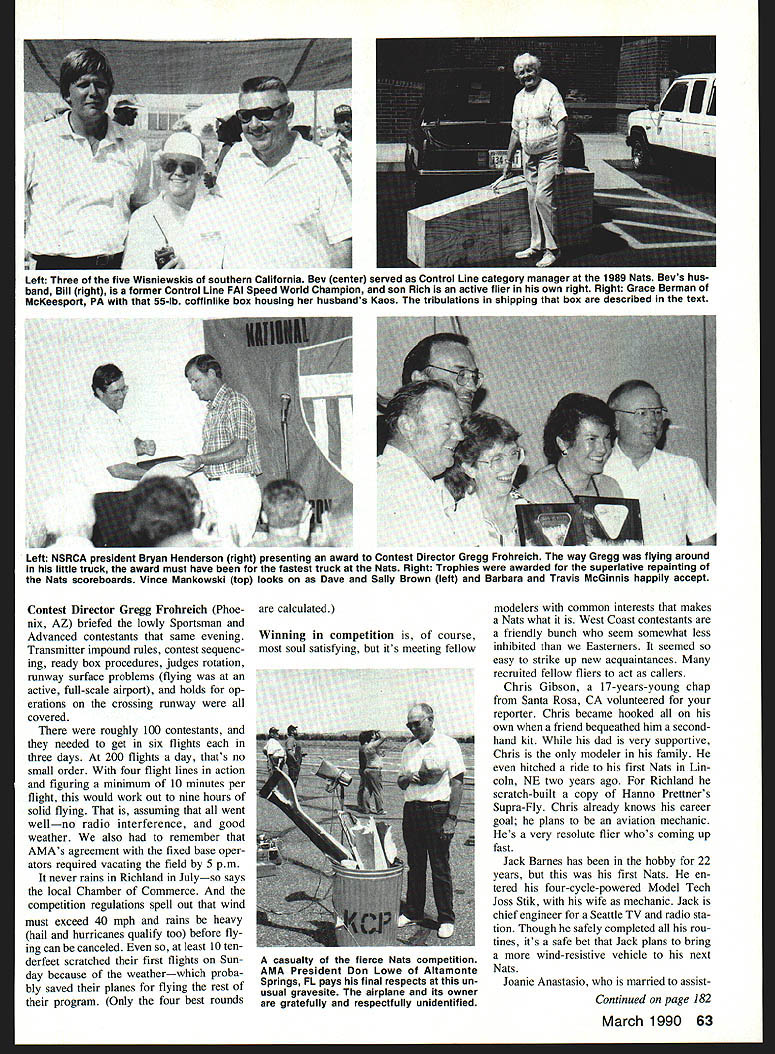
Contest Director Gregg Frohreich (Phoenix, AZ) briefed the lowly Sportsman and Advanced contestants the first evening. Transmitter impound rules, contest sequencing, ready box procedures, judges rotation, runway surface problems (flying was at an active, full-scale airport), and holds for operations on the crossing runway were all covered.
There were roughly 100 contestants, and they needed to get in six flights each in three days. At 200 flights a day, that's no small order. With four flight lines in action and figuring a minimum of 10 minutes per flight, this would work out to nine hours of solid flying—assuming no radio interference and good weather. AMA's agreement with the fixed-base operators required vacating the field by 5 p.m., adding pressure to the schedule.
The local Chamber of Commerce claims "it never rains in Richland in July." Competition regulations specify that wind must exceed 40 mph and rains be heavy before flying can be canceled. Even so, at least 10 tenderfeet scratched their first flights on Sunday because of the weather—which probably saved their planes for flying the rest of their program. Only the four best rounds are calculated.
Notable competitors and characters
- Chris Gibson (Santa Rosa, CA): A 17-year-old who scratch-built a copy of Hanno Prettner's Supra-Fly and hauled it across the country. Chris plans to be an aviation mechanic and is a resolute flier who is coming up fast. He volunteered to act as my caller.
- Jack Barnes (Seattle, WA): A veteran modeler with 22 years in the hobby. This was his first Nats; he entered a four-cycle-powered Model Tech Joss Stik with his wife as mechanic. Jack is chief engineer for a Seattle TV and radio station.
- Joanie Anastasio: One of only two women Pattern fliers at the Nats (she's been flying for only five years under her husband's tutelage). Joanie came away with a trophy for seventh place. She flies an Eclipse, maintains the plane herself, works for an engineering firm, and is upgrading her education toward an EE diploma.
- Fay Carruthers and son (Springfield, OH): They braved the long ride to assist husband Steve and his LA-1. Steve flew in the Expert class 20 years ago.
- Darlene Frederick (California): A 10-year member of the USPJA and chief judge at Richland. Jovial and approachable, she also manufactures model airplane propellers (DW Props) in many sizes and pitches.
- Bev Wisniewski (Southern California): Control Line category manager and wife of Bill Wisniewski of K&B Manufacturing. A tireless enthusiast, Bev manages Control Line Jet Speedsters and other events and champions the idea of permanent AMA flying sites.
- Many wives, families, and volunteers: Countless unnamed officials, organizers, helpers, judges, and staffers make the Nats possible. Ground crew volunteers posed for photos despite the tight schedule.
Events and classes
Pattern (Sportsman and Advanced)
- The NSRCA (National Society for Radio-Controlled Aerobatics) assisted the host region, arranged a buffet of free snacks, and conducted the awards for Sportsman and Advanced Pattern classes.
- Sportsman winners: Ken Rice (first) and Orrin Rice (second), both of Utah.
- Advanced winner: Shane Gray, a 16-year-old Junior from Texas.
- NSRCA President Bryan Henderson raised the topic of increasing dues for his 700 members to cover newsletter costs.
- Guest speaker Don Lowe gave a glimpse of AMA's future: if growth continues, AMA could reach a half-million members. He also emphasized the importance of maintaining a presence in the nation’s capital to voice concerns to policymakers.
Control Line and Speed
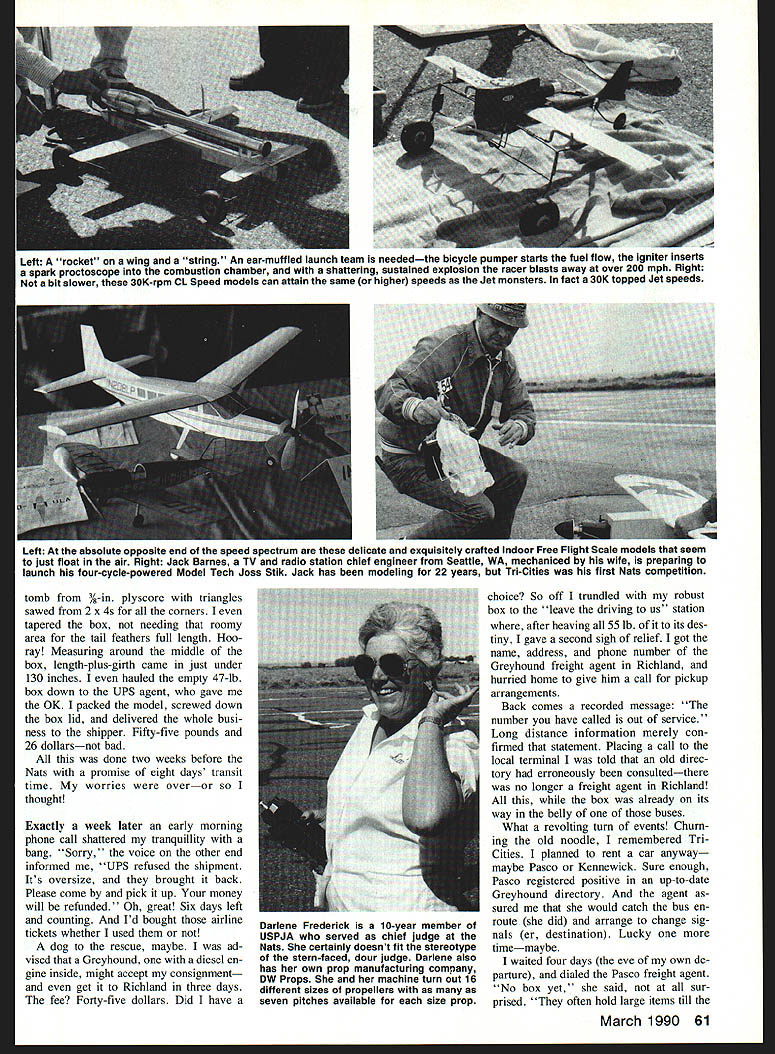
- Control Line Jet Speedsters: At 200-plus mph, these machines use exotic fuel (a 50/50 mix of propylene oxide and nitromethane). Launch teams use a bicycle pumper and an igniter; a 1/2-inch music-wire belly skid helps the craft survive landings.
- 30K-rpm engine racers (Bill Wisniewski's specialty) use twisting of a single wire for elevator control.
- Control Line Team Racing and Combat are high-adrenaline events. Russian teams competed despite language barriers; camaraderie overcame communication gaps.
- Control Line Combat: Jim Gall (Garfield, NJ) and Byron Rohlf (Baltimore, MD) drove 3,000 miles to compete. Norm McFadden (Seattle, 1988 National Combat Champion) noted foam wings cut an opponent's streamer better than wood wings. His son Dave is also involved.
RC Pylon Racing
- Quickie 500 racers use .40-size engines with stock mufflers and draw from a common fuel source. Racers are scored by finish position after 10 laps and best lap time.
- Fifteen-year-old Jerret Caine (Redmond, WA) is a devotee. He and mechanic Bill Peterson of Seattle flooded their engine and failed to start within the required 90 seconds following the signal, eliminating them from contention.
Free Flight Scale
- Free Flight Scale models, indoor and outdoor, demonstrated exceptional workmanship and patience. Judging focuses on realism and fidelity. Transport boxes for these models are delightfully small compared to the cargo needed for larger RC ships.
Hanford tour and energy issues
Thanks to AMA's network, a bus tour of the nearby Hanford atomic facilities was provided. Our guide Si Hyblak pointed out that the U.S. population has doubled since some of us were in school, and the appetite for petroleum far outpaces population growth. We face definitely limited oil supplies; the Earth may soon be drained of its most popular fuel unless alternatives are found.
Hyblak argued that nuclear energy, despite waste disposal issues, is a necessary alternative to fossil fuels. Solar has not proven sufficient for major needs, and hydroelectric capacity is largely used. Combustion of fossil fuels releases contaminants (acid rain, carbon dioxide, ozone depletion, greenhouse effect) that threaten the atmosphere. Nuclear energy shares none of those life-threatening side effects, though it creates its own challenges.
Hanford is a 560-square-mile, taxpayer-financed laboratory where thousands of scientists and support personnel work on nuclear and other problems. Some luminaries who worked there include Albert Einstein, Enrico Fermi, Werner von Braun, and Glenn Seaborg. The plutonium that fueled the Nagasaki bomb was produced there 45 years ago.
Not all projects at Hanford are nuclear. For instance, research into disposing of nonnuclear hazardous wastes (PCBs and other toxics) includes ideas like fusing waste into glass. At one time Hanford had nine operating reactors; today only two remain in operation—the Washington State power reactor and an experimental fast-flux facility.
Our guide gave us a sample uranium fuel pellet the size of a pencil eraser (a facsimile), equivalent to half a ton of coal or 90 gallons of gasoline—what a neat fuel package for a model!
AMA, national sites, and organizational notes
- Don Lowe and others discussed the possibility of AMA purchasing one or more national sites to handle headquarters and permanent Nats facilities. Some 60 sites were offered; an indicative tract was the Academy's favorite choice at the time of the Nats.
- Bev Wisniewski observed that participating contestants tend to come largely from the geographic proximity of the chosen site, which helps explain the Pacific time-zoner predominance at Tri-Cities. Bev supports AMA's aim to secure several well-spaced permanent Nats sites as flying fields disappear to development.
- Bryan Henderson highlighted the need for increased NSRCA dues; Don Lowe spoke to AMA's expected growth.
Banquet, volunteers, and closing notes
A Nats is like a banquet—a huge crowd of diners as well as a regiment of servers, cooks, and dishwashers. But the staff gets neither wages nor tips. Vince Mankowski—quartermaster general, headwaiter, chief cook and bottle washer—arranged dinner for his loyal army. A DJ with old-time music had even us old folks tripping the light fantastic. A heartwarming touch! But Vince, whatever happened to the dessert!?
Winning in competition is deeply satisfying, but meeting fellow modelers with common interests is what makes a Nats what it is. West Coast contestants were friendly and easy to approach; many recruited fellow fliers to act as callers. The event was a reminder that the hobby is fueled as much by people and community as by engines and airplanes.
Transcribed from original scans by AI. Minor OCR errors may remain.

