
Tried Tape for Skinning?
You may prefer special tapes to contact cement when skinning a foam core. Corefilm was used — a very thin Mylar tape that can be lifted without damaging the surface, provides a strapping-tape effect, and is essentially non-stretching. — Dave Herbert
Materials
- Corefilm (double-sided Mylar tape), 1-1/2 in. wide strips recommended
- 1/64 in. plywood (or balsa) for sheeting
- Leading and trailing edge stock (example: 1/8 in. sheet and 1/4 in. square)
- White glue
- Pins
- Sanding block
- Sharp knife, scissors
- Brush, tack rag, or vacuum
- Straight pin or balsa knife (to start peeling backing)
- Optional: pin-glue and 3/16 in. cap piece for leading edge
Procedure
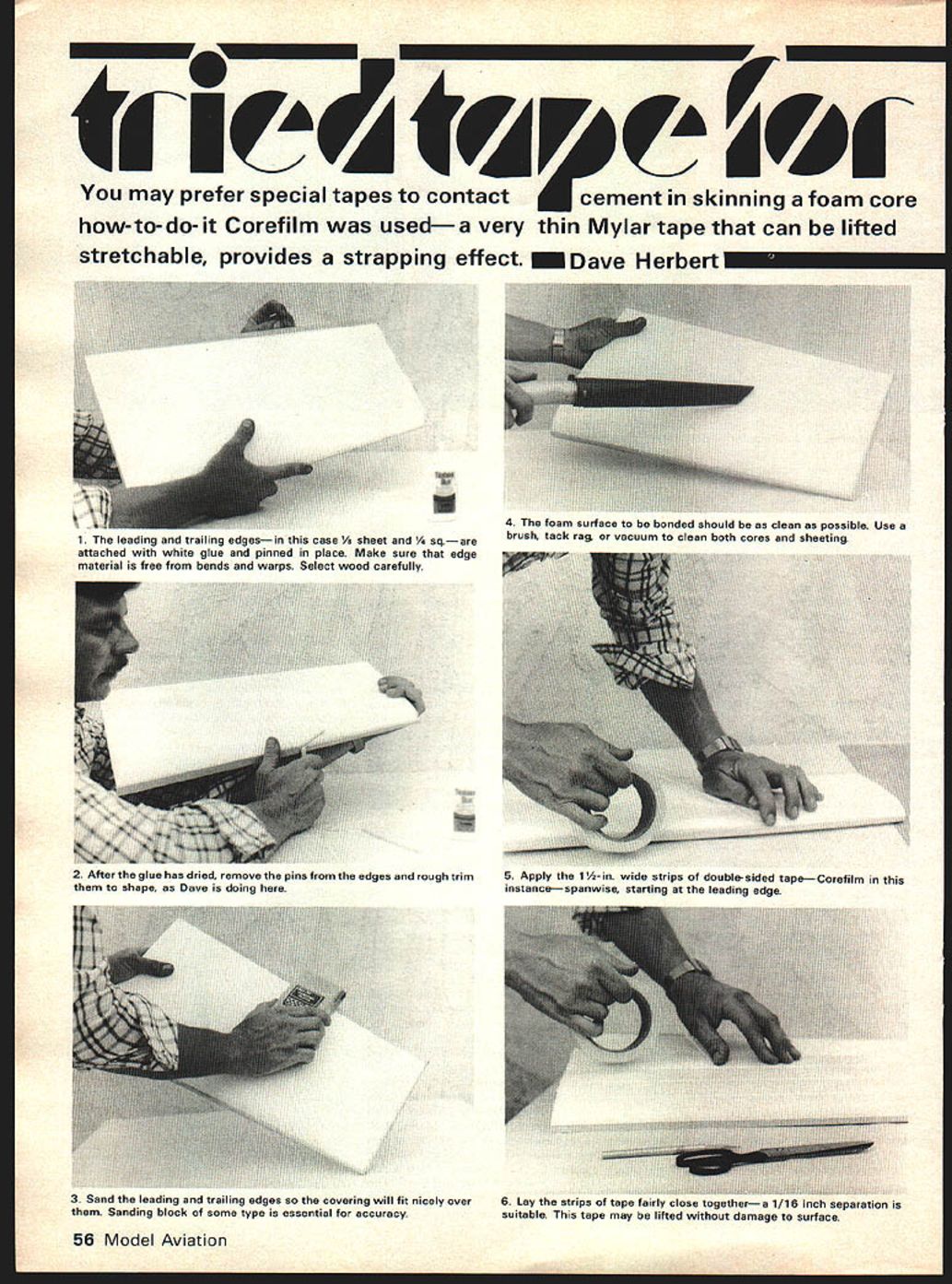
- Select and fit the leading and trailing edge stock (here, 1/8 in. sheet and 1/4 in. square). Attach them with white glue and pin in place. Make sure edge material is free from bends and warps — select wood carefully.
- After the glue has dried, remove pins and rough-trim the edges to shape.
- Sand the leading and trailing edges so the covering will fit nicely over them. A sanding block is essential for accuracy.
- Clean the foam surface to be bonded thoroughly. Use a brush, tack rag, or vacuum to remove dust from both cores and sheeting.
- Apply 1-1/2 in. wide strips of double-sided tape (Corefilm in this instance) spanwise, starting at the leading edge.
- Lay the strips fairly close together — about 1/16 in. separation is suitable. This tape may be lifted and repositioned without surface damage.
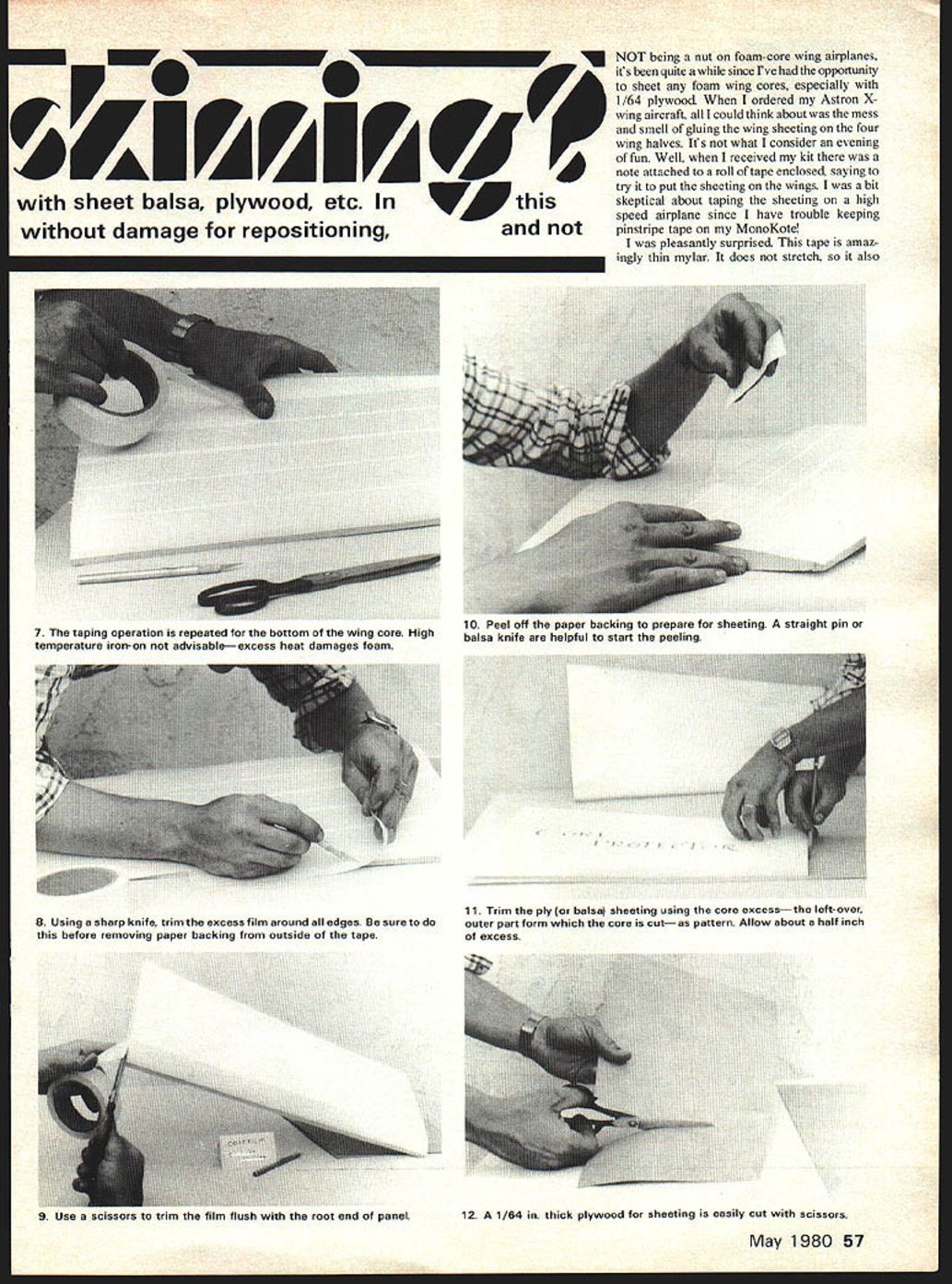
- Repeat the taping operation for the bottom of the wing core. Do not use high-temperature iron-on methods — excess heat damages foam.
- Using a sharp knife, trim excess film around all edges. Do this before removing the paper backing from the outside of the tape.
- Use scissors to trim the film flush with the root end of the panel.
- Peel off the paper backing to prepare for sheeting. A straight pin or balsa knife are helpful to start the peel.
- Trim the ply (or balsa) sheeting using the core excess (the leftover outer part from which the core is cut) as a pattern. Allow about a 1/2 in. of excess.
- A 1/64 in. thick plywood for sheeting is easily cut with scissors.
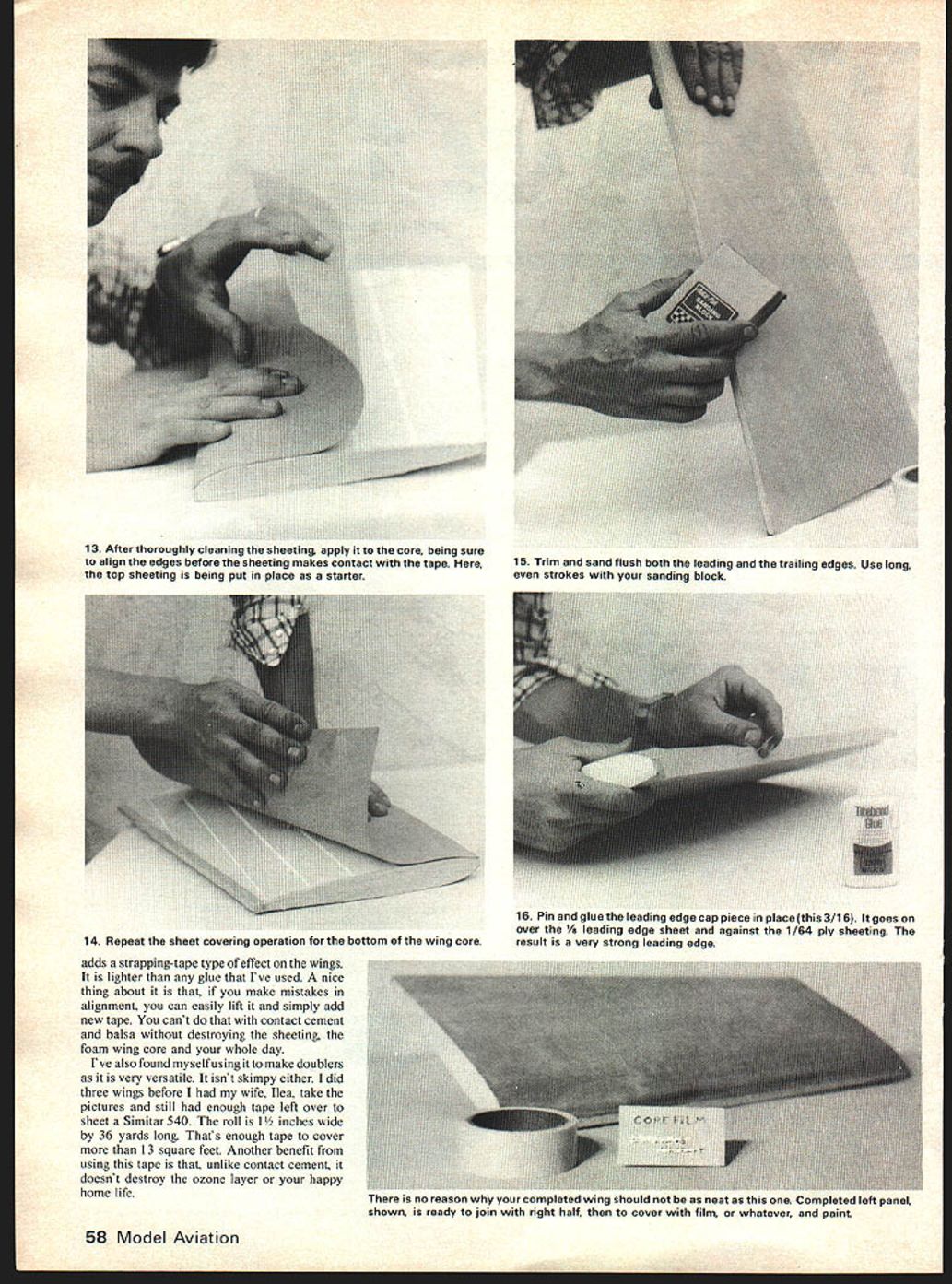
- After thoroughly cleaning the sheeting, apply it to the core, being sure to align edges before the sheeting makes contact with the tape.
- Repeat the sheeting operation for the bottom wing core.
- Trim and sand flush both leading and trailing edges. Use long, even strokes with a sanding block while putting the top sheeting in place.
- Pin-glue a leading edge cap piece in place — this 3/16 in. piece goes over the 1/8 in. leading edge sheeting against the 1/64 in. ply sheeting. The result is a very strong leading edge.
Completed left panel shown ready to join the right half. Cover with film or paint as desired.
Tips and Notes
- The tape makes alignment forgiving: you can lift and reposition the sheeting, which is impossible with contact cement without damaging balsa or foam cores.
- The tape adds a strapping effect to the wing and is lighter than most glues.
- Versatile for making doublers and other reinforcements.
- Roll size example: 12 in. wide by 36 yd. long — enough to cover more than 13 sq. ft. (ample for several wings).
- Unlike contact cement, this tape does not give off solvent fumes — better for home use and household comfort.
Transcribed from original scans by AI. Minor OCR errors may remain.

