
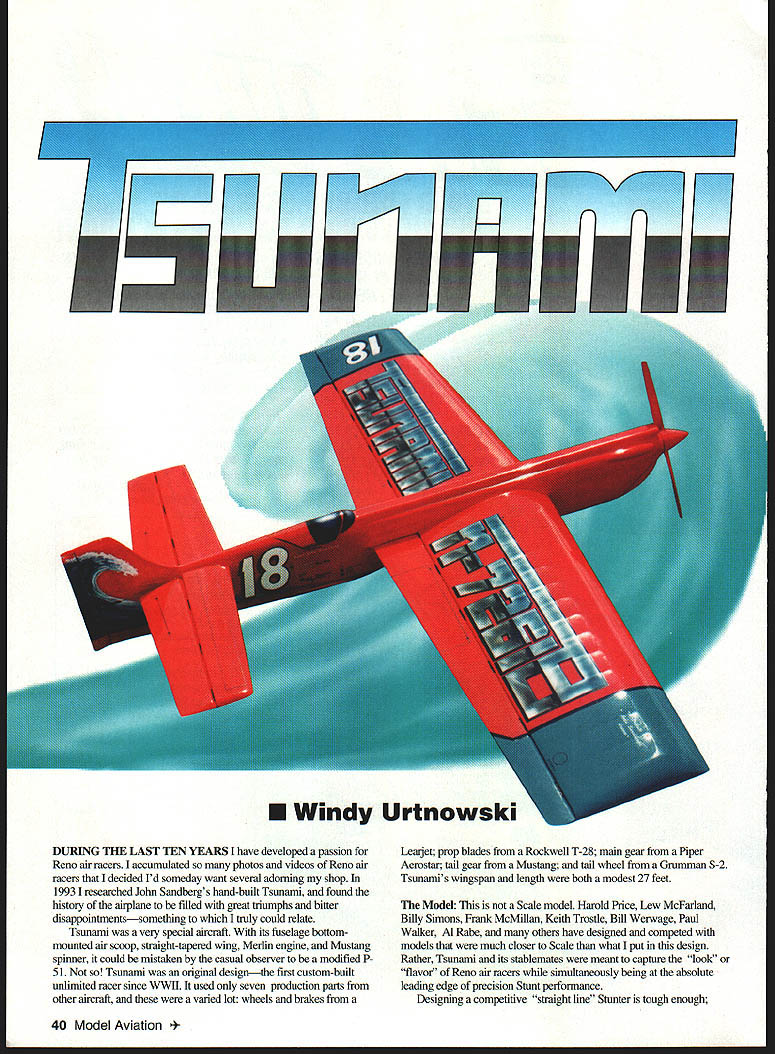
Tsunami
Windy Urtnowski
During the last ten years I have developed a passion for Reno air racers. I accumulated so many photos and videos of Reno air racers that I decided I'd someday want several adorning my shop. In 1993 I researched John Sandberg's hand-built Tsunami, and found the history of the airplane to be filled with great triumphs and bitter disappointments—something to which I truly could relate.
Tsunami was a very special aircraft. With its fuselage bottom-mounted air scoop, straight-tapered wing, Merlin engine, and Mustang spinner, it could be mistaken by the casual observer to be a modified P-51. Not so! Tsunami was an original design—the first custom-built unlimited racer since WWII. It used only seven production parts from other aircraft, and these were a varied lot: wheels and brakes from a Learjet; prop blades from a Rockwell T-28; main gear from a Piper Aerostar; tail gear from a Mustang; and tail wheel from a Grumman S-2. Tsunami's wingspan and length were both a modest 27 feet.
The Model
This is not a scale model. Harold Price, Lew McFarland, Billy Simons, Frank McMillan, Keith Trostle, Bill Werwage, Paul Walker, Al Rabe, and many others have designed and competed with models that were much closer to scale than what I put in this design. Rather, Tsunami and its stablemates were meant to capture the "look" or "flavor" of Reno air racers while simultaneously being at the absolute leading edge of precision stunt performance.
Designing a competitive "straight-line" stunter is tough enough; to get a certain look or flavor without compromising performance makes the job tougher. I spent hours at the drawing board and flying to capture the flavor of Tsunami while maintaining the critical calculations of aerodynamics. Big Jim Greenaway based the proven Patternmaster design. Pat Johnston finalized the original sketches. Gerald Schamp did the lofting that would have set very accurate plans. As always, I videotaped construction, finish, and flight trimming. Building your own Tsunami from plans and/or videos should put you out of the ballpark if you have built full-body stunters before.
Construction
Big Jim Greenaway has always advocated rigid nose construction. Tsunami takes advantage of that technology. Note the small, closely spaced formers—these provide a very rigid fuselage. I've built two wings for Tsunami. I used Tom Hunt's lost-foam method; I also used the rod method, and both wings turned out true and light. Normal C-tube construction applies either way. Ribs are cut from a stack. As blanks, in the traditional manner, the wing can be laid out over the plans, tacked up, rods installed. A built foam wing cradle is available from Scott Smith. He has documented detailed construction on video for anyone interested in this type of construction.
Tsunami uses hollowed blocks for the tail attachments and 1/4" C-grain sheet with the grain running parallel to the trailing edge for the flaps. Tsunami's tail surfaces used foam cores. Scott Smith is the best foam cutter I know, and he has a big book on the subject. Bellcrank horns, arrow shafts, and other heavy-duty items are at the heart of a stunter. A heavy-duty system with proper ratios and no flexing is the biggest improvement in stunters during the last 10 years. Four-inch glass/nylon bellcranks and beefed-up horns pioneered both advancements; I can truly say the improvement lets us fly in windy, turbulent conditions.
At the 1994 Nats in Lubbock, Texas, competitors were impressed; Tsunami made the Walker Cup flyoff and handled very windy conditions well. Patternmaster aerodynamics have always handled wind well, especially turbulent conditions at East Coast flying sites. Tsunami really is an excellent all-weather fighter.
The original Tsunami weighed 60 ounces and was balanced 8 inches ahead of the flap hinge line. As it got more flights I shifted the CG back to 7-3/4 inches. Cut down line spacing to handle large models; I always prefer short arms for power steering feel. Always incorporate the Rabe rudder model. Prop diameter greater than 12 inches is recommended; Tsunami flies best with a 14 x 5 Rev-Up prop cut down to 12 inches diameter. I have always had good success using SuperTigre .60 engines. In designs where I've tried other engines, I have always preferred the classic two-stroke Tigre. Big Jim Greenaway has set up engines and I have never had a bad installation. Tom Dixon is importing the Double Star 60, which seems like a good replacement if you can't get your hands on a Tigre. Note well: SuperTigre .60s hold value—there's a reason.
Muffler type offers an easy way to fine-tune CG location. A tongue muffler is usually the lightest and gives raw power; an expansion type will be a bit quieter at the expense of some power. Big Art Adamisin and Tom Lay make expansion mufflers, and ST .60s are worth having in the arsenal. Some pilots prefer tuned pipes; both Randy Smith and Tom Lay have packages available. They would power Tsunami just fine.
(All these people are in the PAMPA — Precision Aerobatics Model Pilots' Association — directory. If you don't belong to PAMPA, why not join now?) To tell the truth, though, I do have to admit the realistic, low-rpm "growl" of an ST .60 with a tongue- or expansion-type muffler — it's "airplane" to me.
Paint
After building the wing and stab and before installing them into the fuselage, I finished them right up to silver, using Sig dope and DuPont 3608S (not V-3608S) thinner. Medium skim-spray everything, dope-lacquer filler and a coat or two of silver sanded over made a good substrate to finish over. I used Sig silver, as I do on every project. Sig's silver has the finest metallic particles I've found, and the reflection is really a big help in highlighting all the flaws so they can be fixed before the real color coats.
Once the silver-finish wing and tail were installed in the fuselage, I attached the top and bottom blocks and finished the fuselage—even the cowl—up to silver, using the same method, before starting the color work.
The full-scale Tsunami had two distinctive paint jobs: silver and blue, and red with light blue wing tips and a Tsunami (tidal wave) motif painted on the vertical stabilizer and rudder. I decided on the red/blue color scheme, and duplicating that wave on the tail was a true labor of love.
I used 1993 Porsche Fire Red (DuPont acrylic lacquer) and Sig Light Blue for the main colors, and I custom-mixed all the colors needed to airbrush on the spot. It was time-consuming, but necessary to get the look I was after. I back-masked using aluminum foil, as suggested by master painter Walt Prey — it works great!
The lettering was another labor of love. Luckily, I videotaped all these steps for anyone contemplating doing this type of paintwork.
Sig Lite-Coat clear (about 10 coats) sanded with 1200-grit wet-or-dry paper (with Sikkens M-600 degreaser as the "cutting fluid"—much, much better than water!) got me a finish worthy of the Tsunami legacy. I buffed out the whole model with Gorham's silver polish and 3M Final Shine. That red really shines in the sun!
At the 1994 Nats Tsunami was one of only two airplanes in the front row—Steve Buso's was the other. Tsunami won every local contest entered in 1994 and was awarded several local meet concours awards by the fliers—the toughest judges of all!
Final Thoughts
Model airplanes are the focus of my life, and I love them all: old ones, big ones, small ones, semi-scale designs, jets, traditional styles, radical designs, multis. Appreciating their charm adds a lot to my involvement in the hobby. CL precision aerobatics is a diversified field of creativity and talent, with room for everyone to express themselves. It's the diversity that makes the event special. I enjoy sharing what I know about this hobby so we all can have a great time together at the flying field.
John Sandberg and his Tsunami were prominent in my thoughts during my Tsunami's construction in 1993–1994. I wanted my creation to reflect the excellence John put into the real airplane, and so on the outer wing, in small lettering, I added "A Tribute To John Sandberg's Dream."
Thanks to everyone who sent me photos and documentation for the Tsunami project. The world of modeling is full of special friendships, and I've been fortunate to have more than my share. Thanks to you all. Tsunami lives!
Sources
- 'Big Art' Adamisin
22454 Fairfax Taylor, MI 48180 (313) 291-5069
- Tom Dixon
Box 671166 Marietta, GA 30066
- 'Big Jim' Greenaway
111-23 130th Street S. Ozone Park, NY 11420 (718) 529-4631
- Bob Hunt
209 Old Easton Road Stockertown, PA 18083 (215) 759-8813
- Tom Lay
3471 W. 182nd Street Torrance, CA 90504 (310) 769-4935
- PAMPA
327 Pueblo Pass Anniston, AL 36206-1047
- Randy Smith
1880 Scenic Hwy Snellville, GA 30278 (404) 979-2035
- Scott Smith
RD 1 Box 290 Athens, NY 12015 (518) 945-1091
- Videos by Windy
93 Elliott Place Rutherford, NJ 07070
Specifications
- Type: CL Precision Aerobatics
- Wingspan: 61-1/2 inches
- Engine: SuperTigre .60
- Flying weight: 60 ounces
- Construction: Built-up
- Covering/finish: Silkspan and dope/lacquer
Transcribed from original scans by AI. Minor OCR errors may remain.

