
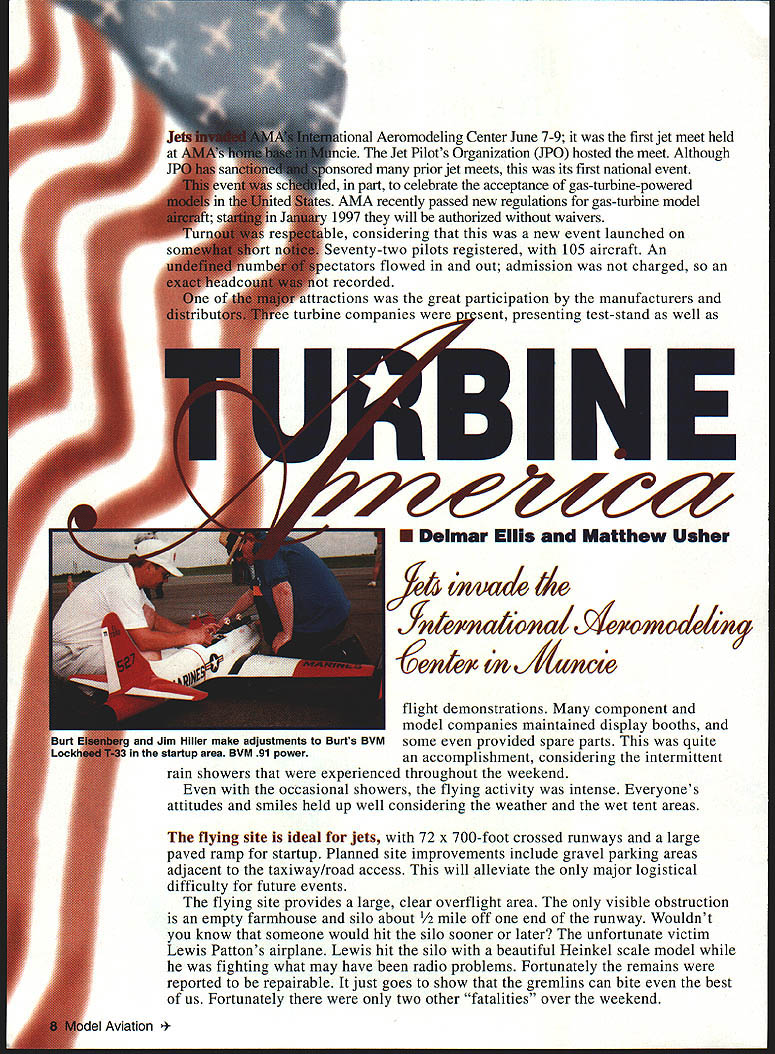
Turbine America
Delmar Ellis and Matthew Usher
Jets invade the International Aeromodeling Center in Muncie
Jets invaded AMA's International Aeromodeling Center June 7–9 in the first jet meet held at AMA's home base in Muncie. The Jet Pilots Organization (JPO) hosted the meet. Although JPO has sanctioned and sponsored many prior jet meets, this was its first national event and was scheduled in part to celebrate the acceptance of gas-turbine–powered models in the United States. AMA recently passed new regulations for gas-turbine model aircraft; starting January 1997 they will be authorized without waivers.
Turnout was respectable considering the short notice: 72 pilots registered with 105 aircraft. Spectators flowed in and out (admission was not charged), and attendance exceeded expectations despite intermittent rain showers throughout the weekend.
Event atmosphere and conditions
One of the major attractions was strong participation by manufacturers and distributors. Three turbine companies were present with test stands and flight demonstrations. Many component and model companies maintained display booths, and several vendors provided spare parts in the startup area. Getting aircraft running on O.S. .91 power was an accomplishment given the wet conditions.
Even with occasional showers, flying activity remained intense and spirits were high. Tents were wet at times, but smiles and enthusiasm held up throughout the meet.
Flying site
The flying site is ideal for jets, featuring 72- by 700-foot crossed runways and a large paved ramp and startup area. Planned site improvements include gravel parking adjacent to the taxiway/road access to alleviate the only major logistical difficulty experienced.
The site provides a large, clear overflight area with no visible obstructions except an empty farmhouse and silo about 1/2 mile off one end of the runway. Unfortunately, Lewis Patton struck that silo with a beautiful Heinkel scale model while he was fighting what may have been radio problems. The model was reported repairable. In all there were only two other "fatalities" over the weekend.
Notable aircraft and pilots
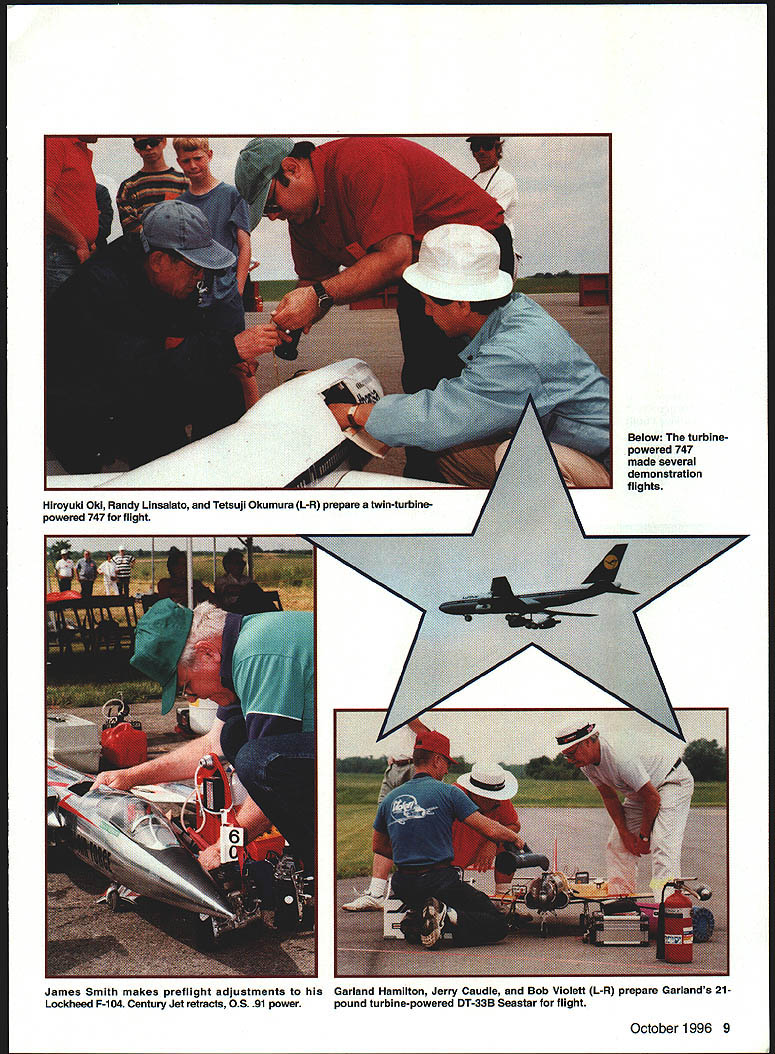
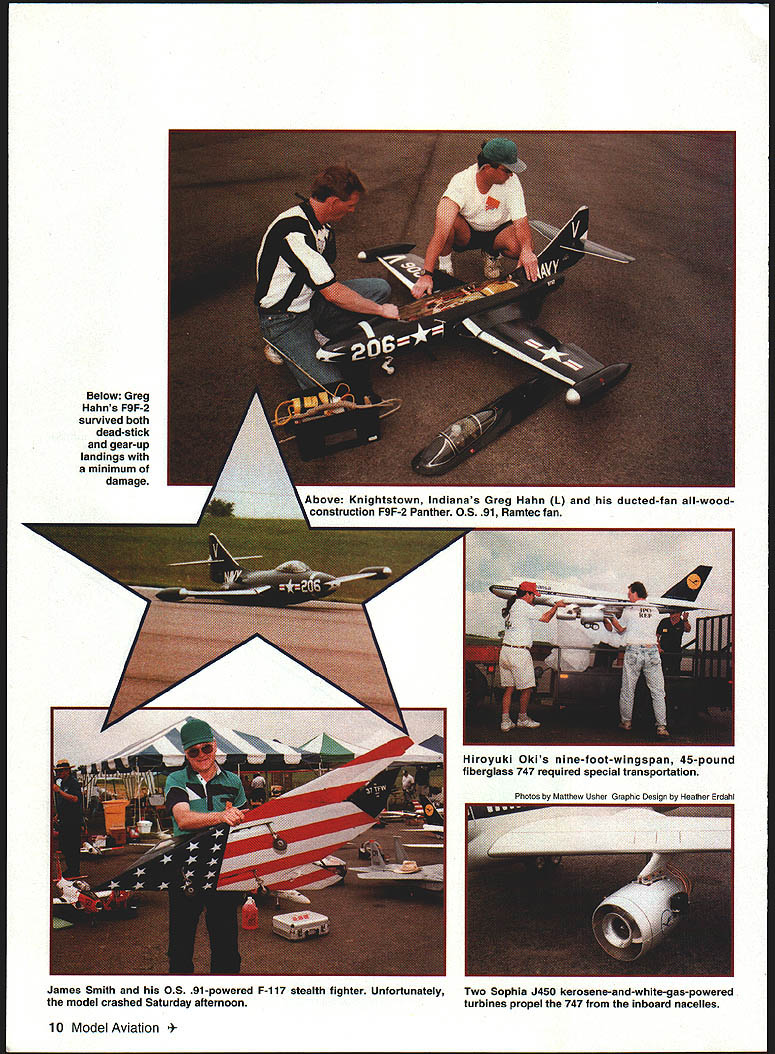
Everyone was thrilled by Japan's Hiroyuki Oki; his 747 was huge and flew magnificently with enough power for a high-rate climb and realistic, scale-style handling.
Jet Hangar Hobbies' Cougar demonstrated that a small-scale jet can perform in a scale manner with remarkable authority. The Golden West turbine performed flawlessly and sounded very realistic — a combination of engine and airframe that impressed many.
Herney Serrano and Larry Wolfe turned in impressive flying; Larry was on the flightline so often he rarely put his radio down. BVM models probably flew more than any other brand, with Bob Violett and Garland Hamilton conducting spectacular demonstrations. Garland earned special note for his smooth style and for obtaining three turbine flights within a 45-minute period.
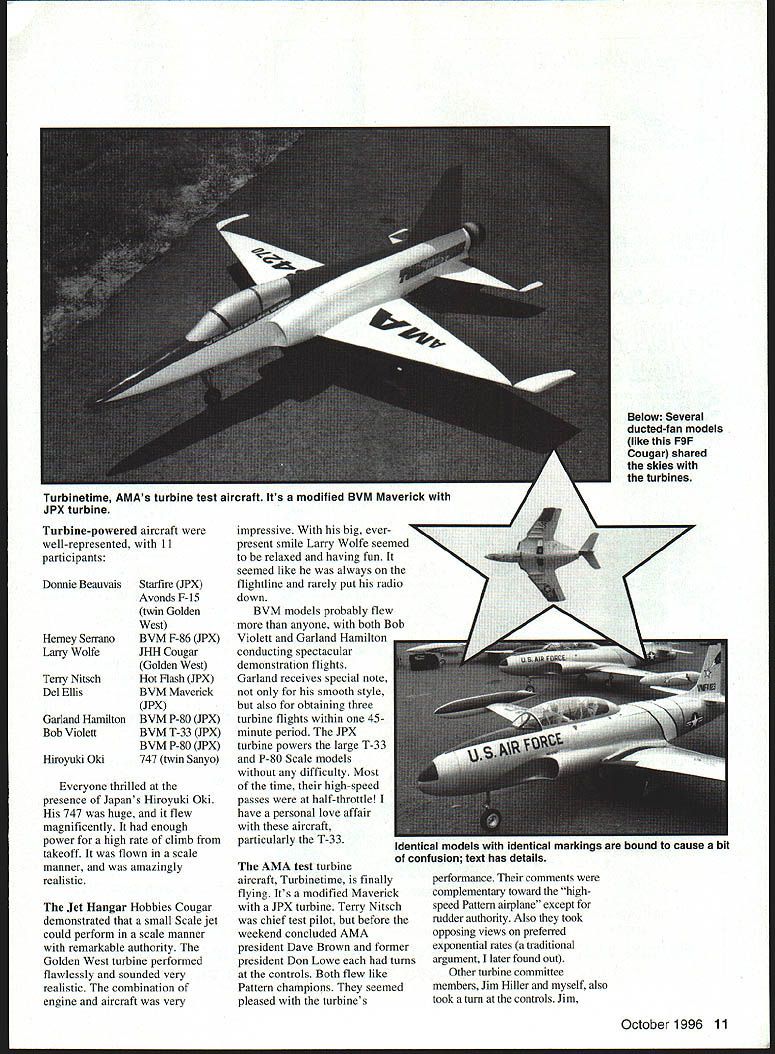
The JPX turbine powers the large T-33 and P-80 scale models; high-speed passes were often done at half-throttle. The AMA test turbine aircraft, Turbine Time (a modified Maverick with a JPX turbine), was also flown successfully. Terry Nitsch served as chief test pilot; AMA president Dave Brown and former president Don Lowe each had turns at the controls and flew like Pattern champions.
Other pilots who contributed notable flying included Donnie Beauvais, who brought two turbine aircraft and shared flight opportunities generously, and Yves Duchesneau, whose Cyclone drew attention (it was said to have been sold early in the meet).
Tom Cook demonstrated the AMT turbine on a test stand; the smooth-starting engine produced 22+ pounds of thrust and features sophisticated controls and safety systems, making it one to watch for large jet models.
Turbine-powered participants
Turbine-powered aircraft were well represented, with 11 participants:
- Donnie Beauvais — Starfire (JPX); Avonds F-15 (twin Golden West)
- Herney Serrano — BVM F-86 (JPX)
- Larry Wolfe — JHH Cougar (Golden West)
- Terry Nitsch — Hot Flash (JPX)
- Del Ellis — BVM Maverick (JPX)
- Garland Hamilton — BVM P-80 (JPX)
- Bob Violett — BVM T-33 (JPX); BVM P-80 (JPX)
- Hiroyuki Oki — 747 (twin Sanyo)
- (Other turbine participants also flew various models and installations)
Manufacturers, vendors, and ducted fans
Other manufacturers and distributors present included Lesher Models, Top Gun, and Century Aircraft. Century drew interest with the Heinkel and a huge twin-engine Phantom. Ninety-four ducted-fan models were in the field, and several ducted-fan pilots and turbine pilots flew simultaneously without incident. Ducted-fan performance was generally complementary to high-speed Pattern airplanes, although rudder authority was noted as a consideration.
A comic moment occurred when Gus Hudson and Herney Serrano taxied out with identical paint-schemed T-33s; they bravely flew simultaneously without mishap. At one point three turbines flew at the same time — perhaps a U.S. record.
Operations and safety
Turbine pilots fueled and started engines in a set-aside area with a 25-foot minimum distance between engines and spectators. Ducted-fan pilots generously minimized delays so turbines could proceed from the pits, compensating for short fuel-burn periods. Fueling and startup procedures worked well and the initial apprehensions about turbines largely dissipated over the weekend.
AMA support and meet organization
AMA was generous in support and encouragement. Dave Brown was guest speaker at Friday's banquet and spoke warmly about jet modeling and JPO's status as an AMA Special Interest Group. He also announced that Bob Violett was being inducted into AMA's Hall of Fame at that year's Celebration of Eagles. AMA Technical Director Steve Kaluf and his crew were ever-present, working to maintain comfort and safety. Many AMA personnel observed and assisted throughout the weekend.
The meet was unique in that it was not held or staffed by a local flying club but was manned by volunteers from across the country. Top credit goes to Contest Director Dave Bloomer, who worked tirelessly for weeks in advance. Bill Midgley ran the flightline with proficiency. Other major contributors included Joe Wilkins, Tom Wallace, Tom Dodgen, Dave Crabtree, and Wayne Jones.
Their combined efforts produced a successful and historic meet. AMA approval seemed likely, and a repeat meet was suggested for the following year — although everyone was too exhausted to reply immediately.
Transcribed from original scans by AI. Minor OCR errors may remain.

