
Turner Racer
Don Berliner
Climaxing the golden age of air racing, Roscoe Turner flew the Special to sensational back-to-back victories in the 1938-39 Thompson races.
ROSCOE TURNER is, without a doubt, the best-known pilot in the history of air racing. He may not have been the best, nor the most innovative, nor even the winningest. But no matter what he did, he made sure that everyone knew about it. And this has paid off with permanent fame.
Roscoe was really interested in just the big-time—the Thompson and Bendix Races. They were the super-prestige events of the 1930's, and regularly drew the tops in talent, experience and raw courage. In those races, Turner's record speaks for itself: three firsts and three thirds in the Thompson, a first, a second and a third in the Bendix.
On top of this, he turned inter-city speed dashes into a fine art, with a flair for publicity that has never been matched. With his waxed mustache, powder-blue uniform and pet lion companion, he was in the newspapers and newsreels as often as any politician or movie star, types with whom he shared many traits.
Turner was everyman's race pilot, the idol of millions of young boys, and the hero of their fathers. Whatever he did seemed exciting, even if it really wasn't. He lived other people's dreams and fantasies.
But he was rarely referred to as a "pilot's pilot," for his fellow throttle jockeys were not among his biggest boosters. They said the only reason Roscoe
won races was because he knew how to hustle enough financial backing to pay for bigger engines. They said he wasn't a very good pylon pilot, frequently cutting pylons while far in the lead, and even getting lost on a 10-mile course. And they said that when they beat him, the press ignored STAR & FLAME ARE RED & WHITE, LETTERING BLUE.
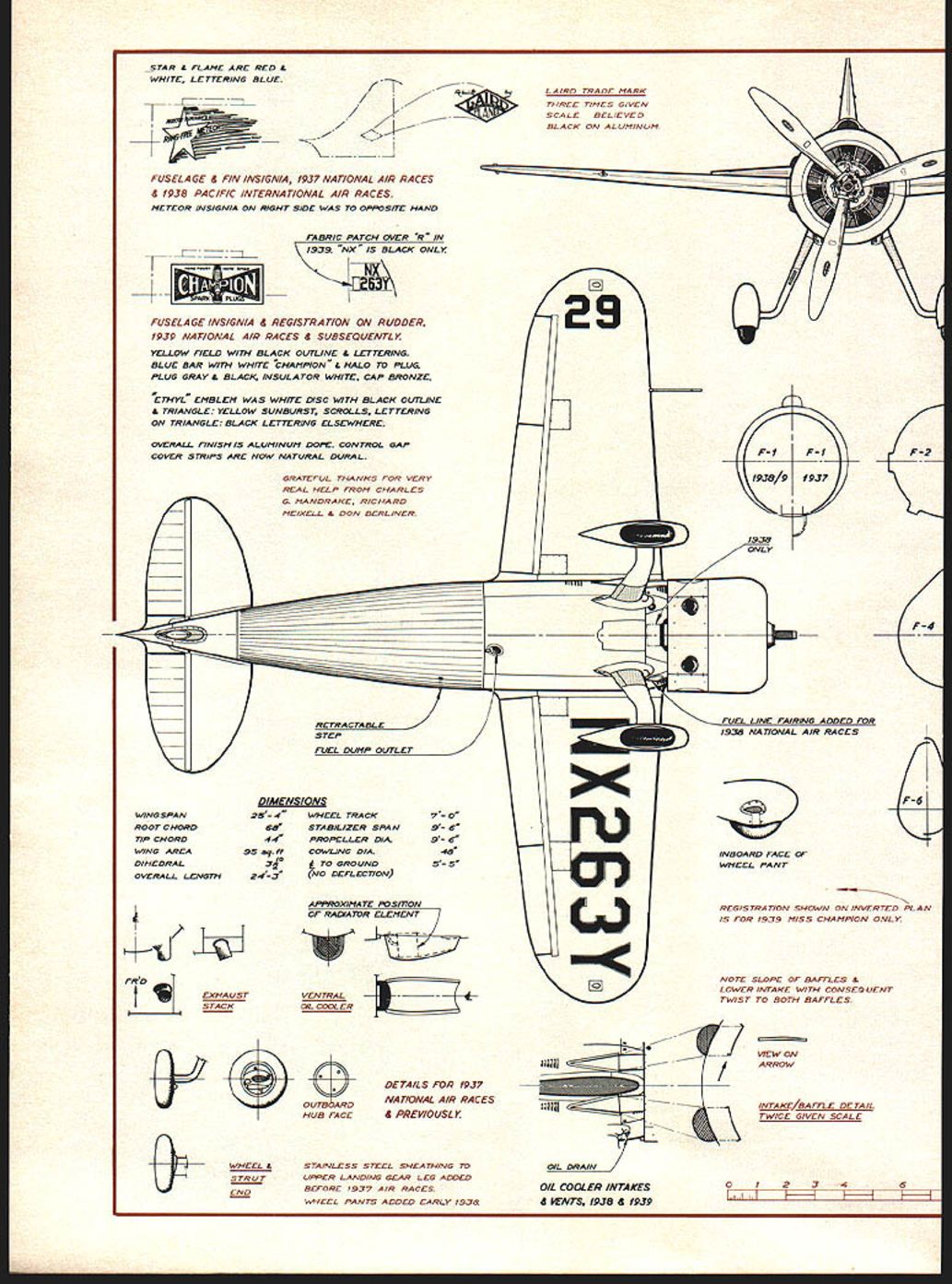
FUSELAGE & FIN INSIGNIA, 1937 NATIONAL AIR RACES & 1938 PACIFIC INTERNATIONAL AIR RACES. METEOR INSIGNIA ON RIGHT SIDE WAS TO OPPOSITE HAND.
FABRIC PATCH OVER "N" IN 1939. "NX" IS BLACK ONLY.
FUSELAGE INSIGNIA & REGISTRATION ON RUDDER. 1939 NATIONAL AIR RACES & SUBSEQUENTLY.
YELLOW FIELD WITH BLACK OUTLINE & LETTERING. BLUE BAR WITH WHITE "CHAMPION" & HALO TO PLUG. PLUG GRAY & BLACK, INSULATOR WHITE, CAP BRONZE.
"ETHYL" EMBLEM WAS WHITE DISC WITH BLACK OUTLINE & TRIANGLE; YELLOW SUNBURST, SCROLLS, LETTERING ON TRIANGLE; BLACK LETTERING ELSEWHERE.
OVERALL FINISH IS ALUMINUM DOPE. CONTROL GAP COVER STRIPS ARE NOW NATURAL DURAL.
GRATEFUL THANKS FOR VERY REAL HELP FROM CHARLES G. HANDGARE, RICHARD MEXELL & DON BECKLINER.
LAIRD TRADE MARK THREE TIMES GIVEN SCALE. BELIEVED BLACK ON ALUMINUM.
RETRACTABLE STEP
FUEL DUMP OUTLET
DIMENSIONS
WINGSPAN 25'-4" ROOT CHORD 6'-8" TIP CHORD 4'1" WING AREA 95 sq. ft. DIHEDRAL 3° OVERALL LENGTH 24'-3"
WHEEL TRACK 7'-0" STABILIZER SPAN 9'-6" PROPELLER DIA 95" COWLING DIA 40" TO GROUND 5'-5" (NO DEFLECTION)
APPROXIMATE POSITION OF RADIATOR ELEMENT
EXHAUST STACK
VENTRAL OIL COOLER
OUTBOARD HUB FACE
FUEL LINE FAIRING ADDED FOR 1938 NATIONAL AIR RACES.
INBOARD FACE OF WHEEL PANT.
REGISTRATION SHOWN ON INVERTED PLAN IS FOR 1939 MISS CHAMPION ONLY.
NOTE SLOPE OF BAFFLES & LOWER INTAKE WITH CONSEQUENT TWIST TO BOTH BAFFLES.
VIEW ON ARROW
INLET/BAFFLE DETAIL TWICE GIVEN SCALE.
OIL DRAIN
OIL COOLER INTAKES & VENTS, 1938 & 1939.
STAINLESS STEEL SHEATHING TO UPPER LANDING GEAR LEG ADDED BEFORE 1937 AIR RACES. WHEEL PANTS ADDED EARLY 1938.
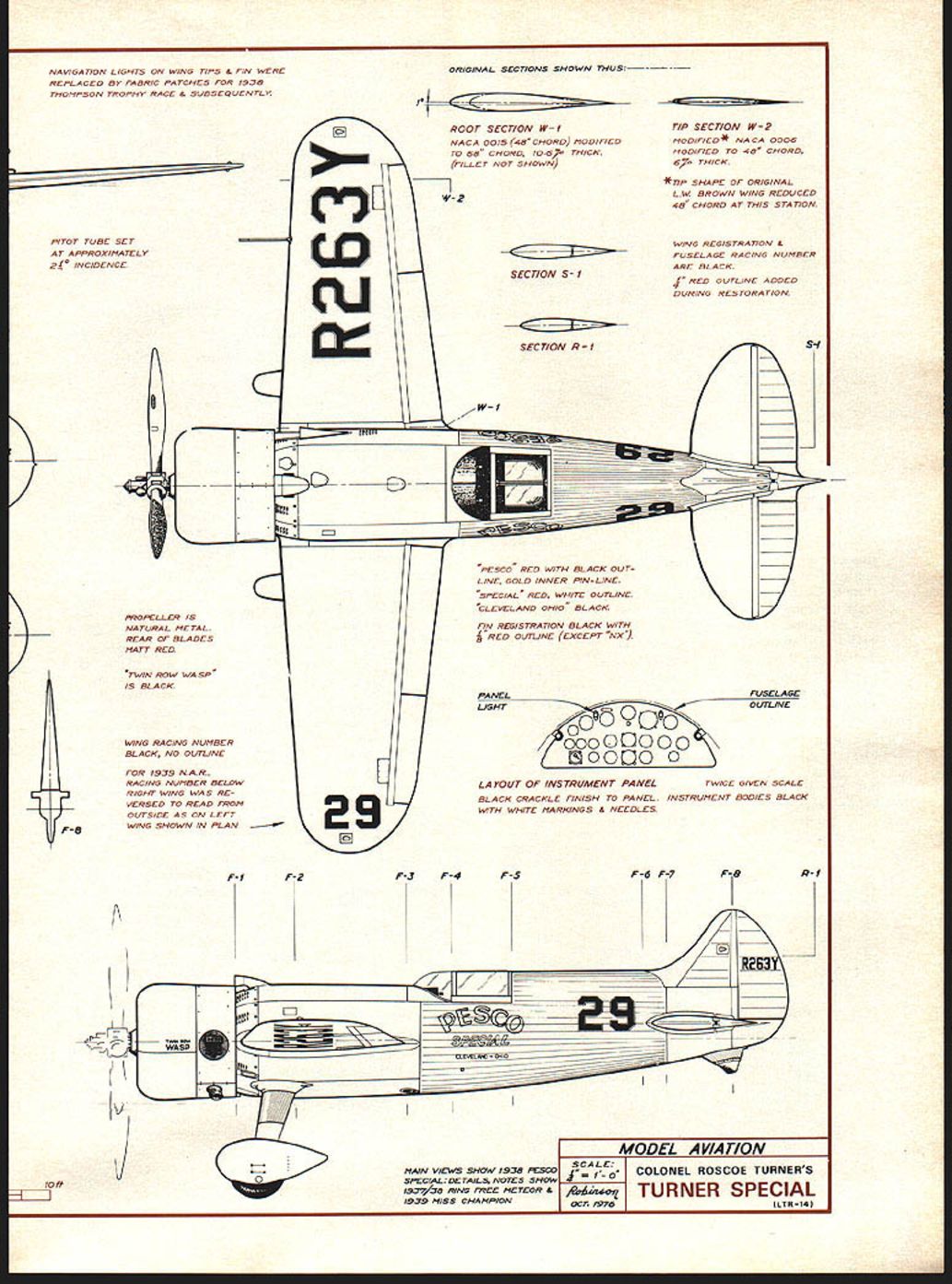
DETAILS FOR 1937 NATIONAL AIR RACES & PREVIOUSLY. NAVIGATION LIGHTS ON WING TIPS & FIN WERE REPLACED BY FABRIC PATCHES FOR 1938 THOMPSON TROPHY RACE & SUBSEQUENTLY.
PITOT TUBE SET AT APPROXIMATELY 2° INCIDENCE.
PROPELLER IS NATURAL METAL. REAR OF BLADES MATT RED.
"TWIN ROW WASP" IS BLACK.
WING RACING NUMBER BLACK, NO OUTLINE.
FOR 1939 N.A.R. RACING NUMBER BELOW RIGHT WING WAS REVERSED TO READ FROM OUTSIDE AS ON LEFT WING SHOWN IN PLAN.
ORIGINAL SECTIONS SHOWN THUS:
ROOT SECTION W-1 NACA 0015 (48" CHORD) MODIFIED TO 68" CHORD, 10.6% THICK. (FILLET NOT SHOWN)
TIP SECTION W-2 MODIFIED NACA 0006 MODIFIED TO 48" CHORD, 6% THICK.
*TIP SHAPE OF ORIGINAL L.W. BROWN WING REDUCED 48" CHORD AT THIS STATION.
SECTION S-1
SECTION R-1
WING REGISTRATION & FUSELAGE RACING NUMBER ARE BLACK. RED OUTLINE ADDED DURING RESTORATION.
"PESCO" RED WITH BLACK OUTLINE, GOLD INNER PIN-LINE. "SPECIAL" RED, WHITE OUTLINE. "CLEVELAND, OHIO" BLACK.
FIN REGISTRATION BLACK WITH RED OUTLINE (EXCEPT "NX").
PANEL LIGHT
LAYOUT OF INSTRUMENT PANEL TWICE GIVEN SCALE. BLACK CRACKLE FINISH TO PANEL. INSTRUMENT BODIES BLACK WITH WHITE MARKINGS & NEEDLES.
MAIN VIEWS SHOW 1938 PESCO SPECIAL. DETAILS/NOTES SHOW 1937/38 RING, FREE METEOR & 1939 MISS CHAMPION.
MODEL AVIATION
SCALE: 3/8" = 1'-0" Robinson OCT. 1976
COLONEL ROSCOE TURNER'S TURNER SPECIAL
Turner Racer
them and just wrote about Roscoe's tough luck.
Some of this was sour grapes, for it seemed that Turner got the headlines no matter what he did. But some of it was close to the truth; he almost always had more horsepower than anyone else... and why not, since the big races in those days were truly "unlimited?" And it was true that he lost more than one race when he either cut a pylon and was penalized, or thought he had cut one and went back to circle it.
Still, the goal in racing is winning. And as long as it's done according to the rules, who's to say that it was done the wrong way? Modest race pilots can be fine people, but they are usually also relatively unknown people, no matter how many first-place trophies they have accepted "with deepest humility...."
For the first few big years of Roscoe Turner's career—1932 to 1935—he flew a Wedell-Williams racer, the gold #57. In it, he had all his Bendix successes, and won one Thompson and almost another. The airplane and pilot seemed a perfect team. Except that it was someone else's design, not Turner's.
After a flop of a 1936 season, thanks to an accident which wiped out the Wedell-Williams, Turner decided that the time was ripe for a brand-new airplane, one that would have so much power and such refined aerodynamics that winning would be almost a sure-thing. Best of all, it would be a "Turner Racer."
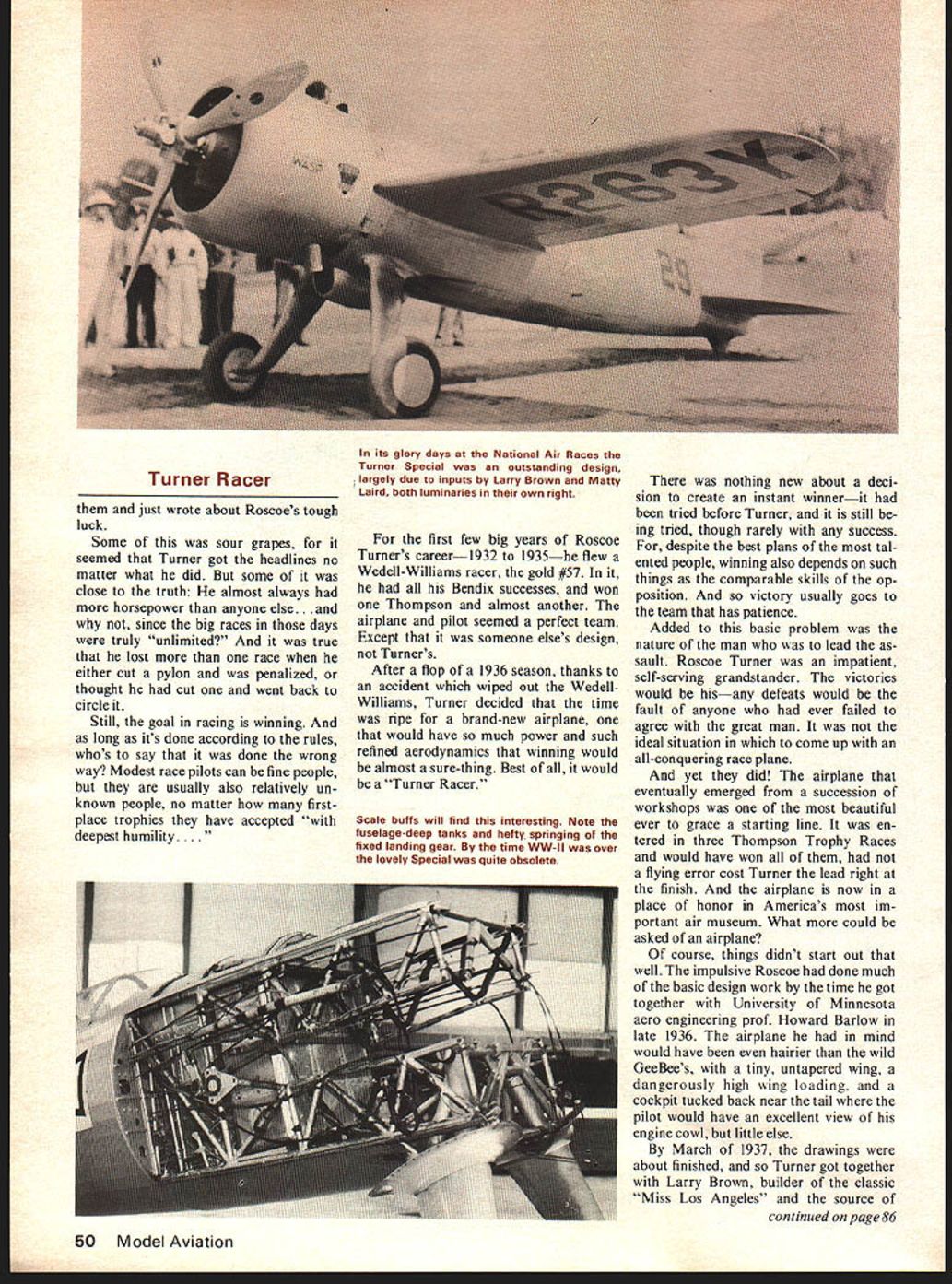
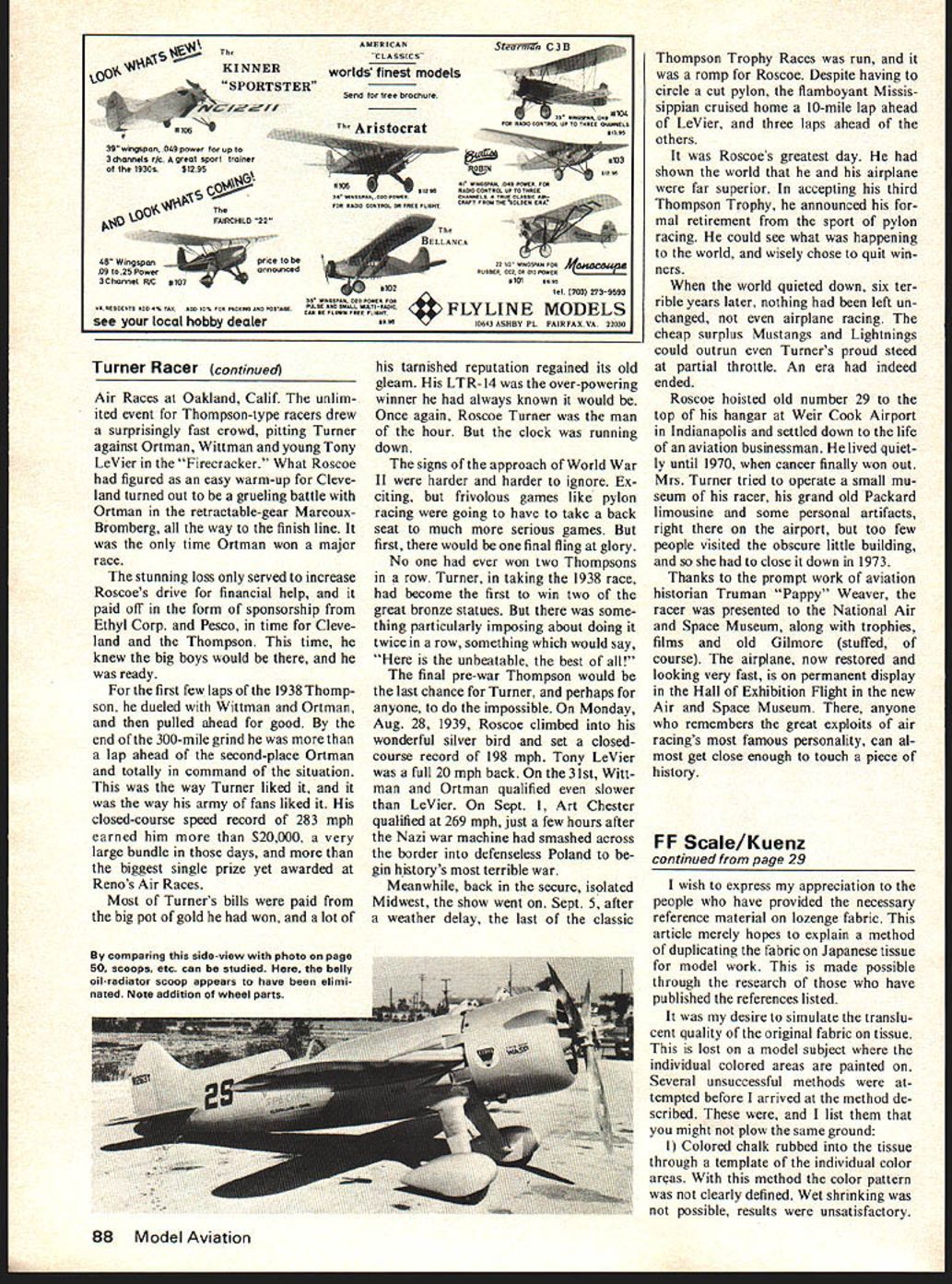
Scale buffs will find this interesting. Note the fuselage-deep tanks and hefty springing of the fixed landing gear. By the time WW-II was over the lovely Special was quite obsolete.
There was nothing new about a decision to create an instant winner—it had been tried before Turner, and it is still being tried, though rarely with any success. For, despite the best plans of the most talented people, winning also depends on such things as the comparable skills of the opposition. And so victory usually goes to the team that has patience.
Added to this basic problem was the nature of the man who was to lead the assault. Roscoe Turner was an impatient, self-serving grandstander. The victories would be his—any defeats would be the fault of anyone who had ever failed to agree with the great man. It was not the ideal situation in which to come up with an all-conquering race plane.
And yet they did! The airplane that eventually emerged from a succession of workshops was one of the most beautiful ever to grace a starting line. It was entered in three Thompson Trophy Races and would have won all of them, had not a flying error cost Turner the lead right at the finish. And the airplane is now in a place of honor in America's most important air museum. What more could be asked of an airplane?
Of course, things didn't start out that well. The impulsive Roscoe had done much of the basic design work by the time he got together with University of Minnesota aero engineering prof. Howard Barlow in late 1936. The airplane he had in mind would have been even hairier than the wild Gee Bee's, with a tiny, untapered wing, a dangerously high wing loading, and a cockpit tucked back near the tail where the pilot would have an excellent view of his engine cowl, but little else.
By March of 1937, the drawings were about finished, and so Turner got together with Larry Brown, builder of the classic "Miss Los Angeles" and the source of
Turner Racer/Berliner
continued from page 50
plans and kits of models of racing planes. The drawings were shipped from Barlow to Brown's California plant, where he was expected to build a winner in six months, give or take a few panics.
The very first panic erupted when the package of plans was opened. Brown, and his chief engineer, Dan Halloway, were thunder-struck by the design, which they considered totally impractical, to put it politely! Despite Turner's insistence that he had designed the airplane, and that much of it had been tested in a wind tunnel, Brown flatly refused to build it. There was so little time left, and Roscoe was so aware of Brown's fine reputation, that he gave in.
First to go was the tubby fuselage, to be replaced by a slim, tapered one which was a full four feet longer. Brown retained the original Barlow wing, but with little enthusiasm, knowing it to lack both area and stability—but on this, Turner was insistent. At least he was until a grand argument began, and led to the smashing of the old wing and the designing of a new one with greater span, greater area and a more efficient tapered platform.
But it also led to a complete break between the pilot and the builder. The last straw was Brown's discovery that good old Roscoe didn't have the money to pay for the project, and so all work was stopped. Exit Larry Brown. Enter Matty Laird to begin the third act of what was becoming a very complicated play. And also a very emotional one, for Laird refuses to discuss his part in the drama to this very day!
But in the beginning, things were not quite so explosive. Turner had the unfinished Brown racer shipped to Laird's Chicago factory, along with the remains of the Wedell-Williams. Less than three months before the 1937 Cleveland Air Races, the stuff arrived: A new racer which was far from complete, and an old one that was little more than junk. The original untapered wing for the Brown-Turner airplane was nowhere to be found, but there was a tapered 21-foot wing, the exact origins of which remain a mystery.
With too little time remaining, Turner concentrated on raising money, while Laird and his skilled craftsmen finished two racers. Matty was very concerned about the 84 sq. ft. wing, and so for safety he increased the span to 25 feet and modified much of the internal structure. The fuselage and tail were completed, and everything was covered and doped. It wasn't until Aug. 24 that the airplane was assembled and ready to go. And it wasn't until Aug. 28 that Turner finally got it into the air—a comfortable four days before the start of time trials!
He took off from Chicago's Midway Airport and flew to Ford-Lansing Airport, on the other side of town, making a smooth flight and a smooth landing. It looked like Lady Luck was at last beginning to smile on the otherwise tempestuous project. They weren't out of the woods yet, but at least a glimmer of light could be seen.
On Aug. 29, Roscoe headed west for the start of the Bendix Transcontinental Derby. All was routine until he approached Los Angeles, when the smell of gasoline filled the cockpit. The landing at Burbank went OK until sparks from the tail skid ignited a flash fire, which Turner was able to blow out with a blast of prop-wash. But enough damage had been done to keep him out of the Bendix, and to keep him from flying back to Cleveland until the very last minute.
Qualifying at 259 mph for the Thompson, Turner was second only to Steve Wittman in his smaller, lighter, less powerful "Bonzo." The crafty Wittman got off first and pushed steadily ahead, leading for 17 of the 20 laps. Then he hit a bird with his prop and was forced to back-off the power. Turner moved ahead of Earl Ortman and it looked like the brand-new racer would do the impossible and win its very first race.
But on the backstretch of the last lap, Roscoe was momentarily blinded by the sun and thought he had cut a pylon. The drill in those days was to circle a cut pylon in order to keep from being penalized a lap, and this Turner did, even though he had not actually cut it. While he was flying around in a circle, both Ortman and Ruby Kling slipped past and headed for the finish line. At the very last moment, Kling dove by Ortman, pushed the nose of his Folkerts Racer in front and won by a scant 17/100ths of a second.
Roscoe Turner was not the happiest man on the airfield. He had had the race in his back pocket and had given it away on a mistake. In an attempt to recapture some much-needed glory, he set a National 3-kilometer speed record at Detroit, two weeks later, averaging 289.9 mph. But two days after that, Jackie Cochran took it away from him with 292.3 mph in her Seversky P-35. These were not the best of times for the glamorous Turner.
During the winter of 1937-38, Roscoe based his racer at Lunken Airport, Cincinnati, Ohio, where friends took him in like some very fancy stray. With creditors less and less inclined to accept his excuses and promises, Roscoe suddenly became invisible. He flitted from here to there, never stopping long in his search for sponsors and shops that would help him out in return for a share of the coming glory.
The Spring of 1938 saw Turner in one of his rare non-National Air Race appearances: In the Pacific International Air Races at Oakland, Calif. The unlimited event for Thompson-type racers drew a surprisingly fast crowd, pitting Turner against Ortman, Wittman and young Tony LeVier in the "Firecracker." What Roscoe had figured as an easy warm-up for Cleveland turned out to be a grueling battle with Ortman in the retractable-gear Marcoux-Bromberg, all the way to the finish line. It was the only time Ortman won a major race.
The stunning loss only served to increase Roscoe's drive for financial help, and it paid off in the form of sponsorship from Ethyl Corp. and Pesco, in time for Cleveland and the Thompson. This time, he knew the big boys would be there, and he was ready.
For the first few laps of the 1938 Thompson, he dueled with Wittman and Ortman, and then pulled ahead for good. By the end of the 300-mile grind he was more than a lap ahead of the second-place Ortman and totally in command of the situation. This was the way Turner liked it, and it was the way his army of fans liked it. His closed-course speed record of 283 mph earned him more than $20,000, a very large bundle in those days, and more than the biggest single prize yet awarded at Reno's Air Races.
Most of Turner's bills were paid from the big pot of gold he had won, and a lot of his tarnished reputation regained its old gleam. His LTR-14 was the over-powering winner he had always known it would be. Once again, Roscoe Turner was the man of the hour. But the clock was running down.
The signs of the approach of World War II were harder and harder to ignore. Exciting, but frivolous games like pylon racing were going to have to take a back seat to much more serious games. But first, there would be one final fling at glory.
No one had ever won two Thompsons in a row. Turner, in taking the 1938 race, had become the first to win two of the great bronze statues. But there was something particularly imposing about doing it twice in a row, something which would say, "Here is the unbeatable, the best of all!"
The final pre-war Thompson would be the last chance for Turner, and perhaps for anyone, to do the impossible. On Monday, Aug. 28, 1939, Roscoe climbed into his wonderful silver bird and set a closed-course record of 198 mph. Tony LeVier was a full 20 mph back. On the 31st, Wittman and Ortman qualified even slower than LeVier. On Sept. 1, Art Chester qualified at 269 mph, just a few hours after the Nazi war machine had smashed across the border into defenseless Poland to begin history's most terrible war.
Meanwhile, back in the secure, isolated Midwest, the show went on. Sept. 5, after a weather delay, the last of the classic Thompson Trophy Races was run, and it was a romp for Roscoe. Despite having to circle a cut pylon, the flamboyant Mississippian cruised home a 10-mile lap ahead of LeVier, and three laps ahead of the others.
It was Roscoe's greatest day. He had shown the world that he and his airplane were far superior. In accepting his third Thompson Trophy, he announced his formal retirement from the sport of pylon racing. He could see what was happening to the world, and wisely chose to quit while a winner.
When the world quieted down, six terrible years later, nothing had been left unchanged, not even airplane racing. The cheap surplus Mustangs and Lightnings could outrun even Turner's proud steed at partial throttle. An era had indeed ended.
Roscoe hoisted old number 29 to the top of his hangar at Weir Cook Airport in Indianapolis and settled down to the life of an aviation businessman. He lived quietly until 1970, when cancer finally won out. Mrs. Turner tried to operate a small museum of his racer, his grand old Packard limousine and some personal artifacts, right there on the airport, but too few people visited the obscure little building, and so she had to close it down in 1973.
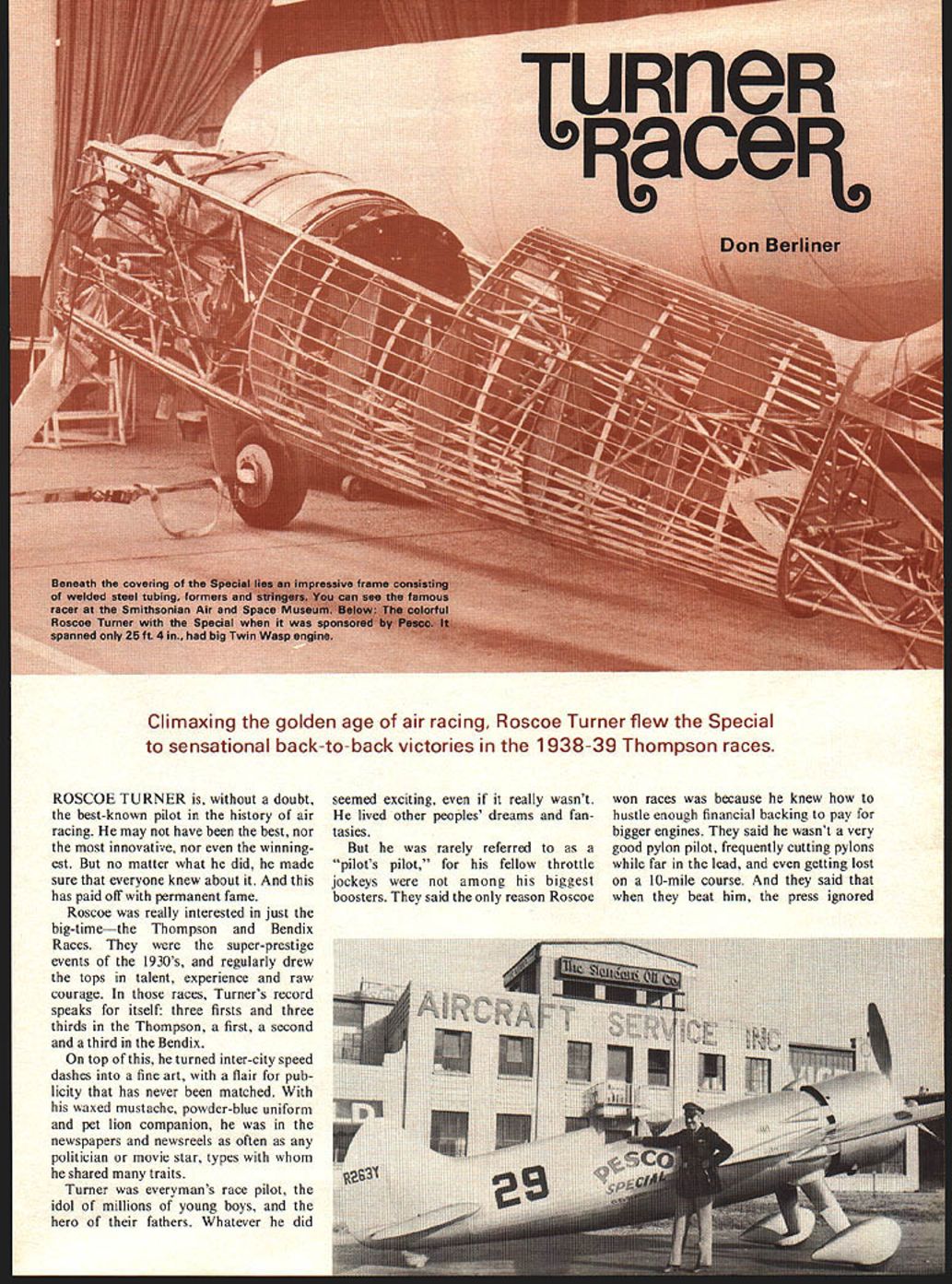
Thanks to the prompt work of aviation historian Truman "Pappy" Weaver, the racer was presented to the National Air and Space Museum, along with trophies, films and old Gilmore (stuffed, of course). The airplane, now restored and looking very fast, is on permanent display in the Hall of Exhibition Flight in the new Air and Space Museum. There, anyone who remembers the great exploits of air racing's most famous personality can almost get close enough to touch a piece of history.
Transcribed from original scans by AI. Minor OCR errors may remain.

