

Two Fledglings Earn Their Wings
Van Twelves
They put the question to their mother first.
We were two weeks into summer vacation, so it was probably a little overdue. Their mother knew just how to deal with the question.
"Go ask your dad."
Since I heard what she told the boys, I had a couple of moments to think about what to do.
Reaching back into my youth, I recalled the summer I built my first gas-powered model airplane. It was a simple balsa profile model of a P-40. Powered by a well-used Babe Bee .049, the P-40 flew and crashed and flew and crashed, as I painfully mastered the art of control line flying.
My uncle Bud, a skilled mechanic and model builder, helped me work through the deep mysteries of building the model, getting the little engine to run, and learning to fly.
The P-40 kept me occupied. I flew it until it became so heavy with glue repairs and oil‑soaked wood that all it could do was taxi around on the ground.
That was a good summer.
It didn't take long for Joseph and David to find me and get straight to the question: "Dad, what is there for us to do?"
I grinned. They would be busy all summer.
A Deal and a Plan
First, we made a deal: they had to work to earn the money for their equipment; they had to build their models themselves (I would only provide assistance); and they had to see the job through and learn to fly their models. I didn't have to do any arm-twisting to extract the most solemn of pledges.
We were committed, but it has been my experience that it is often easier to start something than it is to finish it. What is it like to build a couple of fairly involved model airplanes with two beginners, ages seven and nine?
There were a couple of surprises for me in this endeavor.
Building the airplanes was fun for me and for the boys. Bear in mind that building a model is an endless exercise in compensating for billions of little goofs along the way.
Flying the airplanes resulted in a few bent noses at first. I quickly learned that there are some issues that have to be dealt with if the flight‑training phase is to go smoothly.
The two major problems I discovered were:
- The boys' expectation that they would be able to instantly learn how to fly the airplanes.
- My lack of understanding of how to teach them.
When the airplane wouldn't do what they wanted it to do, the boys became discouraged. When I would have to take over the controls to prevent a crash, they would get mad. I soon learned that they didn't know enough to recognize that they were in trouble, so they didn't appreciate being "saved."
There is a world of flying lore that a modeler learns through the years; what is second nature to me is still virgin territory for the boys. It took a trip to the flying field for this to really sink in. Once I understood the situation, I took the following steps:
- I started a ground school to explain how an airplane flies and how to fly an airplane.
- I broke the instruction process into steps aimed at mastering one small skill at a time, i.e., turns, dives, loops, launching, trimming, hunting for lift, catching a ride, getting out of sink, not flying through the sun, escaping from a boomer, not flying out of sight, not getting too far downwind, setting up the landing approach, and landing.
- We spent lots of time practicing the control inputs with the models sitting on the living room floor.
- I carefully explained the teaching method to the boys: I flew the maneuver first with their fingers lightly touching the controls, to show them how it was done. Then they tried to fly the same maneuver. This explanation is important because they desperately wanted to do it all by themselves from the word go. They needed to be prepared to receive instruction.
- I explained before each flight that I would take over if they got in trouble (and please, don't get mad at me). This included a review of what trouble might look like (diving straight down with the ground only three feet away, for instance, is trouble).
Flying lessons went much more smoothly after I put as much effort into teaching as I had in building. It took a fair amount of both patience and work, but the reward is self-evident: I have two new flying buddies.
One other surprise is worth noting. When the glider is launched and released from the towline, a small parachute opens and lowers the towline back to earth. For the boys it's almost 50/50 whether catching the parachute or flying the airplane is the most fun.
After a test flight to trim one of the gliders, I found David sitting behind the fence, dismally moping in the utter depths of depression. I asked him what was wrong.
"I want my next plane to be an F-16, so I can drop bombs on Joseph's airplane," he said.
Further inquiry revealed that Joseph had caught the parachute when it was David's turn. Careful supervision of the line‑retrieval duty is essential to happy flying.
With the deal made, Joseph, David, and I piled into the car and cruised to the local hobby shop. Listening to the boys' excited talk about the wild and woolly models they wanted to build (the B-2 and F-14 headed the list), I realized that I needed to provide some guidance.
I planned to start with a couple of gentle, inexpensive gliders. (I don't know what it's like at your house, but at my house money is an object.) Their plan was to install machine guns on jet fighters and clear the skies.
By the time we reached the hobby shop, I had persuaded them to make gliders as their first models. They were pretty insistent, however, that their second models would be jets.
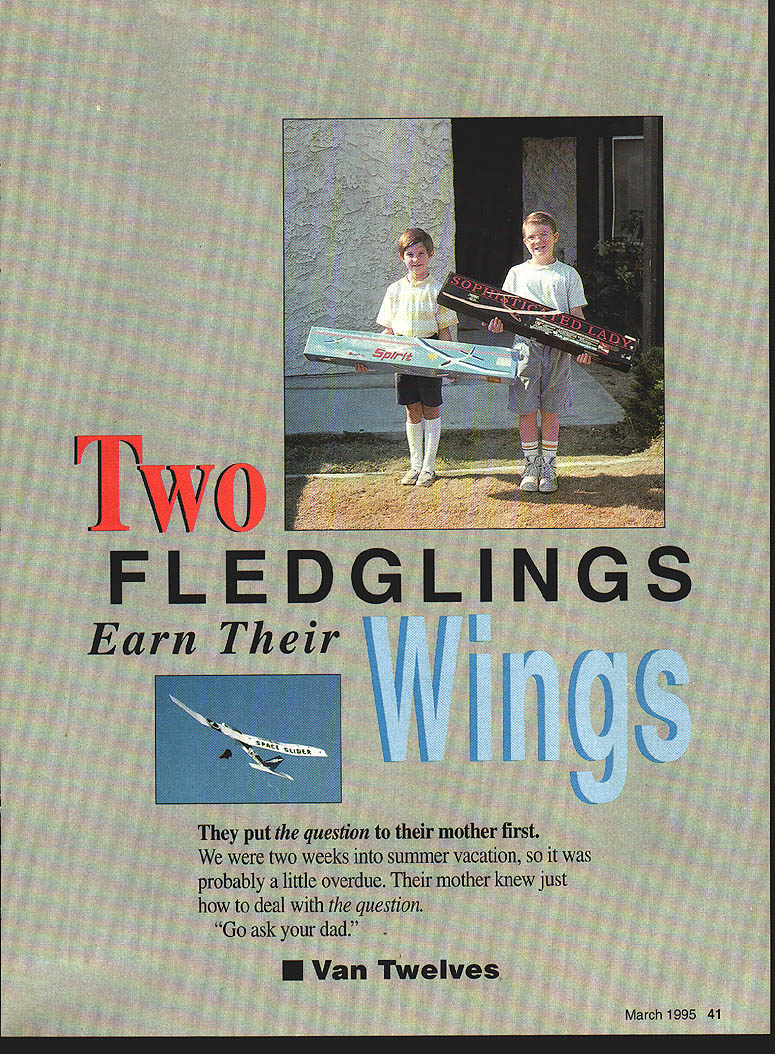
The hobby shop had a nice selection of two-meter sailplanes, and the boys soon picked out their favorites. David selected Great Planes' Spirit, and Joseph liked the Carl Goldberg Sophisticated Lady. Both are excellent gliders and are well suited to the needs of first-time builders.
When we got home, the boys took everything out of the boxes to look the parts over. They soon learned the first principle of model airplanes: once you take the parts out of the box, you can never get them all back in.
Build Log
#### Tuesday, July 10 David framed the rudder and fin on his Spirit, and Joseph framed the horizontal stab for his Sophisticated Lady. The cyanoacrylate (CyA) glues available today make fast work of the building process. I held the parts together on waxed paper over the plans, and each boy placed a drop of fluid on the joints. The glue penetrates by capillary action and cures in seconds.
Frequently, little puffs of smoke can be seen coming out of a joint when the glue "kicks." Not only does it smell terrible, but the fumes are toxic, so good ventilation is important.
Joseph had leaned intently over his stabilizer to apply glue, when he suddenly straightened up and with a scrunched-up look exclaimed, "I got my nose, Daddy!" Thereafter, Joseph gave a wider berth to the curing joints.
#### Wednesday, July 11 We were still working on the tail feathers. Once again, I held the parts down while Joseph and David applied CyA.
David, who had just turned seven, had a difficult time concentrating on the task. He had a new collection of little toy rats that the pediatrician's office gave out. He was more interested in putting the rats all over the plane than he was in building the airplane. After a rather slow start, he got into building and finished off his tail assembly.
Joseph was ready to go. He clipped through the rest of his tail assembly in short order. On several occasions, he glued his fingers and my fingers to the parts, because he deposited excess glue. That's okay, though; his technique improved.
#### Thursday, July 12 Joseph and David finished the tail structures by sanding the leading edges to a rounded shape with 100-grit sandpaper. This was followed by an overall sanding with 180-grit to smooth out any lumps and bumps. With the tails completed, it was time to start on the wings.
Preparing to build the wings was a real delight for both boys. The ribs had been cut from a thin 1/16" sheet of balsa, but they hadn't been removed. It's the model builder's task to punch parts out of the sheets and trim excess edges. Joseph and David thoroughly enjoyed punching the parts out of the sheets. David started sorting ribs into groups—soon three parts were punched out. Joseph said he wanted to put a pile aside to sort out later. Later has a way of never quite arriving, so with a little help a system soon kept things in order.
#### Friday, July 13 Today we worked on the heart and soul of the model—the wing. Framing provides a real sense of progress and a strong measure of the good old airplane feeling—strong magic to us airplane enthusiasts.
We had a small administrative snag this morning. I work with them one hour apiece each weekday, more on Saturdays, and we close shop on Sunday. Yesterday was David's turn to build first, but he decided to play and told Joseph that Joseph could take the first turn. Today, Joseph was scheduled for the first turn.
David complained that it should be his turn first because Joseph went first yesterday and they were supposed to take turns. Joseph said that David gave up his turn yesterday because he wanted to play. We sorted it out and David got the first turn. David had a hard time concentrating, and instead wanted to play with the tools and tell me about the next four models he plans to build.
I intend to make this a fun experience. I gently encouraged him to keep working on the wing, but allowed him to wander around as much as he wanted. We did manage to finish one wing panel, and David was really pleased with his progress.
Joseph was quite a bit more productive, although it did take him a minute or so to get to the task. As we positioned the first few parts for gluing, he told me, "This is boring, Dad." After he got going, he said, "This is fun. I like building wings." At the end of our hour, as he surveyed the two wing panels he had framed—some 39 inches of structure—he announced, "This is awesome!" David came to see what Joseph had done, and was devastated that Joseph had finished two sections to his one. "That's not fair!"
I explained that Joseph worked harder and goofed off less. It didn't satisfy David, but I thought that the next day he would try to best his brother. A little competition speeds things up considerably.
#### Saturday, July 14 Joseph wanted to play with some friends, so I spent building time exclusively with David on his Spirit. David needed some make-up time anyway. We worked on his wing and finished up the right half.
When his hour was up, I turned him loose and spent some time just enjoying building the wing myself. (I used the excuse that I wanted him to keep up with Joseph, so he needed a little extra help.)
#### Monday, July 16 The boys were anxious to get going. The wings were coming along and the models were starting to look like flying machines.
Joseph had the first shift and was up at 6 a.m. ready to start. He chattered happily about how high he was going to fly his model. He paid close attention to his work and nearly finished his entire wing.
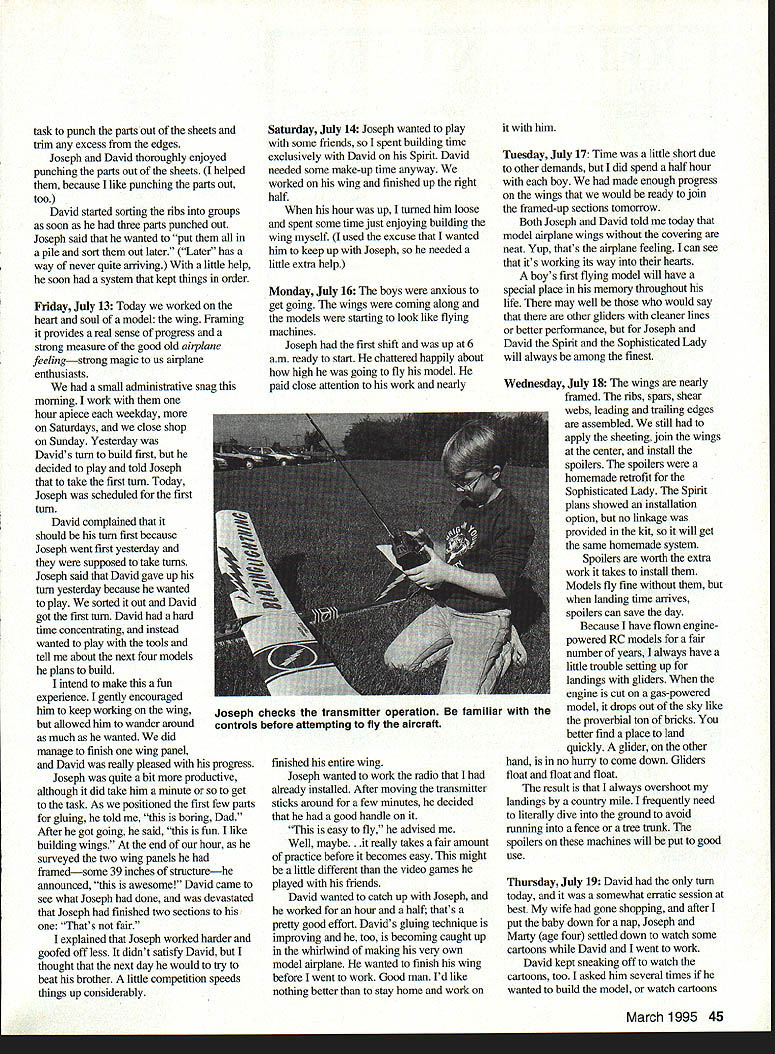
Joseph wanted to work the radio that I had already installed. After moving the transmitter sticks around for a few minutes, he decided that he had a good handle on it.
"This is easy to fly," he advised me.
Well, maybe... it really takes a fair amount of practice before it becomes easy. This might be a little different than the video games he played with his friends.
David wanted to catch up with Joseph, and he worked for an hour and a half; that's a pretty good effort. David's gluing technique is improving and he, too, is becoming caught up in the whirlwind of making his very own model airplane. He wanted to finish his wing before I went to work. Good man. I'd like nothing better than to stay home and work on it with him.
#### Tuesday, July 17 Time was a little short due to other demands, but I did spend a half hour with each boy. We had made enough progress on the wings that we would be ready to join the framed-up sections tomorrow.
Both Joseph and David told me today that model airplane wings without the covering are neat. Yup, that's the airplane feeling. I can see that it's working its way into their hearts.
A boy's first flying model will have a special place in his memory throughout his life. There may well be those who would say that there are other gliders with cleaner lines or better performance, but for Joseph and David the Spirit and the Sophisticated Lady will always be among the finest.
#### Wednesday, July 18 The wings are nearly framed. The ribs, spars, shear webs, leading and trailing edges are assembled. We still had to taper the sheeting, join the wings at the center, and install the spoilers. The spoilers were a homemade retrofit for the Sophisticated Lady. The Spirit plans showed an installation option, but no linkage was provided in the kit, so it will get the same homemade system.
Spoilers are worth the extra work it takes to install them. Models fly fine without them, but when landing time arrives, spoilers can save the day.
Because I have flown engine-powered RC models for a fair number of years, I always have a little trouble setting up for landings with gliders. With the engine cut on a gas-powered model, it drops out of the sky like the proverbial ton of bricks. You better find a place to land quickly. A glider, on the other hand, is in no hurry to come down. Gliders float and float and float.
The result is that I always overshoot most of my landings by a country mile. I frequently need to literally dive into the ground to avoid running into a fence or a tree trunk. The spoilers on these machines will be put to good use.
#### Thursday, July 19 David had the only turn today, and it was a somewhat erratic session at best. My wife had gone shopping, and after I put the baby down for a nap, Joseph and Marty (age four) settled down to watch some cartoons while David and I went to work.
David kept sneaking off to watch the cartoons, too. I asked him several times if he wanted to build the model, or watch cartoons and give Joseph his turn. He didn't want to give Joseph his turn; he wanted to build. He also didn't want to miss the cartoons. (The stress of decision-making starts at an early age.)
We persevered, and finished by joining the wing halves with the spar doublers. David now has a full-blown wing framed up. It looks pretty impressive.
Joseph wanted to play with some friends, so he missed his turn. After eyeballing David's wing, he felt like he had made a bad choice. He told me that all of tomorrow is his turn, and David doesn't get any more until he catches up.
#### Monday, July 23 After a brief hiatus from building, we got back with the program. Joseph was behind, so he got the full turn. We joined his wing halves and started to install the sheeting.
Joseph is less than enamored with the name of his model. Sophisticated Lady isn't something he can relate to at all. After a fair amount of discussion, we wrote some 20+ names that he liked. The two top contenders were Blazing Lightning and Space Glider, with Turtle Plane as a close third.
David told me that his Spirit needed a new name, too. He wasn't sure what, but he wanted what his brother wants. The potential for a little sibling conflict is strong at the moment. My apologies to the marketing people at Great Planes and Carl Goldberg Models, who probably agonized over selecting the names for their products.
#### Wednesday, July 25 David and I finished installing the center section ribs and sheeting at the bottom of the wing. All that remained was installing the top wing sheeting; then we could work on the fuselage.
David had some serious concerns about what to name his model. He really liked Space Glider, but since Joseph dropped it in favor of Blazing Lightning, Space Glider had lost some of its luster. A fairly lengthy examination of the options produced three candidates for David's model: Laser Glider, Space Glider, and B-2 Bomber. Deciding among such powerful, attractive alternatives is not easy. After expressing his frustration several times, inspiration struck.
"My airplane," David said, "will have three names."
#### Thursday, July 26 Joseph and I finished sheeting his wing; it looked good. Joseph learned to use an X-Acto knife and a straightedge to cut balsa. I demonstrated and explained the technique of angling the blade and holding the straightedge just a little bit. That slight upturn keeps the knife from grabbing and keeps the cut straight.
It took a dozen or more practice cuts before he got the hang of it. He got a little frustrated because his knife would follow the grain and wander away from the straightedge causing a crooked cut. When he got the hang of the technique, he was absolutely delighted.
There is always a little trimming and fitting required to join the parts of a wing.
#### Friday, July 27 We started on the fuselages. I showed the boys how to use the plans to locate the formers, and how to pin the fuselage sides down and glue in the formers. Both boys were doing fine, and they were proud of their progress.
Joseph broke a rib in half while trying to trim the spar slot. He was dejected because the model was "ruined." He cheered up after I showed him how to repair the part by gluing it together.
#### Monday, July 30 Both Joseph and David had a building turn. As usual, David had a hard time concentrating. He punched out his fuselage parts, then wandered all over the garage, the front yard, the back yard, and in and out of the house. He would come back to glue parts together, but then the "squirmies" would take over until I could get organized for the next assembly. We did get the fuselage doublers laminated in place and the bulkheads installed in the bottom panel.
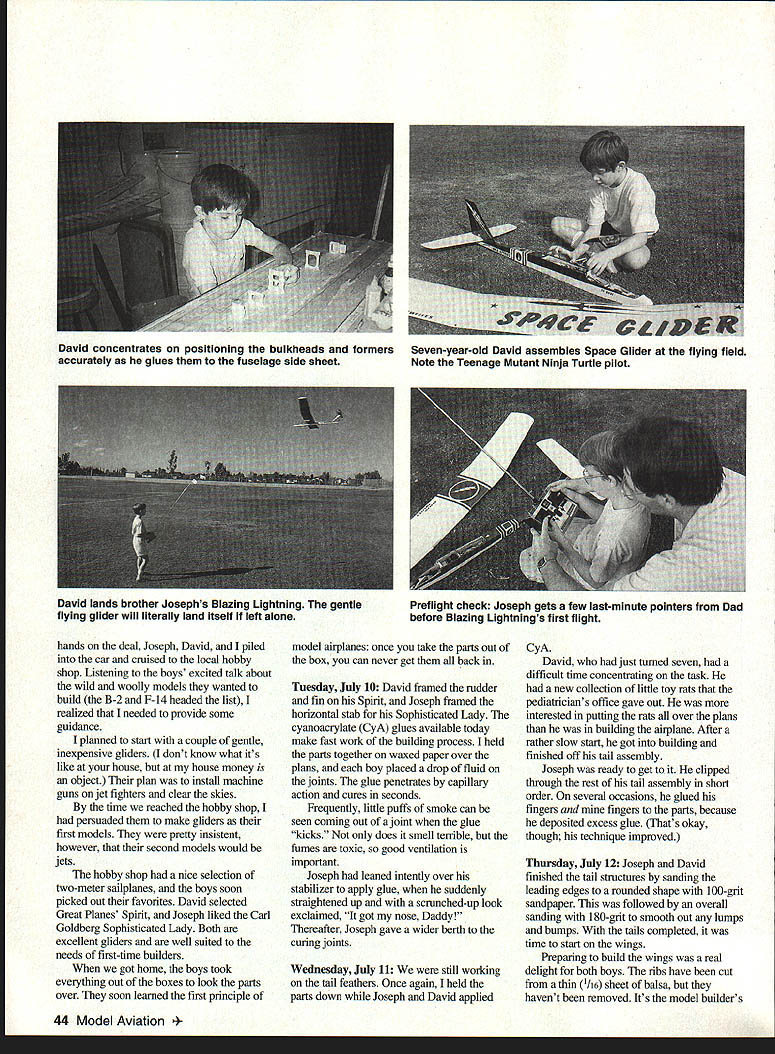
We were working on the fuselage, so David inspected the cockpit closely. The kit includes a plastic pilot that fits under the clear plastic canopy. After due consideration, David informed me that he wants Michelangelo (a Teenage Mutant Ninja Turtle) to be his pilot.
Joseph quickly decided that he wanted Krang as the pilot for Blazing Lightning. (Krang is a wicked, mean alien brain from another dimension who for some reason is missing his body.)
We took a 20-minute break after installing the doubler in Joseph's fuselage. Joseph CyAed his hand to a piece of wood, so it took a while to get him delaminated. A little bottle of debonder is well worth the investment if you are building with kids.
#### Tuesday, July 31 Joseph and I worked on the fuselage again. Joseph's eyes suddenly widened with delight and he exclaimed, "Dad, I can't believe I'm actually building a real model airplane!"
Something in the shape of the fuselage coming together allowed him to visualize the finished model. It's one of the magic moments that make the hobby so enjoyable.
Flying a rock-steady approach and making a smooth landing is a little bit of model airplane magic. The world becomes a nicer place after a good landing. Not many activities provide such a spectrum of pleasure.
#### Wednesday, August 1 David and I assembled the fuselage and glued the nose block on. He squirmed a bit, but he remained seated. Although we were only halfway through building this airplane, David had his next four models planned out in great detail: a high-performance Slope Soarer, an F-16, a helicopter, and a B-2 Bomber. The hobby shop owner's future is assured.
#### Thursday, August 2 To save a little building time, I decided to try to find a plastic toy Ninja Turtle and an alien brain to put in the cockpits. The toy rack at the local drugstore had some turtles that were the right size, but I searched in vain for an alien brain. I was planning to carve a homemade alien brain rather than have Joseph decide that he would rather have a turtle for a pilot.
That made it easy. Due to the limited selection at the drugstore, Raphael became the creature of choice for manning the cockpits.
We went to work fitting Joseph's turtle into his model. David tore his turtle out of its package and ran in the house to play with it. From the way he took off, I didn't know if he would give it up for his model.
#### Saturday, August 4 We managed to get the cockpit assemblies carved, painted, and squared away for David and 90% finished for Joseph. To squeeze the turtles in the narrow cockpits, I had to turn them sideways and raise their arms. They looked as if they were in the process of delivering a flying karate chop to one of their numerous enemies. They were the scariest pilots I had ever seen.
#### Monday, August 6 It was trim-scheme time. The boys watched carefully while I sketched some options and suggested some colors for their models. Since the Ninja Turtles were their pilots, I thought they would like some kind of a turtle theme on the trim.
I was half right. They wanted turtles and their new names for their gliders in the trim. We finally converged on a sort of hodge-podge decor, but they liked it.
#### Wednesday, August 8 I introduced the boys to MonoKote. The plastic film is cut to size, placed on the airframe, then simply ironed down like a shirt. A heat-sensitive adhesive on the backside of the film makes it stick. (Joseph loved it; he MonoKoted a piece of plywood to send to his Grandma and Grandpa, and he wants to MonoKote his house. David wants to MonoKote his Ninja Turtle.)
#### Wednesday, August 29 David and I finished sheeting his wing and started on the fuselage. David wanted a Thunderjet (another cartoon show) logo on his model, and said that his model wasn't going to have a name.
#### Monday, September 3 David was still concerned about his model's name, so we made another list of candidate names and earnestly discussed the merits of each. Space Glider finally beat the competition. We sketched several variations of a spaceship for his logo, and he picked one.
#### Wednesday, September 5 We got back with the building program, and I asked Gary Wells to take some pictures of the boys building their models.
#### Saturday, September 8 We finished installing spoilers and started MonoKoting Joseph's wing. Joseph was intrigued and excited by the process of bending the tubes for the strings that actuate the spoilers. We used some small-diameter nylon tubing and heated it with a match to soften it enough for bending. Joseph hadn't needed to strike a wooden kitchen match before. He thought that was much more fun than building the model.
#### Saturday, September 15 We were in the home stretch. Covering the models with MonoKote and installing the radios was all that was left. We should be finished in a few days.
#### Saturday, November 17 Ha! The last log entry says "a few more days." It took two full months to finish the models, due to the normal course of family life—doctor visits, homework, overtime, a teething baby who needed to be held, and house repairs.
None of that mattered, because we were finally ready to go; we headed to the flying field early in the morning. Joseph and David asked hundreds of little questions as we unwound the towline and surgical tubing for the hi-start—an elastic catapult system that launches gliders into the air. Joseph hammered the stake in the ground and David stretched the line back to where the models were waiting.
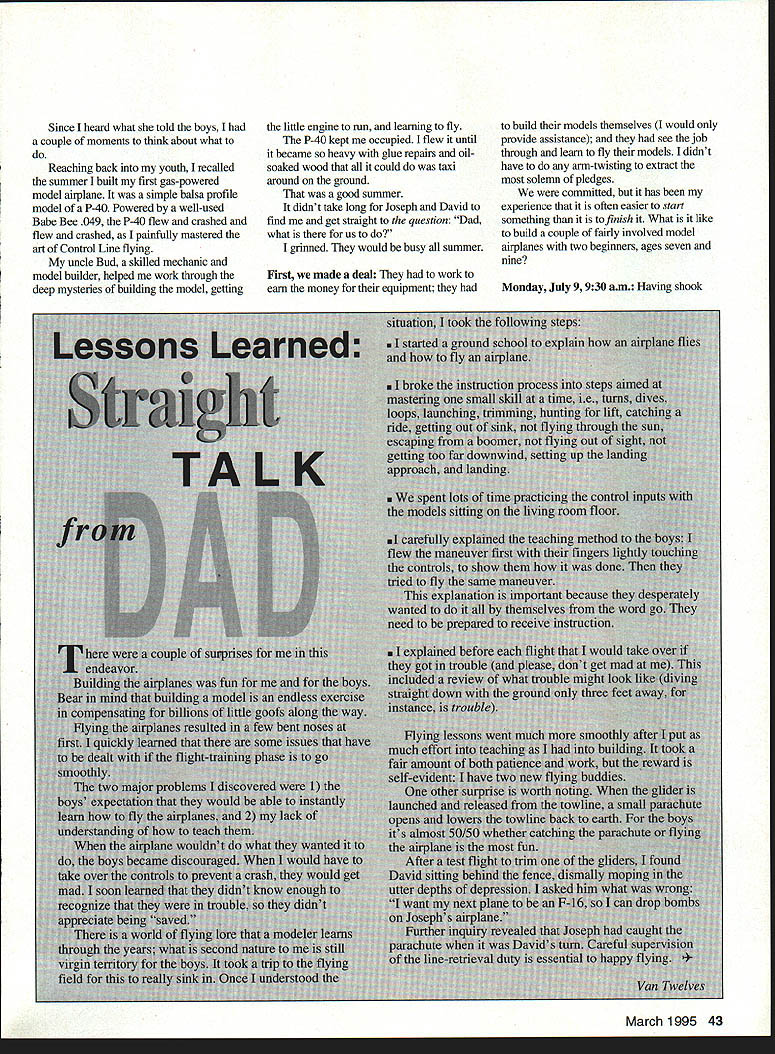
We launched Space Glider first. Having previously dialed the trim in with a series of hand-launched test glides, Space Glider tracked nicely up the towline and flew several circuits of the field before touching down. It was too early for any thermal activity, so we just enjoyed getting used to launching and gliding back down.
Blazing Lightning did itself proud on its first launch. It was a pure delight to fly. The intrepid little Teenage Mutant Ninja Turtles riding in the cockpits clearly had the right stuff.
Joseph and David took turns getting some stick time and feeling out their models. Joseph, who has never been known for holding back, wanted to shoot a landing after his third flight.
The landing was going well until he surprised me by pulling the nose up and popping the spoilers out when the model was flying low and slow on final approach. What followed was a graphic demonstration of a stall.
Fortunately, the field had just been watered; the ground was soft, and no damage was done.
I plan to add a little weight to the nose of both gliders to shift the center of gravity forward. This will make them glide a little faster and allow a little more margin for error.
After a good session at the flying field, we brought both models home intact—success.
The hard part was over, and the fun began. Joseph and David had seen their models through completion. While it's true that simply learning to fly a model airplane isn't particularly difficult, it's fair to say that Joseph and David earned their wings.
Epilogue
A year after the maiden flights of Blazing Lightning and Space Glider, the boys became a couple of pretty good fliers, if not red-hot aces. The models are looking a little worn around the edges, but they are flying as well as they did the first day out of the shop.
I had planned to build and fly models and make a fun scrapbook for the boys—I didn't intend to write about it. But my wife saw that we were having an exceptionally good time, and thought that sharing our project would be worthwhile because someone else might enjoy doing something similar.
It was a good summer.
Transcribed from original scans by AI. Minor OCR errors may remain.

