
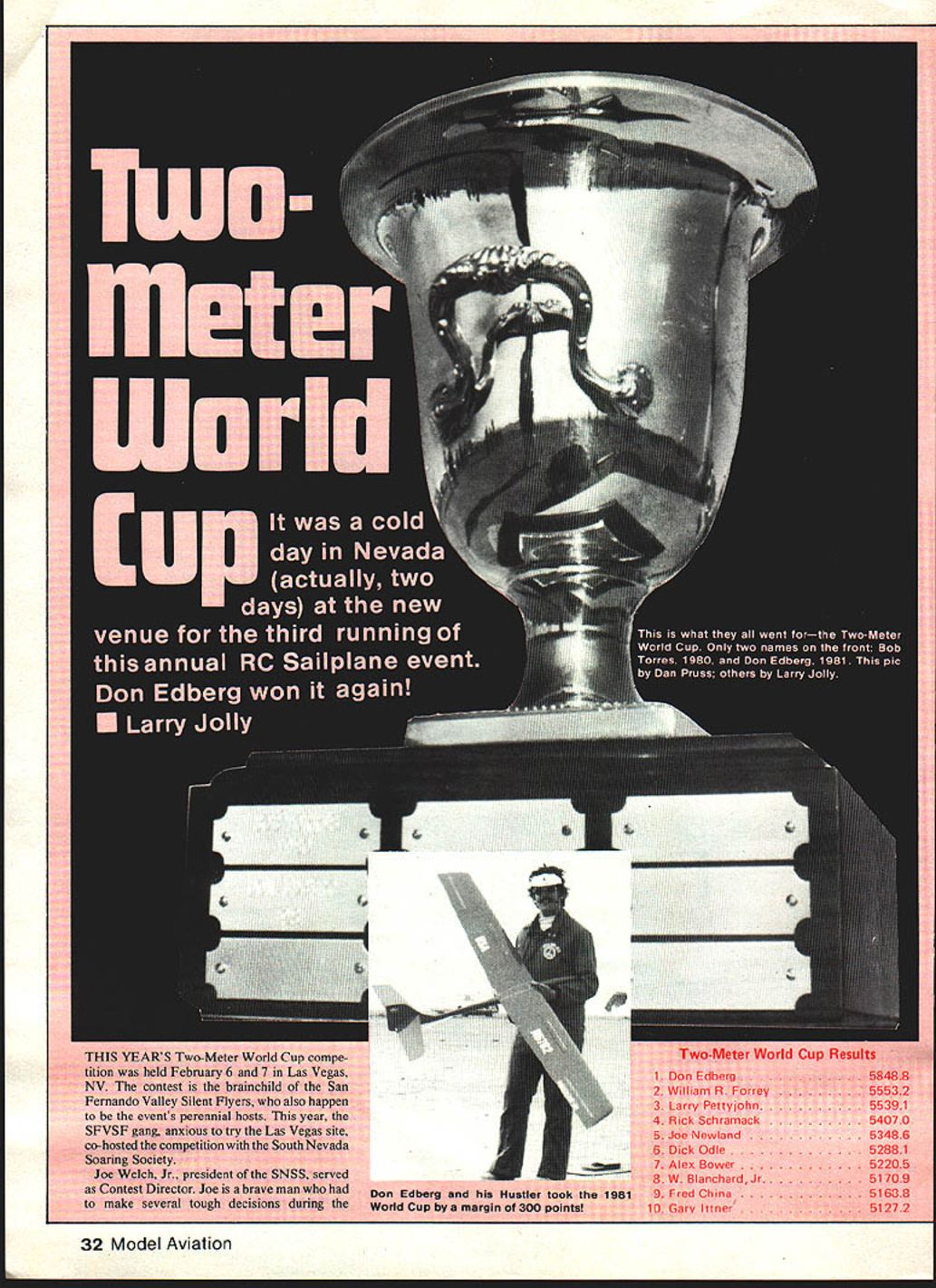
Two-Meter World Cup
By Larry Jolly
Event Summary
The Third Annual Two-Meter World Cup was held February 6–7 in Las Vegas, NV, at a new site co-hosted by the San Fernando Valley Silent Flyers (SFVSF) and the South Nevada Soaring Society (SNSS). Joe Welch, Jr., president of the SNSS, served as Contest Director and managed the event for approximately 70 contestants on a cold, windy desert weekend.
The Two-Meter class follows the AMA rule book: maximum projected wingspan not greater than 78.75 inches, with other specifications following FAI maximum limits. Contest tasks at this meet were primarily Speed and Distance-oriented, with only about 16.5% of scoring delegated to the Duration task.
Models and Notable Aircraft
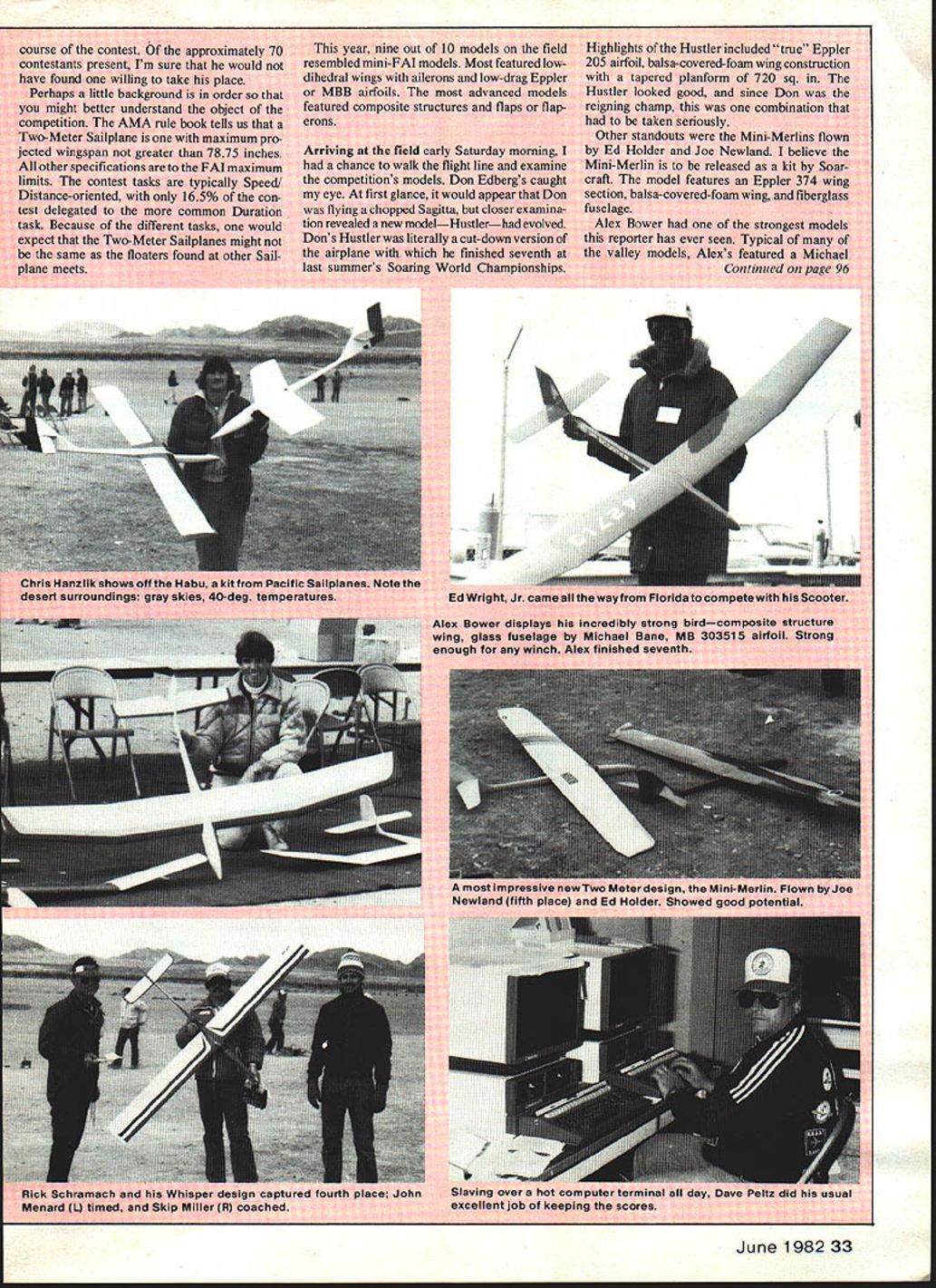
Most entries resembled mini-FAI models: low-dihedral wings, ailerons, and low-drag Eppler or MBB airfoils. Advanced entries featured composite structures and flaps or flaperons.
- Don Edberg — Hustler: A cut-down version of the airplane that finished seventh at the previous Soaring World Championships. Features included an Eppler 205 airfoil, balsa-covered-foam wing construction, tapered planform, and about 720 sq. in. wing area.
- Mini-Merlins — Ed Holder and Joe Newland: Likely a Soarcraft kit, with an Eppler 374 wing section, balsa-covered-foam wing, and fiberglass fuselage.
- Alex Bower — Very strong model: Balsa fuselage with a polyhedral composite wing utilizing an MB 303515 wing section. The wing construction was a foam core with balsa covering and a full-depth carbon-fiber-web spar; Alex joked it would take 200 lb. of force.
- Rick Schramack — Cut-down Speed Whisper: Very fast model flown at the World Champs by Romain Sfredda. Features included an Eppler 182 wing section, fiberglass fuselage, and veneer-covered foam wing — an Austrian "built-in-a-mold" high-technology design reportedly by Fridolin Fritz.
Results
- Don Edberg — 5848.8
- William R. Forrey — 5553.2
- Larry Pettyjohn — 5539.1
- Rick Schramack — 5407.0
- Joe Newland — 5348.6
- Dick Odle — 5288.1
- Alex Bower — 5220.5
- W. Blanchard, Jr. — 5170.9
- Fred China — 5163.8
- Gary Ittner — 5127.2
Competition Rounds
Joe Welch opened the meet with a pilots' meeting outlining the day's itinerary. Tasks included:
- Four-lap Speed on the 150-meter FAI course (downwind towing prevailing).
- 10-minute Duration with a 100-point landing (scored man-on-man).
- 12-lap Distance on the 150-meter course (scored man-on-man).
Round highlights:
- Speed: Don Edberg recorded 308.8 seconds (about 43.5 mph), posting the top Speed score. Alex Bower finished second in Speed. There were 17 "no-times" in Speed; Rick Schramack suffered an unfortunate course cut that resulted in a long turnaround and a much slower time.
- Duration: Don Edberg scored a perfect 1,000 points. Alex Bower remained in second for the round, with Joe Wurts moving into third.
- Distance (day one): Edberg again scored a perfect 1,000 points and led by 303 points over second-place after day one.
- Simulated Cross-Country (man-on-man variant, effectively 10-lap Distance with special scoring): If someone maxed, their time for 10 laps determined the 1,000-point winner; if no one maxed, the event was scored man-on-man. This format caused some debate among pilots.
- Final rounds: Don had a 19th-place finish in one round and lost small amounts of score to Larry Pettyjohn in a couple of rounds, but won his final heat to secure another 1,000-point round and clinch the Two-Meter World Cup. Bill Forrey moved up from 12th after round one to take second place, edging out Larry Pettyjohn by 14 points.
A buffet banquet for contestants was held Saturday night at the Sands Hotel.
Construction Notes (selected details from observed models)
- Wing tips: Build tips from 1/4" balsa, shape to desired size. Add 1/64" plywood to the outside of the wing tip and an aileron counterbalance. When dry, hollow the inside of each counterbalance and add lead shot and epoxy.
- Landing gear: Use 3/16" T-6 aluminum to fabricate the gear. Mount it to a U-shaped box made from 1/8" plywood, securing each gear leg with 1/4-20 bolts.
- Spar-gear box: Construct from 1/8" plywood, epoxied and reinforced with 3/16" dowels. Use T-nuts rather than threading the wood. Epoxy the unit (with micro-balloons) into the wing after joining the wing halves. Tilt the box to allow the landing gear to sweep forward.
- Stabilizer, fin, and rudder: Use standard balsa-and-foam construction; keep them light. Link the two elevator halves through a 1/4" U-shaped plate; the control horn attaches to this plate. The rudder can be made from two pieces of foam and must be carefully aligned when skinning.
- Final assembly: Mate the wing with the fuselage, make fillet plates and fillets, and use them as references to locate the stabilizer and engine. Suggested settings: wing at 1/4° positive incidence, stabilizer at 1° positive incidence, engine at 1/2° downthrust.
- Finishing: Cover the entire wing with 2-oz. glass cloth; reinforce the center with 4-oz. glass cloth out past the landing gear box. Glass the rest of the plane with 3/4-oz. cloth and finish with epoxy paints. Canopy used on one example was from a Bridi (now Great Planes) CAP-20L kit.
- Flying setup: Set elevator travel to about 1/4" in both directions. Ailerons: about 1/4" travel up and down. Rudder: as much travel as practical to ease ground handling. For takeoff: hold a touch of right rudder and apply 1/8 to 1/2 throttle.
Awards
Industry members donated prizes generously. Notable awards included:
- Don Edberg — new Kraft 6-channel radio (winner)
- William Forrey — new Futaba 7G radio outfit (second)
- Larry Pettyjohn — Ace Silver Seven transmitter (third)
- Rick Schramack — Airtronics 6-channel system (fourth)
Closing
Rumor has it next year's contest may be held in Southern California. Plan on attending — Don Edberg could use the competition.
Transcribed from original scans by AI. Minor OCR errors may remain.

