
Two-Meter World Cup
Byline
Larry Jolly
"You're not getting older; you're getting better." How often have you heard someone say that? With regard to the Two-Meter World Cup event, that's very true. I personally believe that Mr. Richard Hanson, who was Contest Director of the fourth annual edition on June 11–12, and the Modesto RC Club succeeded in putting on the finest contest that I have ever attended. I have never witnessed such good organization (or prior thought) as this club exhibited universally in presenting this very difficult contest. The Modesto group obviously was very serious when they committed themselves to running this meet. Their hard work made the competition enjoyable for both the contestants and the many spectators.
Overview
Just what is the Two-Meter World Cup? Briefly, it is a contest originated by the San Fernando Valley Silent Flyers (SFVSF), who also co-sponsor it annually. The contest is for sailplanes of two meters (or less) wingspan. The contest tasks are modified from the RC Soaring World Championships rules.
As a result, the aircraft flown in the contest represent the highest development of the type. The majority of sailplanes flown in the Two-Meter World Cup are special designs built solely for competition. Very few kit models are strong enough to withstand the rigors of competition. In years past the Two-Meter World Cup has been held early in the year and usually associated with bad weather; this year the contest was scheduled in June in Modesto. In the great Central Valley of California, excellent weather resulted.
The Modesto RC Club is very lucky to have a superb grass athletic field at Beyer High School to use as its flying site. The combination of a well-organized club, a large grass flying site, and the convenient location of motels and facilities proved to be a winning team.
The Contest
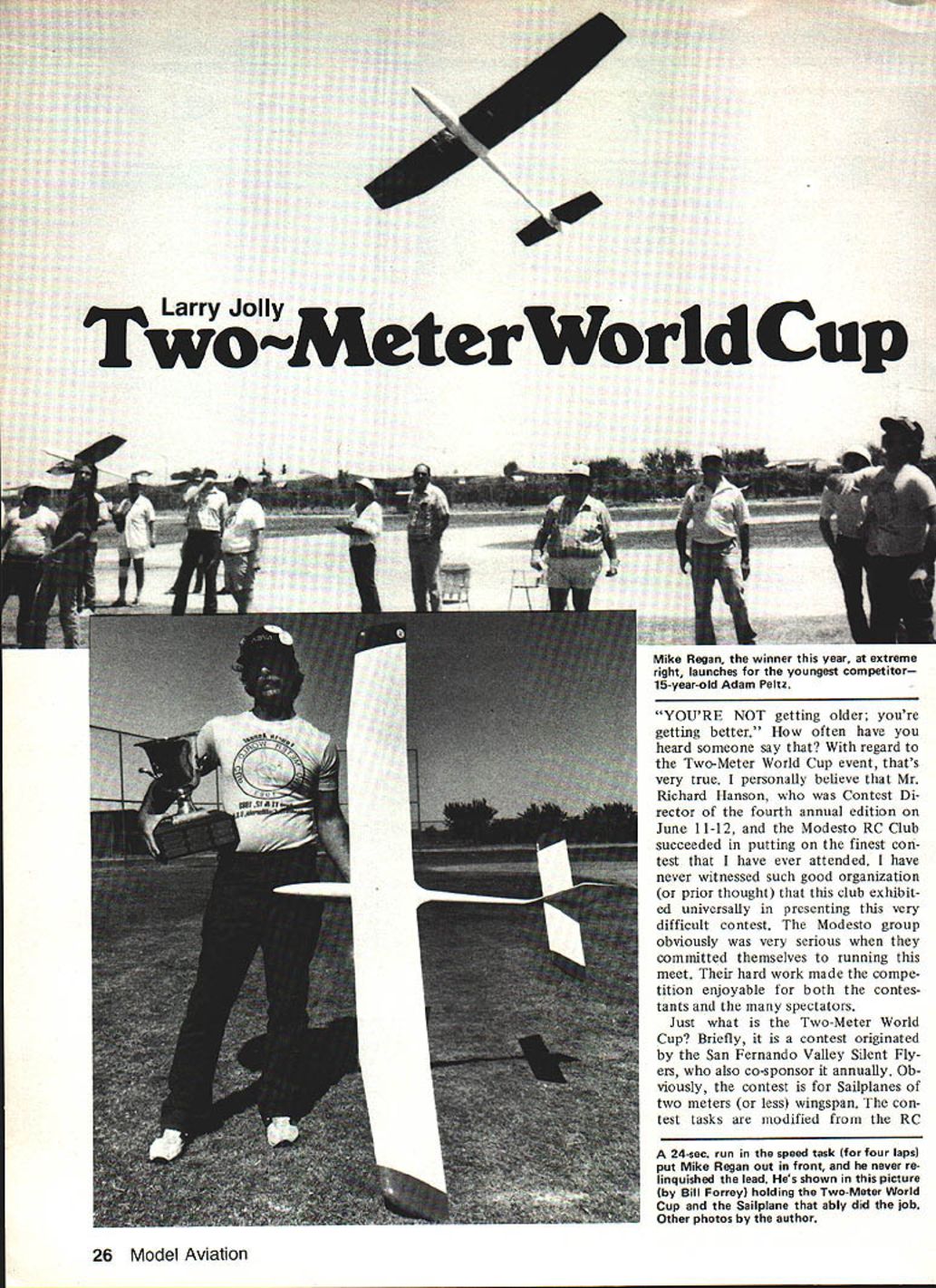
The first task was four-lap speed. Mike Regan blew everyone away with a 24-second run, thus taking the pole position in the contest. Mike got real used to leading the competition. As Don Edberg had done in years past, Mike took the lead in speed and never looked back. This was to be Regan’s year. Though challenged continually throughout the contest, Mike never relinquished his lead and went on to become the fourth champion of the Two-Meter World Cup.
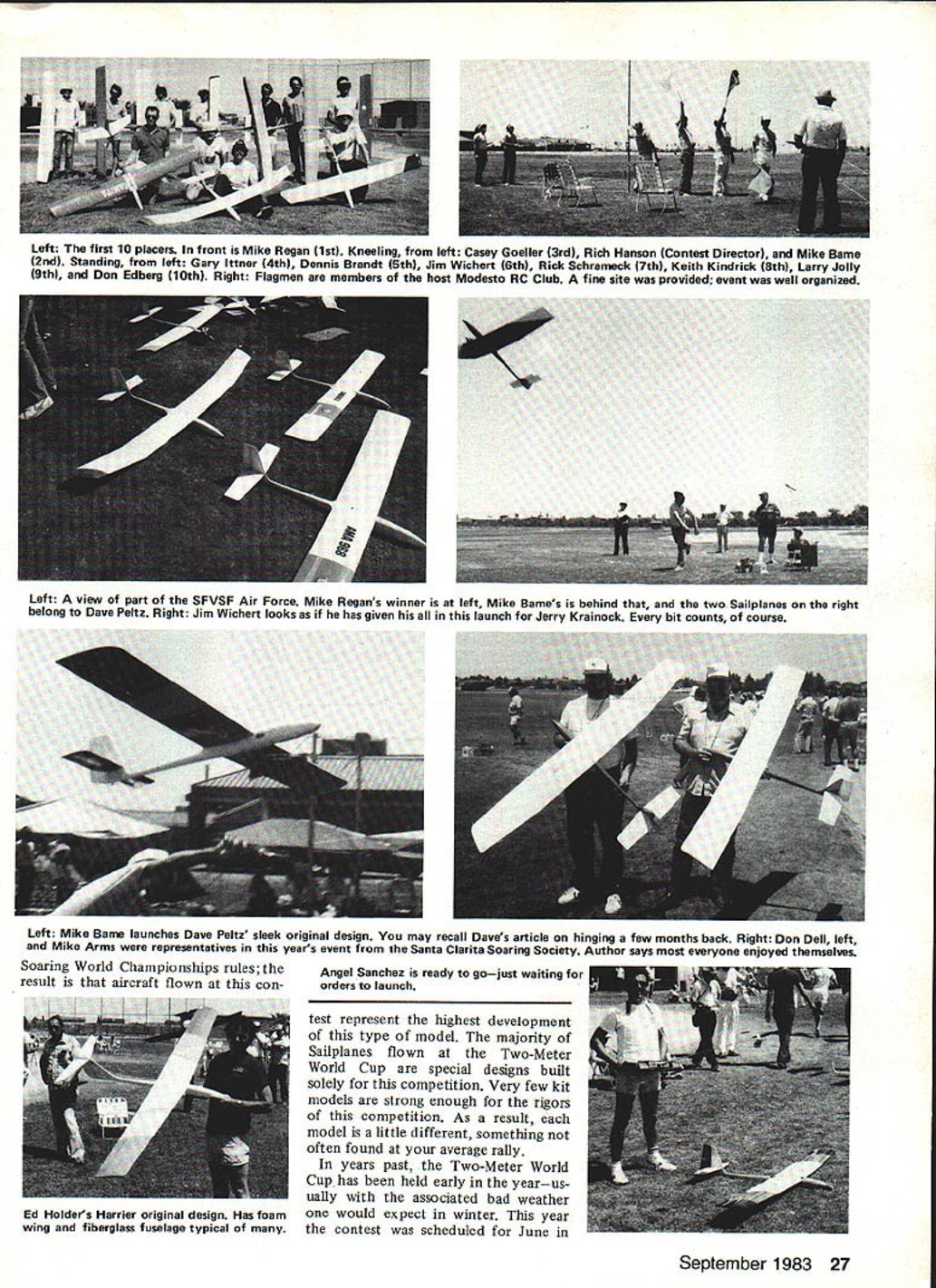
Close on Regan's heels was another SFVSF member, Mike Bame, who finished second. Mike flew an aileroned version of the sailplane flown by Regan. Mike Bame is a very innovative modeler who is responsible for developing many of the materials and techniques used by his fellow club members.
Speaking of the SFVSF, it was no surprise to see its members claim five of the six top places. This club's total commitment to advancing sailplane technology has given their members both the models and the experience necessary to do well in a multi-task contest. Because of the great depth of talent the SFVSF can muster, members of this club will certainly be a strong force to contend with for as long as they choose to compete.
In an effort to do away with any winch advantage, the SFVSF constructed six identical winches for use at the contest. This, of course, gave all the contestants an equal chance for a good launch.
The Winning Aircraft
Mike Regan's model could be described as a typical Valley competition sailplane. It features:
- A fiberglass fuselage
- An incredibly strong wing (foam, spruce, and balsa construction)
- A Mike Bame 15% airfoil
- Conventional polyhedral geometry
Those familiar with the current F3B scene in this country will recognize the similarity to Alex Bower's Tai Tai. The conventional polyhedral geometry leads one to wonder if ailerons are really necessary for a high-speed sailplane.
Reflections and Closing
Of all the memories I have of this contest, the one that sticks most in my mind is the good times generated at this meet. Everyone who came to have a good time did, in fact, have a good time; anyone who didn't should perhaps think about why they compete in this hobby/sport.
Personally, I enjoy multi-task soaring more than any other phase of RC sailplane flying. The concept of the Two-Meter World Cup allows me, and others like myself, to enjoy the thrill and challenge of closed-course racing—something not possible at more usual sailplane gatherings.
To the members of the Modesto RC Club, the SFVSF, and particularly Mr. Richard Hanson, congratulations on a job well done. We're all looking forward to the Fifth Two-Meter World Cup. See you there.
Transcribed from original scans by AI. Minor OCR errors may remain.

