
Two Sunsets
I was born into the Golden Age of Aviation in 1926. By age four I understood that Charles Lindbergh had done a miraculous thing, flying alone across the Atlantic. During the 1930s one-eyed Wiley Post was famous for setting altitude and speed records while wearing a pressure helmet that looked like the top of a hot-water heater. Amelia Earhart flew alone across the North Atlantic, and her smile was seen on newsreels. Jimmy Doolittle flew fantastic speeds in seaplane biplanes. Howard Hughes built a super speedster and was hugged and kissed by movie stars after setting a boomer of a record. Smilin' Jack, the comic-strip pilot, saved damsels in distress and brought bad guys to justice by performing astonishing flying feats. All were heroes.
As were many boys of the decade, my mind was on model airplanes more than girls. The thrill of launching a black-and-yellow tissue-covered rubber-powered Corben Baby Ace was enormous. Red-and-white Rearwin Speedsters and all-yellow Piper Cubs were even better. You learned something new or acquired a skill with each model. Success was not always easy; patience and persistence were among the valuable lessons.
By age nine I had acquired a fairly serious addiction to balsa wood and glue. The habit stuck through high school and two-and-a-half years in the Navy. By the time I entered Penn State, the habit was so severe that I had trouble bringing it under control, even during final-exam week. What was worse was that I was sharing a dormitory room with Warren "Bud" Yenney, whose lust for balsa and glue was almost equal to mine. Glider wings hung on all the walls, bookcases stored fuselages, balsa and building boards stood tall in the corner, and the floor was often sprinkled with shavings. We locked our door on "Cleaning Lady Day" to keep her from ruining our delightful mess.
Bud had the audacity to pursue almost any idea that came to him. He had heard of a man named Walter (Walt) Good, who flew a radio-control (RC) model before World War II. Bud telephoned Walt and asked for a chance to talk. In mid-February 1947 I was a passenger in Bud's unreliable 1937 Ford pushing through a blinding snowstorm from State College to Silver Spring, Maryland. Walt and his wife Joyce welcomed two semi-frozen students to the warmth of their home. Steaks and apple pie were followed by furious RC talk well past Walt's normal bedtime and then nearly an all-day session Saturday. This was the start of a long and wonderful friendship that has been one of the biggest joys of my life.
During the mid-1950s Walt patiently helped me make his single-channel "three-tuber" and then build his five-tube dual proportional control system. Walt called the system two-tone plus width, which soon became TTPW. California modelers were deep into "bang-bang" reed control, and they declared that TTPW meant "too tough to piddle with." I was what you might call illiterate in electronics. Nevertheless, via telephone calls and treks to Walt and Joyce's house, and two years of asking dumb questions about selenium diodes and such, I got the thing working in the spring of 1957.
By the summer of 1959 I was a virtual hotrod with an original-design midwing model called the Pittsburgh Pointer. With it I could fly a pylon course upside-down and do Outside Loops and Cuban 8s that were smooth—free of the jerk-jerk-jerk often seen in reed-controlled models.
Californian Bob Dunham with his Smog Hog and Midwesterner Ed Kasmirski with his Orion had high-speed thumb-twitching skills and won places on the U.S. team to compete in the first Fédération Aéronautique Internationale (FAI) RC World Championships in Zurich, Switzerland, in 1960. I came within inches of being the third team member. Team members were picked on the basis of points scored in regional contests, with the Nationals (Nats) as final input. In the East I was narrowly ahead of Harold (Hal) deBolt during 1958 and the summer of 1959. At the Nats in Los Alamitos my Pittsburgh Pointer rolled 10 inches outside the lime-lined landing circle and scratched off points that otherwise would have been awarded for a "greasy" landing. Hal deBolt came in fourth and I came in fifth, so he was the third team member. Walt Good was to be the team manager. I regretted my failure at the time, but several years later I looked at it as a blessing.
In 1960 I left my job at the research laboratories of Westinghouse in Pittsburgh and took a job at the Applied Physics Laboratory (APL) of Johns Hopkins University in Silver Spring. I had grown tired of "basic research" that didn't seem to be going anywhere useful and liked the word "applied." My friendship with Walt Good influenced the decision; we spent many lively lunch hours talking RC and many sessions on the flying field.
In 1962 Walt pulled some strings with the organizers of the forthcoming second World Championships for Aerobatics. I had written the first RC judges' guide for the Academy of Model Aeronautics (AMA), and Walt pointed out that I'd make a good chief judge at Kenley Aerodrome, England.
More than twenty years earlier Kenley airfield had housed hundreds of Royal Air Force pilots and swarms of Spitfires and Hurricanes during the Battle of Britain. Although that battle was long past, a military presence remained; in 1962 the Cold War with the Soviet Union was hot. The Soviet Union sent a team of modelers to the contest. They were a bit standoffish and reluctant to allow their models to be examined. I was shocked by what I saw.
The Soviet modelers could not purchase smooth-cut balsa in hobby shops; their propellers were hand-carved, some capacitors were homemade from waxed paper and aluminum foil, and at least one control transmitter was an olive-drab box with "RCA" embossed on it because it had been shipped under Lend-Lease during the war. Clearly the model-airplane hobby was not part of the Soviet "Five Year Plans." The contrast with other countries' models and equipment was astonishing. Tom Brett's sleek navy-and-gold low-wing Perigree won for the United States, and the British team finished first in the team competition with lots of flashy red, white, and blue. All of those models were colorful beauties with handheld transmitters. The Soviet team's dull black-and-white shoulder-wingers and ground-based recycled transmitters came in last.
A blatant anomaly hit me hard. Soviet competitor Pietrov Velitchkovsky wore a small pin on his CCCP-labeled T-shirt honoring him as a "Hero of the Soviet Union" for setting seven FAI world records for RC aeromodels. I came home from Kenley with two conclusions: one, communism was very bad — no balsa wood! Two, if Velitchkovsky could set records with such poor stuff, Americans ought to be able to raise the marks considerably with far-superior equipment.
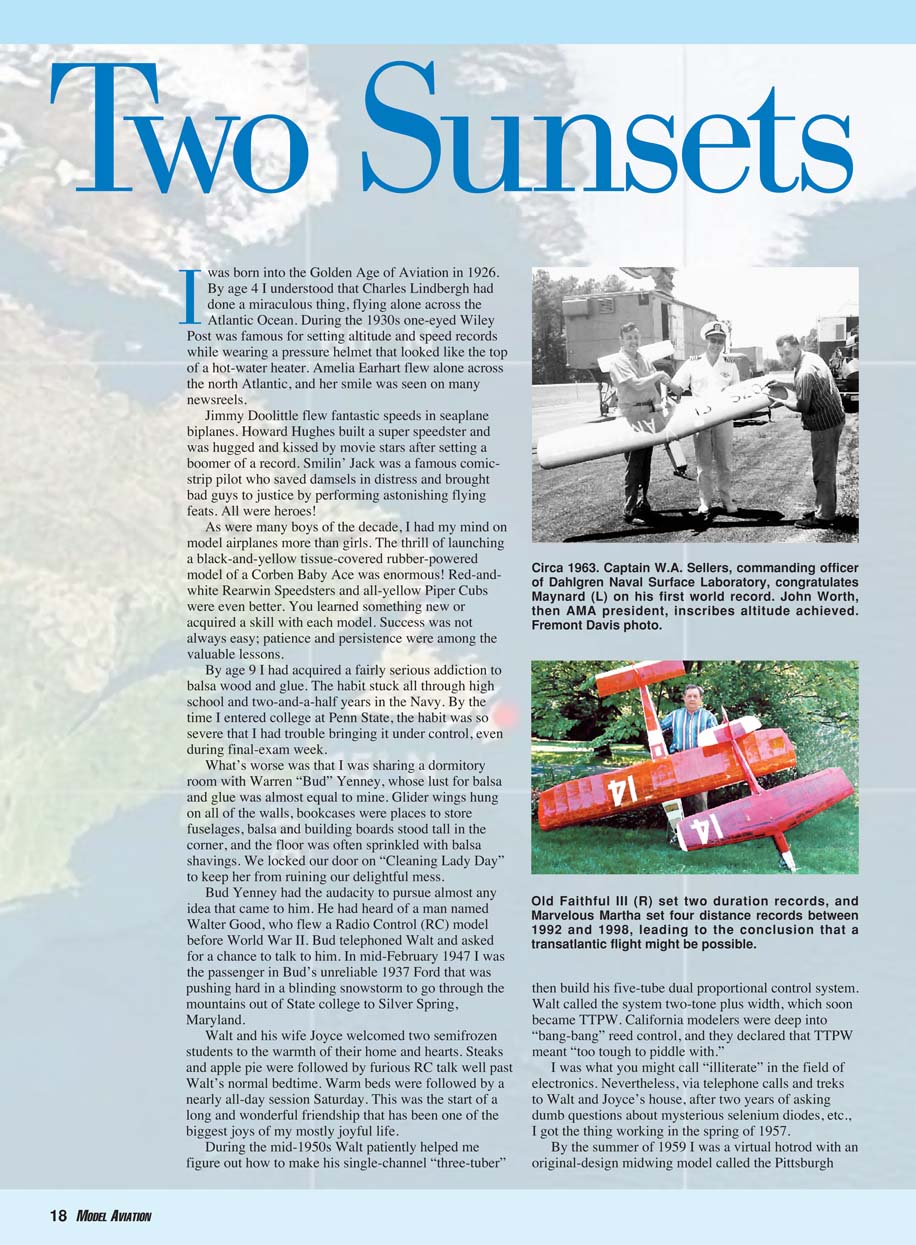
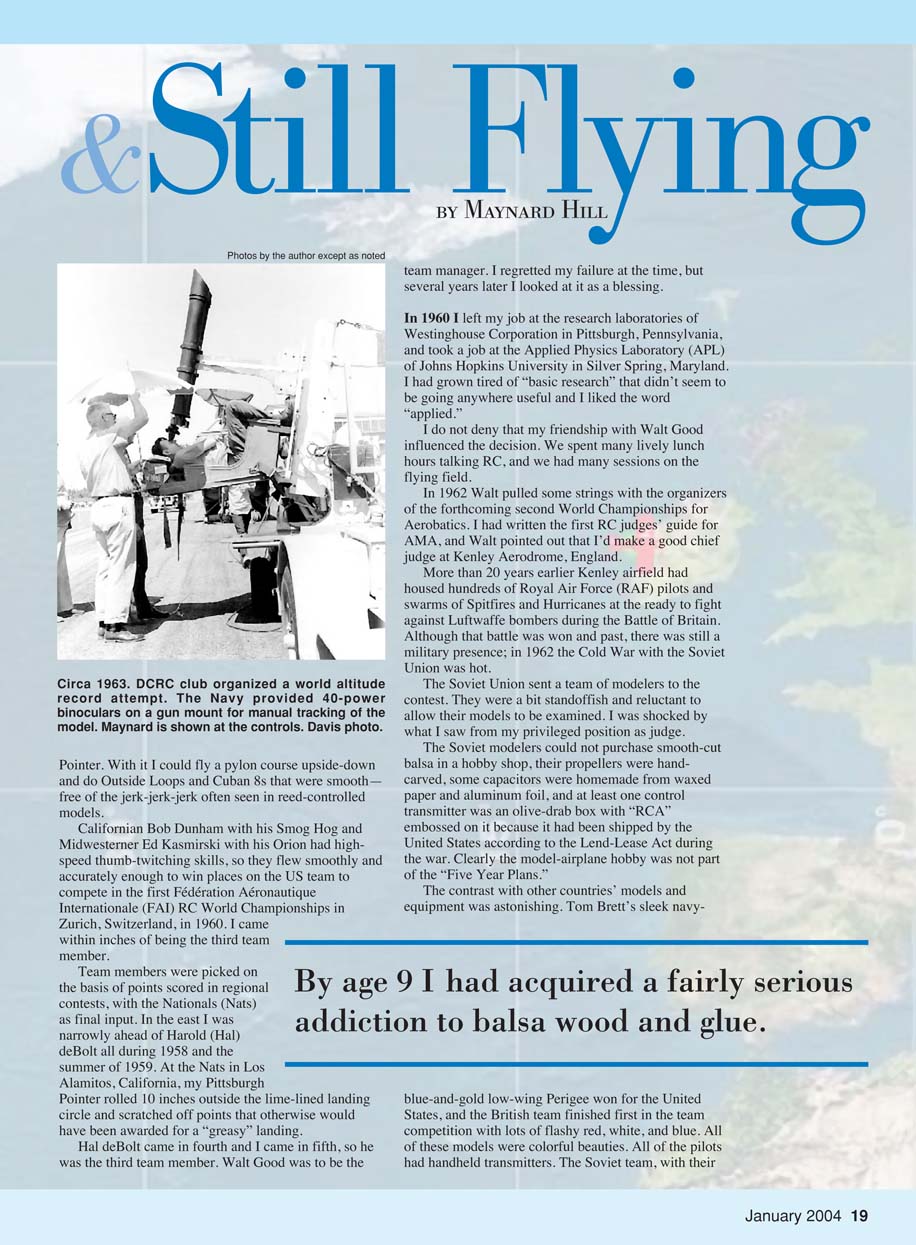
Fellow District of Columbia Radio Control Club (DCRC) members were roused by my preachings at the September 1962 meeting. We laid plans for an assault on Velitchkovsky's altitude record of 7,100 feet. On July 4–5, 1963, the Naval Surface Weapons Laboratory at Dahlgren, Virginia, provided a radar and two operators to measure altitude and two pairs of ships' 40-power binoculars mounted on an old gun mount. Walt Good and Howard McEntee broke Velitchkovsky's record. My model went higher; my first world record of 13,320 feet almost doubled his mark.
This was fun. I went on a crusade to break more of the Soviet hero's records, and by 1968 I held major RC records in duration, speed, distance in a straight line, and distance in a closed circuit. Seaplane and glider altitude marks had also been logged. Velitchkovsky eventually dropped to zero listings.
I continued judging at world aerobatics championships through the 1960s and stopped after Gorizia, Italy, in 1973. In training sessions for judges I emphasized that they should be objective and write scores strictly on the basis of what the airplane does — not who is flying it or how it looks. Yet when I analyzed score sheets for the FAI Committee it was obvious some judges boosted scores of competitors from their own countries or cut others because of national dislikes. Some judges were impressed by competitors who wore neckties or white pants; others marked down airplanes painted green. The tightness of female mechanics' shorts occasionally influenced judgment. Some competitors were angry that the judges weren't fair.
Herein lies my love for busting records, where you compete with Mother Nature and the precise rules of gravity and physics. Performance is measured with stopwatches and tape measures. There are no gray areas; either you did it or you failed.
Fifth Time is a Charm
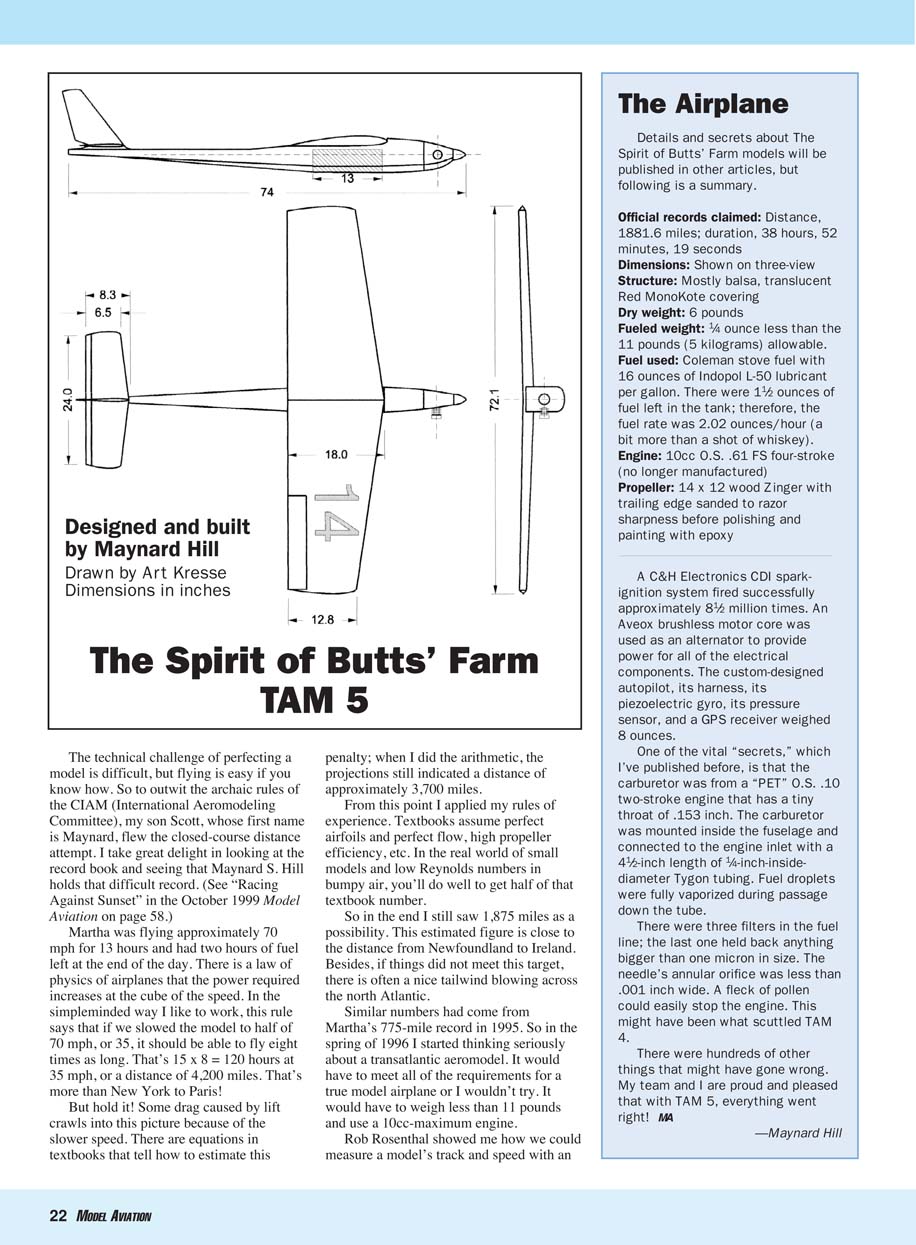
Each of the Transatlantic Models (TAMs) was launched from Cape Spear, Newfoundland, with Joe Foster piloting the takeoff and initial climb. More than one year and five TAMs later, the team completed the transatlantic task. Below are the launch, flight, and failure data for each TAM.
TAM 1
- Launch date: August 8, 2002
- Launch time: 8:00 p.m. local time
- Flight duration: At least an hour
- Flight distance: N/A
- Cause of failure: Possible servo damage from previous test flights
TAM 2
- Launch date: August 10, 2002
- Launch time: 8:00 p.m. local time
- Flight duration: 17½ minutes
- Flight distance: N/A
- Cause of failure: Engine shut off during flight
TAM 3
- Launch date: August 19, 2002
- Launch time: 6:00 p.m. local time
- Flight duration: 8 hours
- Flight distance: 479.0 miles
- Cause of failure: Rainstorm and severe turbulence
TAM 4
- Launch date: August 8, 2003
- Launch time: 8:00 p.m. local time
- Flight duration: 7 hours, 7 minutes
- Flight distance: 430.0 miles
- Cause of failure: Uncertain (lost during satellite coverage gap)
TAM 5
- Launch date: August 9, 2003
- Launch time: 7:45 p.m. local time
- Flight duration: 38 hours, 52 minutes, 19 seconds
- Flight distance: 1,881.6 miles
- Cause of failure: Successful flight!
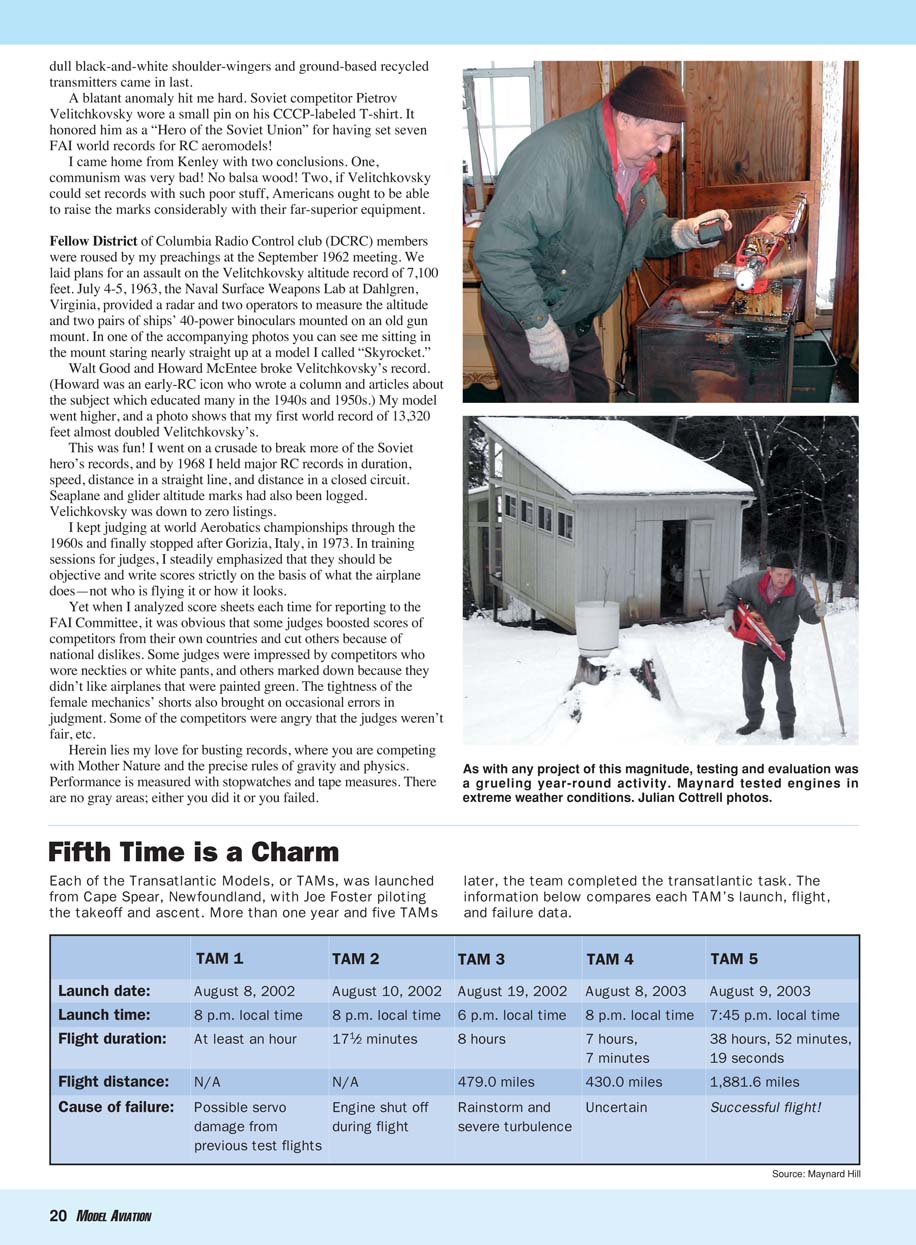
I continued chasing records because it was fun and educational. By 1991 I had 18 records; with Old Faithful III and Marvelous Martha this number rose to 23 by 1999. These two models inspired the dream of flying across the Atlantic.
Old Faithful flew for 33 hours and 39 minutes on October 3–5, 1992. I was the sole pilot because the FAI had a "Hail, Lindbergh!" rule stating that only one pilot was allowed. We beat this rule with technology: Paul Howey made a direction-finding receiver that we put in the wing and we placed an amateur radio beacon on the ground slightly upwind of me. The airplane automatically steered toward the beacon, made a loop downwind when it passed the beacon, then repeated the pattern for most of the flight. I was half asleep on a chaise lounge most of the time.
After this success I joked about building an 11-pound airplane that would fly 60 hours while a big crowd partied on the fantail of a cruiser. Marvelous Martha suggested a different approach. We measured high chase speeds using GPS and calculated drag characteristics. Martha had a CD0 (profile and skin-friction drag) of 0.019, which is smaller than the famous super-clean WWII P-51 Mustang's 0.021. Martha's last record of 808 miles in a closed course, piloted by my son Scott on June 26, 1998, confirmed her capabilities.
I was angry with the FAI for refusing to list me as part of a team for two earlier Martha records. Rob Rosenthal was named record holder for a distance flight; he piloted part-time for roughly nine hours. I had worked for two years to develop the model and certainly would have flown if I weren't nearly blind.
Concept and Formation of STAR
The transatlantic concept used an onboard GPS receiver and autopilot. The idea was to launch under manual radio control, then switch to autopilot. The miniature onboard GPS would provide position data to steer a programmed route. Landing in Ireland within 500 meters of a predesignated spot would be accomplished under manual RC control by a pilot. Newfoundland to Ireland isn't New York to Paris, but it is across the Atlantic.
By September 1998 I realized Newfoundland was a faraway island and that it would take money to put the project into motion. At Les Hamilton's and John Chrieta's urging, the Society for Technical Aeromodel Research (STAR) was formed. A pro tem board of mostly DCRC members began asking for contributions in exchange for membership and an occasional newsletter.
Paul Howey and Ted Rollins designed and built the front end of an autopilot: gyro, wing leveler, roll stabilizer, and servo controller coupled to a Futaba receiver. Joe Foster started on the massive job of software for GPS navigation and altitude hold in summer 1998.
We flight-tested during the winter and spring of 1999–2000 in a horse pasture owned by Beecher Butts, an 88-year-old legend who still flew ultralights. If the grass got too tall, he'd make a runway with his farm tractor. In honor of his kindness, I suggested naming our transatlantic model "The Spirit of Butts' Farm."
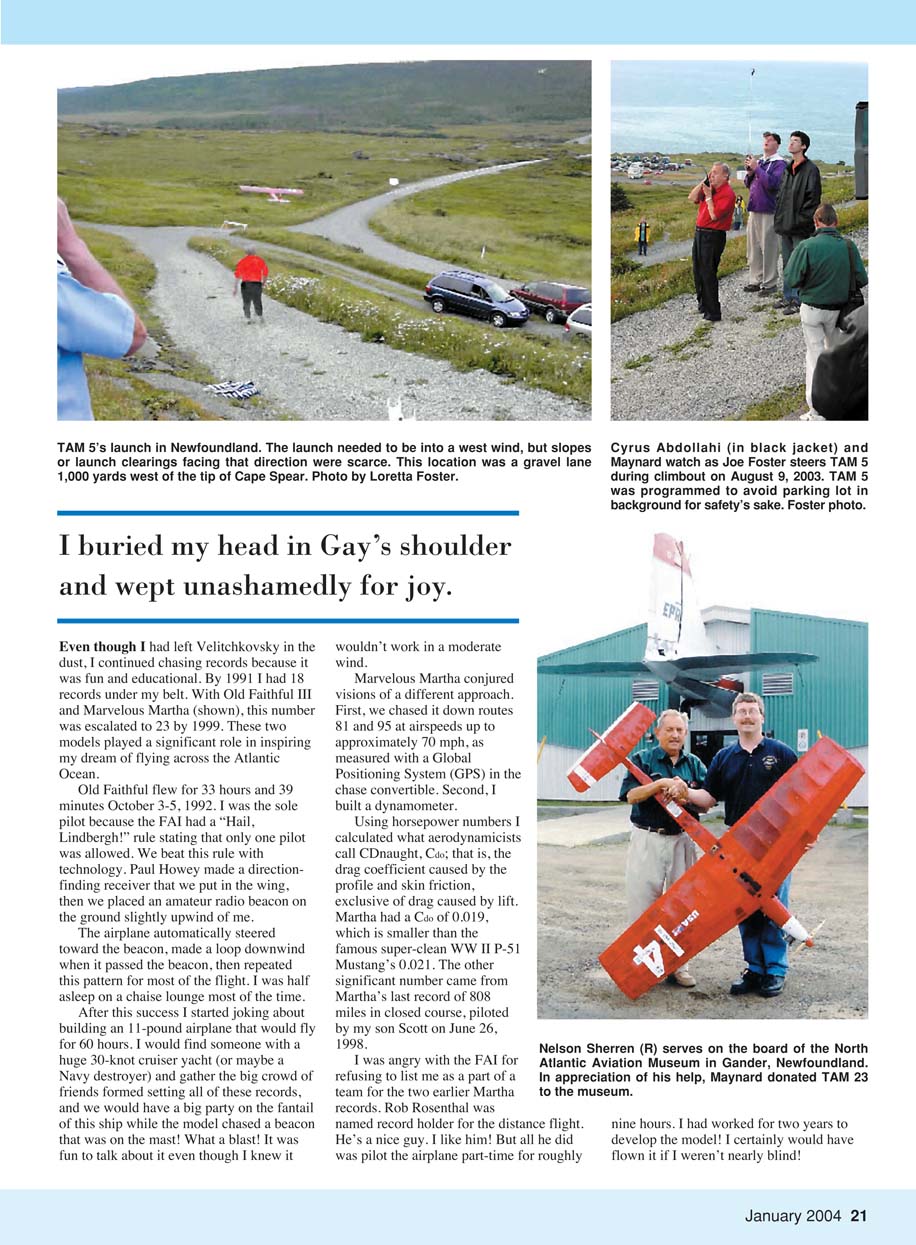
We planned to try in August 2001 and bought cheap airline tickets, crates, and began preparations. Problems in May and June 2001 forced a postponement until August 2002. Using those tickets, John Patton, Roy Day, Joe Foster, and I flew to Newfoundland to survey the terrain and meet Carl Layden, Atlantic province director for the Model Aeronautic Association of Canada (MAAC). Saint John's newspaper, The Telegram, ran a pleasant story about our visit. Nelson Sherren, a former RAF Lancaster pilot and Newfoundland aviation-history buff, read the article and joined the team. Nelson, president of the 150th wing of the North Atlantic RCAF Association, arranged low-cost housing and a large workspace on a military base for our 2002 and 2003 efforts.
Building and Testing
During winter and spring 1999–2000 I built five airplanes with 6-inch-diameter fuel tanks. They were too fat and flew only about 38 mph. In 2000–2001 I built six airplanes with skinnier fuselages and more complicated fuel plumbing; they flew approximately 43 mph but three were crashed during tests and two more totaled after the 2001 postponement.
In winter–spring 2001–2002 I built four more airframes. By then I had constructed 21 fuselages and 12 wings and logged hundreds of hours of engine testing. In April 2001 we felt confident problems could be solved by August, so we pressed on. In February 2003 we added Cyrus Abdollahi, a talented high-school senior intern who became indispensable in building, testing, and managing software and data.
I acquired 26 O.S. .61 FS engines over the years. After months of mysteries, we found a flaw in two of my homemade rear power takeoffs used to drive an alternator. Tweed Cottrell machined six new ones of superb quality. By June we had six airframes; autopilot construction lagged, so we transferred the single workable unit among airframes for testing. Les Hamilton and Ron Bozzonetti contributed many hours for flight tests.
On July 18 a virgin model (number 26) with a virgin autopilot failed during manual flight and went down in woods on the edge of a wheat field. It was lost. On July 29 Gay and I set out toward Saint John's with five TAM models: numbers 23, 24, 25, 27, and 28. We saved STAR $3,000 by trading vehicles along the way.
The 2002 Attempts
We arrived in Saint John's on August 3, 2002. Joe Foster, Les Hamilton, and Cyrus flew in later. We honed engines and did trim tests. TAM 1 was launched on August 8, 2002 at 8:00 p.m. Joe manually flew it to roughly 1,000 feet, but when he toggled the landing-gear switch to engage the autopilot, it began lazy 300-foot-diameter circles. The wind blew the circling model toward Ireland, but it soon fell into the ocean. The cause may have been that the model was too far out of trim for the gyro and steering software to grab hold.
TAM 2 was launched two days later. It made the programmed half-mile north leg but then flew on a direct heading toward the Azores. Telemetry indicated engine stoppage and the model dropped into the sea 17½ minutes after launch. We suspected an engine issue and a software flaw in steering that had escaped detection because our earlier tests had been over short distances and with the model in sight.
After a pause for code corrections and weather, we launched TAM 3 on August 19, 2002 at 6:00 p.m. This time it departed on the correct 62° track and flew on course for eight hours, logging 479 miles before dropping out of satellite coverage. The most likely cause was a rainstorm and severe turbulence.
Results from 2002 were encouraging enough to try again in 2003.
The 2003 Attempts and TAM 5 Success
I began building slightly modified models immediately, shifting the wing position and moving the autopilot to prevent rainwater ingestion. By early 2003 we had three new airframes (23, 24, 25) and later added others. Cyrus became an essential team member.
TAM 4 was launched on August 8, 2003 at 8:00 p.m. The climbout and smooth straight-line departure were beautiful. Satellite reports showed TAM 4 on course for eight hours, but after 430 miles there was no further report. The model went down during an interval when no satellites were over the North Atlantic; the cause remains a mystery. Joe Foster suggested carburetor ice, but bench tests did not fully support that.
On August 9 we prepared TAM 5 after a tense fueling process. The launch at 7:45 p.m. local time went smoothly. TAM 5 climbed out and beelined on the 62° heading toward Ireland. Data at 11:00 p.m. indicated engine RPM and altitude OK; I went to bed hopeful.
Sunday morning the Spirit was roughly 560 miles out but showed engine RPM swings and altitude variation; it was porpoising (shallow climb to speedy dip). We worried the engine was running lean. Overnight the model picked up a modest tailwind and cruised at 50–55 mph. Around 4:00 a.m. we lost satellite data for three hours; Cyrus kept monitoring and announced when new satellite data arrived. The Spirit was still flying and now performing better: RPM steadied at 3,900 and elevator trim moved toward neutral as fuel burned off.
At 9:00 a.m. Newfoundland time (12:30 Ireland time), 37¼ hours into the flight, the Spirit was approximately 70 miles from the Irish coast, cruising at 43 mph on a perfect heading. The engine had been expected to run about 37 hours on the intended slightly rich setting; it was a tense cliffhanger. At roughly 2:08 p.m. Ireland time the model came into sight at Mannin Beach. Dave Brown, a skilled RC pilot and AMA president, took manual control, killed the engine and landed the Spirit in a dead-stick landing approximately 35 feet from the designated spot. Sally Brown's cell-phone call "It's on the ground!" raised a whooping cheer in the Newfoundland shop. I buried my head in Gay's shoulder and wept unashamedly for joy.
Contributions and Acknowledgments
Special recognition and thanks to:
- Les Hamilton — chief U.S. official, AMA Contest Director, STAR secretary; hundreds of hours in flight tests, telemetry, and data analysis.
- Joe Foster — designed the electronics and wrote navigation autopilot software; pilot during many flight tests.
- Dave Brown — landing pilot in Ireland and AMA president; skilled RC pilot.
- Cyrus Abdollahi — high-school intern (2003 graduate); helped build and test models and monitored incoming data at all hours.
- Gay Hill — comfort, counselor, and driver for the long vehicle ferry to Newfoundland and back.
- Paul Howey — designed and built ARGOS transmitters and recruited amateur-radio support; with Ted Rollins, designed stability and servo-control software for the autopilot.
- Ted Rollins — autopilot software and hardware contributions.
- Roy Day and Ron Bozzonetti — pilots and flight-test support; Roy served as Contest Director in 2002.
- Tweed (Julian) Cottrell — machining, engine testing, and autopilot assembly.
- Art Kresse — machining and technical drawings.
- Charlie Calvert — fuel pumps and alternator couplings.
- Bob Yount — weather data and advice.
- Bill Savage — editor and producer of newsletters.
- John Patton — STAR treasurer and earlier contest director.
- Doug Lechleider (Laytonsville Landscaping) — allowed use of sod farms for testing.
- Beecher Butts — host of early flight tests and inspiring spirit for the team.
- Nelson Sherren — arranged housing and operations center in Canada and helped liaise with local clubs.
- Carl Layden, Craig Trickett, John Shortall (Saint John's Aeromodellers Club) — local assistance in Canada.
- Joe Dible, John Molloy, Noel Barrett — Irish official observers who traveled long distances to be present.
- Ronan Coyne — set up the TAM website and downlink telemetry in Ireland.
- Enda Broderick, David Glynn, Aengus Cullinane, Tom Frawley — Irish crew members.
- Sally Brown — her joyful phone calls during the landing were a vital contribution.
I am grateful for all the help from these wonderful friends.
Maynard Hill 2001 Norvale Rd. Silver Spring, MD 20906
Transcribed from original scans by AI. Minor OCR errors may remain.

