
United States Free Flight Championships
Bob Meuser
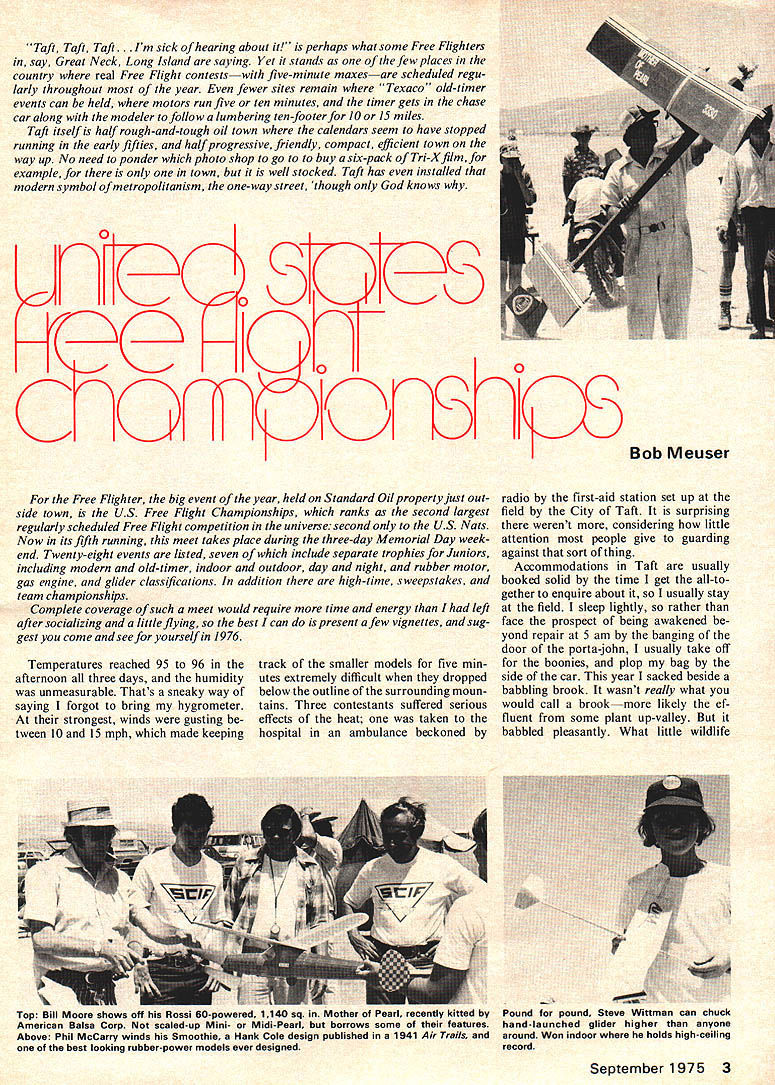
"Taft, Taft, Taft... I'm sick of hearing about it!" is perhaps what some Free Flighters in, say, Great Neck, Long Island are saying. Yet it stands as one of the few places in the country where real Free Flight contests—with five-minute maxes—are scheduled regularly throughout most of the year. Even fewer sites remain where "Texaco" old-timer events can be held, where motors run five or ten minutes, and the timer gets in the chase car along with the modeler to follow a lumbering ten-footer for 10 or 15 miles.
Taft itself is half rough-and-tough oil town where the calendars seem to have stopped running in the early fifties, and half progressive, friendly, compact, efficient town on the way up. No need to ponder which photo shop to go to or to buy a six-pack of Tri-X film, for example, for there is only one in town, but it is well stocked. Taft has even installed that modern symbol of metropolitanism, the one-way street, though only God knows why.
For the Free Flighter, the big event of the year, held on Standard Oil property just outside town, is the U.S. Free Flight Championships, which ranks as the second largest regularly scheduled Free Flight competition in the universe: second only to the U.S. Nats. Now in its fifth running, this meet takes place during the three-day Memorial Day weekend. Twenty-eight events are listed, seven of which include separate trophies for Juniors, including modern and old-timer, indoor and outdoor, day and night, and rubber motor, gas engine, and glider classifications. In addition there are high-time, sweepstakes, and team championships.
Complete coverage of such a meet would require more time and energy than I had left after socializing and a little flying, so the best I can do is present a few vignettes, and suggest you come and see for yourself in 1976.
Temperatures reached 95 to 96 in the afternoon all three days, and the humidity was unmeasurable. That's a sneaky way of saying I forgot to bring my hygrometer. At their strongest, winds were gusting between 10 and 15 mph, which made keeping track of the smaller models for five minutes extremely difficult when they dropped below the outline of the surrounding mountains. Three contestants suffered serious effects of the heat; one was taken to the hospital in an ambulance beckoned to the radio by the first-aid station set up at the field by the City of Taft. It is surprising there weren't more, considering how little attention most people give to guarding against that sort of thing.
Accommodations in Taft are usually booked solid by the time I get the all-together to enquire about it, so I usually stay at the field. I sleep lightly, so rather than face the prospect of being awakened beyond repair at 5 am by the banging of the door of the porta-john, I usually take off for the boonies, and plop my bag by the side of the car. This year I sacked beside a babbling brook. It wasn't really what I would call a brook—more likely the effluent from some plant up-valley. But it babbled pleasantly. What little wildlife can make it in such an environment—there is more than you might think—takes sundown as a signal to do their thing, which consists mainly of making scary noises. I talked myself into thinking that the most ferocious fauna around was a rabbit, and sleep came easily.
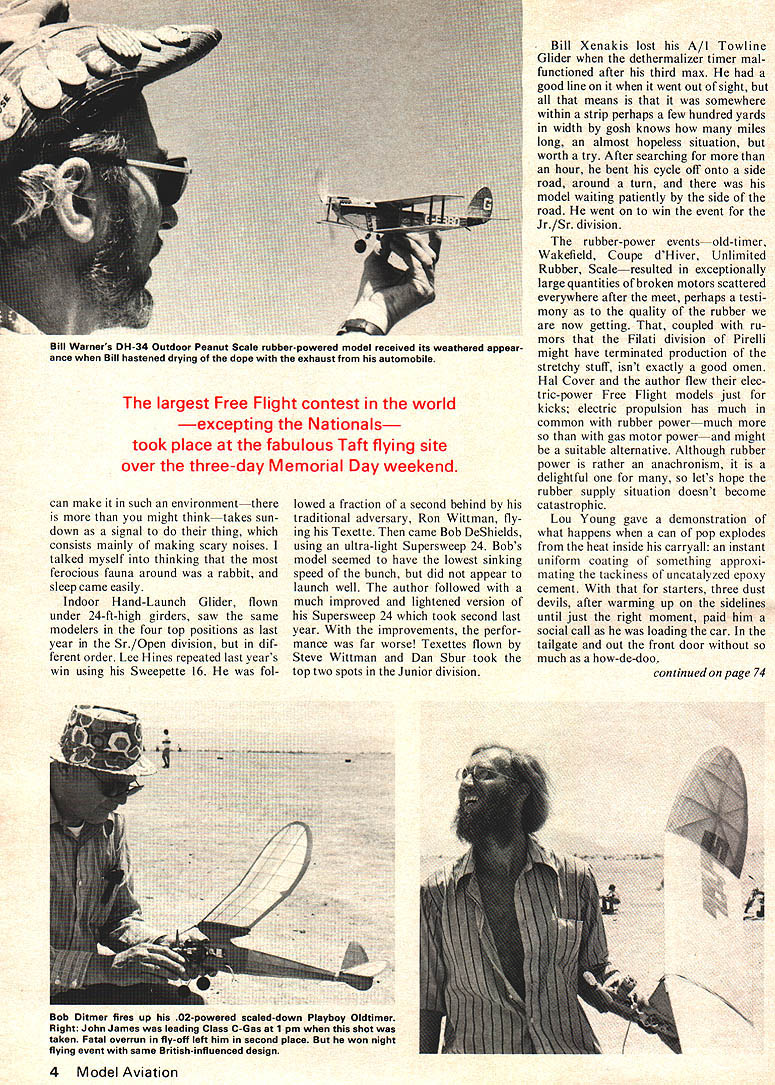
Indoor Hand-Launch Glider, flown under 24-ft-high girders, saw the same modelers in the four top positions as last year in the Sr./Open division, but in different order. Lee Hines repeated last year's win using his Sweepette 16. He was followed a fraction of a second behind by his traditional adversary, Ron Wittman, flying his Texette. Then came Bob DeShields, using an ultra-light Supersweep 24. Bob's model seemed to have the lowest sinking speed of the bunch, but did not appear to launch well. The author followed with a much improved and lightened version of his Supersweep 24 which took second last year. With the improvements, the pe rformance was far worse! Texettes flown by Steve Wittman and Dan Surb took the top two spots in the Junior division.
Bill Xenakis lost his A/1 Towline Glider when the dethermalizer timer malfunctioned after his third max. He had a good line on it when it went out of sight, but all that means is that it was somewhere within a strip perhaps a few hundred yards in width by gosh knows how many miles long, an almost hopeless situation, but worth a try. After searching for more than an hour, he bent his cycle off onto a side road, around a turn, and there was his model waiting patiently by the side of the road. He went on to win the event for the Jr./Sr. division.
The rubber-power events—old-timer, Wakefield, Coupe d'Hiver, Unlimited Rubber, Scale—resulted in exceptionally large quantities of broken motors scattered everywhere after the meet, perhaps a testimony as to the quality of the rubber we are now getting. That, coupled with rumors that the Flitef division of Pirelli might have terminated production of the stretchy stuff, isn't exactly a good omen. Hal Cover and the author flew their electric-power Free Flight models just for kicks; electric propulsion has much in common with rubber power—much more so than with gas motor power—and might be a suitable alternative. Although rubber power is rather an anachronism, it is a delightful one for many, so let's hope the rubber supply situation doesn't become catastrophic.
Lou Young gave a demonstration of what happens when a can of pop explodes from the heat inside his carryall: an instant uniform coating of something approximating the tackiness of uncatalyzed epoxy cement. With that for starters, three dust devils, after warming up on the sidelines until just the right moment, paid him a social call as he was loading the car. In the tailgate and out the front door without so much as a how-de-doo. a thermal. The result was fewer tangled towlines, fewer tangles between towlines and motorcycles.
Crocket won Rocket; put that in your pocket! (Gee, I hope that line doesn't give Danny Kay an inferiority complex.) Jim, chief honcho at Jim Crocket Replicas, used the electric ignition system introduced by Dave and Larry Parsons last year (Am. Aircraft Modeler, Jan. 1975, page 79) on his Sunduster, an NFFS Model of the Year awardee (AAM Jan. 74, page 26).
Jim Scarborough, Contest Manager, doesn't have to make decisions about color schemes for his models, the colors all of them "high-visibility orange." I've remarked to him in the past that the color clashed horribly with that of his car; this year he showed up in a new car painted—what else?—"high-visibility orange!"
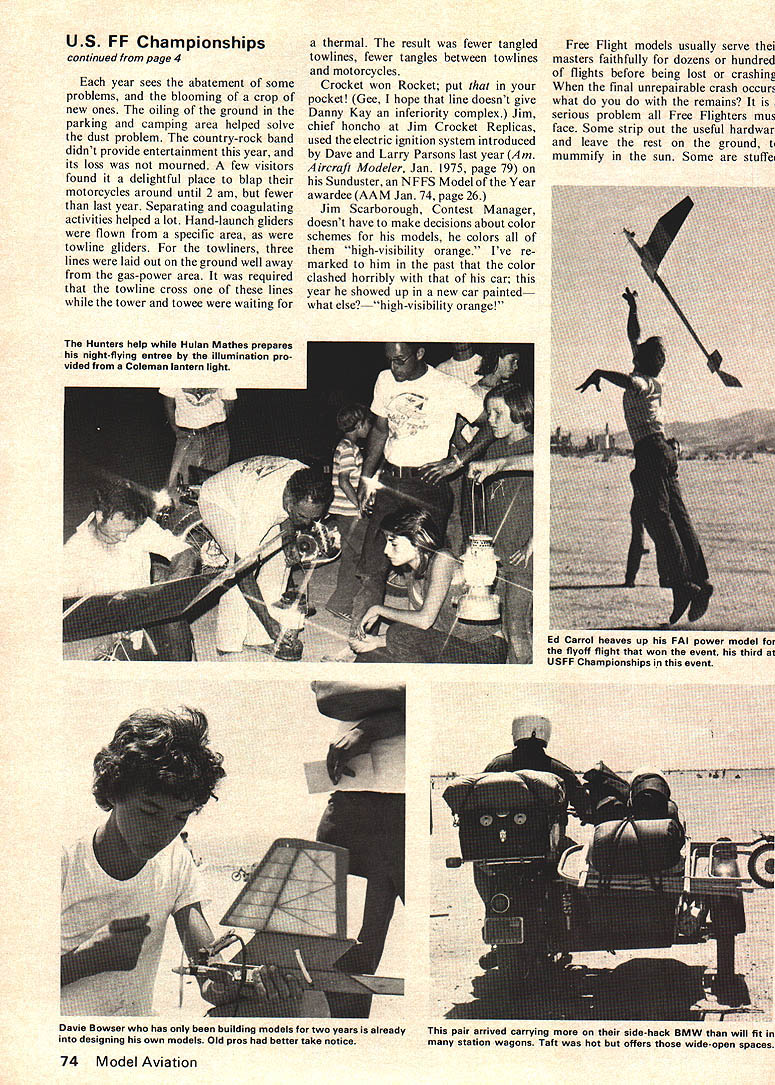
Free Flight models usually serve their masters faithfully for dozens or hundreds of flights before being lost or crashing. When the final unrepairable crash occurs, what do you do with the remains? It is a serious problem at all Free Flighters' meets. Some strip out the useful hardware and leave the rest on the ground, to mummify in the sun. Some are bagged and taken home as souvenirs.
Transcribed from original scans by AI. Minor OCR errors may remain.

