
Unmanned Aerial Vehicles
Rapidly expanding technical development and military use of RC aircraft (UAVs) is bound to have a profound effect on sport RC model flying in the future.
RC model aircraft technology is moving, in a big way, into the military. U.S. and NATO forces are expanding plans to use Unmanned Aerial Vehicles (UAVs) for a multitude of tasks on land and at sea. Beyond the military there are beginnings of civilian uses for model-aircraft derivatives in surveying, border surveillance, forestry, and other fields. This article focuses on the most significant developments occurring in the military.
Origins: Israel and the Lebanon campaign
The modern military use of UAVs began in Israel when a group of RC modelers offered their hobby skills to help the army during the Lebanon campaign. Israeli Air Force aircraft had been vulnerable to surface-to-air missiles (SAMs) that detected radar and infrared signatures. The modelers built a large (about 15-ft wingspan) model fitted with simple camera equipment and an autopilot to search for SAM sites.
The experiment was wildly successful. The model could loiter at about 5,000 ft over known SAM areas and detect sites with its camera. Coordinates were relayed to the Israeli Army, which then sent out artillery and fighters to neutralize the SAMs. The model planes themselves were difficult to detect: they had no radar signature, were small and quiet at altitude, and could loiter unnoticed while transmitting images back to controllers.
Navy use and the Pioneer
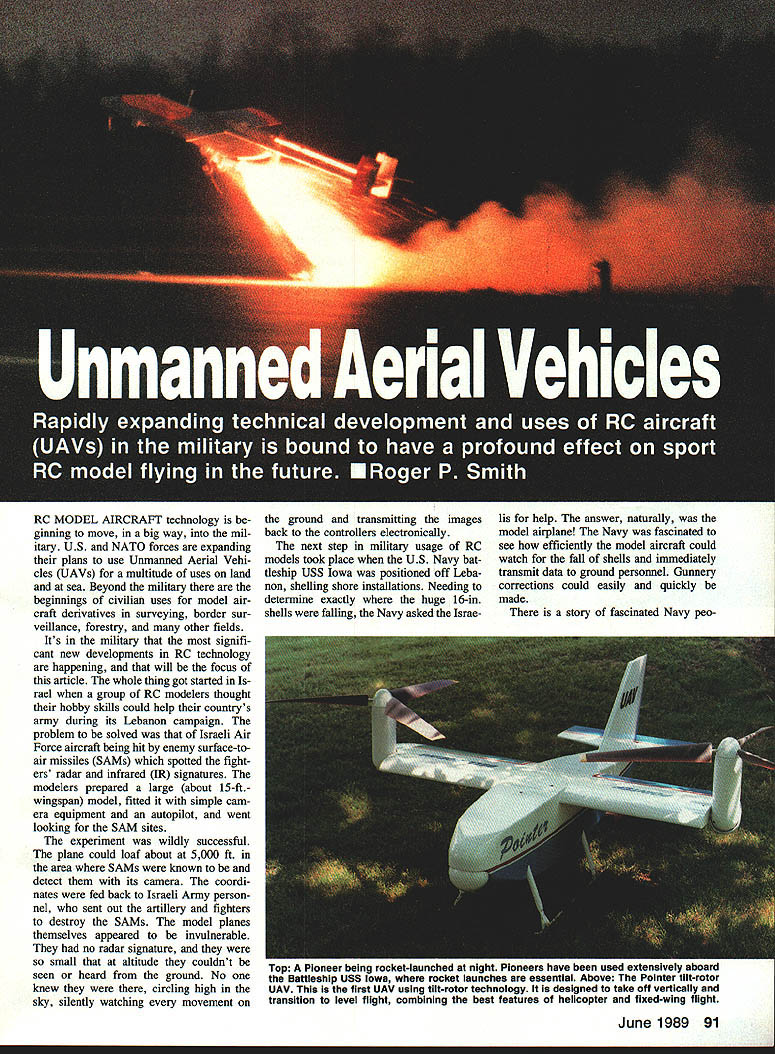
The next step came when the U.S. Navy deployed the battleship USS Iowa off Lebanon and needed to determine where 16-in. shells were falling. The Israelis demonstrated model airplanes watching shell impacts and instantly transmitting data for gunnery corrections. The Navy bought several examples.
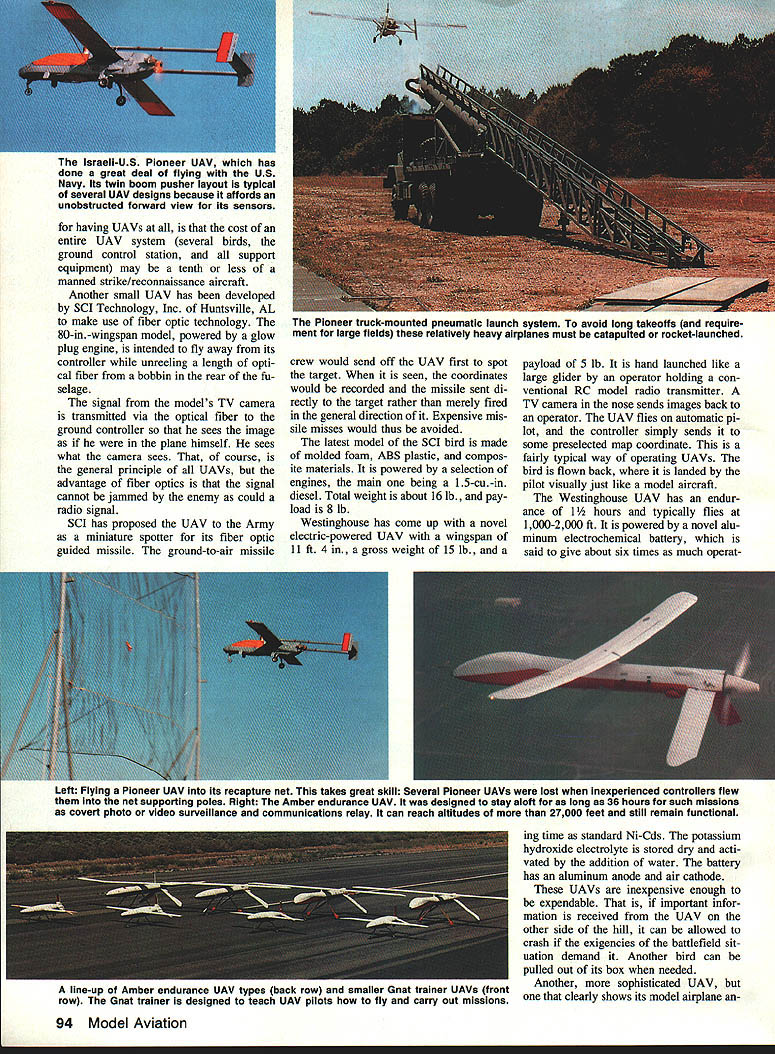
Further development produced the Israeli UAV called the Pioneer, built in the U.S. by AAI Corporation in conjunction with Israel's Malat. The Navy integrated the Pioneer into fleet use, though integration had teething problems — some flights made headlines when inexperienced operators damaged aircraft during recovery.
Marines and battlefield reconnaissance
The U.S. Marine Corps also adopted UAVs for battlefield reconnaissance. The core appeal was simple: a division commander could order a small UAV launched to "see over the hill" or "around the corner" to gain immediate tactical information. Marines acquired Pioneers and trained RC modelers among their ranks to operate them.
U.S. Army programs: Aquila and others
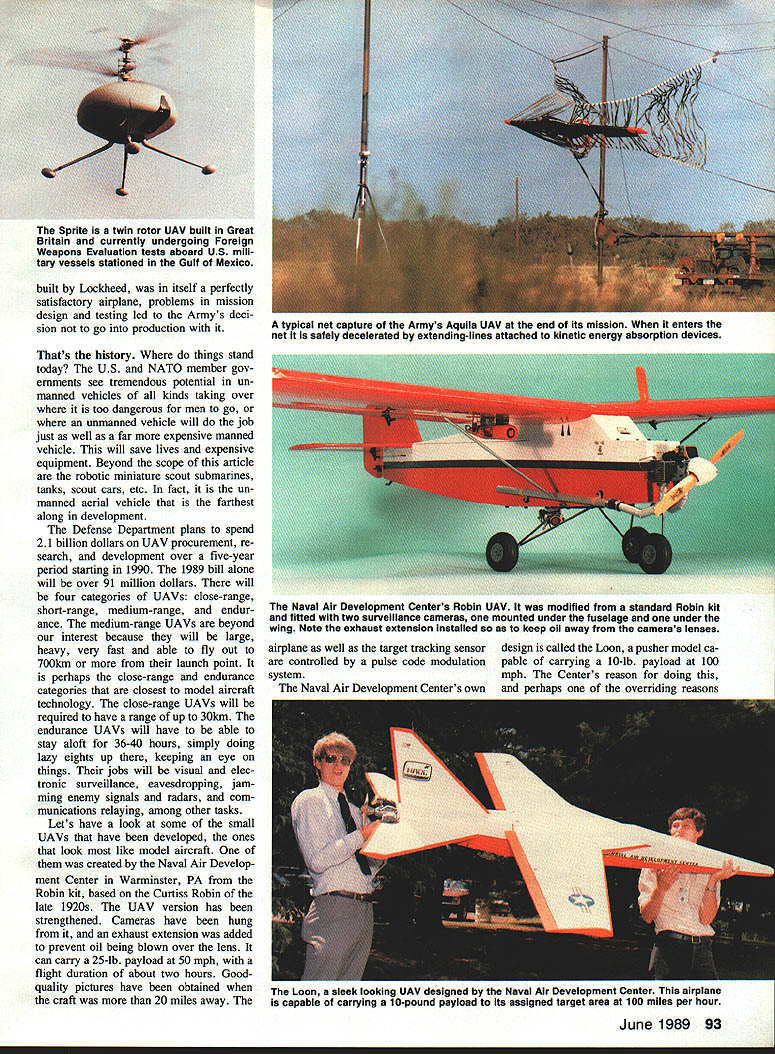
The U.S. Army invested heavily in UAV development. Aquila, built by Lockheed, was a flying-wing, pusher-prop design that used composite materials and departed from typical model-aircraft practice by being larger and heavier. Although Aquila was a satisfactory airplane, problems in mission design and testing led the Army to decide not to proceed to production — an example of how over-ambitious requirements can complicate development.
Categories and defense spending
The U.S. Defense Department planned to spend $2.1 billion on UAV procurement, research, and development over a five-year period starting in 1990. The 1989 bill alone was over $91 million.
There are four UAV categories:
- Close-range: range up to about 30 km.
- Short-range.
- Medium-range: large, heavy, fast; can fly 700 km or more from launch (beyond the scope of model-like UAVs).
- Endurance: long-duration platforms capable of 36–40 hours aloft for sustained surveillance and electronic missions.
Typical UAV missions include visual and electronic surveillance, signals eavesdropping, radar jamming, communications relay, photography, target spotting, decoy duty, and more.
SkyEye R4E-50 and other tactical UAVs
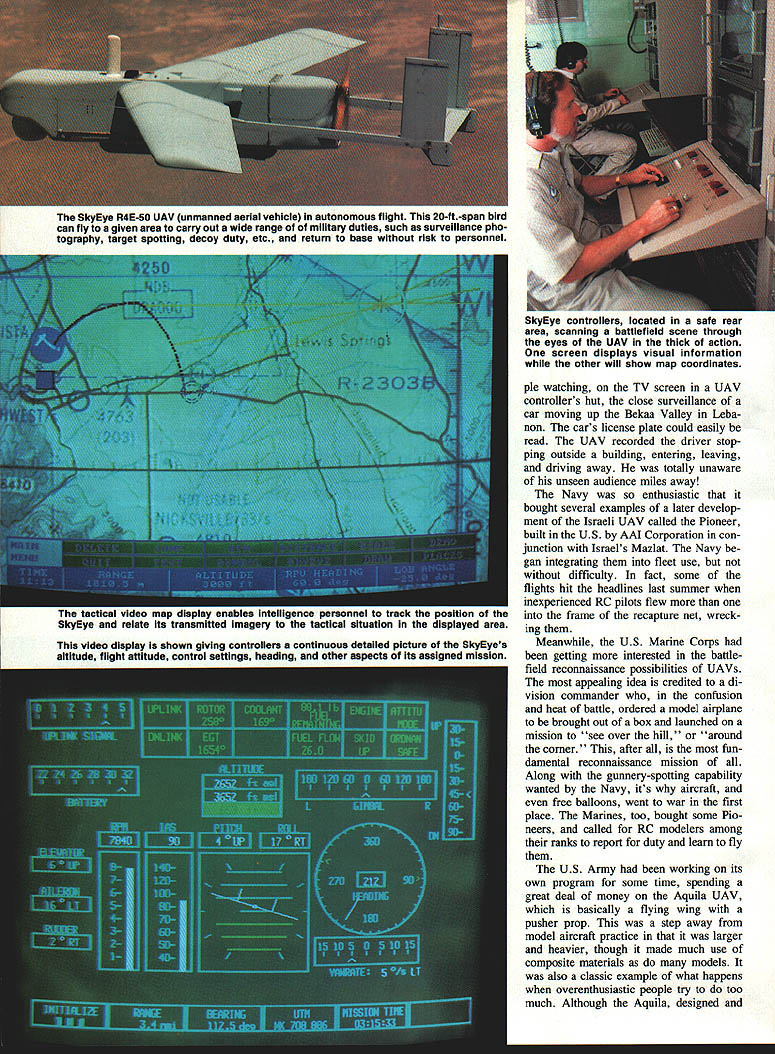
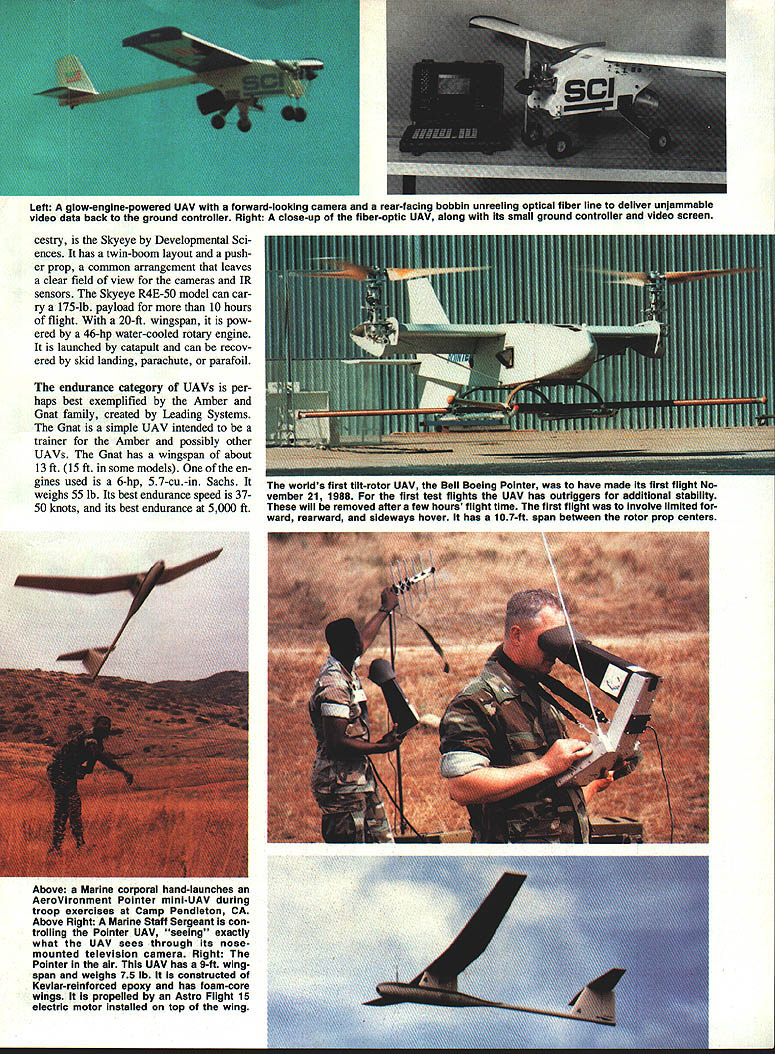
The SkyEye R4E-50 is an autonomous, roughly 20-ft-span UAV designed for surveillance, photography, target spotting, and decoy duties. It can be assigned an area to patrol and return to base autonomously. Ground controllers in a rear-safe area monitor a cockpit-like display that shows continuous video, map coordinates, navigation data, and telemetry such as altitude, attitude, control settings, and heading. Intelligence personnel can correlate transmitted imagery with SkyEye's position and present the tactical situation to commanders.
The SkyEye uses a twin-boom layout with a pusher prop, an arrangement that leaves a clear field of view for cameras and IR sensors. A larger SkyEye variant can carry heavy payloads (for example, reported figures include a 175-lb payload for over 10 hours with a 20-ft wingspan, powered by a rotary engine) and is launched by catapult, recoverable by skid landing, parachute, or parafoil.
Smaller UAV developments with model ancestry
Many small UAVs closely resemble model aircraft and have been developed by military and independent teams:
- Naval Air Development Center projects:
- A strengthened variant based on the Curtiss Robin (late 1920s) can carry a 25-lb payload at about 50 mph for roughly two hours. Cameras are mounted and an exhaust extension prevents oil from fouling lenses. The airframe and target-tracking sensor are controlled by pulse code modulation.
- The Loon: a pusher model capable of carrying a 10-lb payload at about 100 mph.
- SkyEye family: See above.
- Sprite (ML Aviation, UK): a twin-rotor UAV undergoing Foreign Weapons Evaluation tests aboard U.S. military vessels. It has contra-rotating rotors (each about 5 ft 3 in diameter), a spherical fuselage (~2 ft diameter), weighs less than 40 kg, and is man-portable. Powered by two 6.5-hp twin-cylinder two-stroke engines, it cruises at about 60 knots, has a ceiling of 8,000 ft, endurance of about two hours, and typically operates up to 20 miles from the controller.
- SCI Technology (Huntsville, AL): an 80-in wingspan model that unreels optical fiber from a fuselage bobbin as it flies. The TV camera signal transmits via fiber to the ground, making the link unjammable. The latest SCI model uses molded foam, ABS plastic, and composites; typical powerplants include a 1.5-cu.-in. diesel, with total weight around 16 lb and an 8-lb payload.
- Westinghouse electric UAV: wingspan 11 ft 4 in, gross weight 15 lb, payload 5 lb. Hand-launched like a glider and operated with a conventional RC transmitter. TV camera transmits images to the ground. Uses an aluminum electrochemical battery (dry KOH electrolyte activated by water) that reportedly yields about six times Ni-Cd operating time. Endurance about 1.5 hours at 1,000–2,000 ft. Operates on automatic pilot to preselected map coordinates and is landed visually like a model.
- AeroVironment mini-Pointer (not to be confused with the Bell-Boeing Pointer tilt-rotor): a 9-ft span, 7-lb glider-type UAV with an Astro Flight 15 electric motor on the wing. Built of Kevlar-reinforced epoxy with foam-core wings, it carries a daylight TV camera. Reconnaissance data downlink is by radio or by unjammable fiber-optic link. Flight duration is an hour or more, patrol radius about 3.5 miles at 22–45 mph. Hand-launched with a simple gyroscopic autostabilizer; landing by deep stall near the pilot. AeroVironment supplied Pointers to the U.S. Marine Corps for evaluation; Marines with minimal training have assembled and flown them successfully.
Endurance UAVs: Amber, Gnat, and Pointer tilt-rotor
- Amber and Gnat family (Leading Systems): endurance-category UAVs. The Gnat is a simple trainer UAV for Amber, with about a 13–15 ft wingspan, engines such as a 6-hp Sachs, and weights around 55 lb. The Amber is more advanced, with wingspans ranging from 25 to 40 ft depending on model, maximum endurance up to 35 hours at 5,000 ft, and service ceilings around 27,800 ft.
- Pointer tilt-rotor (Bell/Boeing consortium): a model-scale tilt-rotor UAV based on the V-22 Osprey concept. Tilt-rotor designs take off like helicopters (rotors vertical) and transition to fixed-wing horizontal flight by tilting the engines/propellers. The Pointer has about a 10.7 ft span between pro-rotor centers, length 13.7 ft, gross weight ~600 lb, designed for 6-hour endurance at 100 knots with a 100-lb payload. The Pointer was planned to use an RC model transmitter for initial flight testing.
Advantages of rotary-wing UAVs
Rotary-wing UAVs do not require specialized launch systems (catapults, rockets) or runways. Any reasonably level ground will do. Automatic flight controllers minimize demand for continuous piloting: operators typically steer to a waypoint while the autopilot handles attitude and stabilization. More sophisticated systems can autonomously cruise, search for targets, and decide when to return to base to refuel.
Expendability and battlefield use
Many small UAVs are inexpensive enough to be considered expendable. If a UAV provides crucial information from a hazardous area, it can be sacrificed if necessary. Another unit can be launched when needed. This operational concept reduces risk to personnel and to far more expensive manned systems.
Impact on the RC hobby and future outlook
UAV development has drawn heavily on the RC model community for ideas, skills, and talent. Major defense contractors (Lockheed, Bell, Boeing) now dominate the industry, but smaller developers and skunk-works teams — often populated by RC enthusiasts — continue to innovate.
As military requirements grow, new small UAV designs for close-range reconnaissance and target acquisition will appear. This will spur development of new construction materials, control servos, and electronics — innovations that will inevitably influence the RC hobby. If UAVs gain broader civilian acceptance (for surveying, surveillance, etc.), the resulting public recognition and technology transfer could benefit all modelers in the long run.
Transcribed from original scans by AI. Minor OCR errors may remain.

