
U.S. FF Championships
Ralph I. Prey
Overview
The 15th running of the U.S. Free Flight Championships was a competition-oriented extravaganza: 42 events concentrated into three days of flying from sunrise to midnight at Taft, CA. Events were flown in pre-sunrise dead air, midday thermals, a star-studded night, and in two large gymnasiums for indoor contests. Over 300 contestants attended the Memorial Day Weekend meet—the Mecca of Free Flight—drawing regulars, out-of-state fliers, Canadians, and newcomers who recognized many of the sport’s well-known competitors.
Arrival and camaraderie
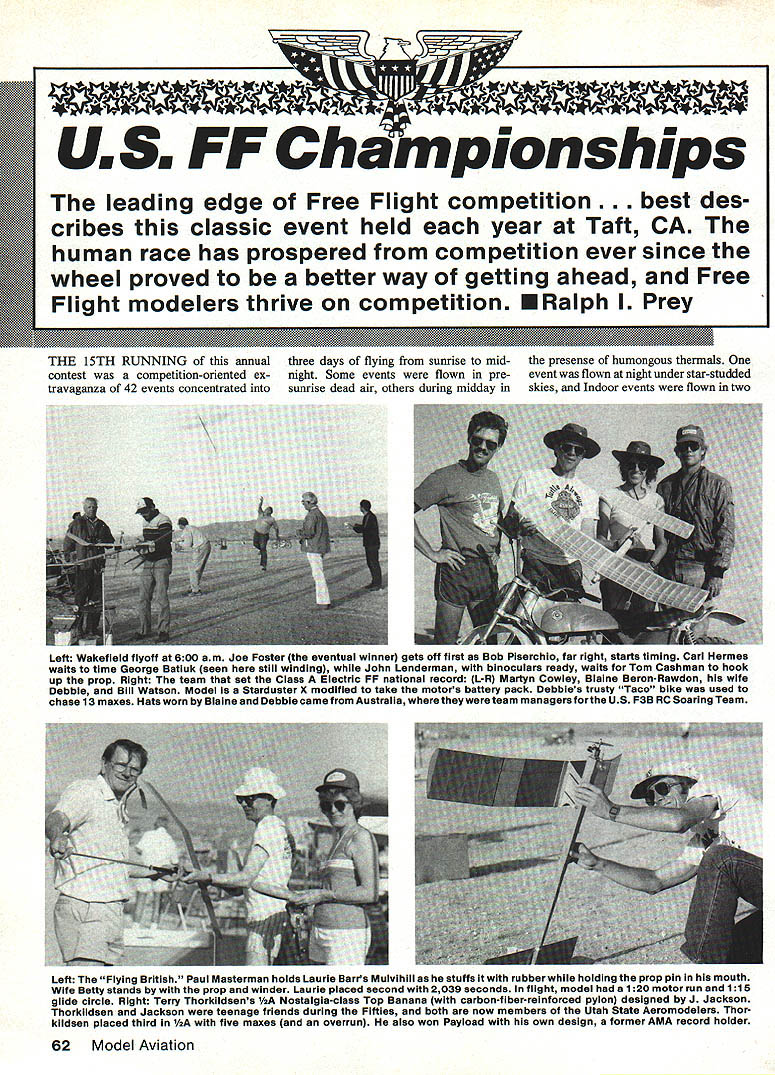
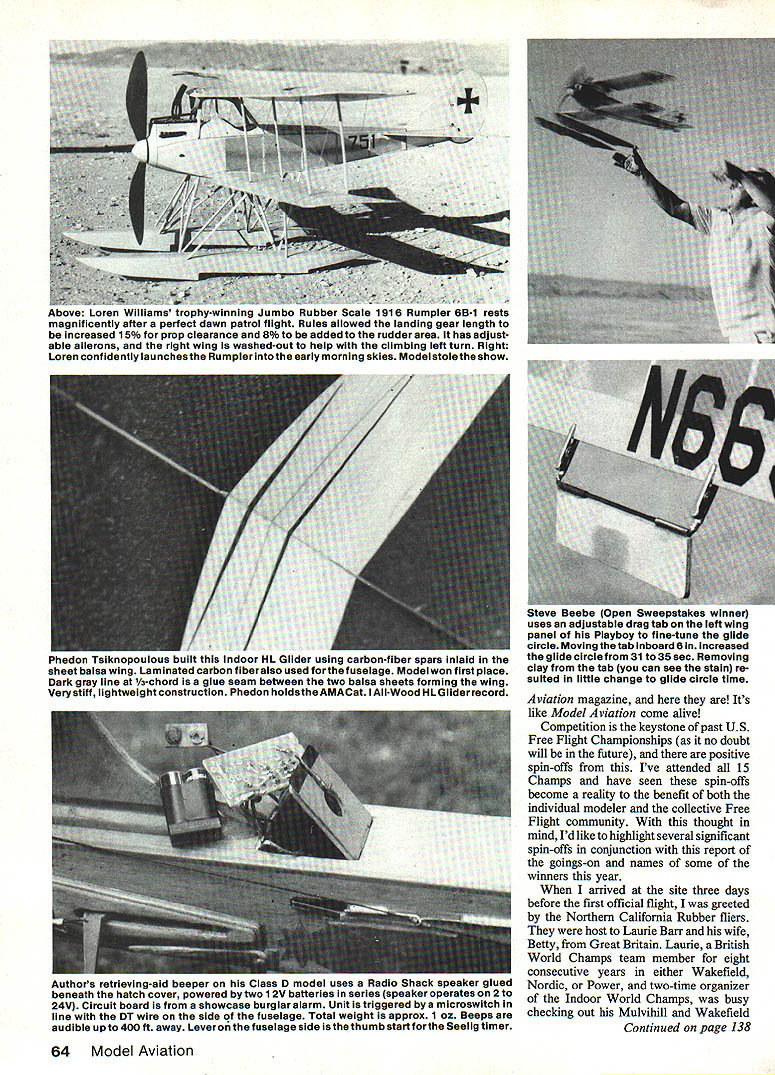
Fliers began arriving days ahead of the first official flights. Northern California Rubber hosts greeted visiting guests from Great Britain, including Laurie Barr (a multi-year World Champs team member and indoor organizer) and Paul Masterman. Contestants came from New York, the Pacific Northwest, the Midwest, Texas, Alabama, the Southwest, and California. The field glowed from dozens of campfires as flying buddies swapped stories, made new friends, and renewed old friendships.
Esprit de corps, fellowship, friendship, camaraderie, respect, and appreciation best described the competition spirit throughout the event. Personal feelings were cemented into friendships that will last a lifetime.
Pre-flight activity and preparations
Before sunrise on the first official day, Honda trail bikes shuttled starter boxes, flight boxes, and equipment to flying areas. FAI Power fliers checked timer settings; Old-Timer fliers tuned vintage engines (thankful for electric starters); Nordic Glider fliers did stretch exercises; AMA Gas fliers sipped coffee and watched Wakefield models. The activity made it impossible to sleep in.
Watching models go from travel boxes to assembled competition aircraft made it clear that competition has driven state-of-the-art advances in Free Flight. Notable developments included:
- Electric timers actuating dethermalizers on Nordics.
- Ingenious mechanisms for flight functions to enhance climb and altitude on Power models (e.g., bunt-and-wing wigglers).
- Combinations of springs, levers, and wires to allow Nordic fliers to control and release gliders from a standing position.
- Fixtures to control rubber motor torque for steady, efficient climbs on Wakefields using variable-pitch props or movable surfaces.
These advancements have substantially increased performance.
Competition highlights
All three FAI-rule events—flown in rounds (seven rounds of one-hour duration)—went to flyoffs to decide winners:
- Wakefield: 9 of 38 fliers maxed out; Joe Foster won the flyoff with 1,745 seconds.
- Power: Jack Greeling won the flyoff with 1,800 seconds.
- Nordic Glider: Mike McKeever won the flyoff with 1,950 seconds (and took the Tom Hutchinson Memorial Trophy).
Other notable flyoffs and performances:
- Mulvihill: Steve Beebe won with 2,160 seconds.
- A-1 Glider: Martyn Cowley won with a new AMA national record of 57:37 (bettering his old record of 45+ minutes).
- Martyn Cowley also won first in Outdoor HL Glider with 670 seconds.
Sportsmanship and honesty
Sportsmanship, honesty, integrity, self-control, and fair play were prominent. Many fliers experienced damaged or lost models, unpredictable trim changes, or near-max failures during flyoffs; in each case, contestants reacted without tantrums or bitterness and continued to compete with good grace. One example of honesty: a contestant found and promptly returned Hal Cover’s wallet, which had been lost three weeks earlier, intact with credit cards and cash.
Teamwork examples
Competition breeds teamwork; several teams exemplified this:
- Texas/Alabama gas team: C. C. Johnson and Jim Summerset, aided by Alabama’s “Buckets” Johnson, used fellow Texan Russ Snyder’s flight time strategy to achieve 46:39—initially enough for first place and the Ocie Randall Memorial Trophy—until the Bakersfield Flying Team rallied Scott Reid to pick air for 10 maxes and a 2:29 for a winning D gas total of 52:29 and the Ocie Randall Trophy.
- Booth brothers: Channing and Cameron Booth won first and second in Junior P-30, supported by family and friends.
- Mindy Staines and her father: Mindy (the only Senior-class girl contestant) helped her dad fly all AMA Gas events, including Night Gas, and chased his flights even at night on her Honda—showing that a wheelchair is no handicap when VTOing large scale models.
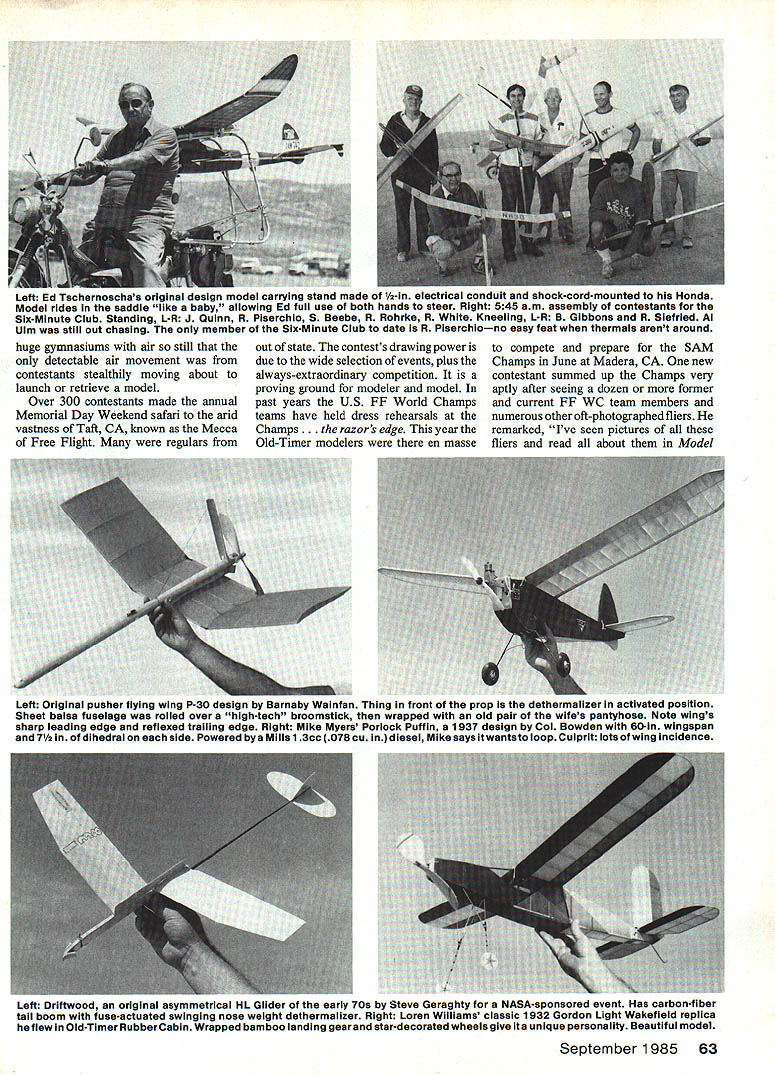
A crowning example of teamwork set a new AMA record for Class A Electrics:
- Team: Blaine Beron-Rawdon, Debbie Beron, Tony Beron, Martyn Cowley, and Bill Watson.
- Result: a string of thirteen 3-minute maxes and a final flight of 1:04 for a total record time of 40:04. The last flight ended at 6:45 p.m.
- Notes: Debbie and Martyn worked on the Solar Challenger; Bill built a 40-ft man-powered blimp and an RC pterodactyl; Blaine is an aircraft configuration engineer and Tony is a McDonnell-Douglas director—an aeronautically talented team that expertly iced batteries and picked rising air.
Growth of Nostalgia and Old-Timer events
Competition motivates and stimulates new and revived classes. The Nostalgia class has grown from a few entries to about two dozen entries across three events, with a variety of subjects beating the predicted dominance of Ram Rods:
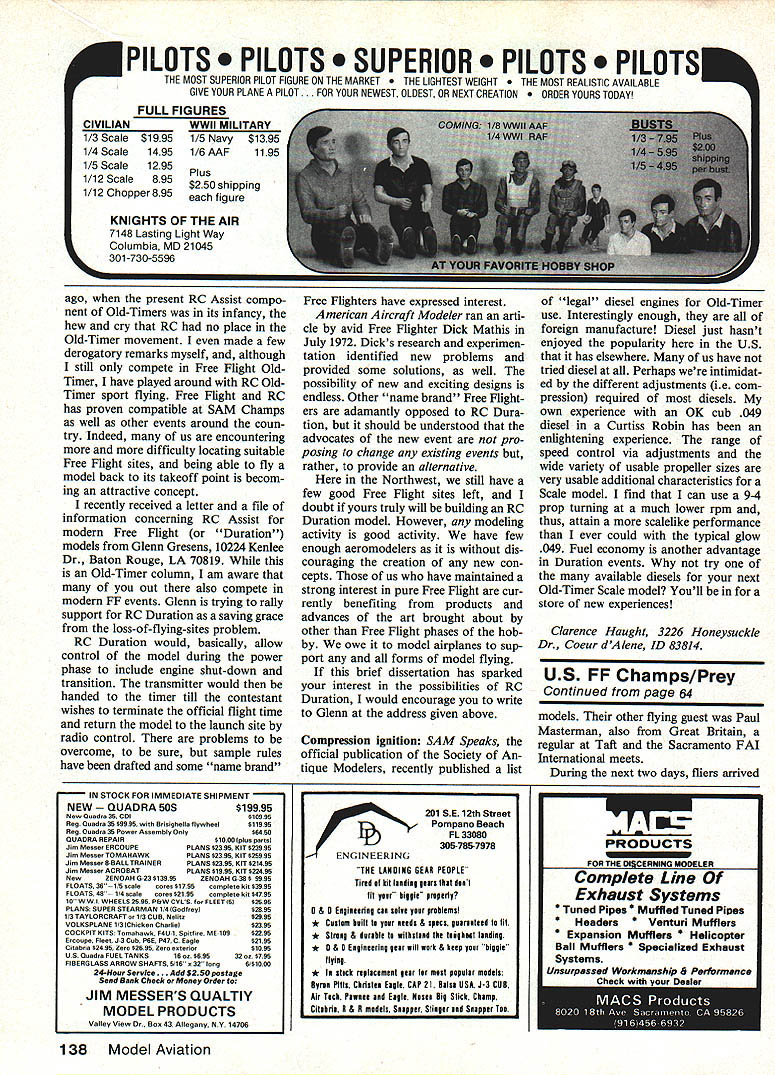
- 1/2A Nostalgia: Bob Sunberg won with twelve 5-minute maxes.
- 1/4A Gas: Paul Funk first with 35:50; Bob Sunberg third.
- C/D Nostalgia: Dan Keegan won flying a Sandy Hogan.
- A/B Nostalgia: the author’s Lucky Lindy maxed out.
Old-Timer events continue to promote casual, enjoyable competition and sportsmanship. Examples of Old-Timer winners and times:
- 30-sec. Antique: C. J. Jordan — 14:31.
- A Old-Time Pylon: Cliff Silva — 15:00.
- C Old-Time Pylon: Tom Keppler — 13:22.
- B Old-Time Cabin: Bruce Chandler — 12:44.
- Old-Time Rubber Cabin: Al Richardson — 13:49.
- 1/2A Texaco: Sal Taibi — 36:29.
- Texaco: Bob Dittmer — 31:35.
Spectator appeal: indoor, night, and scale events
Spectators played an essential role and enjoyed many events:
- Indoor: Gyms were lined with spectators watching fragile Easy B and Pennypalme models. Winners included Cezar Banks (Novice Pennypalme, 7:10) and Clarence Mather (Easy B, 11:07). Junior HL Glider: Jeff Wittman — 41.3 sec; Open HL Glider: Phedon Tsiknopoulos — 66 sec.
- Night Gas: Wind threatened to blow out the event, but conditions calmed after 8:30 p.m. and Night Gas began at 8:45 p.m. Large Class D models with small lights or chem-lites roared off in VTO dust clouds into the night. Over 150 spectators clustered around lanterns; Larry Babcock maxed out and won Night Gas, with Steve Beebe second after a short fuse.
- Scale: Perhaps the most crowd-pleasing. Notable winners and models:
- Peanut Scale: Don Srull — Voisin.
- Indoor Scale: Clarence Mather — V-Witt.
- Rubber Scale: Dick Seifried — Fairchild PT-19.
- Gas Scale: Frank Cagle — Pietenpol.
- Ray Beggins Perpetual Jumbo Rubber Scale Trophy: Loren Williams won with a superb 1916 Rumpler 6B-1 seaplane replica, notable for construction, workmanship, and realistic float touchdowns.
Organization and acknowledgements
The Champs would not be possible without many dedicated Free Flight modelers, family members, and volunteers. Special recognition is due to Contest Director Bill Stroman and his teenage assistants Kim and Cynde Waddell for their tireless efforts, enthusiasm, and ability to run the event smoothly.
Conclusion
Attendees of the 15th Annual U.S. Free Flight Championships were part of an extraordinary competition. Congratulations to all the winners. For those who didn’t win a trophy, take the opportunity to reflect, redirect efforts, and accept the challenge to compete next year. Think Free Flight!
Transcribed from original scans by AI. Minor OCR errors may remain.

