
U.S. FF Champs
By John Oldenkamp
Overview
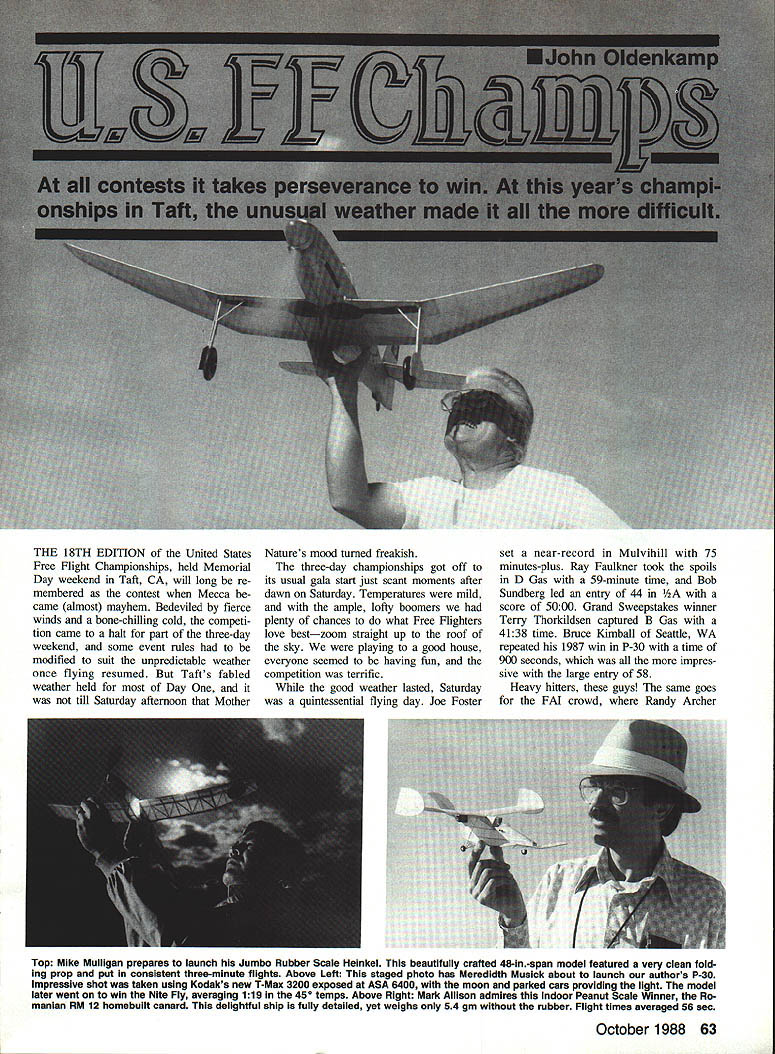
The 18th United States Free Flight Championships, held Memorial Day weekend in Taft, CA, will long be remembered. Contest Mecca came almost to mayhem. Bedeviled by fierce winds and bone-chilling cold, competition was halted for part of the three-day weekend and some event rules were modified to suit the unpredictable weather. Once flying resumed, Taft's fabled weather held through most of Day One, but Mother Nature's mood turned freakish on Saturday afternoon.
Saturday: A Near-Perfect Start
The three-day championships got off to their usual gala start just moments after dawn on Saturday. Temperatures were mild and, with ample lofty boomers, there were plenty of chances to do what free flighters love best — zoom straight up to the roof of the sky. Everyone seemed to be having fun and the competition was terrific.
Notable Saturday performances:
- Joe Foster — near-record in Mulvihill: 75+ minutes.
- Ray Faulkner — D Gas: 59 minutes.
- Bob Sundberg — led the 1/2 A entry (44 entrants) with a score of 5,000.
- Terry Thorkildsen — Grand Sweepstakes and B Gas: 41:38.
- Bruce Kimball (Seattle, WA) — repeated his 1987 win in P-30: 900 seconds.
- Randy Archer and Matt Gewain — strong showings in FAI: F1C Power and F1A Nordic, respectively.
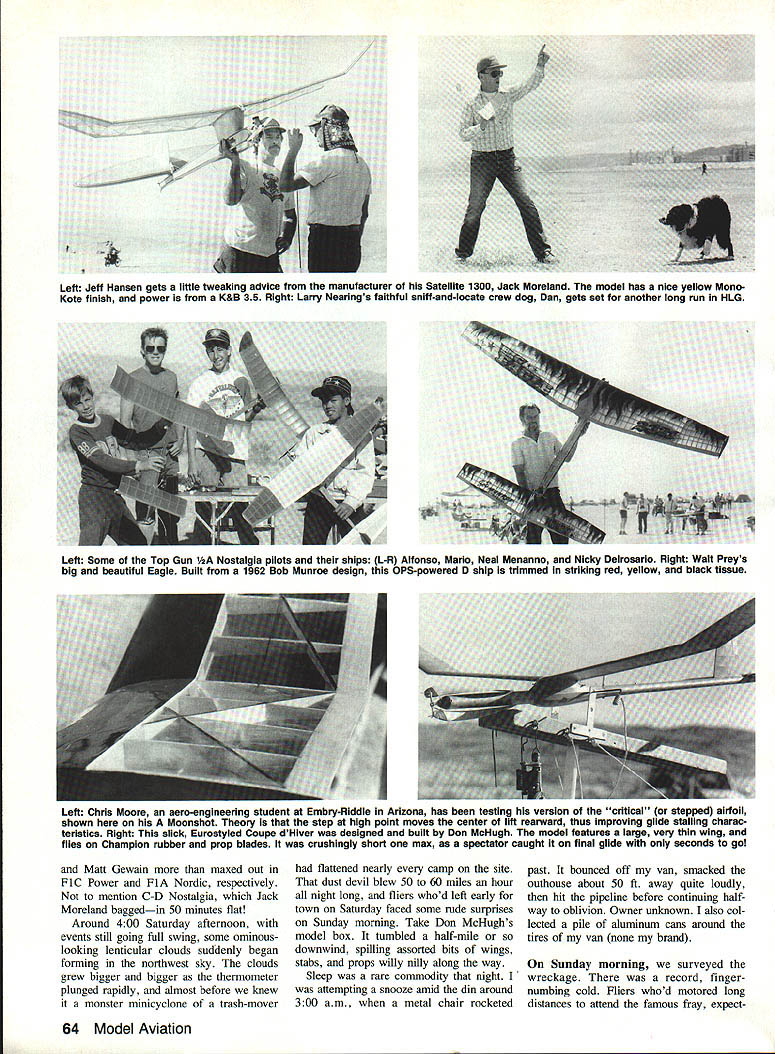
- Jack Moreland — C–D Nostalgia: 50:00.
The Storm
Around 4:00 p.m. Saturday, while events were still going full swing, ominous lenticular clouds formed in the northwest sky. The clouds enlarged, the thermometer plunged, and almost before anyone knew it a monster mini-cyclone — a trash-mover — flattened nearly every campsite. A dust devil blew 50–60 mph and persisted into the night.
Night-long fliers who'd left early for town faced rude surprises Sunday morning. Don McHugh's model box tumbled a half-mile downwind, spilling wings, stabs, and props. Sleep was scarce; around 3:00 a.m. a metal chair rocketed past, bounced off a van, smacked an outhouse about 50 ft away, hit a pipeline, and continued onward. One camp collected an odd pile of aluminum cans around a van's tires. Sunday morning revealed widespread wreckage amid record, finger-numbing cold: shredded tents and canopies, a few models bent into fascinating new shapes.
Despite the inevitable muttering and grumbling, people were snapping back quickly. Scenes of repair and "we-can-do-it" affirmation were everywhere; coffee proffered by a couple in a huge motor home tasted terrific.
Sunday: Perseverance and Rule Changes
Contest Director Carlo Godel had announced that Category II (three-minute maxes) would be flown Sunday, but strong winds forced a change to Category III — a rarity at Taft. This was unfortunate for the Wakefield group, since they had to fly three-minute maxes anyway. Some competitors packed up and left; the die-hards stayed.
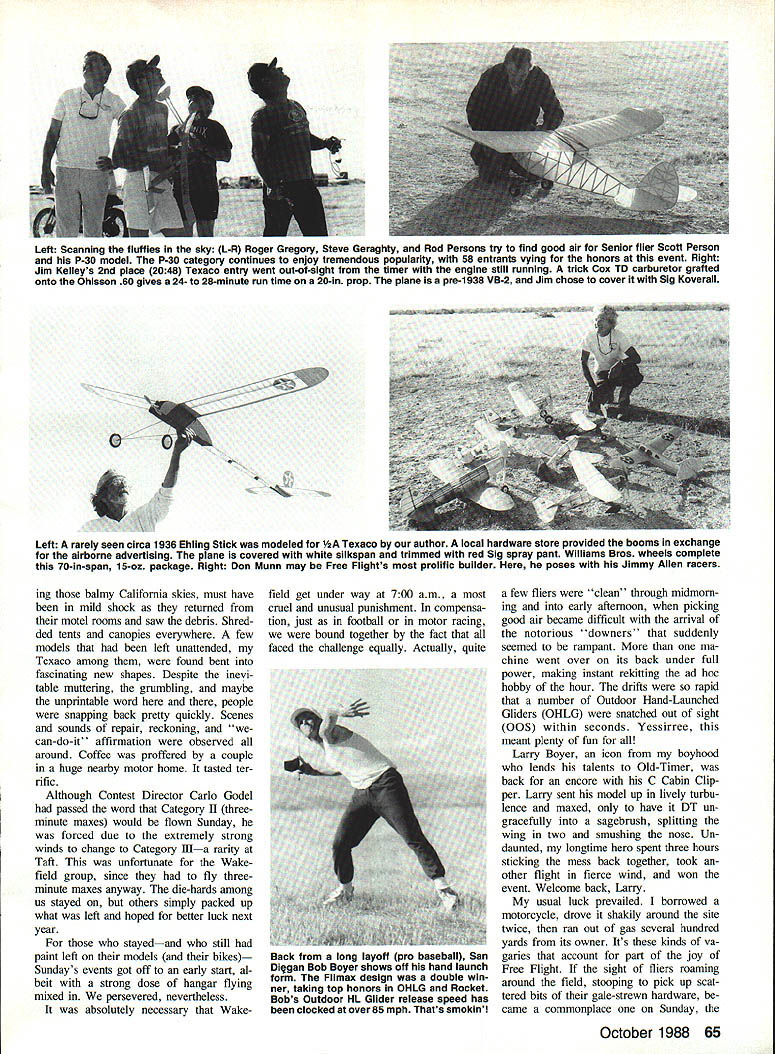
Wakefield had to start at 7:00 a.m., a cruel and unusual punishment but fair in the sense that everyone faced the same challenge. Many fliers were "clean" through midmorning, but picking good air became difficult when notorious downers arrived. More than one machine nosed over under full power, making instant re-kitting the ad hoc hobby of the hour. Drifts were so rapid that several Outdoor Hand-Launched Gliders (OHLG) were snatched out of sight within seconds.
A memorable comeback: Larry Boyer, an old-timer, launched his C Cabin Clipper, maxed in a lively thermal, then had it DT into sagebrush, splitting the wing and smushing the nose. He spent three hours repairing it, flew again in fierce wind, and won the event.
Personal vignette: I borrowed a motorcycle, rode it shakily around the site twice, then ran out of gas a few hundred yards from its owner. The sight of fliers stooping to pick up scattered bits of gear became commonplace on Sunday; the scene had its own charm and cheer.
Night Flying
Around 10:00 p.m. the winds finally quieted and, despite frigid temperatures, several determined fliers ventured out under a full moon for Hand Launch, P-30, and Gas events. Loading and winding rubber ships with numb fingers is no joke, but results were surprisingly good:
- Doss Porter — Gas: 9:59.
- (Author) — P-30: 3:43.
- Bob Boyer — OHLG: 1:50.
Midnight signaled the end of competition; some flew "one more time," drained the last refreshments, and retired.
Scale and Coupe d'Hiver
Scale had been rescheduled for Monday, so many usual competitors were able to watch. Larger-than-usual Scale rubber ships are a trend; Wakefield and Mulvihill fliers have been building huge fragile beasts to extract maximum duration from folding props and large rubber loads.
Scale highlights:
- Mike Mulligan — a whopper Heinkel, majestic until a half-span parted company with the airframe causing a vertical shut.
- Dick Siegfried — replaced his 5-ft Heinkel with a new Porter of heroic proportions; it flew extremely well.
Scale entries were otherwise slim, many entrants having left after the postponement.
Coupe d'Hiver drew 21 entrants and was excitingly close. Final scores:
- Hank Cole: 703
- Neal Furutani: 702
Rubber Events and Observations
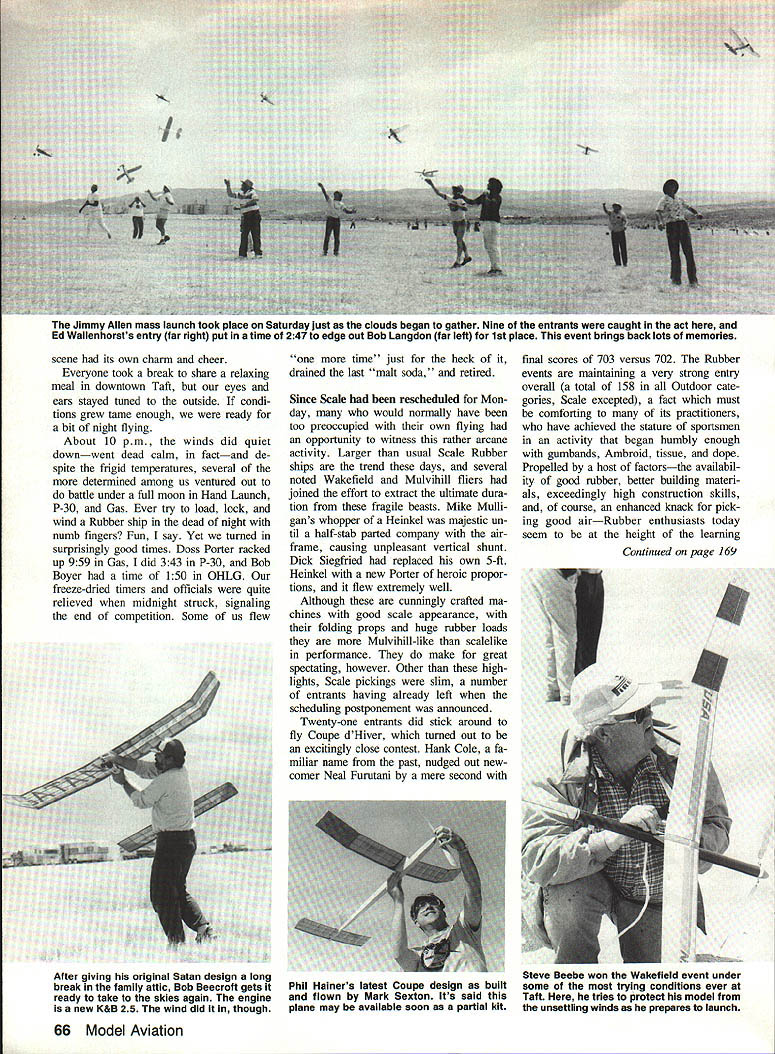
Rubber events remain strong overall: 158 entries in all outdoor categories (Scale excepted). Rubber's health is encouraging to many practitioners. The activity, which began humbly with gumbands, Ambroid, tissue, and dope, is propelled today by the availability of good rubber, better materials, high construction skills, and improved ability to pick good air. Rubber enthusiasts appear to be at the height of their learning curve.
Miscellany
I recently tackled the so-called "Canadian" Jimmy Allen and can pronounce it a job best left to others — satisfying, though, for modelers around 60 years of age as a nostalgic echo of earlier Air Race days.
Taft's Future
How do we assess Taft as a viable flying site? I spoke with Steve Beebe, who reassured me that, aside from the continuing expansion of the Kitty Litter factory (a potential airplane grabber), there is no immediate threat to our annual migration to Taft. Foot races after errant models across a 2.5-mile radius remain common, and Steve sees no reason they won't continue. Most Taft residents are supportive; locals often scour hills and ditches to retrieve and return out-of-sight equipment, and we do fill local lodges and eateries many times a year. As Steve puts it, "So not to sweat!"
Thanks and Closing
Contest Director Carlo Godel has shaped and led the USFFC for several years — an excruciating and mostly thankless job. His ability to show fairness while making quick decisions is admirable. Monster free flight carnivals like the USFFC do not spring full-blown from a vacuum; they require a ton of volunteer brains and sweat each year. All pilgrims to Mecca owe a huge thanks to Carlo and his crew — and a welcome to next year's contest director, Bill Booth, Jr.
With that we sum up aching legs and hoarse voices for a yearlong weather dance dedicated to the U.S. Free Flight Championships, 1989 edition, when the event comes of age. If our propitiations are successful, next year the sun will shine on skies bedecked with tall, friendly boomers. Sunscreen No. 32 recommended.
Transcribed from original scans by AI. Minor OCR errors may remain.

