
U.S. F.F.C. 1987
Returning to Taft for the annual U.S. Free Flight Championships is a pilgrimage that, to many, represents the height of flying free. The friendships and the chance to witness the best the sport has to offer almost outweigh the chance to be the winner of any event. — John Oldenkamp
Taft — Free Flight's Land of Oz
To go to Taft, California is to visit Free Flight's Land of Oz, aeromodeling's Mecca, and Kitty Litter HQ. Taft is the venue of our largest, most exciting contest, the United States Free Flight Championships. This annual blockbuster occupies the Memorial Day weekend, and it's where the Al Unsers of the world of Free Flight gather to test their equipment against man and nature in a paroxysm of competition unlike anything else in our sport/hobby.
The town of Taft itself is a small but important oil and agriculture hub, spotted with friendly mom-and-pop motels and diners, fast-food outlets, a modern supermarket, and lots of peace and quiet. Four miles east of town lies the field. Several hundred acres of hardpan circled by scrubby pucker-bush colonies stretch out for miles; this field is the stuff of Free Flighters' dreams. Manmade obstacles are few: oil pipelines, the California Aqueduct, a power line or two, and not much else. Nature is in abundance, and kit foxes (lovely little food beggars), an occasional sleepy scorpion or rattlesnake, and hawks are not uncommon sights.
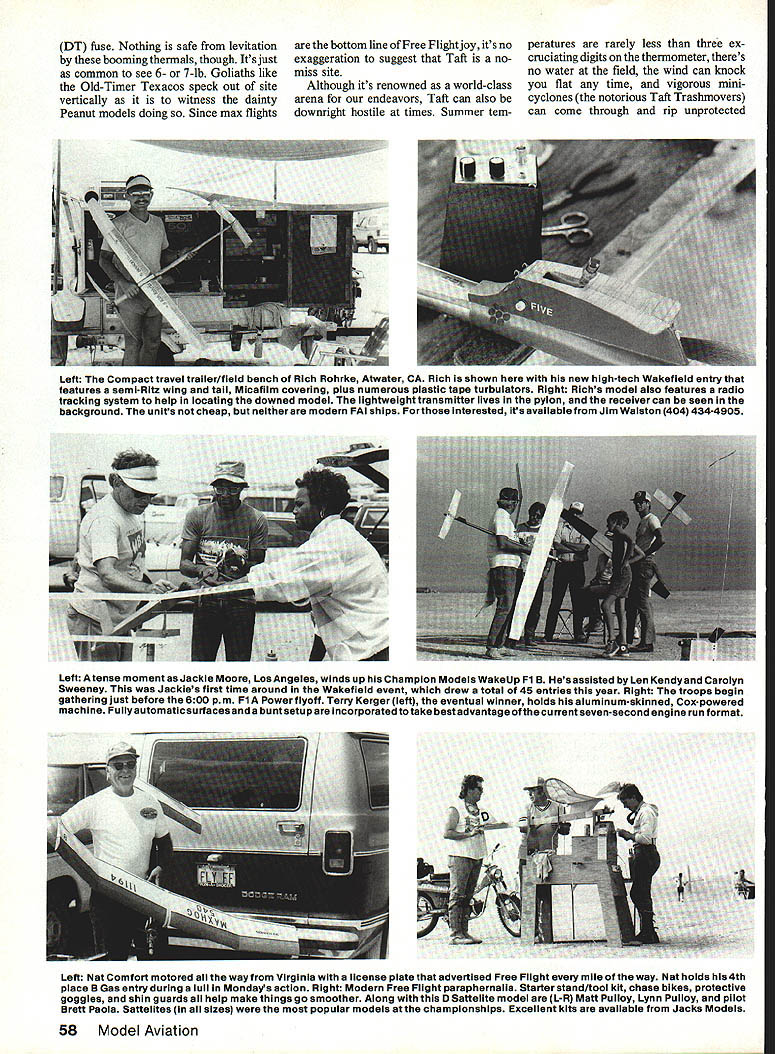
During most months of the year Taft also sports monumental thermals that rise like invisible monoliths and sometimes last through the nighttime hours. Nothing is safe from levitation by these booming thermals; it's common to see 6- or 7-lb Goliaths like Old-Timer Texacos speck out of sight vertically, just as it is to witness the dainty Peanut models doing the same. Since max flights are the bottom line of Free Flight joy, it's no exaggeration to suggest that Taft is a no-miss site.
Although it's renowned as a world-class arena for our endeavors, Taft can also be downright hostile at times. Summer temperatures are rarely less than three excruciating digits on the thermometer, there's no water at the field, the wind can knock you flat any time, and vigorous minicyclones (the notorious Taft Trashmovers) can come through and rip unprotected gear and shelters. Even so, when you look across the ample field, past the mini-city of RVs, tents, trucks, bikes, and people to the splendid distant mountain scarps, it is difficult to imagine a more inspiring setting. I find myself on the Taft terra at least four times a year—and wishing I was there the rest of the year.
Organization, weather, and atmosphere
Big contests of all types need the proper ingredients: good management, excellent weather, airplanes, and people. This year's USFFC was fortunate to be amply supplied with all four. Overall Contest Director Carlo Godel and his staff ran a splendid event with little fuss or confusion. The weather was blessedly cool—unusually so for May—making jackets mandatory for the early morning flights. In answer to those prayers, not a snake was seen—although an errant scorpion or two did come out of camouflage to dance with us.
Then there were the airplanes. Hundreds, perhaps a thousand of them, in every size, shape, and color imaginable. The people, also numbering in the hundreds, were in many cases dressed in wild desert outfits so that they, too, presented a motley quilt of size, shape, and color. There were funny people, famous people, newcomers, and veteran competitors, all into flying and all smiling.
The Free Flight Championships have incredible drawing power. It's great to be able to visit with modelers who've come from as far away as Virginia, New Jersey, Florida, Michigan, Salt Lake City, Texas (with a large and garrulous contingent), Washington, Oregon, Canada, and on and on. The appeal of the USFFC also spans the oceans, and there were competitors from both England and Israel. (Itsak ben-Itsak, the 1979 World Wakefield Champion, was there to represent Israel.) And of course Californians came from every corner of the state.
All told, this wonderful melange drew approximately 660 event entries from 274 officially registered modelers. Add to this family members, helpers, and nonflying interested parties—maybe another 200 souls or so—and you get a picture of the mini-city the contest had become.
Daily rhythm and contest action
The USFFC is not so much a contest as it is a celebration of the art—almost the ageless flying the way we like best. We designers and pilots come together for one purpose: to fly, fly, fly—unfettered and uncontrolled, except in the ways that we determine. Ideally, those determinations have been made by each of us before we convene. But no matter how much prior planning has been done—and if you've been to Taft before you know what I mean—the sound of the starting gun sets off a rush of intense and powerful activity. It's a peak experience, and you can feel it reverberating through the group.
The USFFC is a three-day event. Every early Saturday morning I knew that the first day had begun, as the sporadic roar of nervous motorcycle blips punctuated my state of groggy half-sleep. By 6:30 a.m. registration is going hot and heavy. A truck is on the way with free coffee provided by Truman Puckett and family of Bakersfield—very generous and very welcome.
With chilly fingers and pounding hearts, some pilots offer up nervous test flights, but no one wants to be the first to launch a model on an official flight. The morning skies are still leaden, and it's too early to be able to pick out the good air. More bikes filter up, some of them have teeth, I'm convinced (as my week-old "bites" attest), and begin ferrying support gear and models out to the flight line.
Promptly at 7:00 a.m., the real roar begins. A gas ship screams to incredible heights and then dethermalizes more or less instantly. The wise ones are content to wait until ambient flow rises a bit. They don't have to wait long—by 8:00 things are in full growl, and the time cards begin to fill with maxes. Not easy maxes, you understand, but maxes nevertheless. Concentration turns to the myriad little details that separate the winners from the also-rans. The timers are busy; the retrieval crews hustle; the digital thermometers climb steadily. We hear the whoops and see the effects of those long, graceful flights. Things are underway for sure now. Are we having fun yet? You bet!
Up and down the line, model boxes are open to reveal the many-splendored things that drew us here in the first place. The mind boggles at the variety of design approaches, gadgetry, and trends. By noon, a lifetime of Zaic books has passed by in three-dimensional form. It's enough to give you sensory overload. Time for a break and to begin the sharing and learning in earnest. Time for handshaking with old friends, new acquaintances, and the movers and shakers.
The smell of nitro, castor oil, rubber lube, and Truman Puckett's charcoal-broiled hot dogs wafts through, and, feeling overpowered, I have an early lunch. Or was that breakfast? Time warps are common at the Free Flight Champs. Silly behavior is allowed as well—in fact, the feeling of celebration generates it.
Featured competitions and highlights
The Ferraris of modeling and their intrepid masters were having their best go at it. There were 14 contestants in FAI Power, and the competition was awesome. After a long day there were still five with perfect scores, and a flyoff was set for 6:00 p.m. The winds picked up, the air went flat and chilly. Test flights found nothing but duff air.
Buckets Johnson from Montgomery, AL shot up a tremendous four-minute max. Hardy Brodersen, Terry Kerger (a relative newcomer from Pomona, CA), Roger Simpson, and Randy Archer followed with maxes. Strong drift forced retrieval delays; Brodersen's plane was seemingly lost despite two-way radio contact with his helpers. Eventually the plane returned in the hands of a local volunteer, but the hour was late and the wind high, so the fliers voted to do the five-minute round at 7:00 a.m. the next morning. What a finish!
Elsewhere, the event list was a total reflection of every Free Flight event in the AMA rule book, including many specials:
- Indoor and Outdoor events
- Peanuts (inside and out)
- Easy B
- Pennyplane
- All the FAI categories
- Old-Timer
- Payload
- Mulvihill
- Jetex
- One-shot and special events (many growing in importance)
A giant meet such as the USFFC can accommodate many more categories than most while still offering the AMA regulars super competition. Nearly all of the specials began as club-sponsored competitions to prevent memberships from going stale, and they may have rescued more than a few from quitting the sport altogether. Once they'd gained a following, the more attractive of the innovations were made official.
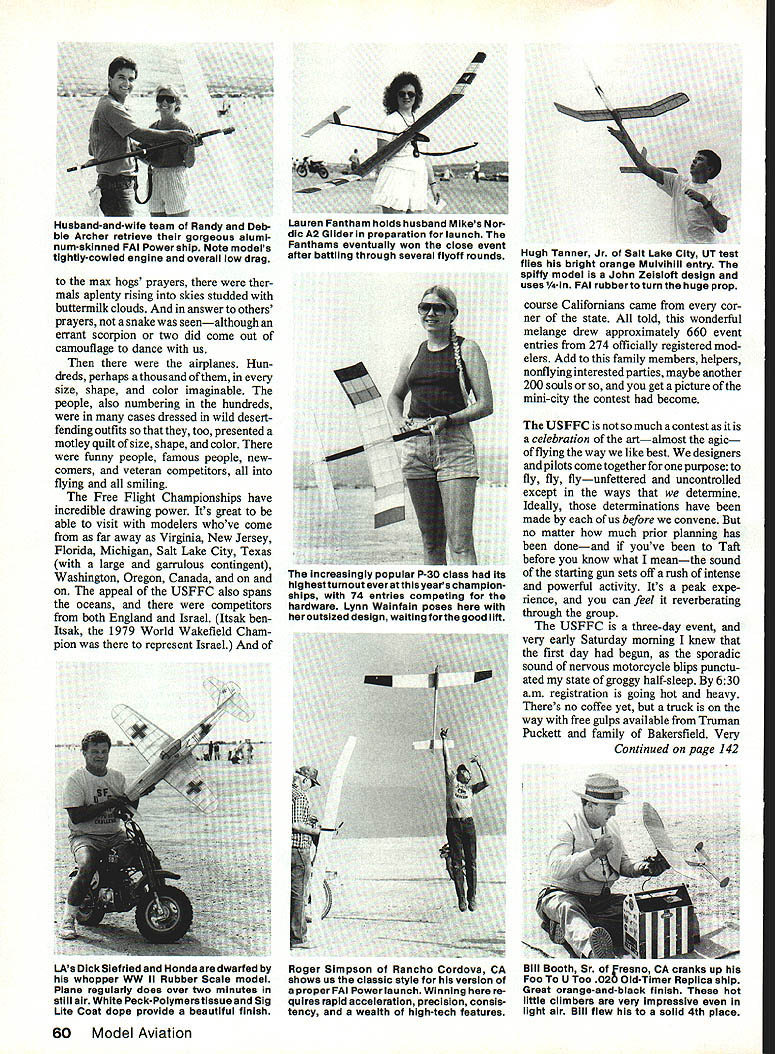
One outstanding example is the P-30 Rubber event, still running strong after its humble beginnings in the San Diego Orbiters club. At the USFFC there were 74 P-30 entries, including 14 in the Night Fly. A number of maxes were recorded under total darkness in both P-30 and Hand-Launch Glider. Lost models were retrieved the following day. Even under chilly and windy conditions, people were obviously getting a big bang from this version of blindman's buff.
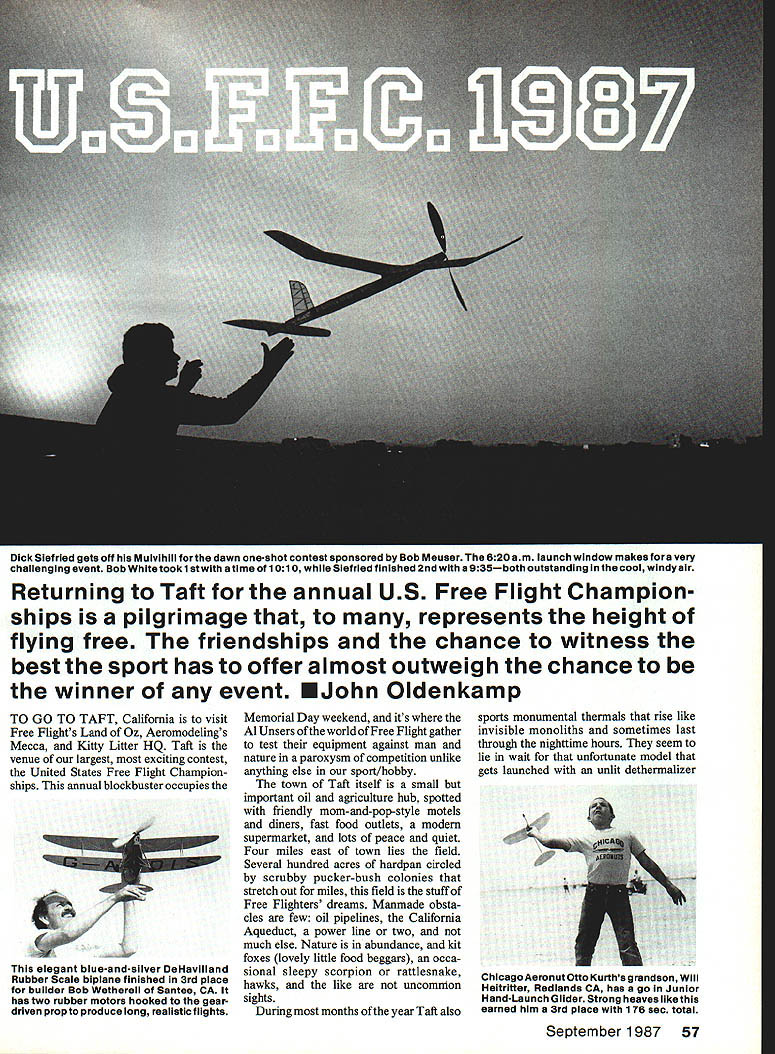
Sunday's events began at dawn. The one-shot OHLG drew perhaps 30 chuckers, and Bob Meuser's Mulvihill early-morning event saw Bob White putting up over 10 minutes in truly difficult air. For the first time, the San Diego Orbiters offered its P-30 contest, a kind of motorized P-30 clone that promises some wonderful fun for the future. These 100-gram, 30-inch models with Cox .020 reed-valve power really do perform.
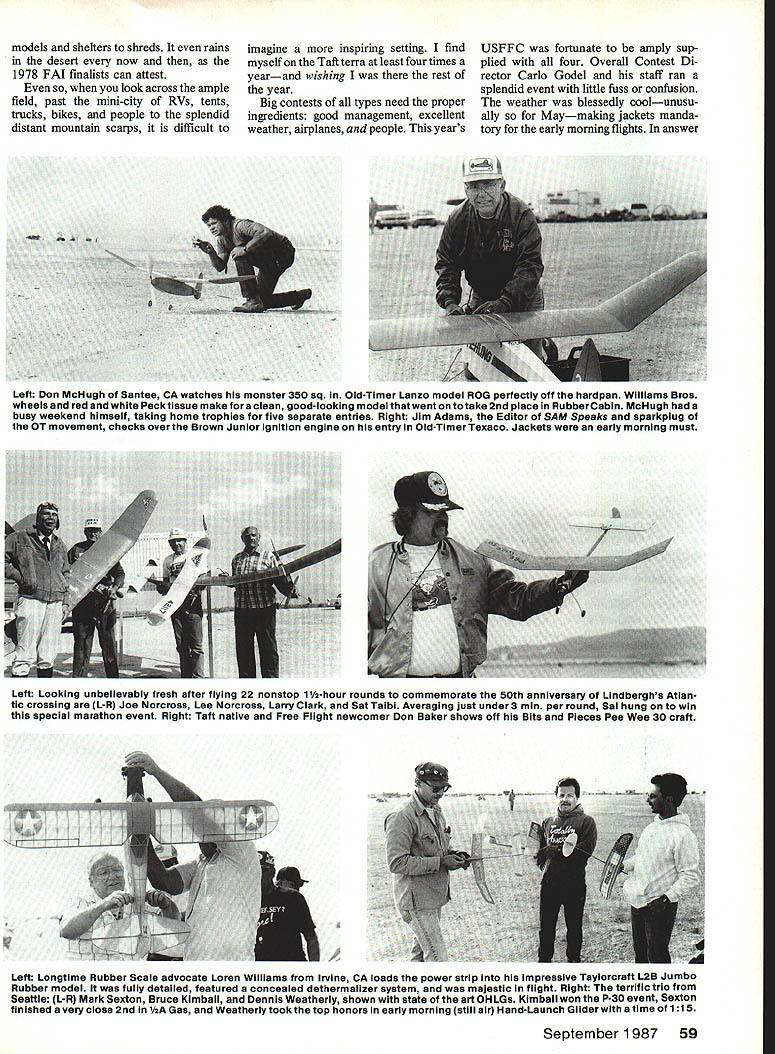
The granddaddy of the fun specials—the Norcross' 33½-hour, 22-round salute to the 50th anniversary of Lindbergh's landmark crossing of the Atlantic—was over and done before the actual start of the championships. The contest started at 7:52 a.m. on Wednesday and finished at 4:52 p.m. on Thursday, duplicating the original timeframe of the Lindbergh flight. Sal Taibi averaged nearly four minutes per attempt for 22 rounds, through 33½ uninterrupted hours—a staggering endurance performance.
As the burgeoning importance of special events indicates, our fraternity shows a craving to do different things these days. A good example of this is the recent CIAM decision to back a mini-FAI Power category, F1H, developed around the ubiquitous Cox .049 mills. We shall see how that develops.
Entries, trends, and craftsmanship
Rubber entries outnumbered Power about 62% to 38%, with FAI and Champion Model Products rubber preferred. With the exception of F1C, the Power events were mostly the territory of the Satellite variants, with a few originals thrown in. Wakefield had a huge entry of 45, showing a fairly even split between old and new. The usual seven-rounder was pre-climactic this time; many perfect scores qualified for the flyoff, which, after San Diego's Bob Pischero worked through the six-minute round, eventually went on to be won. To score highly in Mulvihill in indifferent and difficult conditions, one has to string out seven or eight maxes.
It quickly became obvious that performance and competition are way up across the board. Some of the building and flying efforts that we saw were as professional as one can get—without forming corporations. Free Flight's most enduring enticement remains the satisfaction of doing the very best you can—and making the entry from your private "skunkworks" shine against one and all.
Reflections and invitation
It is my view that there are no winners or losers at a meet such as the USFFC, particularly against the wonderful backdrop of Taft. We go there to enjoy, to meet, to examine, to sniff and scratch among the best the movement has to offer. The trophies and citations are great, but the gab, the way of recognition, and the chance to witness some of the premier modelers in the land are just as important to us. Those experiences cannot be matched, or easily forgotten. Mother's little pilot returns home bruised and battered, but happy, and with indelible memories in his head.
Envious? Don't be. Make a big, broad splash on next year's calendar; mark it "USFFC 1988," and lay travel plans. Sell the Mercedes and mortgage the ranch if that's what it takes. You'll be glad you did.
Transcribed from original scans by AI. Minor OCR errors may remain.

