
U.S. Fliers Win at '92 Control Line World Championships
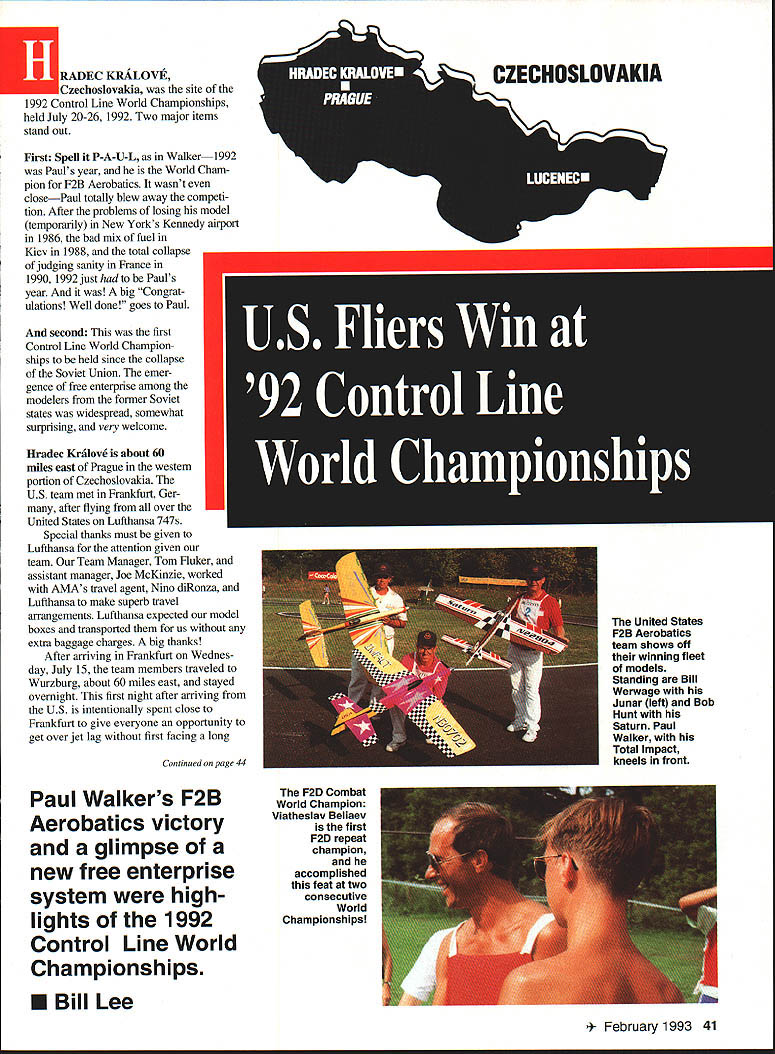
Hradec Králové, Czechoslovakia, was the site of the 1992 Control Line World Championships, held July 20–26, 1992. Two major items stand out.
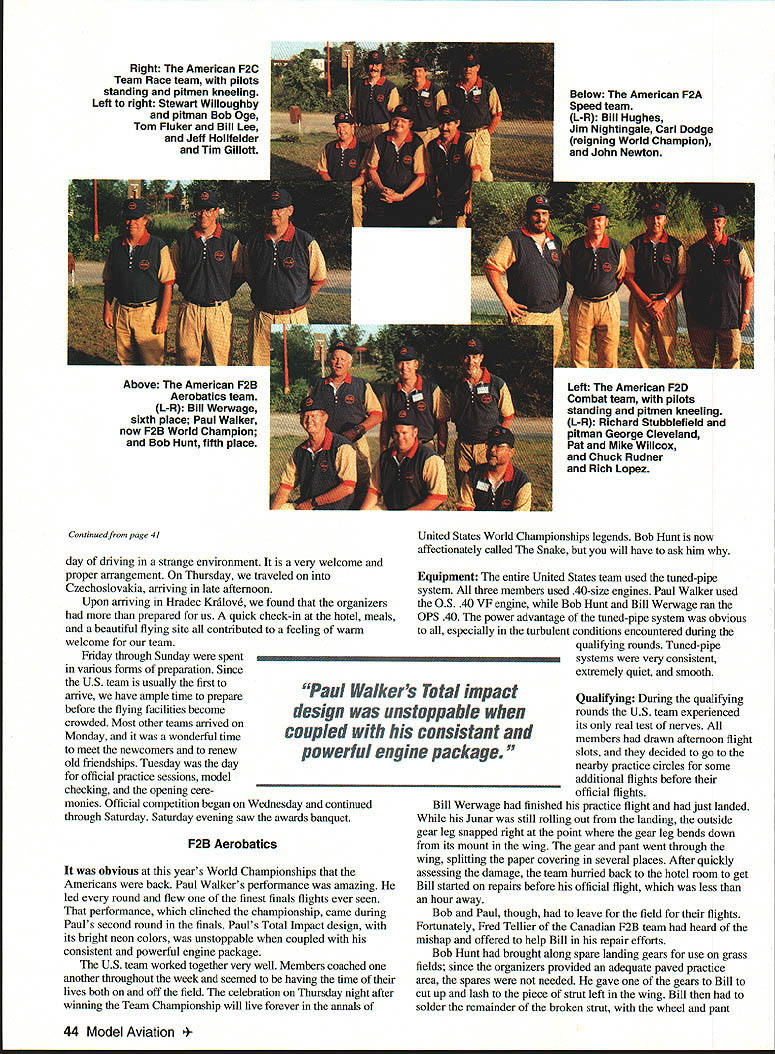
First: Spell it P-A-U-L, as in Walker—1992 was Paul's year, and he is the World Champion for F2B Aerobatics. It wasn't even close—Paul totally blew away the competition. After the problems of losing his model (temporarily) in New York's Kennedy airport in 1986, the bad mix of fuel in Kiev in 1988, and the total collapse of judging sanity in France in 1990, 1992 just had to be Paul's year. And it was! A big "Congratulations! Well done!" goes to Paul.
Second: This was the first Control Line World Championships to be held since the collapse of the Soviet Union. The emergence of free enterprise among the modelers from the former Soviet states was widespread, somewhat surprising, and very welcome.
Hradec Králové is about 60 miles east of Prague in the western portion of Czechoslovakia. The U.S. team met in Frankfurt, Germany, after flying from all over the United States on Lufthansa 747s. Special thanks must be given to Lufthansa for the attention given our team. Our team manager, Tom Fluker, and assistant manager, Joe McKinzie, worked with AMA's travel agent, Nino diRonza, and Lufthansa to make superb travel arrangements. Lufthansa expected our model boxes and transported them for us without any extra baggage charges. A big thanks!
After arriving in Frankfurt on Wednesday, July 15, the team members traveled to Wurzburg, about 60 miles east, and stayed overnight. This first night after arriving from the U.S. is intentionally spent close to Frankfurt to give everyone an opportunity to get over jet lag without first facing a long day of driving in a strange environment. It is a very welcome and proper arrangement. On Thursday we traveled on into Czechoslovakia, arriving in late afternoon.
Upon arriving in Hradec Králové, we found that the organizers had more than prepared for us. A quick check-in at the hotel, good meals, and a beautiful flying site all contributed to a feeling of warm welcome for our team.
Friday through Sunday were spent in various forms of preparation. Since the U.S. team is usually the first to arrive, we have ample time to prepare before the flying facilities become crowded. Most other teams arrived on Monday, and it was a wonderful time to meet the newcomers and to renew old friendships. Tuesday was the day for official practice sessions, model checking, and the opening ceremonies. Official competition began on Wednesday and continued through Saturday. Saturday evening saw the awards banquet.
Paul Walker's F2B Aerobatics victory and a glimpse of a new free enterprise system were highlights of the 1992 Control Line World Championships.
F2B Aerobatics
It was obvious at this year's World Championships that the Americans were back. Paul Walker's performance was amazing. He led every round and flew one of the finest finals flights ever seen. That performance, which clinched the championship, came during Paul's second round in the finals. Paul's Total Impact design, with its bright neon colors, was unstoppable when coupled with his consistent and powerful engine package.
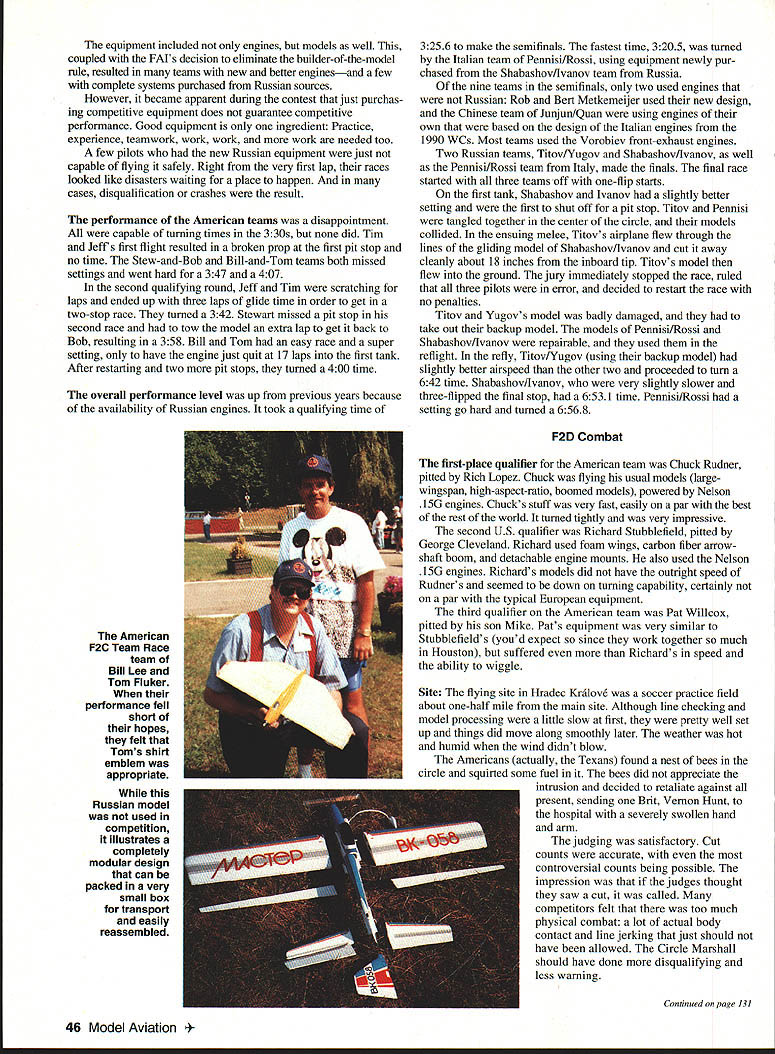
The U.S. team worked together very well. Members coached one another throughout the week and seemed to be having the time of their lives both on and off the field. The celebration on Thursday night after winning the Team Championship will live forever in the annals of United States World Championships legends. Bob Hunt is now affectionately called "The Snake," but you will have to ask him why.
Equipment
The entire United States team used the tuned-pipe system. All three members used .40-size engines. Paul Walker used the O.S. .40 VF engine, while Bob Hunt and Bill Werwage ran the OPS .40. The power advantage of the tuned-pipe system was obvious to all, especially in the turbulent conditions encountered during the qualifying rounds. Tuned-pipe systems were very consistent, extremely quiet, and smooth.
Qualifying
During the qualifying rounds the U.S. team experienced its only real test of nerves. All members had drawn afternoon flight slots, and they decided to go to the nearby practice circles for some additional flights before their official flights.
Bill Werwage had finished his practice flight and had just landed. While his Junar was still rolling out from the landing, the outside gear leg snapped right at the point where the gear leg bends down from its mount in the wing. The gear and pant went through the wing, splitting the paper covering in several places. After quickly assessing the damage, the team hurried back to the hotel to begin repairs. Bill started on repairs before his official flight, which was less than an hour away.
Bob and Paul, though, had to leave for the field for their flights. Fortunately, Fred Tellier of the Canadian F2B team had heard of the mishap and offered to help Bill in his repairs.
Bob Hunt had brought along spare landing gears for use on grass fields; since the organizers provided an adequate paved practice area, the spares were not needed. He gave one of the gears to Bill to cut up and lash to the piece of strut left in the wing. Bill then had to solder the remainder of the broken strut, with the wheel and pant attached to the new stub leg. All this had to be done in 40 minutes!
Meanwhile, Bob Hunt had to fly his way into the finals in some of the most turbulent and windy conditions of the contest. Bob's first flight was a washout because of a pull-test accident that bent a lead-out in his Saturn. Not realizing the lead-out was bent, Bob found that he had to hold considerable down at the handle to achieve level flight.
In the vertical eights, the pressure line popped off the tank and caused the engine to go very lean. The result was an overrun of the allotted seven-minute flight time and a low score. Even though his first flight was a 2,889, good enough for 12th position, Bob certainly needed his second flight.
Bill Werwage was still back at the hotel, waiting in the parking lot for Bob and Paul to return. He related the fix to his teammates as they raced back to the site. He had to cut through the D-tube sheeting on the top of the wing to lash the new gear leg in place. He said that Fred Tellier's help was invaluable, serving to remind us how much sportsmanship is a part of this hobby. With a few pieces of Fascal covering the holes in the wing, Bill proceeded to lay in the third-highest score, a 3,014. That's a competitor and a team!
Finals
The finals were a treat to watch. The fliers from the other countries have improved dramatically, and this was to be a war. The weather was not a factor in the finals, except that the very light wind kept shifting throughout the day.
Bill and Bob had to fly back-to-back on all three of their flights; they never got to fly later than eighth in any round. Since scores normally float a bit at the end of the rounds, their placings could have been better with the benefit of a later flight or two.
Paul Walker just destroyed everyone! He put in three flights of (in order) 3,069, 3,116, and 3,113, for a winning total of 6,229. Bob Hunt pulled up from his 12th-place qualifying position to fifth with flights of 2,943, 2,995, and a great 3,077. Bob's score of 6,072 was only one point behind the two fliers who tied for third at 6,073. Bill Werwage flew very well and posted flights of 2,976, 2,990, and 3,071 for a close sixth place. Tight!
F2C Team Race
There's nothing like Team Race at a world-class level! The quality of equipment, the intensity of preparation, the heightened sense of competitiveness, all coupled with a spirit of friendship—these only begin to describe the feelings at this event.
The practice days were very busy, with many teams trying for the last bit of performance. Tim Gillott and Jeff Hollifield, the top-placing U.S. team, had the same equipment they used in the Soviet Union in 1988 and in France in 1990. It runs about as well as ever, capable of 3:30s when everything is right. During the practice days, they were flying continuously, always searching for a little more: laps, speed, whatever.
Tim continues to use the rear-exhaust Nelson, with which he has had considerable success. His models are the only conventional (as opposed to flying wing) models still left in World Championships use.
Stew Willoughby and Bob Oge were also flying Nelson engines, but of the side-exhaust variety. Stewart, using flying wing models, had much of his equipment from previous years. Stew and Bob have been working on developing a single-blade prop, and the combination seems to run quite well.
At the WCs, Stew and Bob did not turn the sort of times of which they are capable; however, they won TR at the United States Nationals in June with a fine 3:31 qualifying and a 7:18 final race. In Czechoslovakia, they ran into engine problems. Two engines were damaged when wrist-pin keepers came loose, and three others encountered bearing problems.
Bill Lee and Tom Fluker, the third-place qualifiers, were the newcomers to the United States team. Both Bill and Tom are experienced in WC activities, but this was their first opportunity to compete in TR. Their equipment for this year's efforts was all new.
Bill built three new flying wing models that evolved from the Walt Perkins design of the early '80s. Bill and Tom were using the newest of Henry Nelson's designs, featuring integral-fin liners with side exhaust. The timing of these engines (quite high by previous Nelson standards) was nearly the same as for the glow engines. They proved to be very happy running at 34–35 laps and seemed to have performance as good or better than any other Nelson variants around. Since these new engines have much different characteristics from the older versions, more testing needs to be done to extract their full potential.
This year's TR event was especially interesting because of the availability of competitive equipment from the countries of the former Soviet Union. The professional modelers from Russia, the Ukraine, and the other countries are taking advantage of their newfound freedoms by bringing their equipment into production and sale.
The equipment included not only engines, but models as well. This, coupled with the FAI's decision to eliminate the builder-of-the-model rule, resulted in many teams with new and better engines—and a few with complete systems purchased from Russian sources.
However, it became apparent during the contest that just purchasing competitive equipment does not guarantee competitive performance. Good equipment is only one ingredient. Practice, experience, teamwork, work, work, and more work are needed too.
A few pilots who had the new Russian equipment were just not capable of flying it safely. Right from the very first lap, their races looked like disasters waiting for a place to happen. In many cases, disqualification or crashes were the result.
The performance of the American teams was a disappointment. All were capable of turning times in the 3:30s, but none did. Tim and Jeff's first flight resulted in a broken prop at the first pit stop and no time. The Stew-and-Bob and Bill-and-Tom teams both missed settings and went hard for a 3:47 and a 4:07.
In the second qualifying round, Jeff and Tim were scratching for laps and ended up with three laps of glide time in order to get in a two-stop race. They turned a 3:42. Stewart missed a pit stop in his second race and had to tow the model an extra lap to get it back to Bob, resulting in a 3:58. Bill and Tom had an easy race and a super setting, only to have the engine just quit at 17 laps into the first tank. After restarting and two more pit stops, they turned a 4:00 time.
The overall performance level was up from previous years because of the availability of Russian engines. It took a qualifying time of 3:25.6 to make the semifinals. The fastest time, 3:20.5, was turned by the Italian team of Pennisi/Rossi, using equipment newly purchased from the Shabashov/Ivanov team from Russia.
Of the nine teams in the semifinals, only two used engines that were not Russian: Rob and Bert Metkemeier used their new design, and the Chinese team of Junjun/Quan were using engines of their own that were based on the design of the Italian engines from the 1990 WCs. Most teams used the Vorobiev front-exhaust engines.
Two Russian teams, Titov/Yugov and Shabashov/Ivanov, as well as the Pennisi/Rossi team from Italy, made the finals. The final race started with all three teams off with one-flip starts.
On the first tank, Shabashov and Ivanov had a slightly better setting and were the first to shut off for a pit stop. Titov and Pennisi were tangled together in the center of the circle, and their models collided. In the ensuing melee, Titov's airplane flew through the lines of the gliding model of Shabashov/Ivanov and cut it away cleanly about 18 inches from the inboard tip. Titov's model then flew into the ground. The jury immediately stopped the race, ruled that all three pilots were in error, and decided to re-start the race with no penalties.
Titov and Yugov's model was badly damaged, and they had to take out their backup model. The models of Pennisi/Rossi and Shabashov/Ivanov were repairable, and they used them in the reflight. In the refly, Titov/Yugov (using their backup model) had slightly better airspeed than the other two and proceeded to turn a 6:42 time. Shabashov/Ivanov, who were very slightly slower and three-flipped the final stop, had a 6:53.1 time. Pennisi/Rossi had a setting go hard and turned a 6:56.8.
F2D Combat
The first-place qualifier for the American team was Chuck Rudner, pitted by Rich Lopez. Chuck was flying his usual models (large-wingspan, high-aspect-ratio, boomed models), powered by Nelson .15G engines. Chuck's equipment was very fast, easily on a par with the best of the rest of the world. It turned tightly and was very impressive.
The second U.S. qualifier was Richard Stubblefield, pitted by George Cleveland. Richard used foam wings, a carbon-fiber arrow-shaft boom, and detachable engine mounts. He also used the Nelson .15G engines. Richard's models did not have the outright speed of Rudner's and seemed to be down on turning capability, certainly not on a par with the typical European equipment.
The third qualifier on the American team was Pat Wilcox, pitted by his son Mike. Pat's equipment was very similar to Stubblefield's (you'd expect so since they work together so much in Houston), but suffered even more than Richard's in speed and the ability to wiggle.
Site: The flying site in Hradec Králové was a soccer practice field about one-half mile from the main site. Although line checking and model processing were a little slow at first, they were pretty well set up and things did move along smoothly later. The weather was hot and humid when the wind didn't blow.
The Americans (actually, the Texans) found a nest of bees in the circle and squirted some fuel in it. The bees did not appreciate the intrusion and decided to retaliate against all present, sending one Brit, Vernon Hunt, to the hospital with a severely swollen hand and arm.
The judging was satisfactory. Cut counts were accurate, with even the most controversial counts being possible. The impression was that if the judges thought they saw a cut, it was counted. Many competitors felt that there was too much physical contact: a lot of actual body contact and line jerking that just should not have been allowed. The Circle Marshall should have done more disqualifying and less warning.
They had revised the thongs so they could not come loose again, but this made them difficult to put on. In his second match Pat Wilcox lost by only a couple of air-time seconds when he was delayed in getting his second model launched while struggling with the revised thong. Richard Stubblefield was out 0–2 on the first day.
Pat Wilcox ended at 2–2. Pat won a match against Vadim Arifov when the streamer hook was pulled off the Russian's model. The streamers were made from very strong material, and the string used was so strong that it caused the streamer hook problem for Arifov when Pat got a kill. In one of Pat's losses, the hand-to-hand combat in the center of the circle became so bad that the Americans protested, but to no avail.
Chuck Rudner also finished at 2–2, winning over Mauricio Malagrino of Brazil and Tom van Mourik (the fourth-place finisher) from the Netherlands. Chuck lost to Pat McKenzie, from Canada, and Henning Forbech, from Denmark.
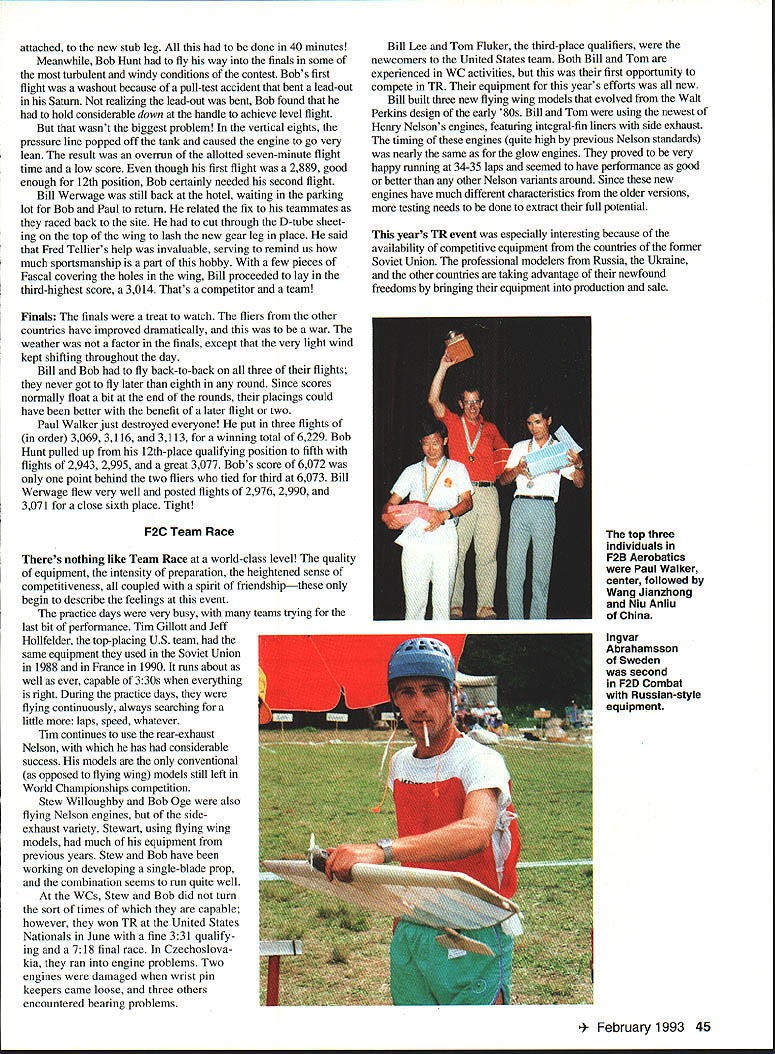
Viatcheslav Beliaev, of Russia, again won the F2D event. He is the first F2D repeat champion, and he accomplished this feat at two consecutive World Championships.
Best fly-away: One of Tom van Mourik's lines broke, and Mack Henry, the Circle Marshall, had him put the handle on the ground. The model looped around and finally snagged the spare model on the ground, breaking the other line. Tom's model flew away, and it's uncertain whether he got it back.
Future: Mufflers will be required in 1993. The Russians had several prototypes that did lower the noise level slightly; however, speed seemed to suffer by about five miles per hour when the mufflers were used. Many discussions about dirty tactics were held, and many western Europeans seem to want to clean up the event.
F2A Speed
After Carl Dodge's banner win in 1990 in France, 1992 was a disappointment for the American team. With Carl there as the reigning World Champion, the team consisted of Jim Nightingale and John Newton from California and Bill Hughes from Illinois.
John flew with the same equipment he used in France in 1990: Moki engines in the standard single-wing, asymmetrical model. John turned 282.8 kph, the fastest time of any of the team. This speed, which is about 5 mph faster than John turned to qualify for the team last fall, is typical of John's expected performance.
Jim Nightingale, who used Irvine engines, turned 265.0 kph (164.36 mph), somewhat slower than his qualifying speed of 171.22 mph in Los Angeles in 1991.
Bill Hughes, the third qualifier for the team, turned the second-fastest of the American team at 266.20 kph (165.40 mph), slightly faster than the 162.74 he turned for Team qualifying.
Carl Dodge, as the reigning World Champion, had one of the most frustrating experiences possible. His best speed of 286.30 kph (177.5 mph) was superior to that of all his fellow Americans but 15 kph off his Championship performance of two years earlier. Carl's equipment is superb as usual, with his own-designed and -built engines producing horsepower equal to or better than the best in the rest of the world. But Carl suffered from consistent six-lap failure: six laps of superb speed, and then a burndown and mediocre times. Lots of theories about the cause were bouncing around the field, but none proved to be of help to Carl.
Sergei Schekailin, of Russia, won the F2C event; his best time was 308.50 kph.
Some insight: The availability of premium-quality equipment from Russia and other provinces of the former Soviet Union was nowhere more apparent than in Speed. But the winning combination seemed to be a combination of Russian engine design and Italian construction. The first six places—two to Russians, three to Italians, and one to a French flier—were all taken with a new engine designed cooperatively by the Russian flier and the Rossi factory. The French flier, Gerard Billon, had a purchased setup identical to the Russian/Italian equipment.
With the demise of the builder-of-the-model rule in FAI competition, Speed has very much turned into a checkbook event. "How fast do you want to go? How big is your checkbook?"
At this World Champs, you could buy just about any level of performance you wanted. The only saving grace, just as in the other events, is that world-class equipment does not mean world-class performance: it still takes a great deal of work and practice to be competitive at this level.
It is great to have superb equipment available. However, you must wonder if buying a complete setup and then winning with it doesn't take some of the value of the effort away. Did the FAI make a mistake in eliminating the builder-of-the-model rule? Some will say they did. Others will say that it just made legal what everyone was doing, anyway!
1992 Junior World Championships
The 1992 Junior World Championships was an adventure to be remembered for a lifetime—by the team members and by the parents who shared in the experience. A special thanks to all of you who made it possible by your generous contributions of time, money, and supplies.
Round one — 210 seconds: It had been determined that Mark Richmond had a good calm-air model, so he was designated to fly first. This long-winged plane was designed to have a long, 60-second motor run at some sacrifice in altitude. Mark started winding up, but a strand broke and a new motor was obtained. After winding in 700 turns, he launched. The power still didn't help the altitude, but the plane continued up in a straight power run that carried it past the near end of the runway. The air beaters were fresh, and they were working the air enthusiastically. They claimed credit for keeping the plane above a tree as it made its max.
Rod Rogers was next in line, and his dad consulted the thermistor and their bubble machine, which was viewed with interest by some of the other participants. He launched to good altitude; however, the lift was still weak and he was down at 152 seconds.
David Fee proved to have a talent for picking air and found enough lift to make his max.
Round two — 180 seconds: The in-between air of this round had everyone fooled, and the entire team failed to max, although David was only seven seconds short.
Round three: Mark's flight was carried high in a thermal for its max, and it DT'ed into the top of some small trees nearby. No damage.
David had a good climb; his air was bad at first, but then the plane found a thermal and made its max. With the help of our air beaters, Rod also made his max.
Round four: Mark launched into a boomer with a DT fuse that was closer to four minutes than to three. The wind had come up, and the plane went far downrange, giving the chase crew a chance to show their stuff.
David waited for a time for some good air; he finally elected to give up his turn and rewind. Rod waited and finally launched for a high climb, but the lift gave out and he was down in 136 seconds. David also missed his max with a 122-second flight.
Round five: The wind was really blowing, making thermal picking difficult. Rod went up but was down in 133 seconds. David managed to find some good air and made his max. Mark was still flying his calm-air model; the long, delicate wings had to be held during winding to protect them from the wind. His flight lasted 146 seconds.
Round six: The wind had become very strong and turbulent. David's flight was buffeted down seven seconds short of his max. Rod was able to make his max, but the wing broke when the model landed in a tree. Mark switched to his "C" plane, which had a more powerful climb and stronger wings. It went up well, stalled and bounced in a turbulent thermal, and DT'ed early to disappear behind a hill two seconds short of his max.
Round seven: The wind had slacked off, and David went up with a good, high climb into a nice thermal. It looked beautiful up there in the clear sky against the background of fluffy cumulus clouds. Max.
Rod was up next; however, the line of fliers was playing a waiting game, and none wanted to go first to show the air to the others. After a 30-minute hold, Rod launched and made his max. Mark could not get his rubber from the timers until Rod's flight ended, which left him 10 minutes to load, wind, get back to the timers' table, look at the air, and launch. The chasers downwind were really getting concerned. A cheer went up when they saw Mark's plane shoot up into the sky just before the flare signaled the end of the round.
We all were happy that the boys won a Bronze team medal, and we were very proud of them as they stood on the podium the next day with our flag to receive their awards. Jody was also honored for his F1A individual fourth place and was asked to stand with the other winners to receive his diploma.
As a closing touch, the Czechs arranged sightseeing trips for those of us who were interested. Our group visited a 160-year-old glass factory where beautiful leaded crystal ware was being handcrafted. The reporter purchased a nice crystal vase to serve as a peace offering to his spouse upon his return!
The banquet was held that evening in the restaurant of our hotel. It was more like a big party with free drinks, hors d'oeuvres, and disco music. A few high-school girls were there for dancing partners, but the boys were enthusiastically engaged in trading T-shirts and other items and had little time for them. The Russians were offering planes and parts for sale at bargain prices, and we bought some interesting items. Thus we said farewell to our new friends from faraway places.
The United States team wishes to acknowledge the following:
- The AMA for providing team uniforms and funds as well as handling the necessary paperwork.
- Circus-Circus Enterprises for being the team's primary sponsor.
- Hardy Broderson, Bill Vanderbeek, the Detroit Balsa Bugs, Ken Phair, the Stockton Gas Modelers, and many others for their generous cash contributions.
- Ron McBurnett for donation of carbon-fiber parts.
- Gail Gewain for donating the neat team T-shirts and for serving as assistant team manager.
- Jim Bradley and Dan Earl for donations of supplies.
- Bob Waterman for chairing the fundraising drive and finding good places to eat in Lucenec.
- Matt Gewain for a great job of managing the team.
The Junior fliers of today are the future of model aviation, and this kind of activity is the ultimate incentive for them to participate. Continued support for the Junior Free Flight Championships program by AMA, NFFS, and individual modelers nationwide is strongly recommended. It is hoped that U.S. participation in Junior World Championships programs will expand into other modeling categories as well.
Transcribed from original scans by AI. Minor OCR errors may remain.

