
U.S. Free Flight Championships
Text and Photos by Bob Meuser
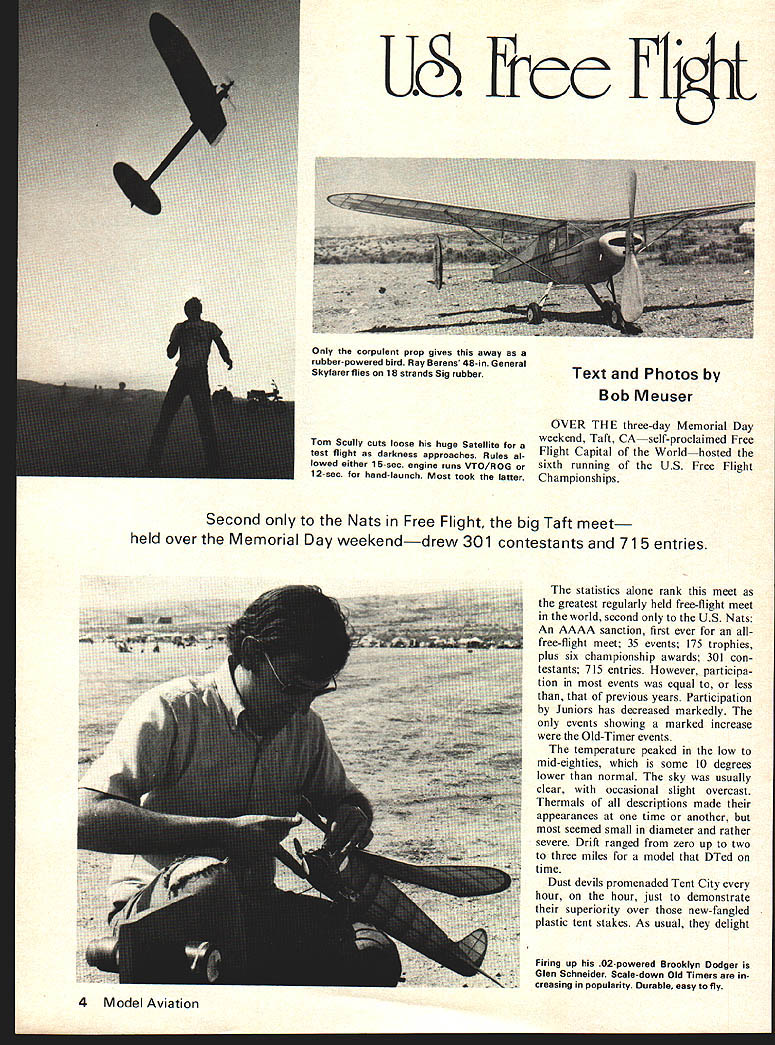
OVER THE three-day Memorial Day weekend, Taft, CA—self-proclaimed Free Flight Capital of the World—hosted the sixth running of the U.S. Free Flight Championships.
Second only to the Nats in Free Flight, the big Taft meet—held over the Memorial Day weekend—drew 301 contestants and 715 entries.
The statistics alone rank this meet as the greatest regularly held free-flight meet in the world, second only to the U.S. Nats. An AAAA sanction, first ever for an all-free-flight meet; 35 events; 175 trophies, plus six championship awards; 301 contestants; 715 entries. However, participation in most events was equal to, or less than, that of previous years. Participation by Juniors has decreased markedly. The only events showing a marked increase were the Old-Timer events.
The temperature peaked in the low to mid-eighties, which is some 10 degrees lower than normal. The sky was usually clear, with occasional slight overcast. Thermals of all descriptions made their appearances at one time or another, but most seemed small in diameter and rather severe. Drift ranged from zero up to two or three miles for a model that DTed on time.
Dust devils promenaded Tent City every hour, on the hour, just to demonstrate their superiority over those new-fangled plastic tent stakes. As usual, they delight in collecting loose bits of modeling gear: one wing was timed at 1 min. 30 sec.
Taft is situated in the northwest corner of a rather flat valley. The low-lying hills to the north peter out right at the edge of the field. To the immediate west lie small but steep hills, followed by the mountains of the Coast Range. The mountains to the south are some 15 miles distant. For all practical purposes, the valley extends to infinity toward the east. The drift is usually toward the south or the west, occasionally toward the east, and almost never toward the north. The camping and launching area is dead flat and clear, but the surrounding terrain is criss-crossed with ditches, pipelines, sagebrush, roads and trails that start nowhere and go nowhere, railroads, and the like. But despite such hazards to navigation, modelers cope quite handily on foot or by motorcycle, and occasionally even by bicycle.
One hazard is the ponds and tanks containing mucky goop of one sort or another. Fortunately, the mucky-goopers have been leaned on by the environmentalists sufficiently to induce them to cover their tanks with screens in order to inhibit the demise of such endangered species as the California Condor and the FAI-Power Model. Ken Oliver tested the system by plopping his super-sleek model onto one of the screens. There were a few anxious moments, then he managed to fish it off with a long pole and a bit of twine.
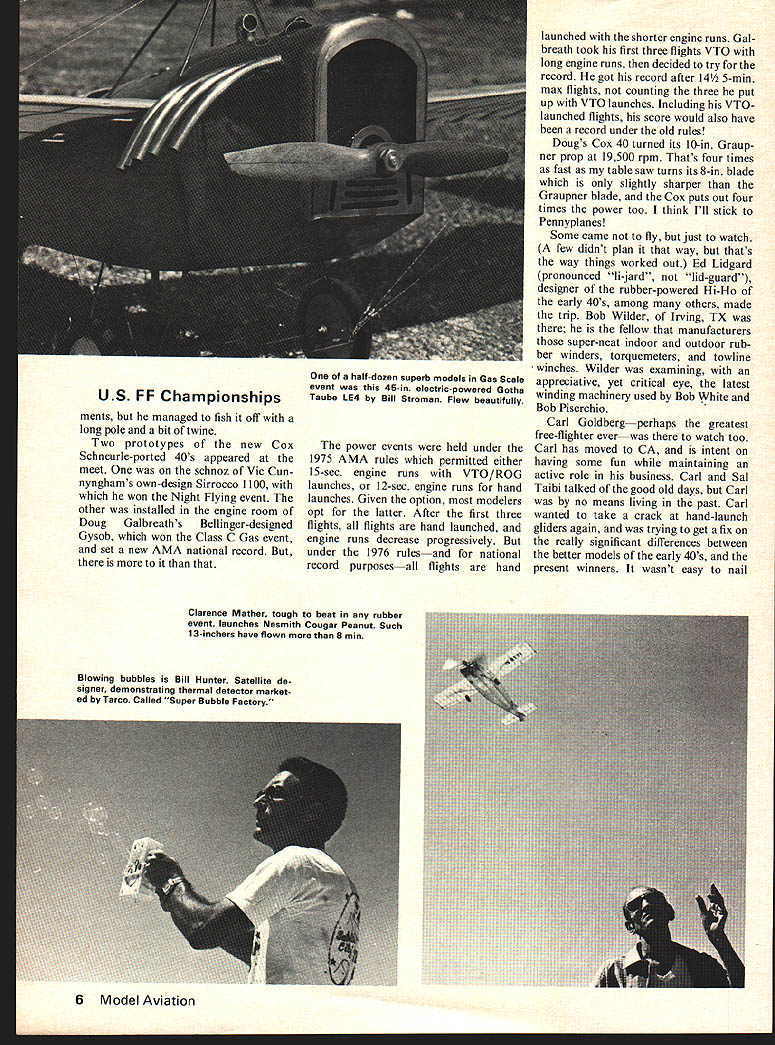
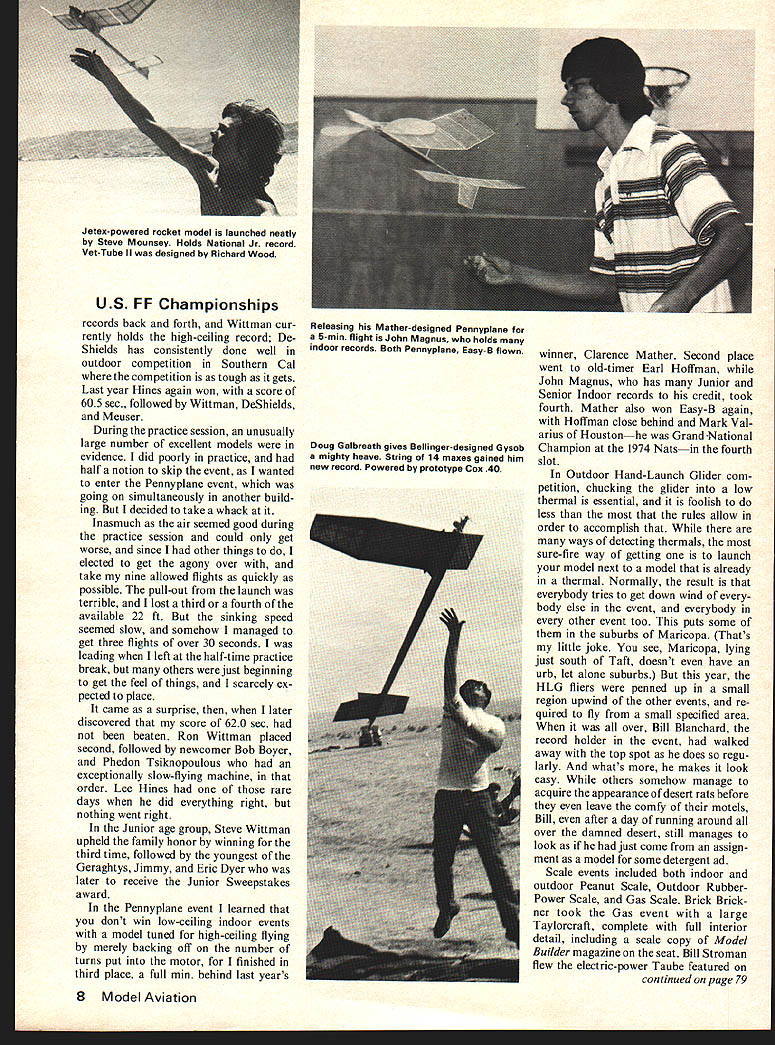
Two prototypes of the new Cox Schneurle-ported 40s appeared at the meet. Vic Cunnyngham's own-design Sirrocco 1100 won the Night Flying event. Doug Galbreath's Bellinger-designed Gysob, with another installed engine, won the Class C Gas event and set a new AMA national record. A half-dozen superb models competed in the Gas Scale event — a 45-in. electric-powered Gotha Taube (LE-4) by Bill Stroman flew beautifully.
Power events, held under 1975 AMA rules, permitted either 15-sec engine runs for VTO/ROG launches or 12-sec engine runs for hand launches. Given the option, modelers opted for the latter. After the first three flights, for flights hand-launched the engine runs decrease progressively. Under 1976 rules, and for national-record purposes, all flights are hand-launched with shorter engine runs. Galbreath took the first three flights VTO with long engine runs, decided to try for the record and got the record after 14½ ... max flights counting three put-up VTO launches. Including VTO-launched flights, the score would also have been a record under the old rules. Doug's Cox 40 turned its 10-in. Graupner prop 19,500 rpm. That's four times faster than a table saw turns its
U.S. Free Flight Championships
8-in. blade which is only slightly sharper than the Graupner blade, and the Cox puts out four times the power too. I think I'll stick to Pennyplanes!
Some came not to fly, but just to watch. (A few didn't plan it that way, but that's the way things worked out.) Ed Lidgard (pronounced "li-jard", not "lid-guard"), designer of the rubber-powered Hi-Ho of the early 40's, among many others, made the trip. Bob Wilder, of Irving, TX was there; he is the fellow that manufactures those super-neat indoor and outdoor rubber winders, torquemeters, and towline winches. Wilder was examining, with an appreciative, yet critical eye, the latest winding machinery used by Bob White and Bob Pischerich.
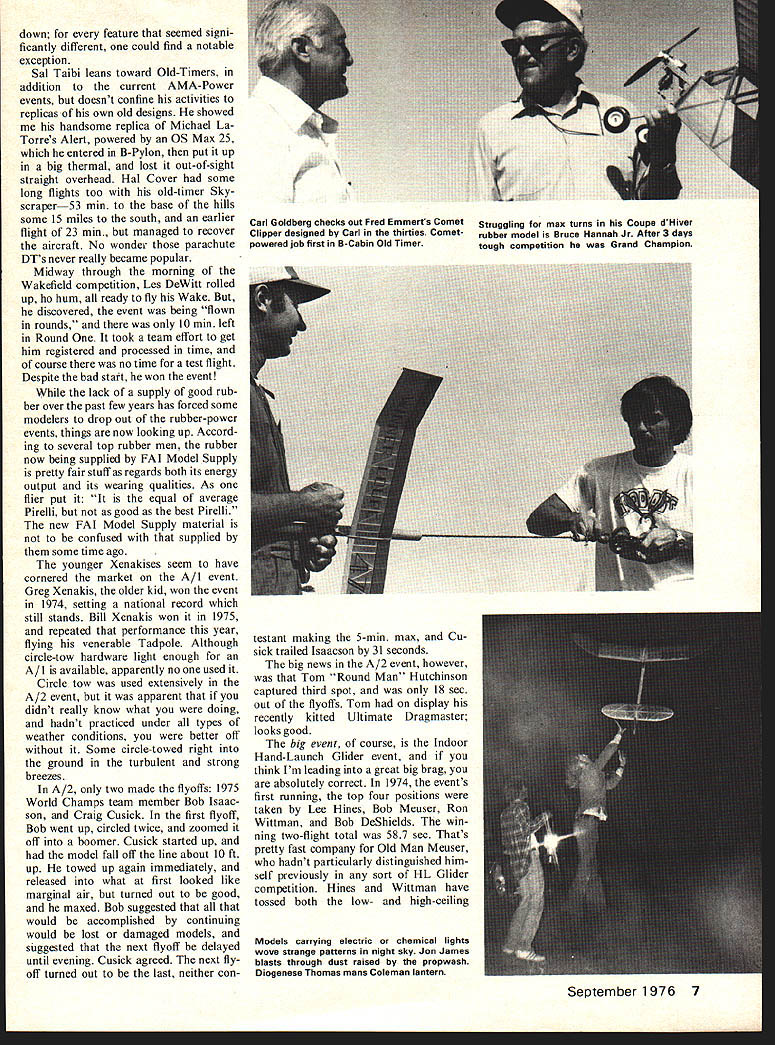
Carl Goldberg—perhaps the greatest free-flighter ever—was there to watch too. Carl has moved to CA, and is intent on having some fun while maintaining an active role in his business. Carl and Sal Taibi talked of the good old days, but Carl was by no means living in the past. Carl wanted to take a crack at hand-launch gliders again, and was trying to get a fix on the really significant differences between the better models of the early 40's, and the present winners. It wasn't easy to nail down; for every feature that seemed significantly different, one could find a notable exception.
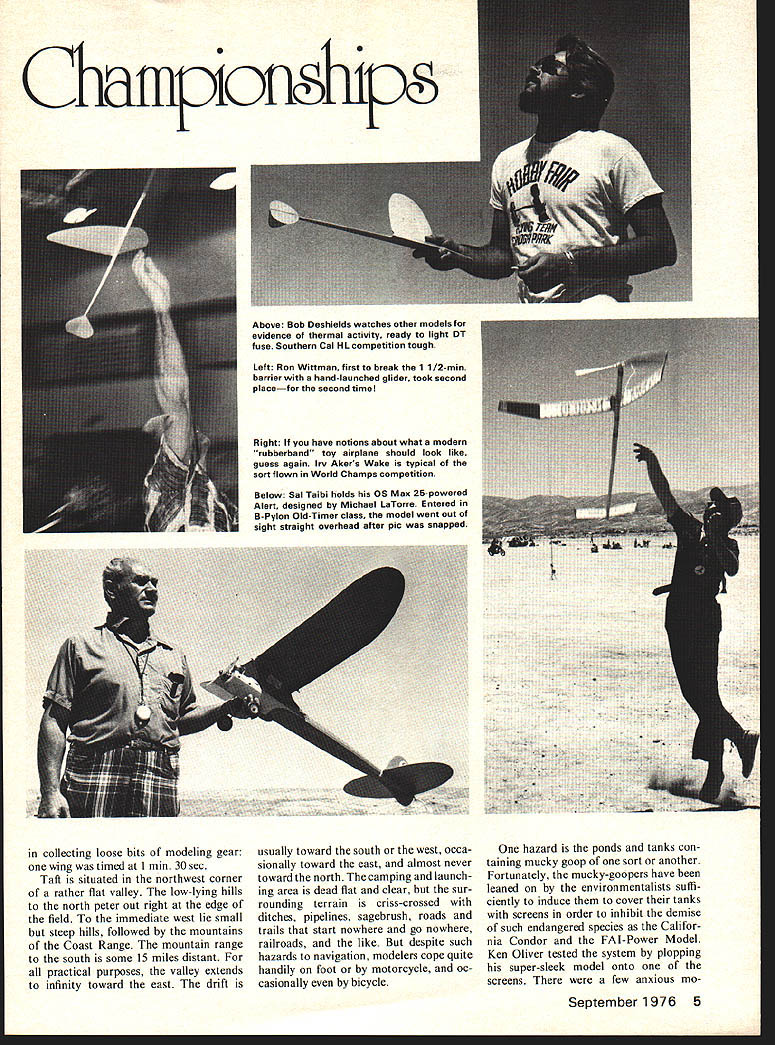
Sal Taibi leans toward Old-Timers, in addition to the current AMA-Power events, but doesn't confine his activities to replicas of his own old designs. He showed me his handsome replica of Michael LaTorre's Alert, powered by an OS Max 25, which he entered in B-Pylon, then put it up in a big thermal, and lost it out-of-sight straight overhead. Hal Cover had some long flights too with his old-timer Skyscraper—53 min. to the base of the hills some 15 miles to the south, and an earlier flight of 23 min., but managed to recover the aircraft. No wonder those parachute DT's never really became popular.
Midway through the morning of the Wakefield competition, Les DeWitt rolled up, ho-hum, all ready to fly his Wake. But, he discovered, the event was being "flown in rounds," and there was only 10 min. left in Round One. It took a team effort to get him registered and processed in time, and of course there was no time for a test flight. Despite the bad start, he won the event!
While the lack of a supply of good rubber over the past few years has forced some modelers to drop out of the rubber-power events, things are now looking up. According to several top rubber men, the rubber now being supplied by FAI Model Supply is pretty fair stuff as regards both its energy output and its wearing qualities. As one flier put it: "It is the equal of average Pirelli, but not as good as the best Pirelli."
The new FAI Model Supply material is not to be confused with that supplied by them some time ago.
The younger Xenakises seem to have cornered the market on the A/1 event. Greg Xenakis, the older kid, won the event in 1974, setting a national record which still stands. Bill Xenakis won it in 1975, and repeated that performance this year, flying his venerable Tadpole. Although circle-tow hardware light enough for an A/1 is available, apparently no one used it. Circle tow was used extensively in the A/2 event, but it was apparent that if you didn't really know what you were doing, and hadn't practiced under all types of weather conditions, you were better off without it. Some circle-towed right into the ground in the turbulent and strong breezes.
In A/2, only two made the flyoffs: 1975 World Champs team member Bob Isaacson, and Craig Cusick. In the first flyoff, Bob went up, circled twice, and zoomed it off into a boomer. Cusick started up, and what the model did off the line about 10 ft. up. He towed up again immediately, and released into what at first looked like marginal air, but turned out to be good, and he maxed. Bob suggested that all that would be accomplished by continuing would be lost or damaged models, and suggested that the next flyoff be delayed until evening. Cusick agreed. The next flyoff turned out to be the last, neither contestant making the 5-min. max, and Cusick trailed Isaacson by 31 seconds.
The big news in the A/2 event, however, was that Tom "Round Man" Hutchinson captured third spot, and was only 18 sec. out of the flyoffs. Tom had on display his recently kitted Ultimate Dragmaster; looks good.
The big event, of course, is the Indoor Hand-Launch Glider event, and if you think I'm leading into a great big brag, you are absolutely correct. In 1974, the event's first running, the top four positions were taken by Lee Hines, Bob Meuser, Ron Wittman, and Bob DeShields. The winning two-flight total was 58.7 sec. That's pretty fast company for Old Man Meuser, who hadn't particularly distinguished himself previously in any sort of HL Glider competition. Hines and Wittman have tossed both the low- and high-ceiling
U.S. Free Flight Championships
records back and forth, and Wittman currently holds the high-ceiling record; DeShields has consistently done well in outdoor competition in Southern Cal and the competition is as tough as it gets. Last year Hines again won, with a score of 60.5 sec., followed by Wittman, DeShields, and Meuser.
During the practice session, an unusually large number of excellent models were in evidence. I did poorly in practice, and had half a notion to skip the event, as I wanted to enter the Pennypalne event, which was going on simultaneously in another building. But I decided to take a whack at it.
Inasmuch as the air seemed good during the practice session and could only get worse, and since I had other things to do, I elected to get the agony over with, and take my nine allowed flights as quickly as possible. The pull-out from the launch was terrible, and I lost a third or a fourth of the available 22 ft. But the sinking speed seemed slow, and somehow I managed to get three flights of over 30 seconds. I was leading when I left at the half-time practice break, but many others were just beginning to get the feel of things, and I scarcely expected to place.
It came as a surprise, then, when I later discovered that my score of 62.0 sec. had not been beaten. Ron Wittman placed second, followed by newcomer Bob Boyer, and Pheden Tsiknopoulos who had an exceptionally slow-flying machine, in that order. Lee Hines had one of those rare days when he did everything right, but nothing went right.
In the Junior age group, Steve Wittman upheld the family honor by winning for the third time, followed by the youngest of the Geraghtys, Jimmy, and Eric Dyer who was later to receive the Junior Sweepstakes award.
In the Pennypalne event I learned that you don't win low-ceiling indoor events with a model tuned for high-ceiling flying by merely backing off on the number of turns put into the motor, for I finished in third place, a full min. behind last year's winner, Clarence Mather. Second place went to old-timer Earl Hoffman, while John Magnus, who has many Junior and Senior Indoor records to his credit, took fourth. Mather also won Easy-B again, with Hoffman close behind and Mark Valvarius of Houston — he was Grand-National Champion at the 1974 Nats — in the fourth slot.
In Outdoor Hand-Launch Glider competition, chucking the glider into a low thermal is essential, and it is foolish to do less than the most that the rules allow in order to accomplish that. While there are many ways of detecting thermals, the most sure-fire way of getting one is to launch your model next to a model that is already in a thermal. Normally, the result is that everybody tries to get downwind of everybody else in the event, and everybody in every other event too. This puts some of them in the suburbs — or Maricopa. (That's my little joke. You see, Maricopa, lying just south of Taft, doesn't even have an urb, let alone suburbs.) But this year, the HLG fliers were penned up in a small region upwind of the other events, and required to fly from a small specified area. When it was all over, Bill Blanchard, the record holder in the event, had walked away with the top spot as he does so regularly. And what's worse, he makes it look easy. While others somehow manage to acquire the appearance of desert rats before they even leave the comfy of their models, Bill, even after a day of running around all over the damned desert, still manages to look as if he had just come from an assignment as a model for some detergent ad.
Scale events included both indoor and outdoor Peanut Scale, Outdoor Rubber-Power Scale, and Gas Scale. Brick Brickner took the Gas event with a large Taylorcraft, complete with full interior detail, including a scale copy of Model Builder magazine on the seat. Bill Stroman flew the electric-power Taube featured on the June issue of Model Builder, and it flew beautifully. Mather and Warner tried their level best to lose their Peanut Scale models in thermals, and Warner put up at least one flight of around five min. Other names such as Cover, Moss, Mulligan are prominent in the winners lists for all three scale events also. But I wonder if my leg is being pulled when I see M. Mulligan on top of the list for Indoor Peanut. Next they'll be trying to tell me that Mister Mulligan was flying a peanut-scale model of Bill Warner.
While the Night Flying event is routine in contests arranged by the Southern Californians, it might seem a bit strange to those used to more conventional after-sundown pursuits. Those who do it frequently make it seem easy. A chemical light, or a semi-haywire arrangement of batteries, wires, and a lamp bulb, are taped or rubber-banded onto the fuselage of a conventional Gas model, usually a large B or C-class model. A gasoline lantern—or perhaps one of the snazzier cordless electrics—raises the local environment to slightly above the threshold of visibility. For the flier, the rest is conventional competition free flight. For the chaser and the timer, the best that can be said is that the chances for contracting sunstroke are extremely small.
One of the Xenakis kids hooked a chem light to a hand-launch glider; it worked out reasonably well. And there was even — you should pardon the expression — a radio controlled Old-Timer model out there trying to do its thing under the worst of circumstances. Maybe we could hold the entire Nats at night!
It was a quiet meet, for a change. No blaring radios, few motorcyclists demonstrated their cleverness at making noise and kicking up dust, nobody got Hot Stuff in their eyes or severe lacerations from a prop, nobody sank gurgling into the quicksand ponds surrounding the local kitty-litter works, and scarcely anybody reported a loved one being eaten by a rattlesnake. Actually, it was sort of dull in such extracurricular aspects.
But then, you can't win 'em all...
Transcribed from original scans by AI. Minor OCR errors may remain.

