
U.S. Free Flight Championships
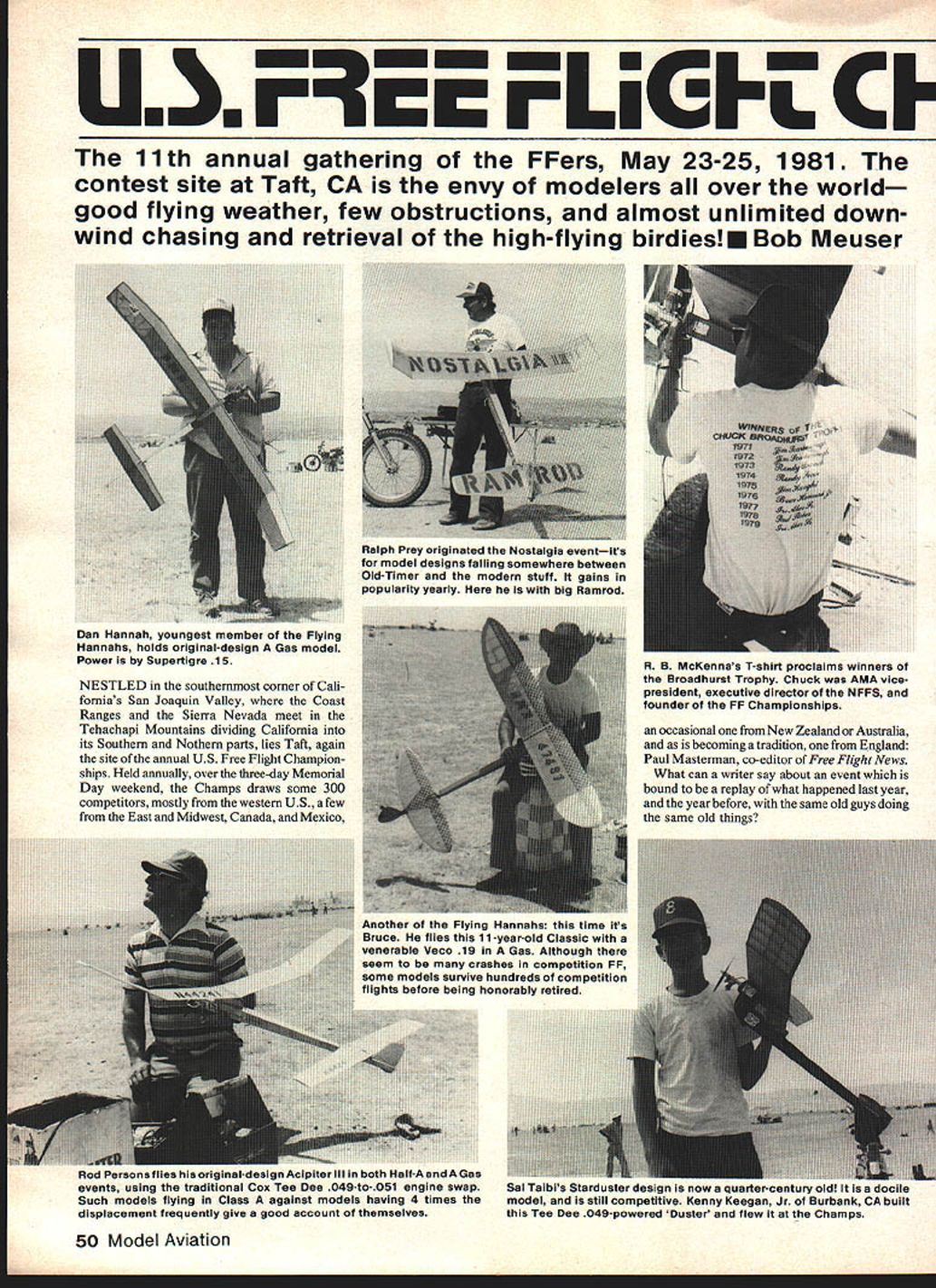
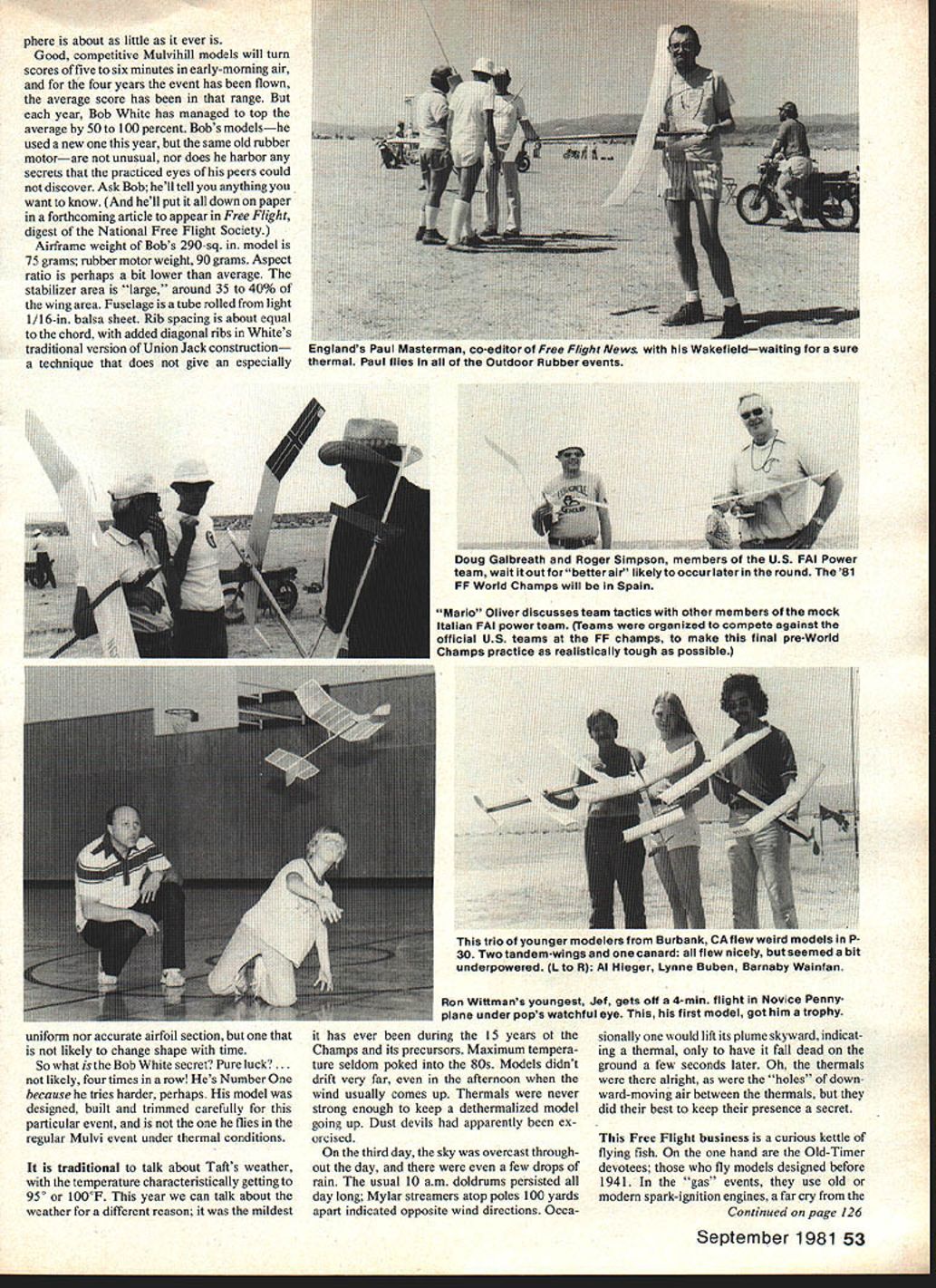
The 11th annual gathering of free-flight modelers was held May 23–25, 1981, at Taft, California. Nestled in the southernmost corner of the San Joaquin Valley where the Coast Ranges and the Sierra Nevada meet, Taft again proved an ideal contest site—good flying weather, few obstructions, and ample downwind retrieval area. The Champs, held over the Memorial Day weekend, drew about 300 competitors, mostly from the western U.S., with entrants from the East, the Midwest, Canada, Mexico and occasional visitors from New Zealand, Australia and England (notably Paul Masterman, co-editor of Free Flight News).
Participants and newcomers
The event combines continuity and renewal: many of the same veteran flyers return each year, while new and younger faces periodically appear.
Notable newcomers and teams:
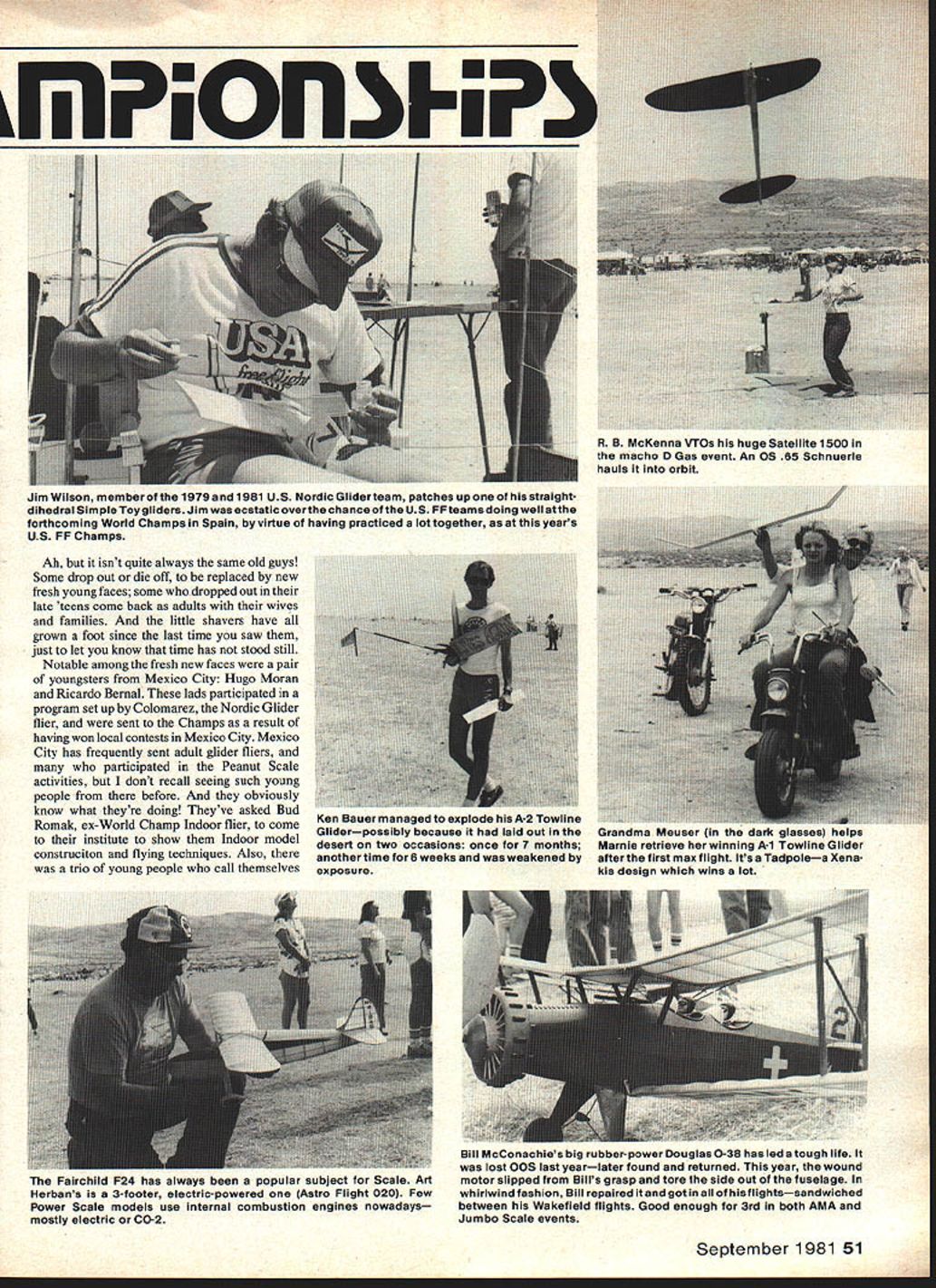
- Hugo Moran and Ricardo Bernal from Mexico City, sent to the Champs as a result of a program organized by Colomarez (a Nordic glider flier). They have been practicing and invited Bud Romak, ex-World Champ indoor flier, to teach indoor construction and flying techniques.
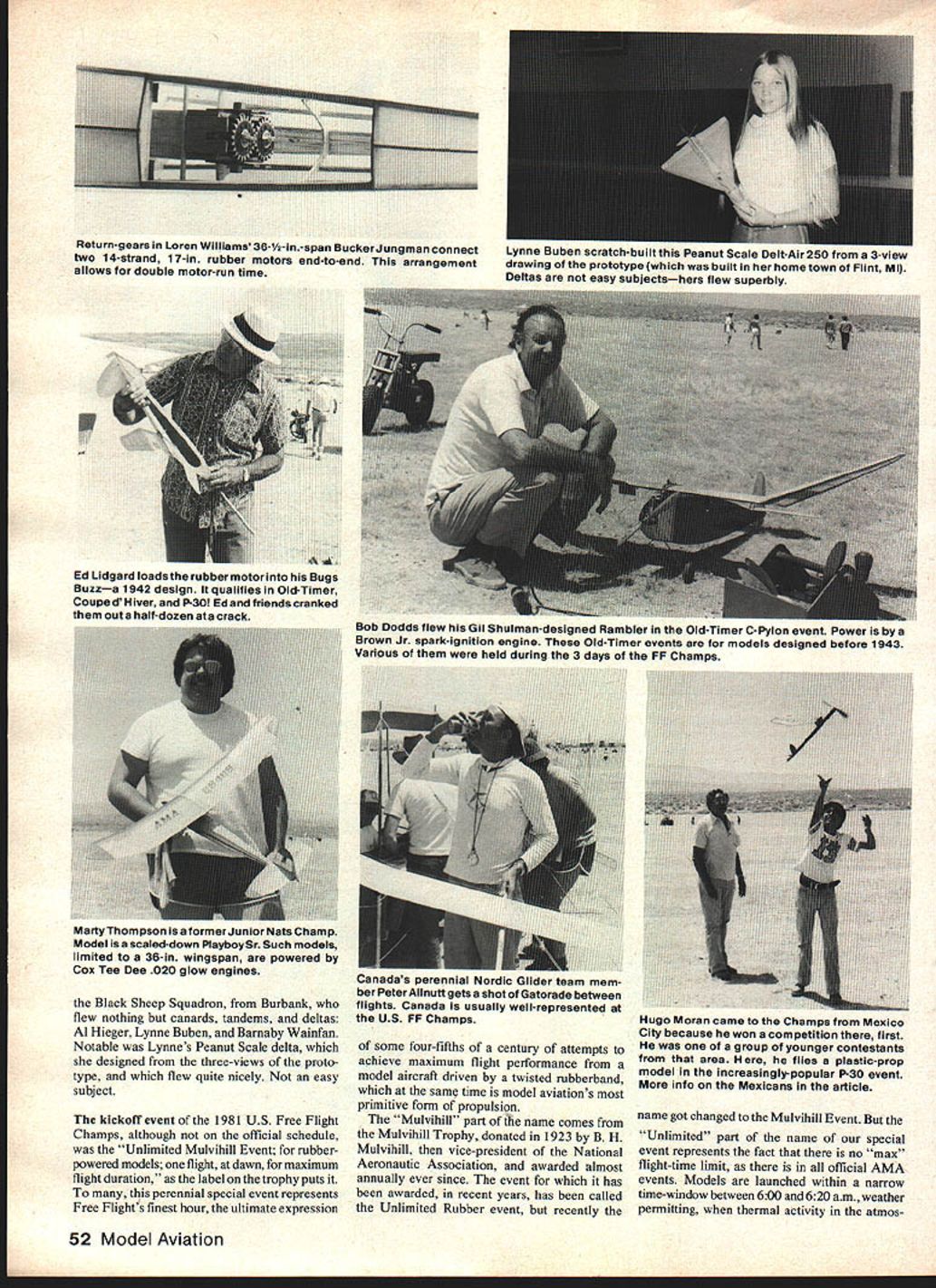
- The Black Sheep Squadron (Burbank): Al Hieger, Lynne Buben, and Barnaby Wainfan, who flew canards, tandems and deltas. Lynne’s Peanut Scale delta—designed from three-views—flew notably well.
- Veterans and contributors seen at the meet included R. B. McKenna and other regulars; Ralph Prey was noted as originator of the Nostalgia event.
Unlimited Mulvihill Event
The kickoff special was the Unlimited Mulvihill Event (rubber-powered models only). This one-flight-per-entrant dawn event seeks maximum duration; models are launched within a narrow early-morning window when thermal activity is increasing. Maxes are cumulative to five minutes; later longer flights replace earlier shorter maxes. Traditionally this event celebrates the long history of rubber-powered performance, and scores in good early-morning air often reach five to six minutes.
Bob White has consistently dominated this event, topping the average by large margins. Details of his winning model this year:
- Wing area: about 290 sq. in.
- Airframe weight: ~75 grams
- Rubber motor weight: ~90 grams
- Stabilizer area: large—about 35–40% of wing area
- Construction: fuselage tube rolled from 1/16-in. balsa sheet; rib spacing approximately equal to chord with diagonal ribs in a Union Jack pattern
White’s success is attributed to careful design, construction and trimming specific to the event rather than secret techniques.
Weather
Taft is often very hot during the Champs, but 1981 was unusually mild. Maximum temperatures seldom reached the 80s, and models didn’t drift far even in the afternoons when wind typically increases. Thermals were weak and inconsistent; on the third day the sky was overcast with a few drops of rain, and the usual 10 a.m. doldrums persisted. Mylar streamers on poles showed variable wind directions and short-lived thermals. Overall, thermal activity was present but elusive.
Classes of fliers
The free-flight community at Taft encompasses several overlapping groups:
- Old-Timer devotees
- Fly designs from before 1941, often using spark-ignition engines or traditional rubber-power designs.
- Their aircraft, when airborne, evoke classic 1930s–1940s flying and remain competitive when well-trimmed.
- Middle-ground (AMA events)
- Most competitors fly the usual AMA events with gradual, evolutionary innovations. Consistency and the avoidance of bad luck are major factors in victory.
- Examples: Sal Taibi’s Starduster (a quarter-century-old design still competitive); Hod Ellerson flying original-design Class I power models with Cox engines.
- FAI-event competitors
- Focused on international competition and World Championships; emphasize incremental technical advantages in airfoils, rubber selection, launch techniques and team strategy.
- The meet served as final practice for U.S. teams preparing for the World Championships in Spain; all team members attended and practiced as teams. Ad hoc challenger teams also formed to test the champions.
Notable middle-ground competitor: Bob Vinson, who started flying with a Carl Goldberg Sailplane decades ago and won the big-engine D-gas event with an evolved design.
Scale modeling
Scale entrants ranged from 13-in-span Peanut Scale rubber models to 3-ft Jumbo Scale rubber models. Glow and diesel engines were once common, but electric and CO2 systems have largely replaced them in power-scale classes. Scale judging evaluates workmanship and fidelity to the prototype, and for powered models, flight quality; rubber-powered scale is judged for duration.
A highlighted effort:
- Bill McConachie flew a large rubber-powered Douglas O-38 in both AMA Scale and Jumbo Scale, sandwiching scale flights between Wakefield flights. He suffered motor and structural damage when a wound motor slipped and damaged the fuselage and wing, but repaired the model and completed the required flights, earning two trophies.
Indoor events
Indoor events at the Champs are flown in a relatively small gym (lights about 20 feet above the floor). The chosen events—Novice Pennyplane and Easy B—fit the space and skill levels well.
- Easy B allows experimental indoor designs without covering or minimum-weight restrictions, offering seasoned indoor fliers room to play.
- Novice Pennyplane’s strict limits give novices a fair chance to develop necessary skills quickly.
Despite the openness, the same top competitors (notably Mather, Banks and Hoffman) frequently win both events. Mike Stoy (Chicago area), a repeated national Hand Launch Glider winner, stopped by and took the Indoor Glider event this year.
Hand-launched gliders
Hand-launched Glider (HLG) is split into Indoor and Outdoor classes with very different skills and goals:
- Indoor HLG: Launch a 16-in., ~4-gram solid balsa model to the rafters and trim it to settle into a steady glide—requires skill, luck and delicate handling. Multiple long flights are needed to win.
- Outdoor HLG: Launch a ~1-oz., solid-balsa glider to about 100 ft. and find a thermal. Small, low-altitude thermals are hard to detect; cattail fluff is commonly used to locate lift.
Jim Leuken won the Outdoor HLG event; he previously won the event at the 1977 Nats as a newcomer.
Final thoughts
As trophies are packed and competitors depart, thoughts turn to next year—likely hotter, and likely a repeat of many of this year’s performances. Yet each year the Champs refreshes itself with new faces and renewed enthusiasm, which is what keeps the free-flight community vibrant and unpredictable.
Transcribed from original scans by AI. Minor OCR errors may remain.

