
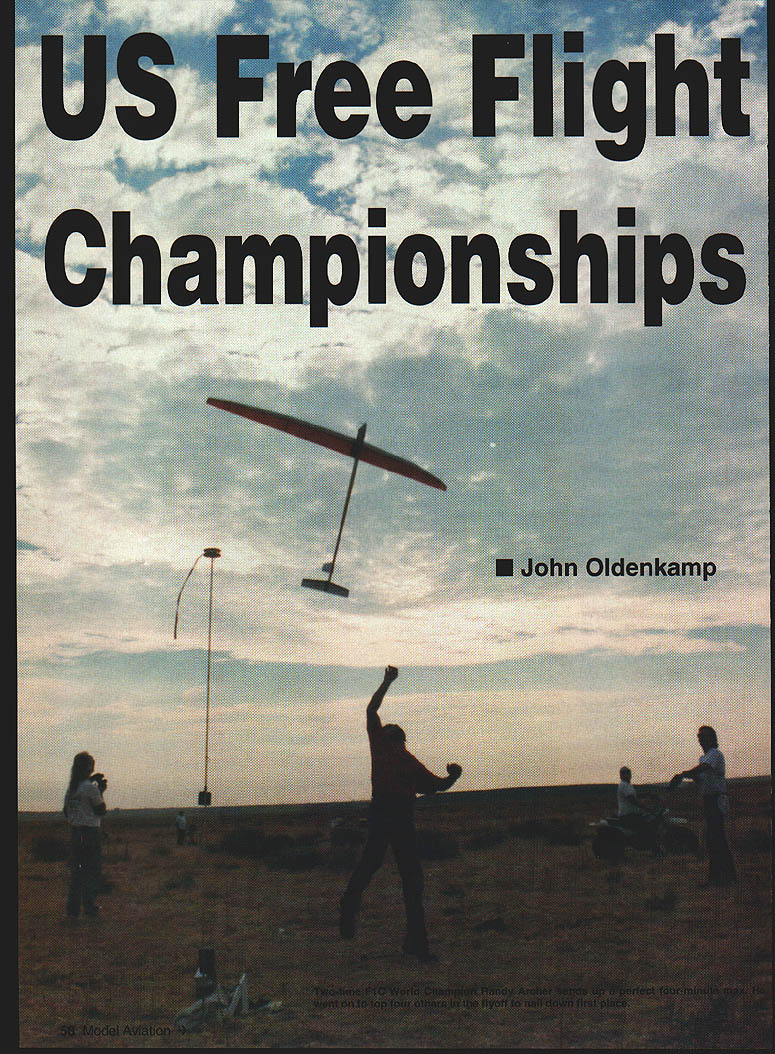

US Free Flight Championships
For the third consecutive year, the United States Free Flight Championships at Lost Hills, California, had to fend off regional uncertainties to produce a stellar blend of challenging events and flyer‑friendly amenities. Despite forecasts of continuing adverse weather and conflicting calendar dates, resilient free flight diehards stayed on and were rewarded with excellent flying conditions and many standout performances.
Weather and field conditions
- A pesky marine layer scudded off to the east, leaving Lost Hills in great shape: the normal dust layer was damped down and fire hazard along chase paths was low.
- Air was hot, heavy and humid with negligible drift or wind; upper‑level stratocirrus lessened the discomfort.
- Mornings were awesomely still and palpably dense, enabling easy, often heroic maxes. Midday thermals proved stingy and demanding, requiring patience.
- Weekends featured frantic early‑morning flights to escape the heat and languid late afternoons when monumental cumulonimbus thunderheads formed over distant ridges.
- Night flying took place under a full moon.
Site and logistics
- Lost Hills, some 130 miles north of Los Angeles, becomes a tiny agri/truck support village appended to the site during the contest.
- Despite rain and fog on the eve of the event and some entrants leaving (including groups en route to other contests such as the SAM Champs at Muncie), a core contingent remained and put on a very competitive meet.
- Vendors did brisk business supplying gallons of Gatorade and bottled water.
Competition highlights
- Great performances were the norm, with multiple‑round flyoffs in many classes.
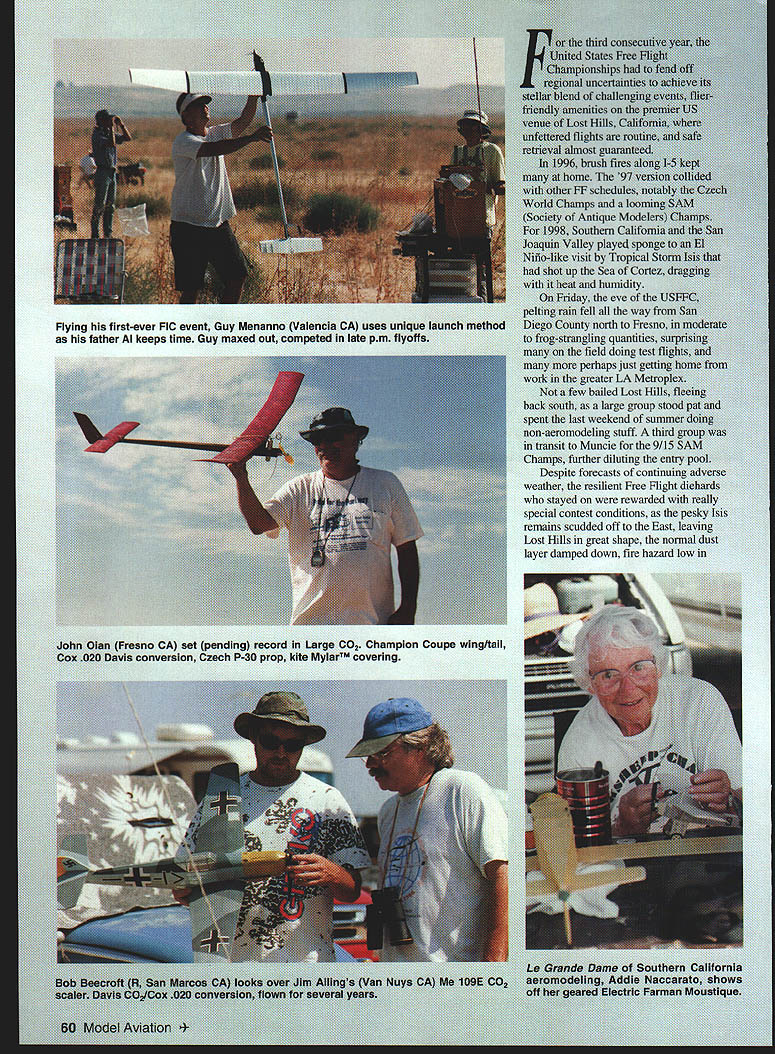
- In PC power, F1J and Wakefield events, Fresno's John Oian set a record in a Large CO2‑modified Coupe d’Hiver.
- Mike Thompson and Dave Anderson posted notable performances in AMA B Gas, with a meet High Time reported at 2,543 seconds (about 42.5 minutes).
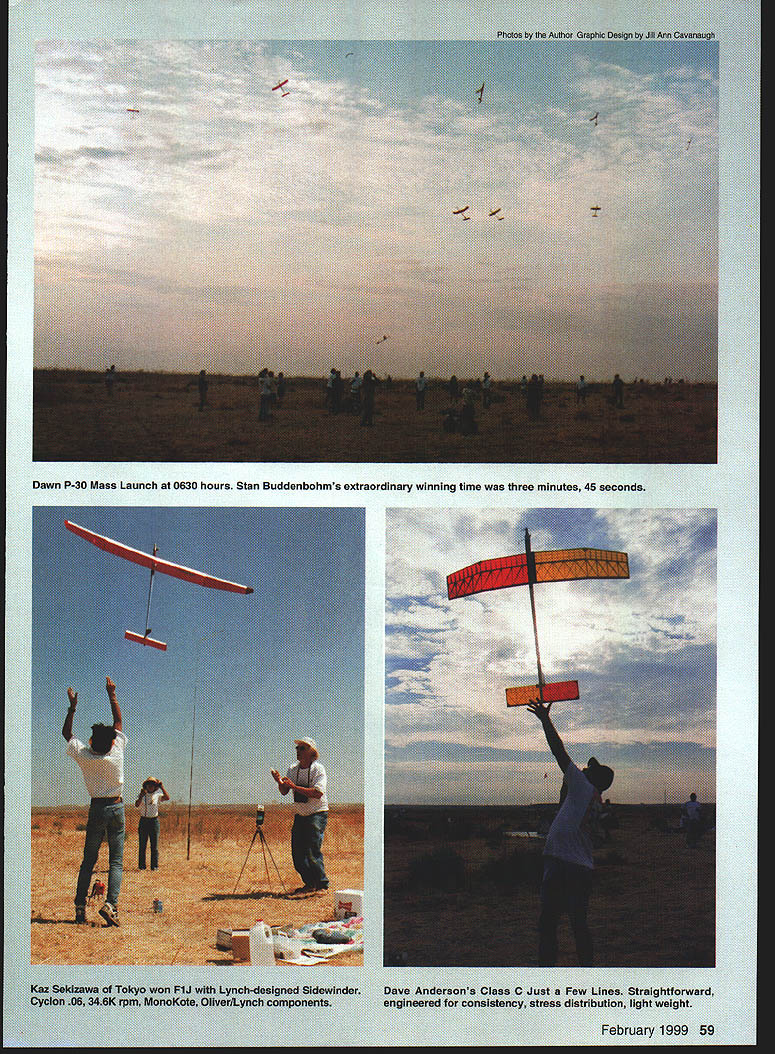
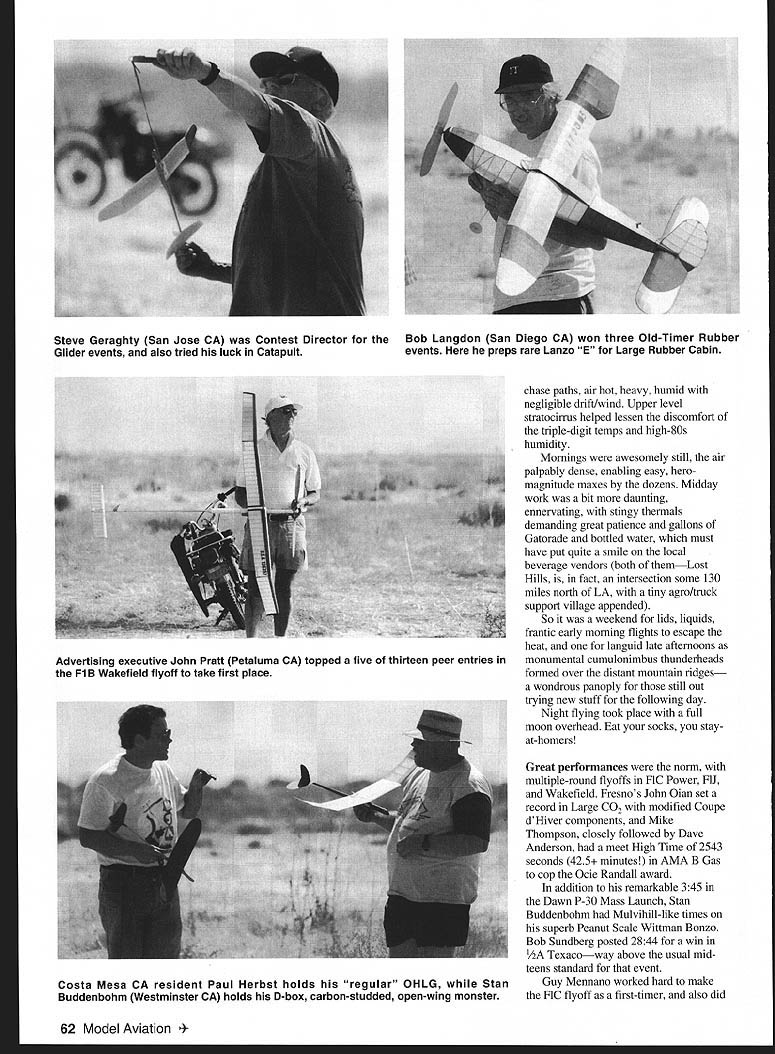
- Stan Buddenbohm produced Mulvihill‑like times in the Dawn P‑30 mass launch and showed an impressive D‑box, carbon‑studded open‑wing design.
- Peanut Scale Wittman "Bonzo" and 1/2A Texaco saw much better than usual results; Bob Sundberg posted an especially long winning time (accounts cite very large times).
- Guy Mennano worked hard to make the F1C flyoff and did well as a first‑timer.
- D Gas outperformed B Gas overall during the meet.
Notable competitors and achievements
- Bob Langdon (San Diego) — Contest Director — won three Old‑Timer rubber glider events and also competed in catapult events.
- John Pratt (Petaluma) — topped five of thirteen peer entries in Large Rubber Cabin.
- Paul Herbst (Costa Mesa) — first place in the F1B Wakefield flyoff.
- Stan Buddenbohm (Westminster) — standout models and strong contest flights.
- World Champion Randy Archer, plus fliers Terry Kerger, Terry Thorkildsen, Tom Carman, Bob Norton and Martyn Cowley — provided F1C demonstrations and entertaining flights.
Scale, nostalgia and other trends
- Change is underway: old‑time towline and nostalgia models showed renewed interest.
- Scale — once a major element at the USFFC — appeared to be making a comeback, with revived interest in OT Scale and Texaco Scale.
- An informal tally indicated Nostalgia Gas entries eclipsed AMA Gas in at least two classes on Sunday.
- Special events (1/2A Combat exercises, F1C demonstrations) and the contest’s catering (the T‑Bone Special from Chex Sloane) helped keep spirits high.
Organization, scheduling and the future
- Given recurring problems with high heat and conflicting dates, CUFFMAC (California United Free Flight Model Airplane Clubs) sponsors and the USFFC proposed restructuring the annual meeting.
- Suggestions included moving the USFFC to Veterans Day weekend (to replace the jurisdictionally weak Fall Free Flight Festival) or other calendar changes to reduce conflicts.
- Greg Weissenberger wryly suggested renaming the event the "United States Free Flight Finale" as a season‑ender.
- Contest Director Allen Heinrich cited recurrent high heat and conflicting dates as strong reasons to consider altering the schedule.
- If ratified, the Labor Day slot could revert to the San Diego Orbiters' Annual, the other remaining Category I contest, as part of a broader reformatting of major events.
- The USFFC will march toward its 30th presentation in the year 2000.
Transcribed from original scans by AI. Minor OCR errors may remain.

