
U.S. Free Flight Champs
— John Oldenkamp
Overview
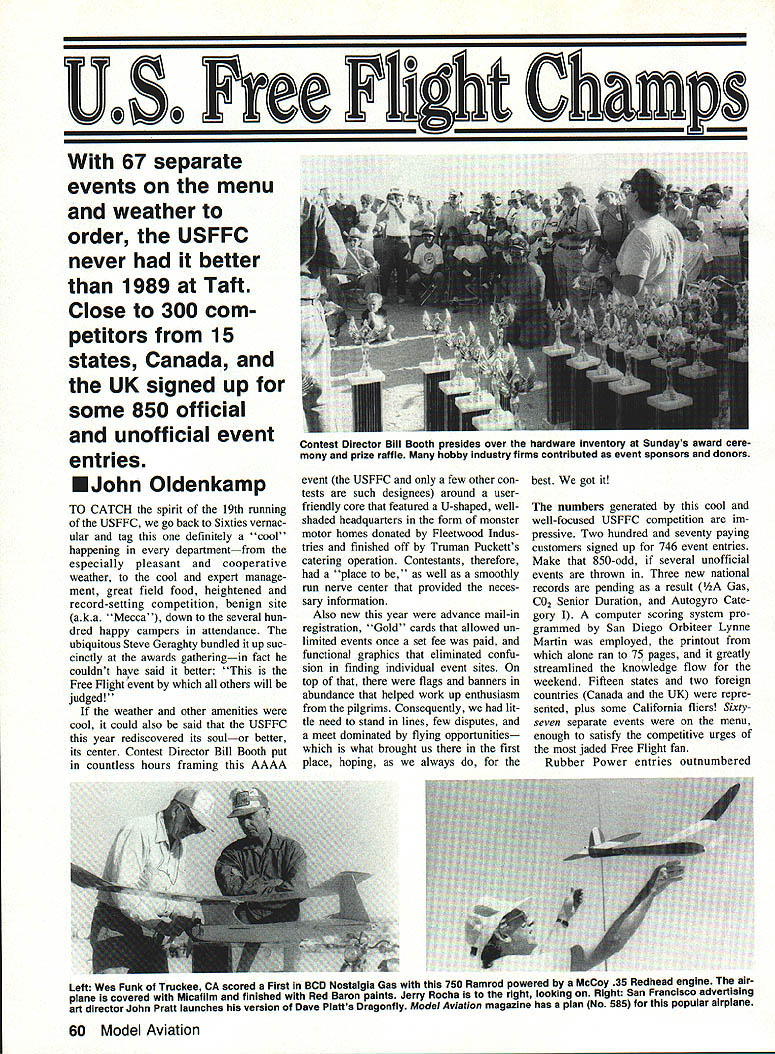
The 19th U.S. Free Flight Championships (USFFC), held in 1989 at Taft, was a standout event: 67 separate events on the menu, close to 300 competitors from 15 states, Canada, and the UK, and roughly 850 official and unofficial event entries. Weather, management, and site amenities combined to produce one of the most user-friendly and competitive USFFC gatherings in years.
Management and facilities
Contest Director Bill Booth and his team framed this AAAA-designated meet around a comfortable, U-shaped, well-shaded headquarters formed by motor homes donated by Fleetwood Industries and supported by Truman Puckett’s catering. New conveniences this year included:
- advance mail-in registration
- “Gold” cards allowing unlimited events for a set fee
- clear graphics and abundant flags/banners to direct contestants and build enthusiasm
- a computer scoring system programmed by Lynne Martin (San Diego Orbiteer), whose printout alone ran 75 pages and greatly streamlined information flow
These innovations reduced lines and disputes and let the meet remain focused on flying opportunities.
Participation and numbers
- 270 paying contestants signed up for 746 official event entries (about 850 when unofficial events are included)
- Fifteen states and two foreign countries (Canada and the UK) were represented
- 67 separate events offered, satisfying even the most jaded Free Flight fan
- Power vs. Rubber entries: 313 to 281, emphasizing the continuing strength of Rubber Power
- Most populous events:
- P-30: 49 entries plus 8 junior fliers
- 1/4A Gas: 46 entries
- Three new national records were pending: 1/2A Gas, CO2 Senior Duration, and Autogyro Category I
Notable competitors and performances
Ironmen and leaders
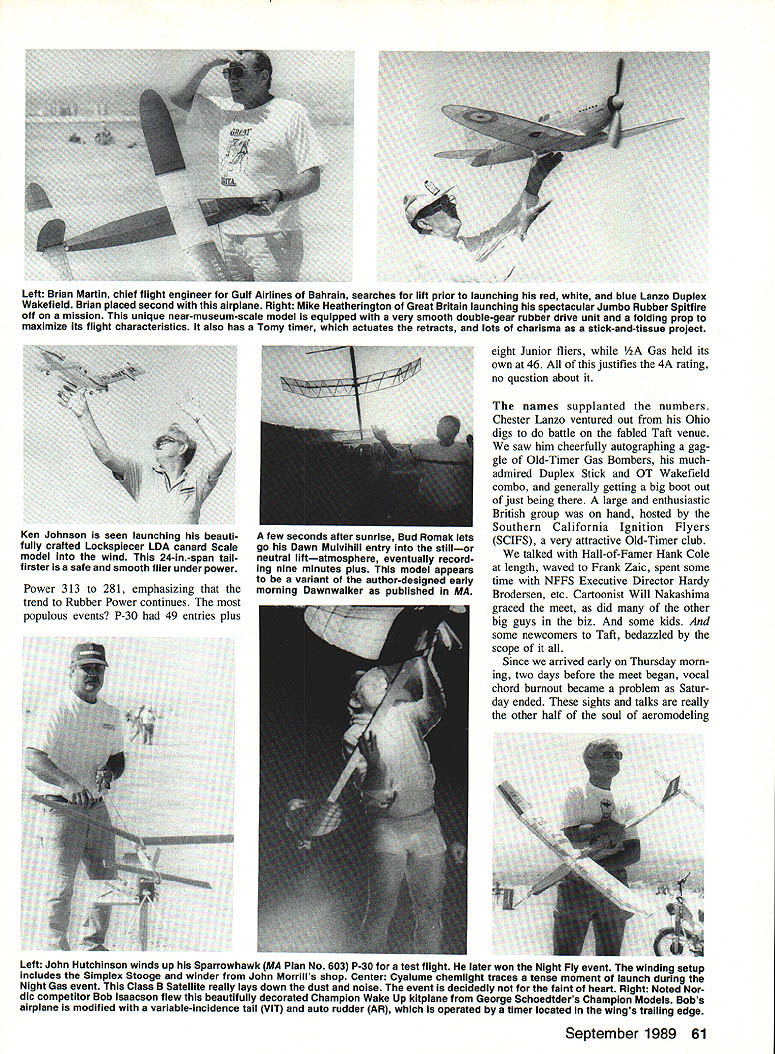
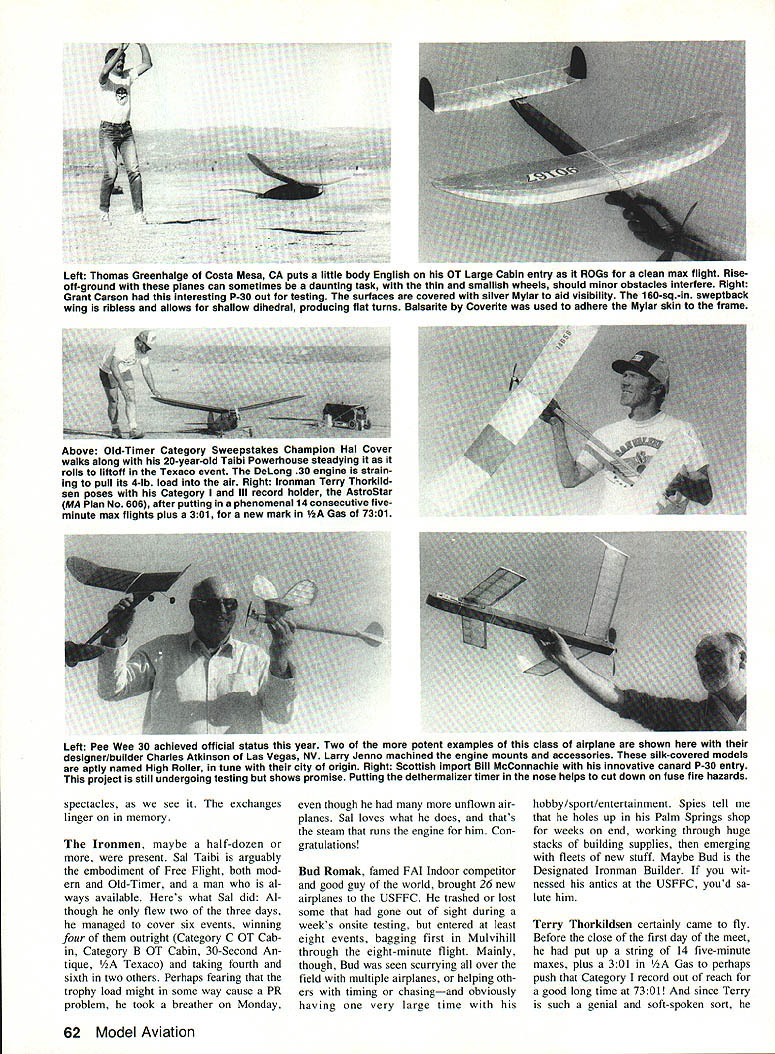
- Sal Taibi: Although he flew only two of the three days, Sal covered six events—winning four outright (Category C OT Cabin, Category B OT Cabin, 30-Second Antique, 1/2A Texaco) and placing fourth and sixth in two others.
- Bud Romak: Brought some 26 new airplanes, entered at least eight events, won Mulvihill and placed second in the eight-minute flight. Known for intense building spurts and large fleets of new designs.
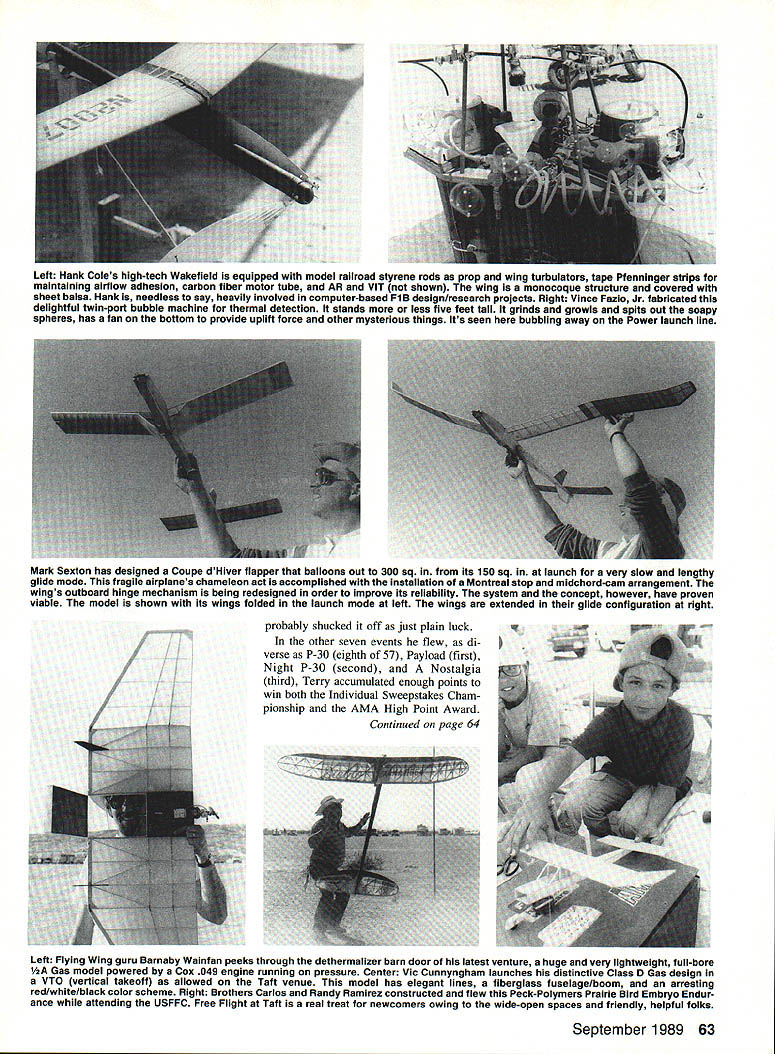
- Terry Thorkildsen: Opened with a string of 14 five-minute maxes and a 3:01 in 1/2A Gas, accumulating enough points across diverse events (including P-30, Payload, Night P-30, Nostalgia) to win both the Individual Sweepstakes Championship and the AMA High Point Award. Terry is noted for steady practice, meticulous preparation, and sportsmanship.
- Hal Covey: Old-Timer Sweepstakes Champion; flew eight events (mix of Power and Rubber), winning Nostalgia A and Indoor Bostonian Cabin West and collecting trophies in multiple other categories. Known for high build standards and tight retrieval.
Other participants and guests
- Chester Lanzo (from Ohio), a large British contingent hosted by the Southern California Ignition Flyers (SCIFS), Hall-of-Famer Hank Cole, Frank Zaic, NFFS Executive Director Hardy Brodersen, cartoonist Will Nakashima, and many juniors and newcomers helped fill the fields and add social energy to the meet.
Records, special flights, and anecdotes
- Jean Andrews set a national Autogyro record (9:46) with a Delta Dart-type ship.
- Senior flier Jeff Whitman posted a CO2 book‑buster of 26:05 (13 straight two-minute maxes and an 05) on Monday—one of the best flying days Taft has seen.
- Wakefield Cup 50th Anniversary events:
- 28 entries for Korda replica competition
- Window re-creation (two-minute minimum): Bob Langdon teamed with the author to record 32+ minutes in-window; Scottish transplant Bill McConnachie reportedly had a 33:10 in-window flight (lost during a motorbike chase after 65 minutes).
- Dawn events and mass launches:
- Dawn Mulvihill (Bob Muesser’s event): Joe Foster launched at 6:15 a.m. for a 10+ minute flight.
- Dawn P‑30 mass launch: about 22 participants; winning time roughly 2:11.
- Hand-launch glider mass throw: won by Bob Boyer with a basic lightweight glider in the low 11s.
- Personal anecdote: the author’s Catapult Glider achieved an eight-plus-minute flight after a recommended 90° right bank launch; fewer than six people saw it, and the second-place prize was a six-pack of Pepsi.
Nonofficial events and experimentation
A number of nonofficial events were flown to test popularity and feasibility for future official recognition. The Dawn Mulvihill and various mass-launch and nighttime events attracted interest and highlighted the meet’s experimental side.
Design, construction, and materials trends
New and experimental designs abounded:
- Canards and a variety of unusual planforms appeared, suggesting renewed interest in arcane approaches.
- Bill Bogart debuted a double V‑FIB Wakefield variant (wing and stab notched up 10°, no rudder), competitive though it didn’t show during scheduled events.
- Nordic towliners increasingly used foam wing construction inspired by Martyn Cowley’s innovations.
Material tech advances:
- Carbon fiber mats, rods, and shreds are now common in Power and Rubber designs, producing lighter and stronger components.
- Plastic heat-shrink films for covering are creeping into P‑30, Coupe, and 1/2A Nostalgia classes, improving durability and aerodynamic smoothness.
Vendors, products, and services
A lively vendor scene featured new kits, fuels, finishes, gadgets, and accessories:
- Larry Jern: replica Old-Timer engines
- Stan Bubendang: “Silly Putty” dethermalizers (fireless, lightweight, repeatable)
- Sal Foundado: Coupe and Wakefield front-end hubs imported from Poland (spinners, bobbins)
- Al Heinrich: rotors, nitro dope, thinners, covering adhesives, exotic imported Rubber and Gas classic kits
- Event mementos: hats, T-shirts, banners, and other USFFC souvenirs
For product inquiries the author suggested contacting Motor Books International, P.O. Box 2, 829 Prospect Ave., Osceola, WI 54020.
Looking ahead
Organizers and participants were already imagining an even larger 1990 (or 1991) edition: bigger headquarters (circus tents mentioned), improved computer scoring and displays, increased corporate sponsorship, more food and events, and larger attendance. If 1989 was any indication, future USFFCs promise to grow while preserving the spirit and camaraderie that made Taft “Mecca” for free-flight enthusiasts.
Closing thanks and cheers to the future.
Transcribed from original scans by AI. Minor OCR errors may remain.

