
U.S. Free Flight Champs
Despite unusually severe weather conditions, the 20th of these competitions — and the first at the new Lost Hills site — came off splendidly. Nine new national records were established, and the consensus was that the Free Flight community would have little trouble making a home out of its new field. John Oldenkamp
Venue and Attendance
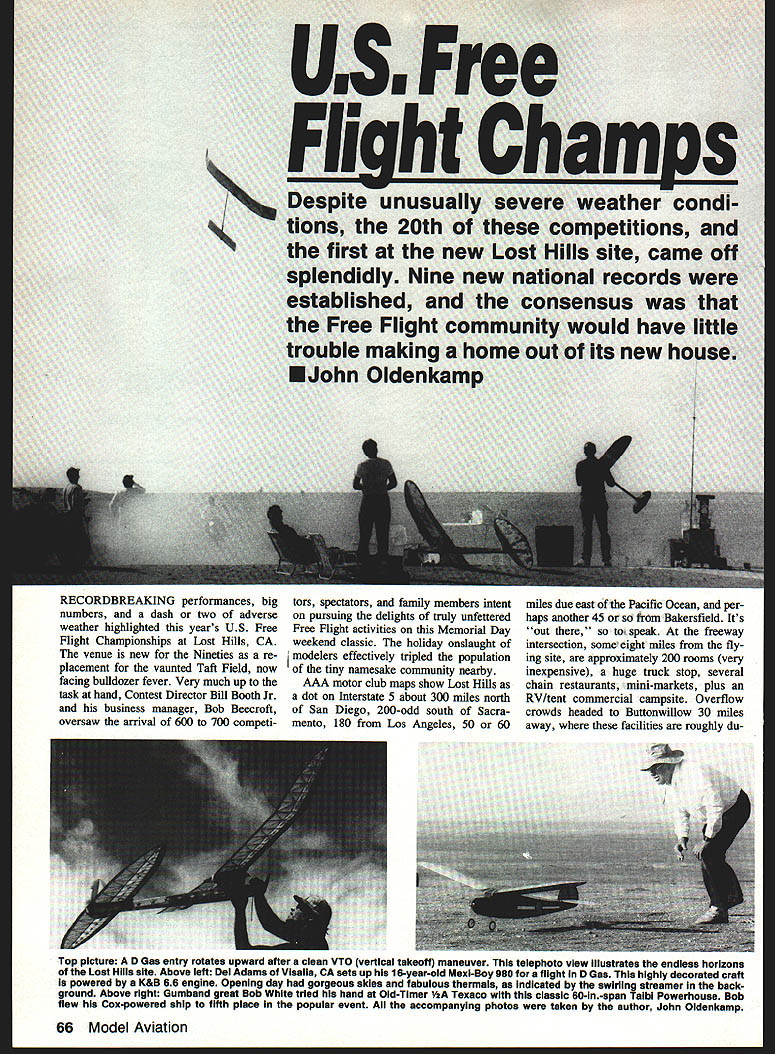
Record-breaking performances, big numbers, and a dash or two of adverse weather highlighted this year's U.S. Free Flight Championships at Lost Hills, CA. The venue is new for the Nineties as a replacement for the vaunted Taft Field, now threatened by development. Contest Director Bill Booth Jr. and business manager Bob Beecroft oversaw the arrival of 600 to 700 competitors, spectators, and family members intent on pursuing the delights of truly unfettered Free Flight activities over the Memorial Day weekend. The holiday onslaught of modelers effectively tripled the population of the tiny nearby community.
Lost Hills sits on Interstate 5 about 300 miles north of San Diego, roughly 200 miles south of Sacramento, 180 from Los Angeles, and 50–60 miles due east of the Pacific Ocean, with Bakersfield another 45 miles or so away. At the freeway intersection, some eight miles from the flying site, are approximately 200 inexpensive rooms, a large truck stop, several chain restaurants, mini-markets, and an RV/tent commercial campsite. Overflow crowds headed to Buttonwillow, 30 miles away, where similar facilities are available.
Wandering to the flying field, first-time attendees were impressed by the huge yet benign scale of the site. Soft enough underfoot for comfort, firm enough to accept anything from mountain bikes to Cadillacs for chase, the site is big enough (three by five miles), flat, and unobstructed (no bushes, trees, ditches, pipes, utility poles, gates, fences, etc.) to meet anyone's definition of a world-class Free Flight venue.
The central launch area and HQ compound sit on 80 acres leased for our activities, named Bissonette-Mirage Field after the late Al Bissonette. An adjoining 630-acre parcel is in escrow and will be secured and operated exclusively for Free Flight by a yet-to-be-formed not-for-profit trust. An additional 600–800 acres will likely be added to the purchase package in the near future, thus guaranteeing downstream needs. Free Flight has its first permanent home.
Site Characteristics and Challenges
Geography aside, Lost Hills presents other challenges, especially in thermal picking. The whole area, known as the Antelope Valley, is open on all four compass points for many miles. Gigantic boomers, for example, might be preceded or followed by nasty little "broomstick" risers that can end a max attempt very quickly. Thermal streamers can blow in several different directions simultaneously, making old-fashioned seat-of-the-pants thermal search a subject to relearn.
These factors put a little equity back in the game — and more fun, too.
Day-by-Day Summary
#### Day 1 — Saturday: Ideal Opening
As the contest began, a capricious late-season arctic storm front moved down the West Coast, fracturing the normal USFFC format into three separate contests. Hardy folks that Free Flighters are, most of the 58 events went off as scheduled and good humor prevailed.
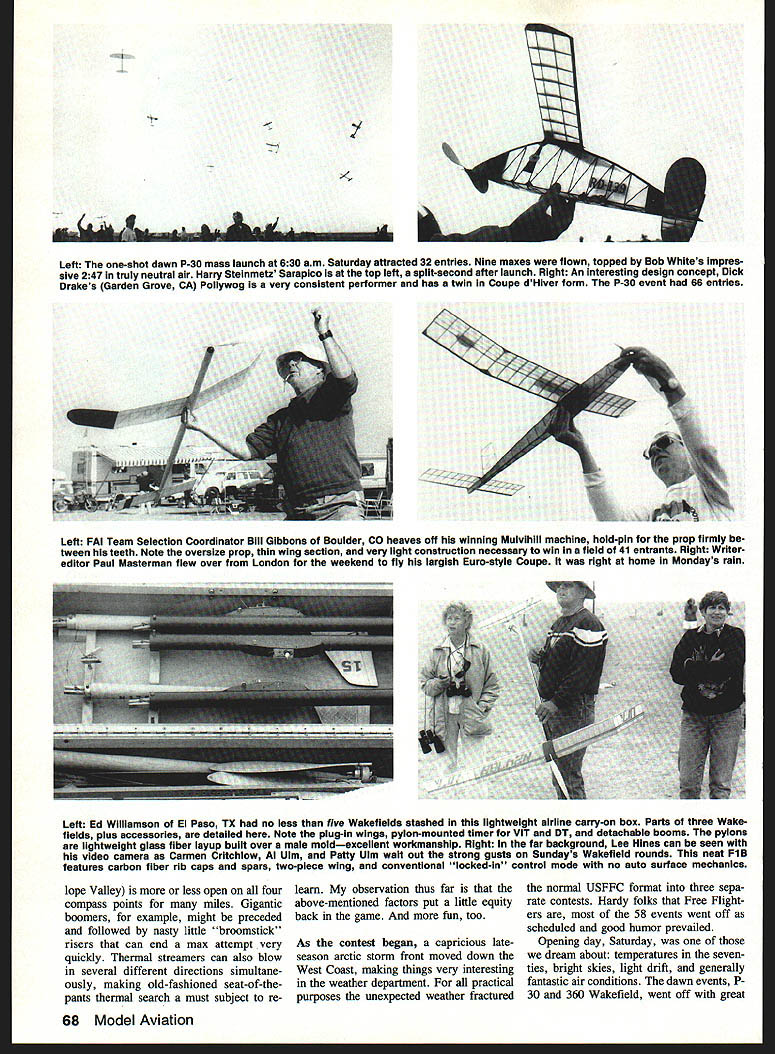
Opening day was one of those we dream about: temperatures in the seventies, bright skies, light drift, and generally fantastic air. The dawn events, P-30 and 360 Wakefield, went off with great success. Bob Piscerchio repeated himself and put up over six minutes' duration in F1B Wakefield at the 5:45 a.m. launch time — a superlative performance compared with a decade ago. Bob White outlasted a 34-plane mass P-30 launch with 2:47 (although eight others did max).
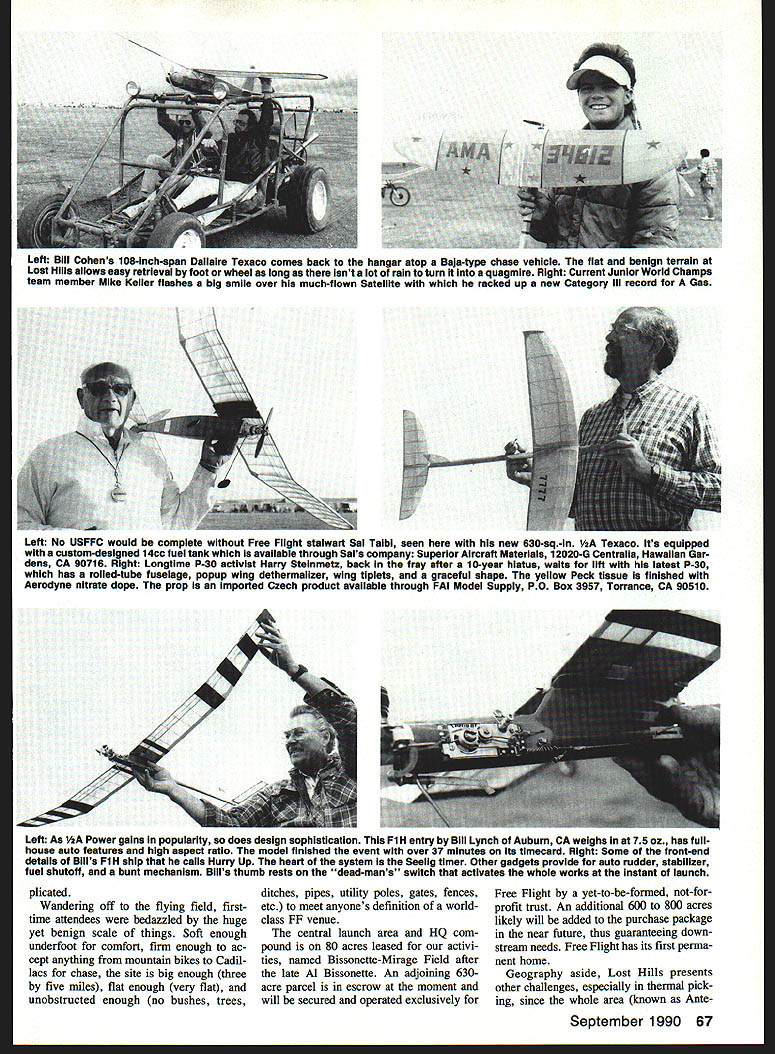
Conditions improved throughout the day. Patient fliers were rewarded with many powerful boomers, while some fell prey to broomstick risers. In 1/2A Texaco, contest official Bob Beecroft broke 52 minutes (three flights) with a brand-new, never-flown Taibi Powerhouse. Charles Yost followed with 28 minutes flying a Leisure Systems Lanzo Bomber (converted from electric to Cox power). Bob White placed fifth with another new Powerhouse. 1/2A Texaco requires a pre-1938 Old-Timer Antique design, .049 Cox reed-valve engine, and 14 cc fuel capacity; engine runs are four to seven minutes depending on prop.
Late afternoon produced several significant records: Paul Herbst broke the 1984 P-30 mark with 30:08. Jon-Mark Carman broke Bobby Morgan's longstanding Junior 1/2A Gas record (31:09, 1977) with 40:49. Terry Thorkildsen won the Ocie Randall High Time Gas trophy with 69:18 in his Model Aviation plan 1/2A Astrostar.
As dusk approached, a brand-new Wakefield (BoomBox IV) succumbed to a violent thermal and was destroyed. A sudden Sahara-like blast sent fliers and models back to storage and town for the night.
#### Day 2 — Sunday: High Winds and Tough Conditions
Sunday brought a stiff, constant gale of 15–18 mph with gusts. CD Bill Booth declared this a Category III rule-book situation. Two-minute flights could carry aircraft a mile and a half east into oil fields — well outside normal drift. Dark skies and fine grit made flight boxes and gear look like Lawrence of Arabia safari kit.
Senior flier Mike Keller set records in both A Gas and C Gas. Forty-four fliers stepped up to the Wakefield starting line in trying conditions. Bob Piscerchio was the only one to score two maxes in all seven rounds. The author suffered an embarrassing stallout by putting the wrong prop set on BoomBox No. 2, but corrected it and managed a flight or two out a mile or so in the strong drift.
Many abandoned the chase temporarily. Truman Puckett charcoaled dozens of burgers and hot dogs from his truck. George Schroedter of Champion Models sold out much of what he brought. When the rain threat increased, many retreated to town for rest and a meal.
#### Day 3 — Monday: Rain and Closure
Monday dawned with lingering drizzle and looming dark clouds. Engines barked and the Hand-Launched Glider crew searched for thermals; the Coupe fliers were set for a five-rounder. By 9:00 a.m. several contestants had double maxes in AMA events and a half-dozen were through two Coupe flights. Then the squall line hit and rain began to pour.
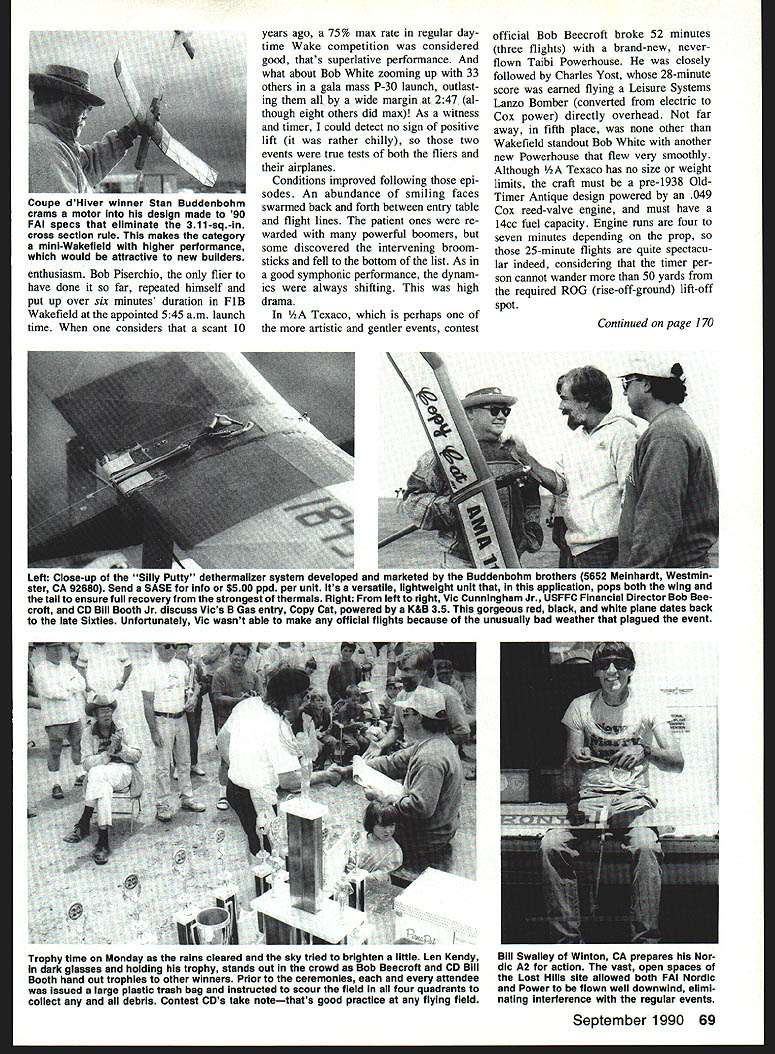
The already-saturated ground turned into a slick quagmire in less than ten minutes. Organizers declared a 10:00 a.m. closure for safety since it was impossible to traverse the goo or mount a chase by motorcycle. Umbrellas and awnings offered shelter while contestants packed up. Around noon the rain stopped, the field was cleaned up, a brief trophy presentation and raffle were held, and the meet closed.
Notable Performances and Records
- Bob Piscerchio: over six minutes in F1B Wakefield at 5:45 a.m.; only flier with two maxes in all seven Wakefield rounds.
- Bob White: 2:47 in a mass P-30; strong Wakefield performances.
- Bob Beecroft: 52 minutes (three flights) in 1/2A Texaco with a Taibi Powerhouse.
- Paul Herbst: new P-30 record, 30:08.
- Jon-Mark Carman: Junior 1/2A Gas record, 40:49 (broke Bobby Morgan's 1977 mark).
- Terry Thorkildsen: Ocie Randall High Time Gas trophy, 69:18.
- Mike Keller: records in A Gas and C Gas.
Nine new national records are pending, three of which fill rule-book vacancies following recognition of F1G (Coupe), F1H (A1 Glider), and F1J (1/2A Power) as FAI events under AMA sanction.
Statistics and Results
- Registered competitors: 284
- Event entries: 647
- States represented: 13
- Foreign countries represented: 4 (Canada, Mexico, New Zealand, England)
- Women competitors: 10
- Juniors: 20
- Seniors: 5
- Women's High Time award: Ima-Jean Villanueva — 11:15 in Open Mulvihill
Full contest results (all entries), plus names and addresses of each contestant, will be available as a computer printout. For $10 postpaid, send payment c/o USFFC 1990, P.O. Box 4203, Carlsbad, CA 92008.
Site Future and Community
The previous 19 USFFCs were held at Taft, which developed a justly deserved reputation as Free Flight's Mecca. Taft had charisma and community, but was no longer available for economic reasons. Lost Hills, in its first hosting, proved every bit as first-class. Many other contests will be held there, including the U.S.A. FAI Team Selection Finals in late September. There are rumors the site may bid for the 1993 World Free Flight Championships — a reasonable possibility given the near-complete lack of obstructions for large free-flight aircraft. An indoor site is available in Wasco, a half-hour drive away, if needed.
Lost Hills lacks Taft's established feeling of community; it will be up to the Free Flight community to establish that. The USFFC does overload restaurant facilities at the Interstate 5 junction, but that is a matter of entrepreneurial opportunity.
Competitors should rethink their air-picking methods and adapt them to Lost Hills conditions. Bring a lunch, and enjoy!
Thanks and Sponsors
The 20th USFFC was produced by the Free Flight Model Aircraft Association of Southern California (FFMAASC), an all-volunteer effort. President Hal Cover and an unpaid team handled meetings and paperwork. Special thanks to CD Bill Booth and business manager Bob Beecroft, and to the many volunteers who made the meet possible.
Corporate and industry support helped make the event financially successful. Major supporters included:
- Fleetwood Enterprises
- Cox Hobbies
- K&B
- Champion Models
- SR Batteries
- Satellite City
- Leisure Electronics
- Model Research Laboratories
- Bob Wilder Design
- Truman Puckett of Ice Cream 'n' Things
Plus many individuals and concerns who donated raffle items.
Let the motto for '91 through 2091 be: "Get lost in Free Flight at Lost Hills."
Transcribed from original scans by AI. Minor OCR errors may remain.

