
U.S. Indoor Championships
Over 70 contestants from across the U.S. and Canada met in Niagara Falls, June 18–20, for what many called one of the best-ever indoor contests. — Bob Clemens
Venue and overview
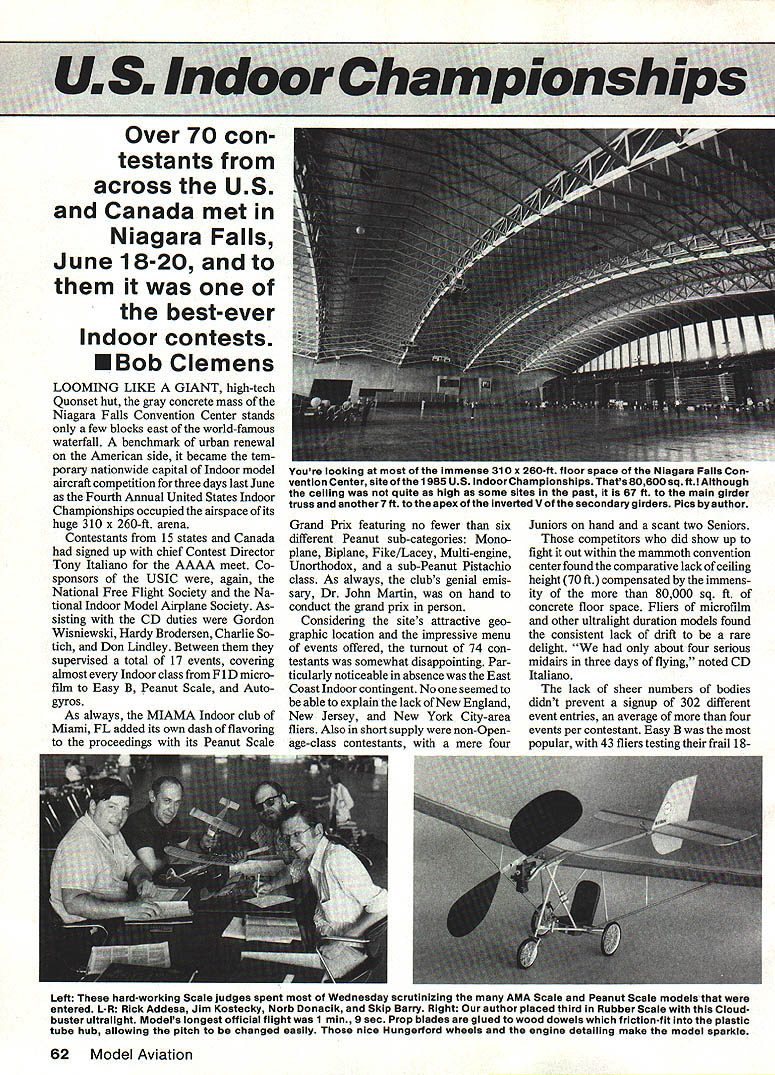
Looming like a giant, high-tech Quonset hut, the gray concrete mass of the Niagara Falls Convention Center—only a few blocks east of the world-famous waterfall—became the temporary nationwide capital of indoor model airplane competition for three days last June. The Fourth Annual United States Indoor Championships occupied the airspace of its huge 310 × 260 ft. arena.
Contestants from 15 states and Canada signed up for the AAAA meet. Co-sponsors were the National Free Flight Society and the National Indoor Model Airplane Society. Chief Contest Director (CD) Tony Italiano was assisted by Gordon Wisniewski, Hardy Brodersen, Charlie Sotich, and Don Lindley. Between them they supervised 17 events covering almost every indoor class—from F1D microfilm to Easy B, Peanut Scale, and Autogyros.
As always, the MIAMA Indoor Club (Miami, FL) added its own flavor with a Peanut Scale Grand Prix featuring six Peanut subcategories: Monoplane, Biplane, Fike/Lacey, Multi-engine, Unorthodox, and a sub-Peanut Pistachio class. Dr. John Martin once again conducted the grand prix in person.
Attendance and entries
Considering the attractive location and wide menu of events, the turnout of 74 contestants was somewhat disappointing. The East Coast indoor contingent was notably absent—New England, New Jersey, and New York City–area fliers were largely missing. Non-Open-age-class participation was light: only four Juniors and two Seniors.
Despite the modest head count, contestants signed up for 302 event entries—an average of more than four events per person. Easy B was the most popular class with 43 entries. Novice Pennyplane drew 35 entries, while Peanut Scale and Pennyplane each attracted 28.
Although the ceiling height was only about 70 ft., competitors found the immensity of the more than 80,000 sq. ft. of concrete floor space advantageous. Microfilm and other ultralight duration fliers appreciated the lack of drift; CD Italiano noted only about four serious midairs in three days of flying.
Organization and judging
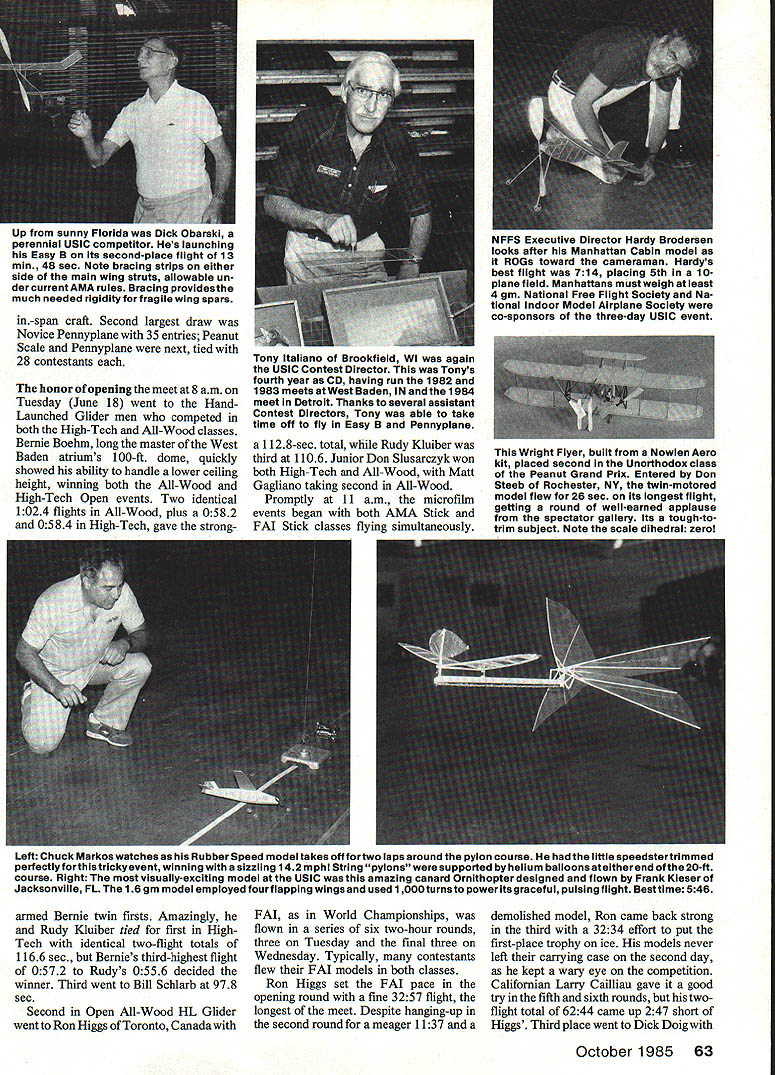
Hard-working scale judges spent Wednesday scrutinizing AMA Scale and Peanut Scale models. The scale judges included Rick Addesa, Jim Kostecky, Norb Donacik, and Skip Barry. Their work continued into the evening.
Hand-Launched Gliders (HLG)
The meet opened at 8 a.m. Tuesday with Hand-Launched Glider competition in both High-Tech and All-Wood classes. Bernie Boehm, well known for his West Baden dome performances, handled the lower ceiling expertly and won both All-Wood and High-Tech Open events. He recorded two identical 1:02.4 flights in All-Wood and 0:58.2 and 0:58.4 in High-Tech. Bernie and Rudy Kluiber tied for first in High-Tech with identical two-flight totals of 116.6 seconds; the tie was broken by comparing third-highest flights (Bernie's 0:57.2 beat Rudy's 0:55.6). Bill Schlarb finished third at 97.8 seconds.
Second in Open All-Wood HL Glider was Ron Higgs (Toronto) with 112.8 seconds; Rudy Kluiber totaled 110.6. Junior Don Slusarczyk won both High-Tech and All-Wood Junior divisions, with Matt Gagliano second in All-Wood Junior.
Microfilm and Stick events
Microfilm events began at 11 a.m., with AMA Stick and FAI Stick classes flying simultaneously. FAT World Championship-style competition (six two-hour rounds—three on Tuesday and three on Wednesday) produced the meet's longest flight.
- Ron Higgs set the FAT pace with a 32:57 flight, the longest of the meet. After a rough second round (11:37 and a demolished model), he rebounded with 32:34 in round three to secure first place overall. His two-flight total surpassed Californian Larry Cailliau, whose 62:44 two-flight total finished 2:47 behind Higgs. Dick Doig placed third with 54:21.
- In AMA Stick, Ron Ganser (Pittsburgh, PA) won with a high single flight of 27:22. Bill Hulbert (Akron) was second at 25:38 and Dick Doig third at 24:18.
- Junior-Senior AMA Stick winners: Bob Skjranac first with 15:06; Don Slusarczyk second with 10:25.
One of four TV crews filmed microfilm flights and contestant interviews; the footage was scheduled to run on P.M. Magazine (Buffalo Channel 2) in late July.
Ornithopter
The visually unique Ornithopter event (5–8 p.m.) drew four competitors and captivated onlookers. Frank Kieser (Jacksonville Beach, FL) led with a four-winged canard ornithopter that pulsed through the air, winning with a high time of 5:46. Les Garber placed second (4:37) using a four-wing design of his own; Joe Krush was third (3:09) and Juergen Kortenbach fourth (2:35). The event suggested the ornithopter has regained popularity.
Autogyro
Only three fliers entered Autogyro. Larry Loucka won with a winged gyro at 6:27. Don Slusarczyk was second (1:37) and Bill Franklin third with a brief 0:02.4.
Rubber Speed events
Unlimited- and Peanut-Rubber Speed events provided much entertainment and laughter as many "grounders" littered one end of the hall. Models must ROG (rise off ground) unassisted from a three-point stance and fly two laps around a 20-ft. course marked by pylons (strings hung from helium balloons). Models must be rubber-powered and propeller-driven; Peanut Speed entries must also qualify as Peanut Scale models.
- Huffing through the course, Chuck Markos recorded a blistering run of 14.2 mph (6.01 sec for the two laps) to take first. Bill Henderson was next best.
Novice Pennyplane
Novice Pennyplane competition was close. Doug Barber (Pennsylvania) posted a 10:04 time on his fifth official flight to edge Toronto's Jack McGillivray by 6 seconds for first place. Del Ogren was third at 9:55. Junior winner Juergen Kortenbach flew 6:54, with Matt Gagliano second (6:33) and Don Slusarczyk third (4:43). No Seniors competed in Novice Pennyplane.
Scale judging and Bostonian/Cabin classes
Scale models gathered for static judging ahead of the following day's flying. Meanwhile, flight competition continued.
- Walt VanGorder won Manhattan Cabin (four-gram class) with a high time of 8:21. Chuck Markos was second (8:14) and Larry Loucka third (7:47).
- Bostonian Cabin winner was veteran free flighter Bob Bienenstein (Boston) who drove from Detroit to compete. He cranked 3,000 turns for flights of 3:03 and 3:13 and won with a judged total of 413.6 (using a charisma multiplier). Don Steeb (Rochester, NY) flew his unhook Boston Gears model to 385.9 for second. Jack McGillivray (Toronto) was third with 376.2.
FAI Stick final rounds and ROG Cabin
The final three rounds of FAI Stick ran from 1 p.m. to 7 p.m. Larry Loucka posted a fine 21:57 to win ROG Cabin. Dick Doig was second (20:07) and Ron Ganser third (18:48). The ROG Cabin class remains popular despite an AMA Indoor Contest Board tie vote earlier in the year on a proposal to remove the class from the rule book.
Awards dinner and presentation
After flying, contestants and guests adjourned to Como's Restaurant for cocktails and an Italian buffet. CD/MC Tony Italiano thanked Jack Brown (Grand Island, NY) for securing the convention center. Tony presided over door prizes and introduced Jack Beilman (Calspan), who presented a program on research activities at Calspan.
Easy B and Paper Stick (final day)
Easy B and Paper Stick shared the hall on the final day. There were 121 official Easy B flights and 41 Paper Stick flights during a 5½-hour session.
- Open Easy B was tightly contested: Walt VanGorder won with 13:52, only 4 seconds ahead of Dick Obarski (13:48). Chuck Markos was third (13:26) and Jim Clew fourth (13:20).
- Junior-Senior Easy B: Charles Gagliano first (7:19), Don Slusarczyk second (6:51), Bob Skjranac third (6:12).
- Open Paper Stick: Dan Belieff first (18:20), Dick Doig second (18:01), Ron Ganser third (15:33).
- Junior-Senior Paper Stick: Don Slusarczyk first (10:01), Bob Skjranac second (6:38).
AMA Rubber Scale and Peanut Scale
Ten AMA Rubber Scale models flew in a 6½-hour session beginning at 1:30 p.m. A close battle developed:
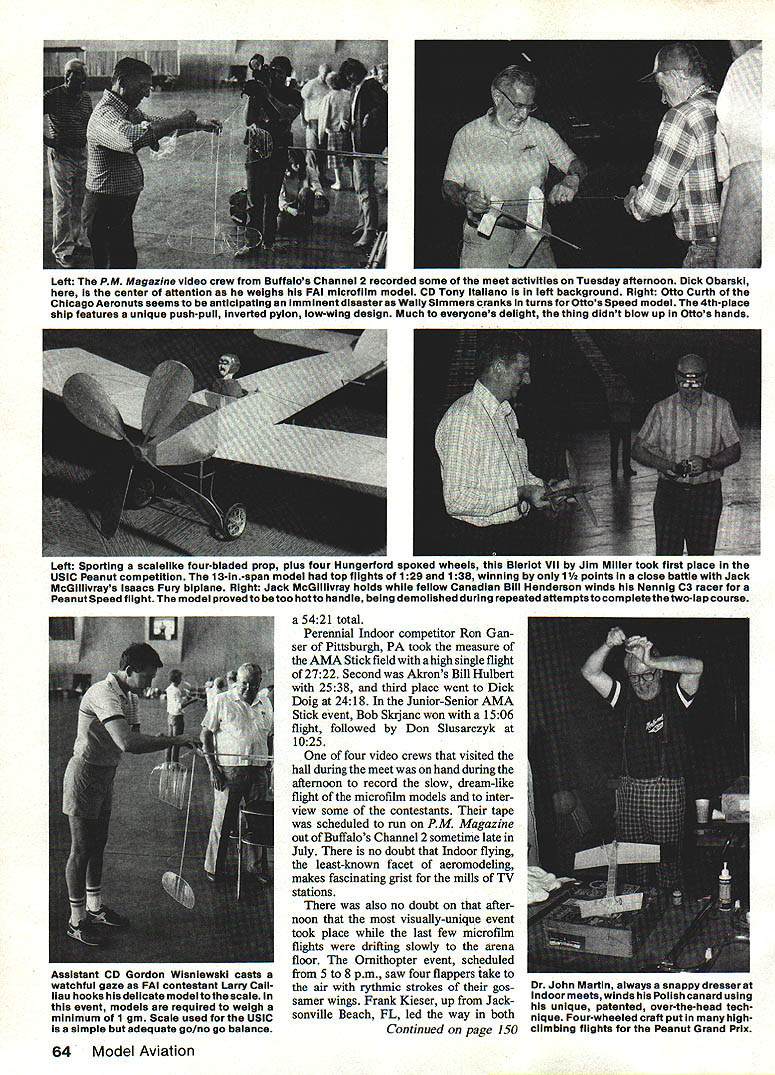
- Jim Miller (Peanut-size Fike E) vs. Jack McGillivray (13-in. Isaac's Fury Mk. II). The Fike had 77 static points to the Fury's 69, but the Fury had a higher two-flight average (86.5 vs. Miller's 81 sec). Miller's higher static score gave the Fike first place: 158 points to 155.5. Bob Clemens (Cloudbuster ultralight) was third with 143.5.
In Open Peanut Scale (23 planes), Jim Miller won with a Bleriot VII scoring 198.5 points, narrowly edging Jack McGillivray's Fury at 196. Miller had high times of 1:29 and 1:38; the Fury had 1:26 and 1:39. Keith Fullmer's Lacey M-10 placed third with 190 points. Junior-Senior Peanut winner was Juergen Kortenbach (Nieuport 11) with 76 points—the only contestant in that class to fly.
MIAMA Peanut Grand Prix
The MIAMA Peanut Grand Prix ran concurrently with USIC Scale events, with 17 models entered—fewer than in past meets but still varied: Wright Flyer, Langley Aerodrome, Bleriot VII, two canards, two ultralights, and a Pistachio-class flying boat.
Winners included:
- Fike/Lacey: Les Garber (high time 2:51.4).
- Ultrabright: Don Steeb (Kimberly Snyder biplane).
- Monoplane: Jim Miller (Bleriot).
- Unorthodox: Bob Clemens (two titles flying a twin-engined Langley Aerodrome).
- Pistachio: Don Steeb (tiny Lacey M-10; high times 1:13.7 and 1:22.5).
Closing remarks
At 8 p.m. the USIC and Peanut Grand Prix concluded. Tony Italiano encouraged the indoor community with these words: indoor flying offers many advantages—no noise, no fumes, low expense, no sunburn, no wind or rain—and has a big future. "Make sure you jump on the wave and become an expert before all those little boys and girls discover the fun and swamp the entry," he said.
Indoor flying, showcased during those three days in Niagara Falls, proved again to be an absorbing, precise, and visually fascinating facet of aeromodeling.
Transcribed from original scans by AI. Minor OCR errors may remain.

