
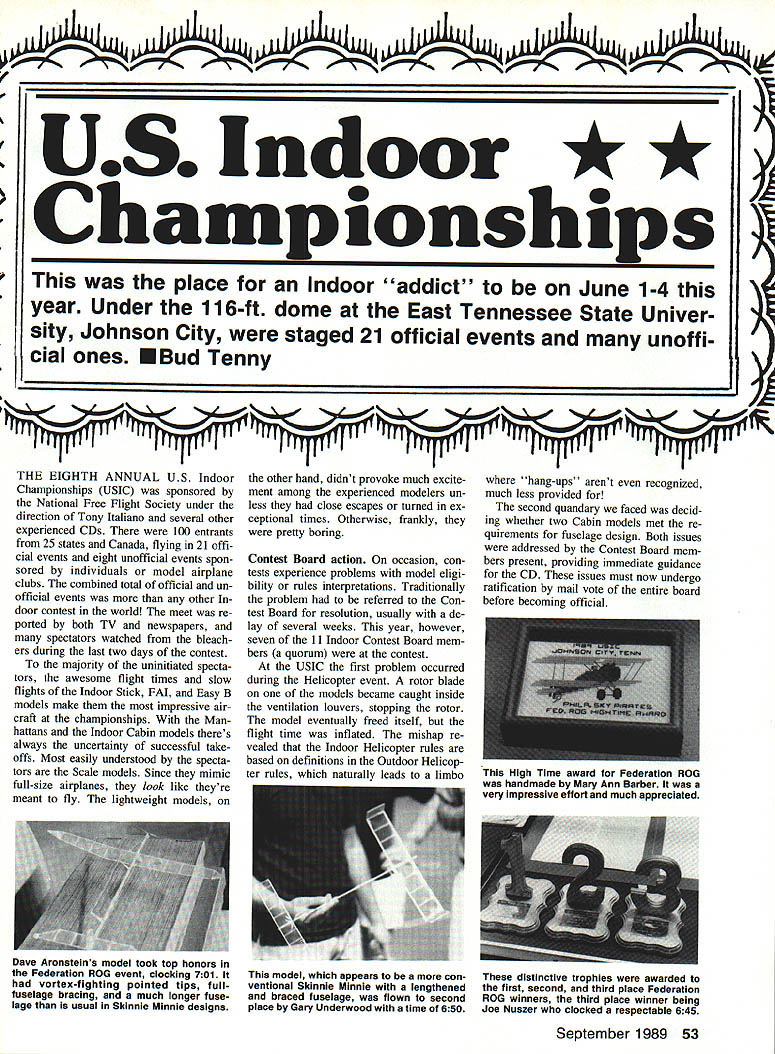
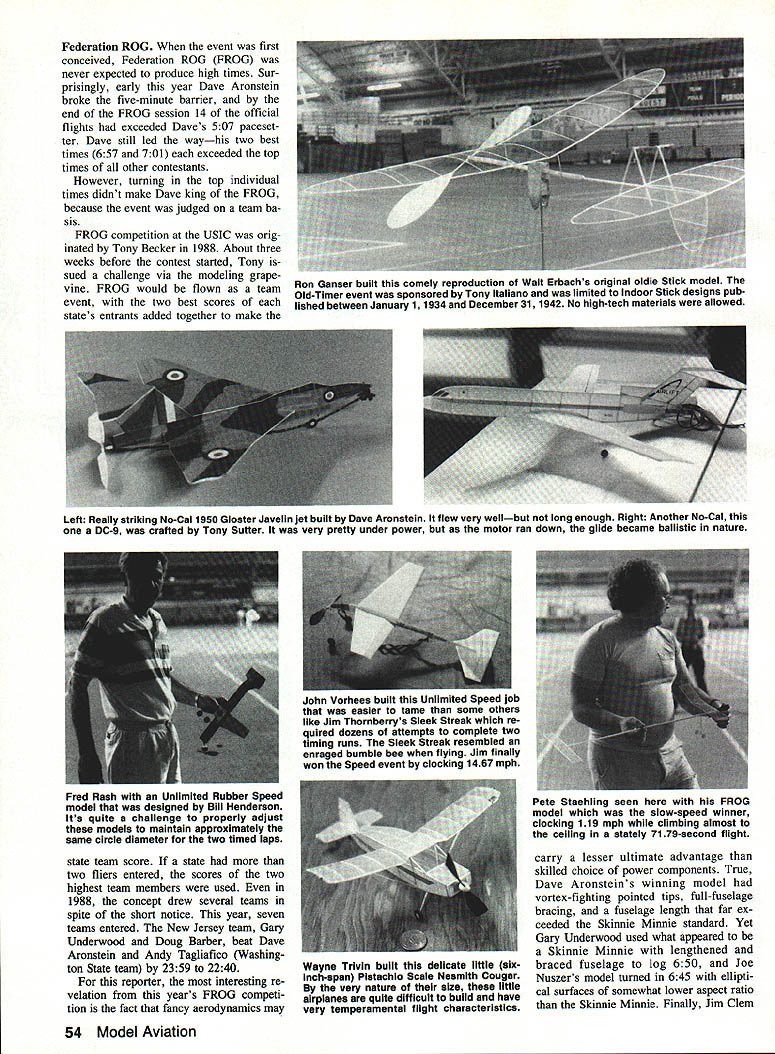
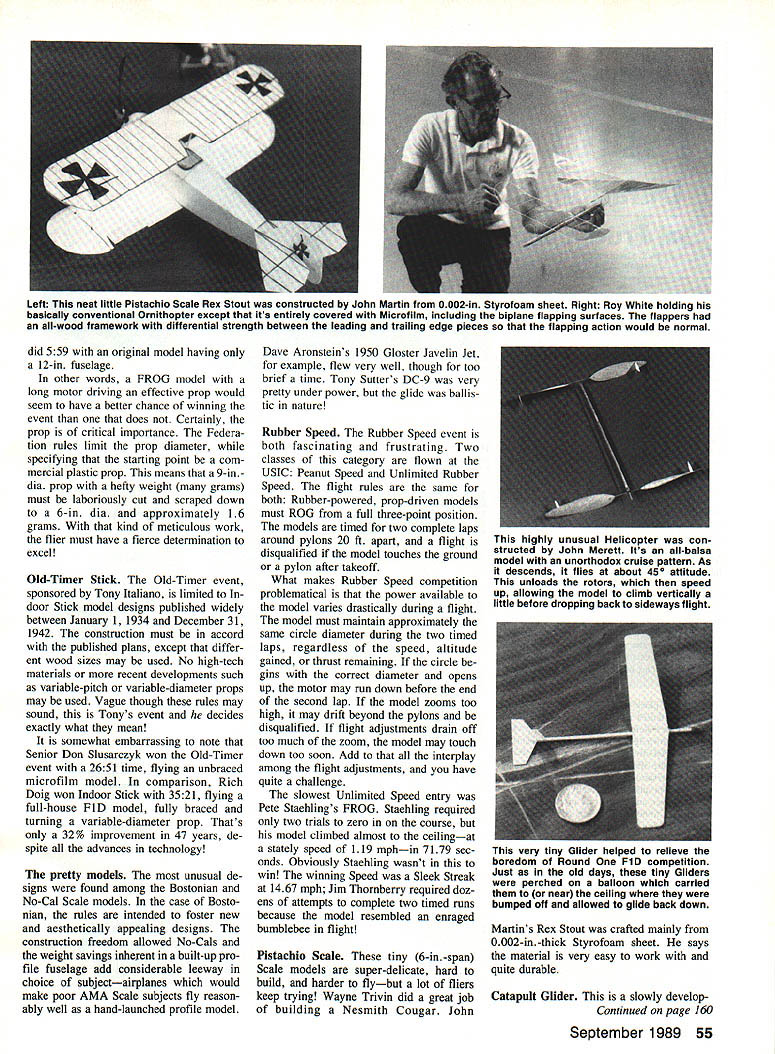
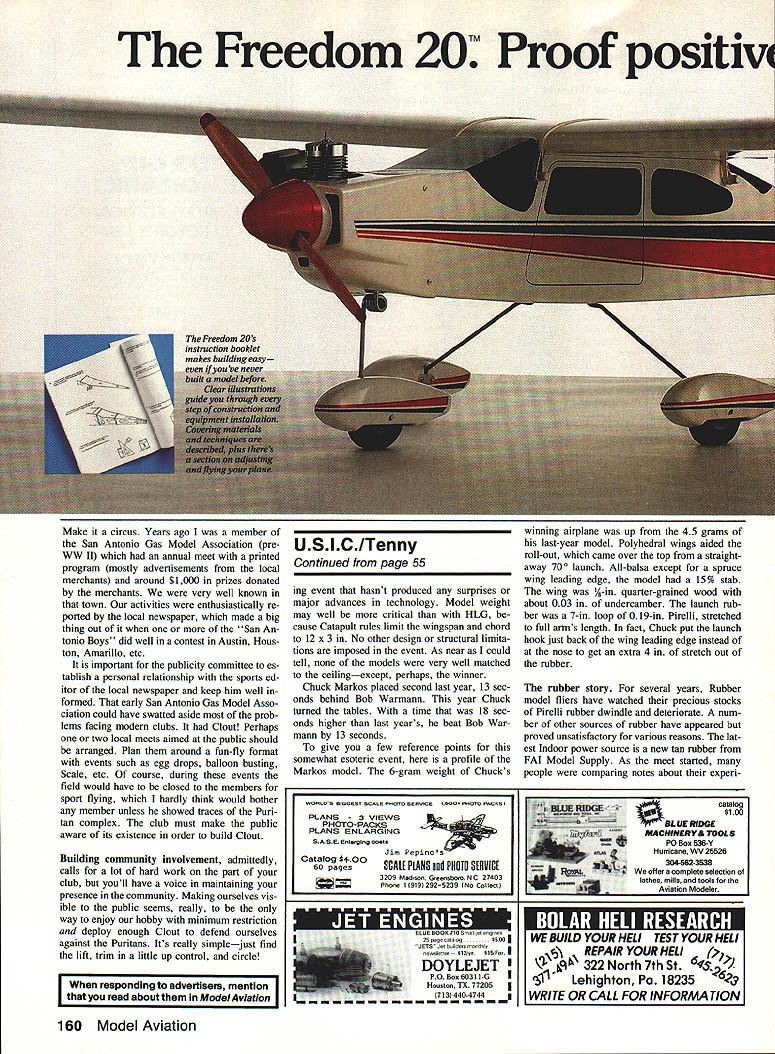
U.S. Indoor Championships
This was the place for an indoor "addict" on June 1–4 this year. Under the 116-ft. dome at East Tennessee State University, Johnson City, the eighth annual U.S. Indoor Championships (USIC) staged 21 official events and many unofficial ones. The meet was sponsored by the National Free Flight Society under the direction of Tony Italiano and several other experienced CDs. There were 100 entrants from 25 states and Canada. The combined total of official and unofficial events was more than any other indoor contest in the world. The meet was covered by TV and newspapers, and many spectators watched from the bleachers during the last two days of the contest.
Contest Board action
- On occasion contests experience problems with model eligibility or rules interpretations. Traditionally such problems were referred to the Contest Board for resolution, usually with a delay of several weeks. This year seven of the 11 Indoor Contest Board members (a quorum) were at the contest, allowing immediate rulings.
- The first problem occurred during the Helicopter event when a rotor blade became caught in ventilation louvers, stopping the rotor; the model eventually freed itself but the recorded flight time was inflated. The mishap revealed that Indoor Helicopter rules, based on Outdoor Helicopter definitions, did not clearly cover "hang-ups" or similar situations.
- The second issue involved whether two Cabin models met the fuselage-design requirements. Both problems were addressed on-site by the Contest Board members present, providing immediate guidance for the CD. These rulings must undergo ratification by mail vote of the entire board before becoming official.
Federation ROG (FROG)
- FROG was never expected to produce very high times, yet early in the year Dave Aronstein broke the five-minute barrier. By the end of the FROG session, 14 official flights had exceeded Dave's 5:07 pacesetter. Dave’s two best times, 6:57 and 7:01, exceeded the top times of all other contestants.
- The event is judged on a team basis. The format used at USIC was originated by Tony Becker in 1988: the two best scores from each state's entrants are added to make the state team score (if a state has more than two fliers, only the two highest scores count). This year seven teams entered. The New Jersey team (Gary Underwood and Doug Barber) beat the Washington State team (Dave Aronstein and Andy Tagliafico) 23:59 to 22:40.
- Equipment and prop work are critical. Federation rules limit prop diameter and specify the starting point be a commercial plastic prop; many competitors laboriously cut and scrape props down to required diameters and weights. A well-chosen motor-plus-prop often matters more than fancy aerodynamics.
Distinctive trophies were awarded for first, second and third places in the FROG event. The Federation ROG handmade Mary Ann Barber was a notable effort appreciated by many entrants.
Old-Timer Stick
- Sponsored by Tony Italiano, the Old-Timer event is limited to Indoor Stick model designs published between January 1, 1934 and December 31, 1942. Construction must follow the published plans, though different wood sizes may be used. No high-tech materials or more recent developments (variable-pitch or variable-diameter props, etc.) are allowed. Tony Italiano interprets and enforces the rules for his event.
- Senior Don Slusarcyzk won the Old-Timer event with a 26:51 time, flying an unbraced microfilm model. By comparison, Rich Doig won Indoor Stick with 35:21, flying a full-house FID model, fully braced and turning a variable-diameter prop—only about a 32% difference despite nearly five decades of technological advances.
The pretty models
- The most unusual designs were found among the Bostonian and No-Cal Scale models. Bostonian rules foster new and aesthetically appealing designs; No-Cal construction freedom and built-up profile fuselages allow subjects that would be poor AMA Scale candidates to work well as hand-launched profile models.
- Examples: Dave Aronstein’s 1950 Gloster Javelin Jet flew well though briefly; Tony Sutter’s DC-9 was very pretty under power but its glide was ballistic.
Rubber Speed
- Two classes were flown at USIC: Peanut Speed and Unlimited Rubber Speed. Rules: rubber-powered, prop-driven models must ROG from a full three-point position; models are timed for two complete laps around pylons 20 ft. apart; a flight is disqualified if the model touches the ground or a pylon after takeoff.
- The challenge: available power varies drastically during a run, yet the model must maintain approximately the same circle diameter for both timed laps. Tightening or opening of the circle, altitude zooms, or drift beyond pylons can cause the motor to run down prematurely or lead to disqualification.
- Notable results: Pete Stahling flew a FROG model at a stately 1.19 mph, taking 71.79 seconds—clearly not in contention to win. The winning Unlimited Speed was a Sleek Streak at 14.67 mph; Jim Thornberry required dozens of attempts because his model’s flight resembled an enraged bumblebee.
Pistachio Scale
- These tiny 6-in. span scale models are super-delicate and temperamental to trim. Wayne Trivin built an excellent Nesmith Cougar. John Martin’s Rex Stout was crafted mainly from 0.002-in. thick Styrofoam sheet—easy to work with and quite durable according to the builder.
Catapult Glider
- Catapult Glider is a slowly developing event in which one-man wins are at a premium. Models are launched from a 2-oz. catapult; the object is maximum time. Historically these tiny gliders were launched on a balloon and then bumped off near the ceiling.
- Event limits: span and chord limited to about 12 x 3 in.; no other design or structural limits are imposed.
- Chuck Markos improved on his previous year's performance and beat Bob Warmann by 13 seconds this year. Profile of Markos’s winning model:
- Weight: 6 grams (up from 4.5 g last year)
- Polyhedral wings to aid roll-out from a 70° straight-away launch
- All-balsa construction except for a spruce wing leading edge
- 15° stab; wing was 1/2-in. quarter-girdered with about 0.03 in. undercamber
- Launch rubber: 7-in. loop of 0.019-in. Pirelli, stretched to full arm's length; the launch hook was placed just behind the wing leading edge instead of at the nose to gain about 4 in. of extra stretch
The rubber story
- Pirelli stocks had dwindled and deteriorated for several years; competitors tried other sources with mixed success. At the meet many compared notes about tan rubber and other supplies. The FAI Model Supply Co. stepped up offerings near the meet, and most competitors were content again.
- Many fliers used tan rubber at the contest. Although few had long-term experience to be definitive, several believed tan offered energy storage at least equal to Pirelli and was less prone to breaking under hard use. Tan has a different torque curve from Pirelli, requiring recalibration of variable props and experimentation to find optimal rubber length/cross-section ratios for a given site. Overall, tan likely won most events at this meet.
Helicopter and Ornithopter
- With USIC giving AMA's "orphan" events an arena, these disciplines are growing in popularity. Two notable models showed innovation though neither placed.
- Roy White’s model was entirely covered with microfilm, including biplane flapping surfaces; differential strengths between leading and trailing edges allowed normal flapping action using conventional linkage.
- John Merett’s all-balsa helicopter was much heavier than other entrants. Its rotors (approximate to Easy-B prop size) had Teflon tails producing an unusual cruise pattern: as the helicopter descends it flies about a 45° attitude, unloading the rotors so they speed up and allow a slight vertical climb before dropping to a slow glide—a very stable, controlled descent.
Time out!
Even the most spirited F1D and Indoor Stick flights can seem slow to spectators as graceful models drift to the ceiling and back over many minutes. During the first round of F1D a small white object was seen rising toward the girders and then descending, causing low-level panic. Vito Gargiulo, Otto Curth and Bob Warmann were reliving modeling history: years ago an F1D'er staged a stunt with a balloon. This time the object was a light rigid Mylar foil attached to a glider. After several tries it detached and was not seen again until the following day.
The bottom line
- The USIC meet has had a dramatic effect on the indoor scene. The number of indoor events nationally will likely rise as clubs and contest directors include these disciplines more often.
- The meet highlighted the need for better indoor facilities and for standardized rules for small-aircraft design and rubber selection.
- Contest management at USIC remains excellent, which helps grow the entry list. Though the National Free Flight Society has subsidized the meet, that generosity cannot continue forever; roughly 125 entrants per year would be required for the USIC to break even.
- Cabin had been waning but is slowly reviving. Catapult Glider, pioneered at Chicago Aeroscouts meets, is now part of USIC and provides another high-level contest class.
It was a fine meet, with good fellowship and a number of memorable performances. Let's all get behind the best indoor meet in the world!
Transcribed from original scans by AI. Minor OCR errors may remain.

