
U.S. Indoor Champs
By Dave Linstrum
The magic of indoor flying
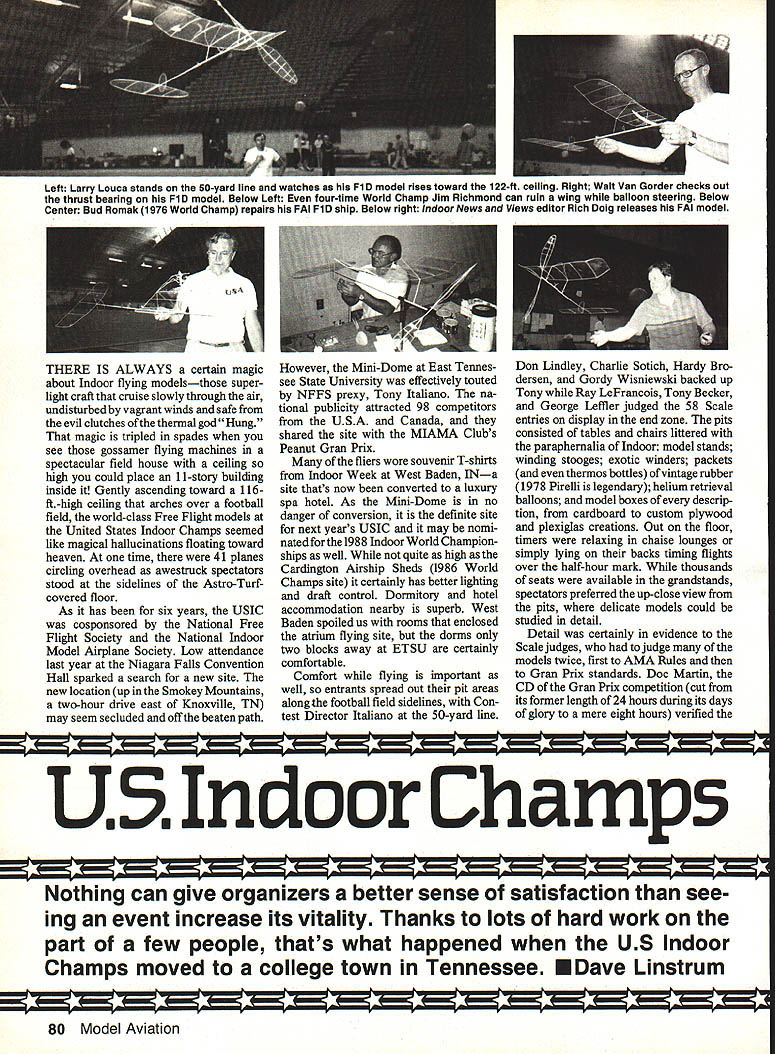
There is always a certain magic about indoor flying models—superlight craft that cruise slowly through the air, undisturbed by vagrant winds and safe from the vagaries of thermals. That magic is tripled in spades when you see gossamer flying machines in a spectacular field house with a ceiling so high you could place an 11‑story building inside it. Gently ascending toward a 116‑ft‑high ceiling that arches over a football field, world‑class free‑flight models at the United States Indoor Champs seemed like magical hallucinations floating toward heaven as some 41 planes circled overhead and awestruck spectators stood at the sidelines of the Astro‑Turf‑covered floor.
Event and site
- Cosponsors: National Free Flight Society (NFFS) and National Indoor Model Airplane Society (NIMAS).
- New site: the Mini‑Dome at East Tennessee State University (Johnson City, TN)—in the Smoky Mountains, about two hours east of Knoxville.
- Attendance: 98 competitors from the U.S. and Canada.
- The Mini‑Dome housed both the USIC and the MIAMA Club’s Peanut Grand Prix.
- The Mini‑Dome is slated to host next year’s USIC and may be nominated for the 1988 Indoor World Championships.
Organization and pits
Contest Director Tony Italiano ran the meet from the 50‑yard line with support from a volunteer staff and judges.
Key officials:
- Contest Director: Tony Italiano
- Assistants: Don Lindley, Charlie Sotich, Hardy Brodersen, Gordy Wisniewski
- Scale judges: Ray LeFrancois, Tony Becker, George Leffler
- Gran Prix CD: Doc Martin
Pits and equipment:
- Fifty‑eight Scale entries were displayed in the end zone.
- Pit areas lined the sidelines with tables and chairs and were laden with indoor paraphernalia:
- model stands and winding stooges
- exotic winders and packet systems
- thermos bottles and vintage rubber (1978 Pirelli noted)
- helium retrieval balloons
- model boxes from cardboard to custom plywood and plexiglass
- Timers often relaxed on chaise lounges or lay on their backs timing flights that ran past the half‑hour mark.
- Spectators preferred to stand in the pits for close study of delicate models rather than sit in the grandstands.
Competitions and model types
The meet showcased a wide variety of indoor free‑flight configurations:
- Scale (AMA and Peanut; models judged twice—AMA rules, then Grand Prix standards)
- Microfilm models and stick‑and‑tissue Scale ships
- Old‑Timer microfilm models (Thirties era)
- Pennyplanes (Mylar covered)
- Easy B models (condenser paper covered)
- 10‑gram Indoor Bostonians and Manhattans
- Peanut and Unlimited Speed models (balloon pylons near the floor)
- Hand‑launched gliders (athletic discus‑style launches, and 12‑in. gliders using rubber catapults)
- Ornithopters and autogiros
- Mass hand‑launches of Profile Scale ships
- ROG (rise‑off‑ground) launches—small strip of Astro‑Turf was removed to permit ROGs
The Grand Prix competition was shortened from its former 24‑hour marathon to an eight‑hour event.
Scale highlights
Scale modeling at the Mini‑Dome combined meticulous research with strong flight performance.
Notable builds and builders:
- Juergen Kortenbach (Toronto): a museum‑quality 1909 Aérodrome Silver Dart, canard pusher reminiscent of early Wright designs. Juergen, a mechanical engineering student at the University of Waterloo and a protege of Ken Groves, devoted more than a month to the model; flight times exceeded 30 seconds.
- Kevin Smith (Ft. Lauderdale): a striking Junkers JU52 “Iron Annie” trimotor with corrugated‑skin simulation and period markings. Kevin solved the trimotor drive problem with a flex‑drive system from the nose blocks to a single rubber motor in the fuselage; all three props pulled and the model flew cleanly.
- Charles Staler (Ft. Lauderdale): part of the local “Skunk Works,” he produced a French Monet push‑pull twin and a true Flying Scale Sikorsky Sky Crane.
- Patti Smith and Nancy Beitz: built and finished scale entries on site—Ansaldo SVA 5 (Patti) and Curtiss S‑1 Speedster (Nancy) with detailed pilot figure.
- “Doc” Martin (Miami): entered three obscure Peanut Scale point‑getters, including a 1912 Polish Drzewiecki canard, Martin MO‑1 floatplane, and Curtiss CT‑1 torpedo plane. He offered a prize for any Scale model that could hit the 116‑ft roof—no takers.
- Jim Miller (Ohio): tribute to Santos‑Dumont with canard pusher biplanes (AMA and Peanut), plus a Bleriot VII in AMA Scale and a first in Peanut Scale with a Voisin.
Canadian contributions:
- Bill Henderson: Peanut Bleriot VII (top Peanut Scale point value, 107.5).
- Ken Groves and Jack McGillivray: fierce AMA Scale rivalry—Ken’s home‑built Fike Dream bested Jack’s S.E.S.A WVI biplane in AMA Scale; Jack outperformed Ken in Bostonian events.
- Ken Groves won the Grand Champion award across seven events, narrowly edging Chuck Markos.
Notable fliers and results
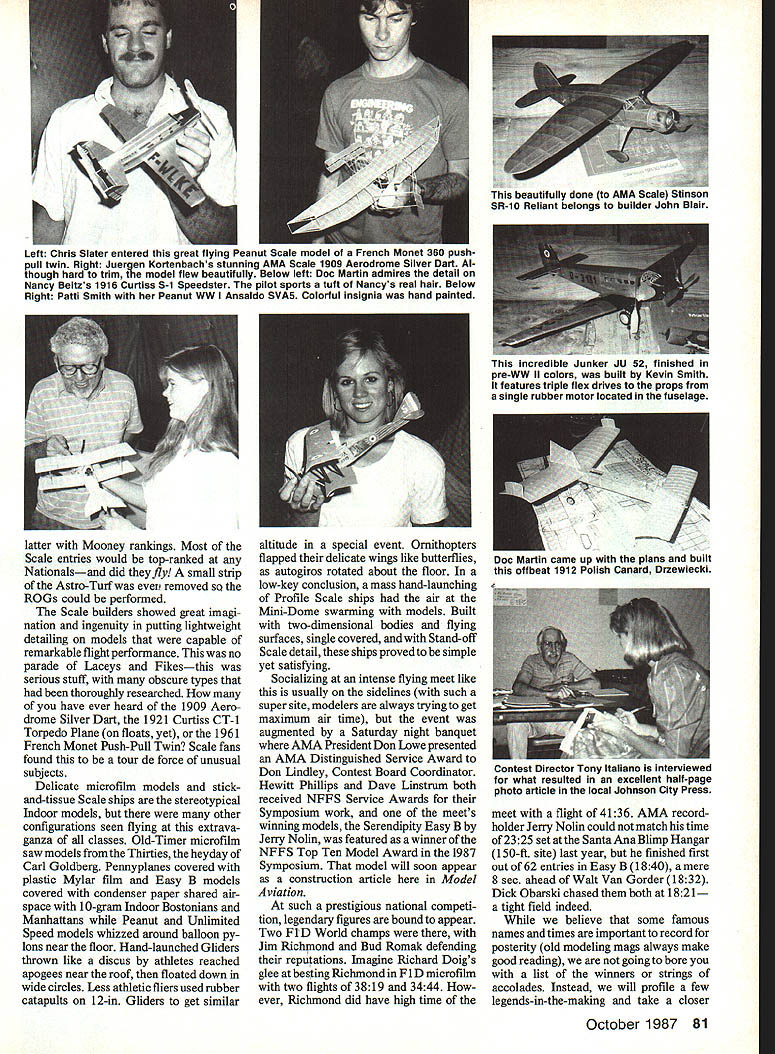
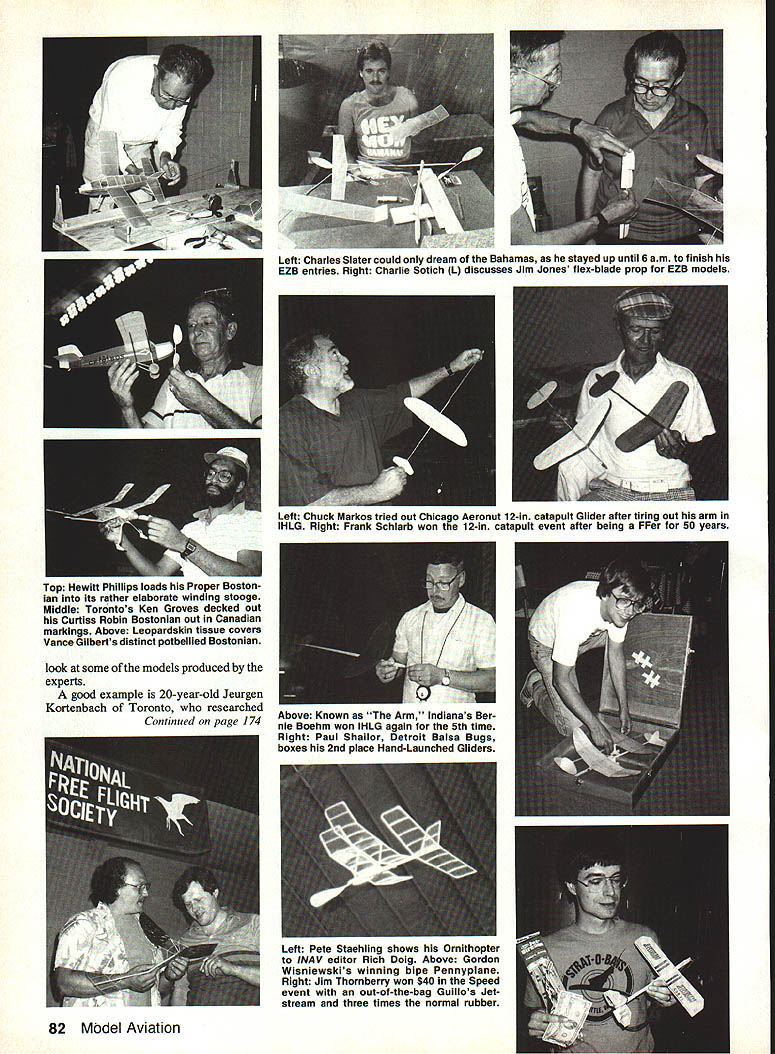
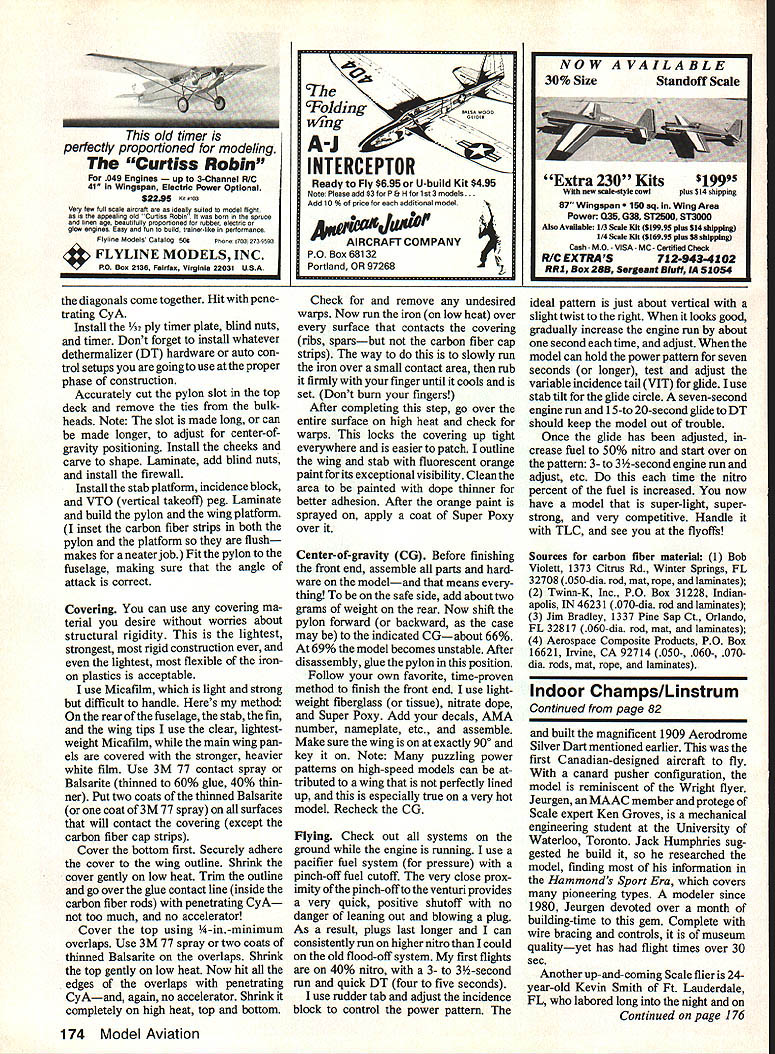
- F1D microfilm: world champions Jim Richmond and Bud Romak attended. Richard Doig posted flights of 38:19 and 34:44, besting Richmond in some heats, though Richmond recorded the meet high time of 41:36 in an AMA Stick microfilm.
- Easy B: Jerry Nolin won the Easy B event with an 18:40 flight; the field was tight with Walt Van Gorder and Dick Obarski posting competitive times.
- Pennyplane & Novice Pennyplane: Jim Richmond aided his 9‑year‑old son Mark, who took second place in both events.
- Unlimited Speed: Nordic expert Jim Thornberry (WI) won with a Guiollot Jetstream—an all‑balsa ROG powered with three times the normal rubber. Sponsor: Hardy Brodersen.
- Longevity: 65‑year‑old Ralph Schlarb of Indiana, modeling for over 50 years, remained active and competitive.
Social events and awards
- Saturday banquet highlights:
- AMA President Don Lowe presented Don Lindley with an AMA Distinguished Service Award (Contest Board Coordinator).
- Hewitt Phillips and Dave Linstrum received NFFS Service Awards for Symposium work.
- Jerry Nolin’s Serendipity Easy B—one of the meet’s winners—was named to the NFFS Top Ten Model Award in the 1987 Symposium and will appear as a construction article in Model Aviation.
Atmosphere and closing
The tone of the meet combined serious competition with a relaxed, convivial mood. New and salvaged models hung on structures; elegance in slow flight set a calm atmosphere even during fast events. With comfortable nearby dormitories and good lighting and draft control, the Mini‑Dome proved an outstanding site. Organizers and competitors alike plan to return next year to fly under the Mini‑Dome’s barrel‑vault roof.
Transcribed from original scans by AI. Minor OCR errors may remain.

