
U.S. Indoor Champs
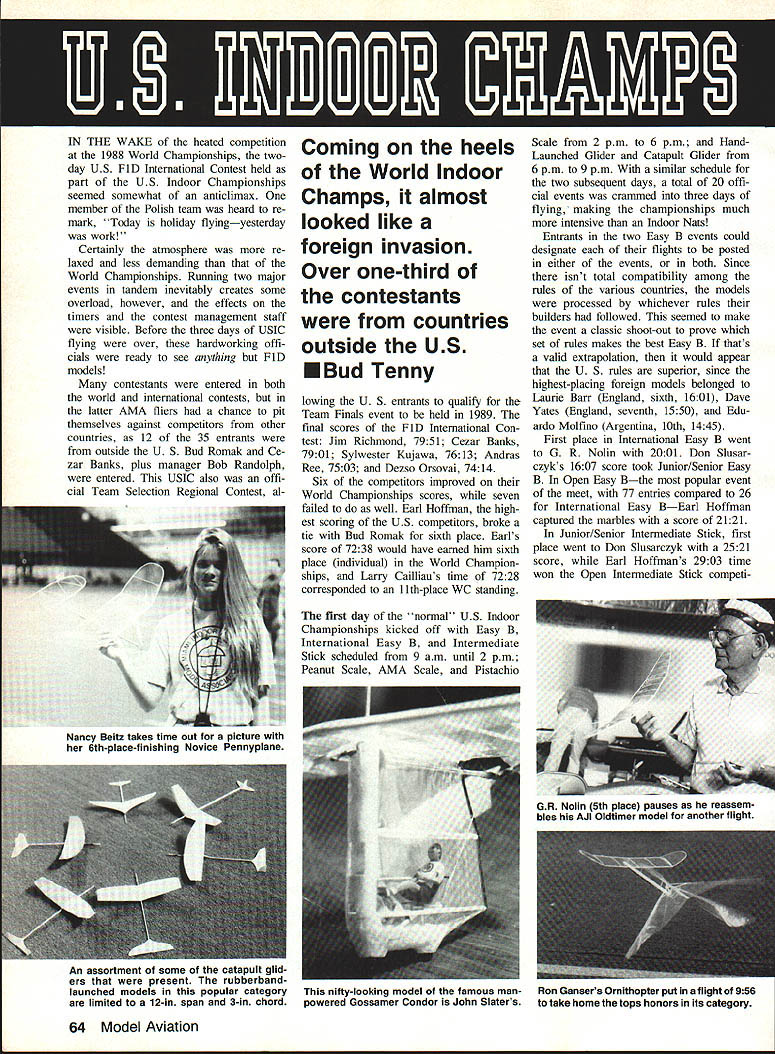
In the wake of the heated competition at the 1988 World Championships, the two-day F1D International Contest held as part of the U.S. Indoor Championships felt somewhat anticlimax. A member of the Polish team was heard to remark, "Today is holiday flying — yesterday was work." The atmosphere was noticeably more relaxed and less demanding than at the World Championships, but running two major events in tandem created overload that showed on the timers and contest-management staff. By the end of the three days of USIC flying, the officials were ready to see anything but F1D models.
Many contestants entered both the World and International contests. The international contest gave AMA fliers a chance to compete against overseas opponents: 12 of the 35 F1D entrants came from outside the U.S. Bud Romak and Cezar Banks, plus manager Bob Randolph, were among the U.S. contingent. This USIC also served as an official Team Selection Regional Contest, allowing U.S. entrants to qualify for the Team Finals to be held in 1989.
F1D International Contest — Final Scores
- Jim Richmond — 79:51
- Cezar Banks — 79:01
- Sylwester Kujawa — 76:13
- Andras Ree — 75:03
- Dezso Orsovai — 74:14
Six competitors improved on their World Championships scores; seven did not. Earl Hoffman, the highest-scoring U.S. competitor, edged Bud Romak to take sixth place; Hoffman's score of 72:38 would have placed him sixth in the World Championships. Larry Cailliau's 72:28 corresponded to an 11th-place World Championship standing.
Schedule and event load
The first day of the "normal" U.S. Indoor Championships began with:
- 9:00 a.m.–2:00 p.m.: Easy B, International Easy B, Intermediate Stick
- 2:00 p.m.–6:00 p.m.: Peanut Scale, AMA Scale, Pistachio Scale
- 6:00 p.m.–9:00 p.m.: Hand-Launched Glider, Catapult Glider
A similar schedule ran the following two days. In all, 20 official events were crammed into three days, making the championships much more intensive than a typical Indoor Nats.
Easy B and Intermediate Stick
Entrants in the two Easy B events could designate flights to be posted in either event or both. Because national rules differ, models were processed under the rules the builders had followed, making the competition a shoot-out of which ruleset produced the best Easy B. From the results, U.S. rules appeared to have an edge; the highest-placing foreign Easy B models were:
- Laurie Barr (England) — 6th, 16.01
- Dave Yates (England) — 7th, 15.50
- Eduardo Molfino (Argentina) — 10th, 14.45
Top Easy B and Intermediate Stick placings:
- International Easy B — G. R. Nolin, 20.01
- Junior/Senior Easy B — Don Slusarczyk, 16.07
- Open Easy B — Earl Hoffman, 21.21 (77 entries)
- Junior/Senior Intermediate Stick — Don Slusarczyk, 25.21
- Open Intermediate Stick — Earl Hoffman, 29.03
Intermediate Stick showed promise as a bridging event for progressing fliers. Novice Pennyplane top times were reasonably close to F1D scores on the average site, and F1D scores suggested the site was well suited to Intermediate Stick. Maximum FAT wingspan remains a compromise for optimum Intermediate design; weight targets should be kept modest. Future team selection programs may include entries where some fliers use Intermediate Stick.
Scale arena and notable projects
The Scale events featured both stiff competition and several esoteric projects. Notable items included:
- John Slater and Juergen Kortenbach (Canada) modeled the Sikorsky Sky Crane in both Peanut and Pistachio sizes. Over three years John developed a method of rotor construction and balance control that he says allows builders to produce realistic, flyable rotorcraft. The Peanut Sikorsky is fragile but John flies it casually even in crowded places.
- John also has an impressive Gossamer Condor model that needs only minor work to be competitive.
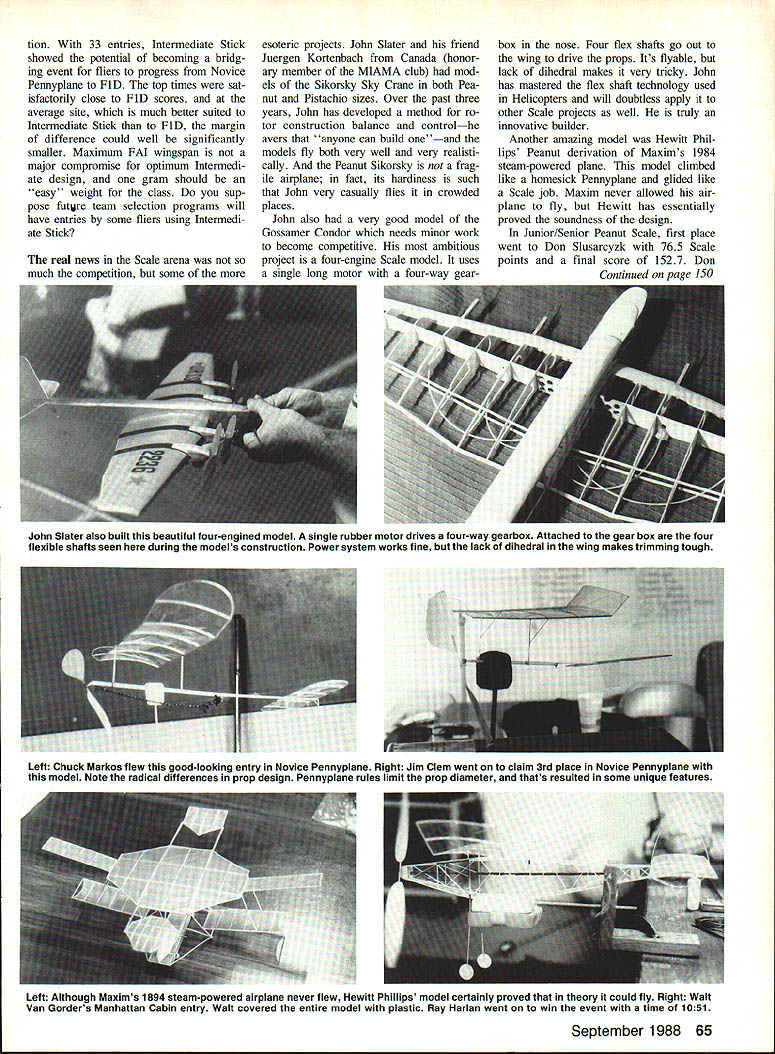
- A four-engine Scale model drew attention: it used a single long motor with a four-way gearbox in the nose and four flex shafts to drive the wing-mounted props. It is flyable but tricky without dihedral. John has mastered flex-shaft technology used in helicopters and is likely to apply it to other Scale projects.
- Hewitt Phillips built a Peanut derivation of Maxim's 1894 steam-powered plane. The model climbed like a Pennyplane and glided like a Scale job; Maxim himself never allowed his airplane to fly, but Hewitt's model essentially proved the design's soundness.
In Junior/Senior Peanut Scale, first place went to Don Slusarczyk with 76.5 Scale points and a final score of 152.7.
Awards and banquet
A special award for the youngest flier was presented to Laszlo Ree by an anonymous donor. The award was matched by the National Free Flight Society (NFFS) and then matched by the AMA. The 19-year-old from Hungary placed ninth in the championships and outscored the other Hungarian entrants, Dezso Orsovai and his father Andras Ree.
The banquet and awards ceremony were well managed: speeches were brief and the proceedings moved briskly. The U.S. Indoor modeling community owes a debt of gratitude to the directors of the NFFS for hosting the World Championships resources and to Tony Italiano for his persistent efforts to secure sites and host the U.S. Indoor Championships.
Technology and propeller developments
One hallmark of the championships and the two-day F1D International Meet that followed was the technology on display. Variable-geometry propellers — introduced by the British team at West Baden in 1980 — appeared in one form or another on many top models. The most troublesome problem with variable props is the sensor that initiates pitch or diameter change: it is difficult to make, difficult to calibrate, and often unreliable. Richmond and the Canadians had the most reliable setups.
Examples:
- Mike Thomas' variable-pitch prop transitioned very smoothly and gradually to a lower pitch; only careful rpm measurement revealed when it began its change.
- During Richmond's 44:09 flight (his fifth), the prop changeover was subtle: the prop ran at 33 rpm, then kicked in around 19:30 of the flight and the rpm jumped from 33 to 55. Effective diameter decreased by about 4 in., pitch decreased, and rpm settled to about 50 at touchdown. An early changeover could have been disastrous — the airplane climbed for about four minutes after the prop kicked in — but on that flight the airplane had dropped away from the ceiling in the "big prop" mode, avoiding the iron-work.
- Cezar Banks brought several variable-pitch prop mechanisms, including a "bi-stable" version. On one flight the airplane climbed out at 45 rpm and ultimately dropped to 31 rpm; the model descended to about 45 ft. before the prop kicked in, then climbed again at 34.5 rpm and gained about 15 ft. That mechanism was governed by motor tension and worked similarly to a freewheeling device: blades locked in high pitch until release, then snapped to low pitch.
The Swiss team, pioneers of the long-fuselage configuration, used a new prop technology with blade outlines molded from carbon fiber and epoxy. The prop spar was abbreviated and reached only to the second prop rib. The outline is currently too stiff, producing a slightly higher-than-desirable average rpm; nevertheless, the Swiss placed third with a 4½-minute max.
Larry Cailliau demonstrated that a lightweight plastic tube around the balloon string reduced model damage and helped catch props during steering. This innovation was widely adopted: over half the balloons used plastic tubes, textured tape, or other attachments effectively.
Incidents, midair collisions, and contest management
Even with carefully spaced processing and launch schedules, air-traffic control-style restrictions, and limited timers, midair collisions still occurred. Collisions sometimes caused scheduling problems for three-man teams: a top team might make six flights of 30 minutes or longer in a day — over half the total time allotted for a session — so multiple collisions could leave teams pressed for time. In response, the Day Three schedule was expanded by one hour, an example of management fine-tuning to improve the meet.
Rescue attempts for airplanes caught in the girders led to an uncommonly large number of destroyed models. Several balloons shattered during floor-based rescue efforts, shredding models in the process. One or two balloons exploded when not in contact with the structure, suggesting the balloons had been weakened by earlier contact with the girders.
Conclusion
The U.S. team and five-time World Champion Jim Richmond's wins were impressive, but equally notable was the skill and energy demonstrated by fliers from the other 12 indoor teams around the world. All 13 teams did their countries proud.
Transcribed from original scans by AI. Minor OCR errors may remain.

