
U.S. Scale Masters
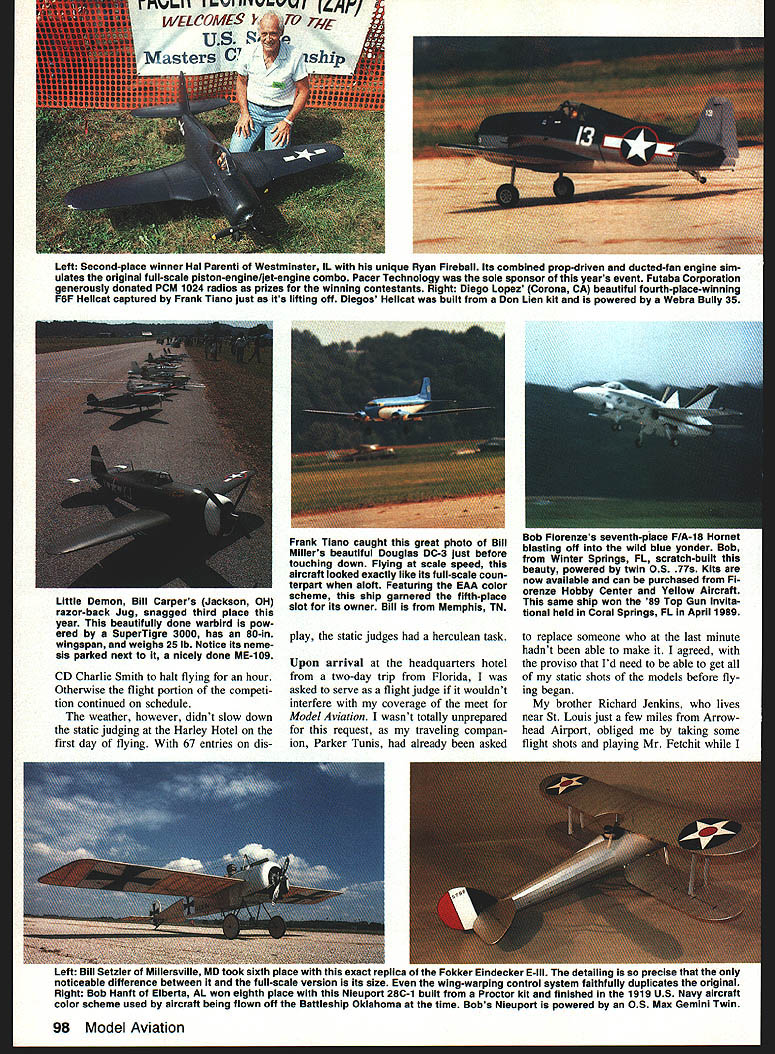
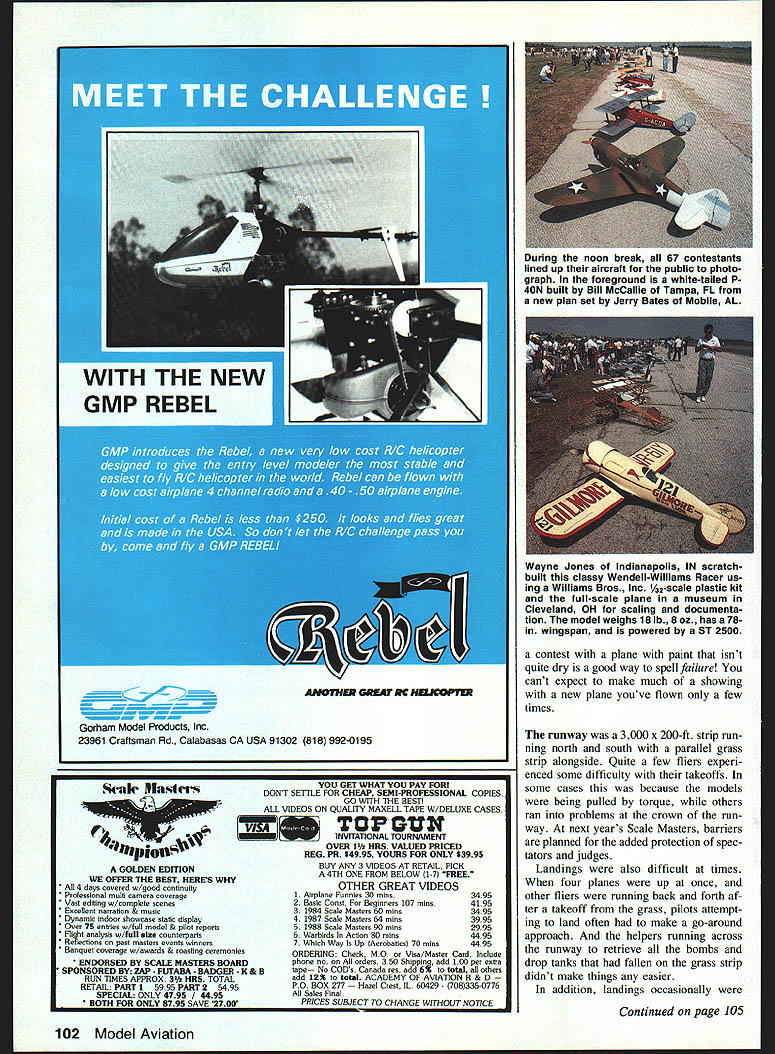
The who's who of scale modeling—some 67 entrants—came together again this year near St. Louis, MO, for the 10th anniversary U.S. Scale Masters. As the foremost annual national competition in RC scale modeling, the event showcased the best aircraft and pilots in RC Scale. The technical skill evident in many of the aircraft was extraordinary, and competition was stiff. Modelers came from nearly every state and Canada, and one pilot traveled from Sweden. Pacer Technology (maker of Zap adhesives) was the sole sponsor and provided a crash kit of sample-size products for every contestant. Futaba Corporation provided place prizes of PCM 1024 equipment.
Weather and judging overview
Flying conditions could have been better. Rain, a low-hanging mist, and a 56°F chill made the site at Arrowhead Airport feel more like the English countryside than the Midwest. At times pilots with glasses looked as if they'd need windshield wipers to see their planes. Despite the damp, the flight portion of the competition continued on schedule, and static judging proceeded at the Harley Hotel on the first day. With 67 entries on display, the static judges had a herculean task.
Having previous experience as both a static and flight judge at the Nationals, I saw right away that the Scale Masters judging would be more rigorous than what I had been used to. The pilots generally found the judging fair: flight scores were quite consistent from one line to the next.
Serving as a flight judge (personal notes)
Upon arrival at the headquarters hotel from a two-day trip from Florida, I was asked to serve as a flight judge so long as it wouldn't interfere with my coverage for Model Aviation. My traveling companion, Parker Tunis, had already arranged for a last-minute replacement when someone couldn't make it, and I agreed to judge on the proviso that I'd be allowed time to get static shots of the models before flying began. My brother, Richard Jenkins, who lives a few miles from Arrowhead Airport, took some flight photos while I completed static photography and judging.
Flying observations — common problems and strengths
Many contestants scored highly in static judging, but the shakeout came in flying. Common problems included:
- Pilots adding power on approach, causing the model to dip.
- Landing too slowly so the plane fell out of the air in the last few feet.
- Difficulty establishing a consistent reference point at the side of the runway to center maneuvers.
- Failure to use the same crossover point and altitude on figure eights.
- Poorly rounded maneuvers and inconsistent speeds that cost realism points.
- Rushed maneuvers, announcing or beginning maneuvers before the airplane was stable.
Simple maneuvers such as figure eights and straight-flight-outs with procedure turns often proved hardest to fly well. Conversely, pilots who were contest-wise, consistent, and stayed with one airplane tended to take home the prizes. The principle: staying with a single airplane and learning to fly it well makes a major difference in competition.
Winners and notable entrants
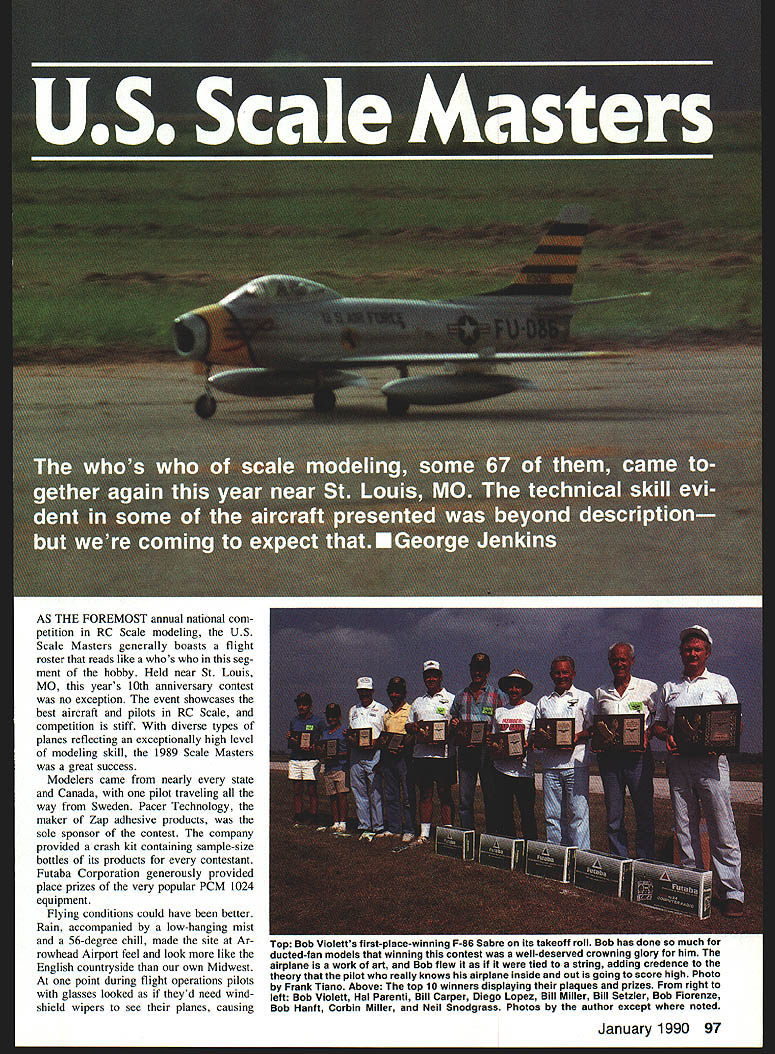
- Champion: Bob Violett — Violett has done much for ducted-fan models and earned the Scale Masters title flying a ducted-fan F-86 Sabre. His flying demonstrated intimate knowledge of the airplane.
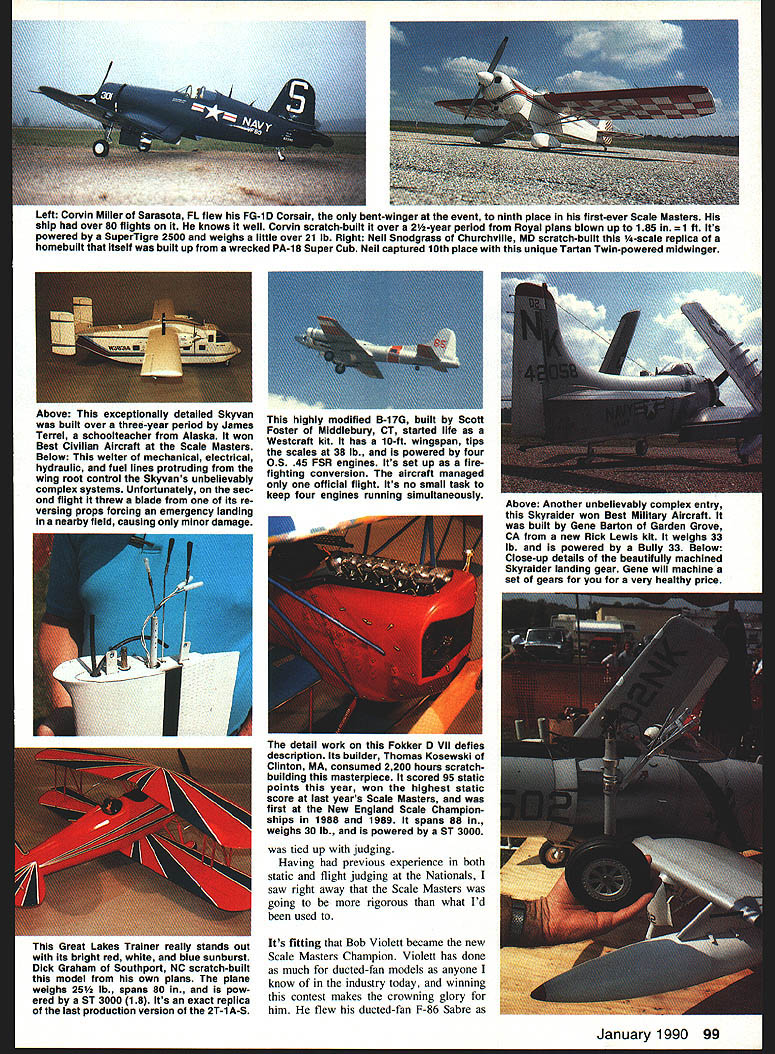
- Second place: Hal Parenti — Combined a prop-drive with a ducted-fan unit in his Ryan Fireball; the reliable fan unit improved performance.
- Fifth place: Bill Miller — Flew a DC-3 built from a Royal kit in an EAA paint scheme. Its scale flight speed and an excellent landing helped secure his top-five finish.
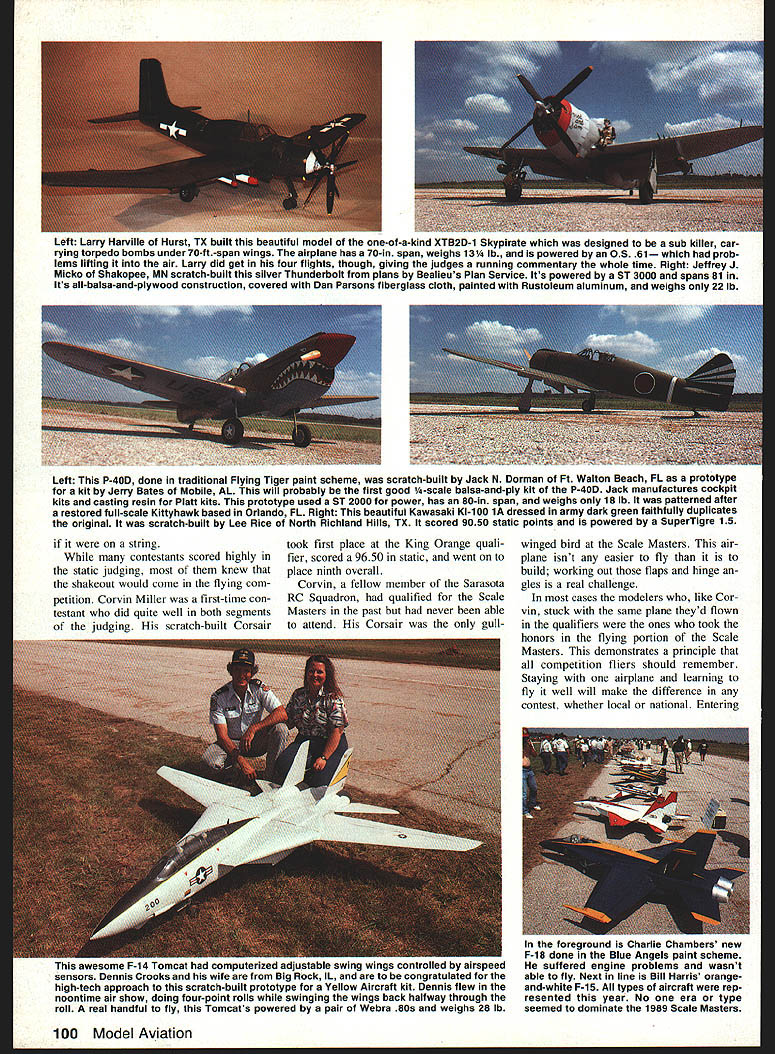
- Corvin Miller (first-time Scale Masters contestant) — His scratch-built Corsair, the only gull-winged airplane at the meet, scored 96.50 in static, had won at the King Orange qualifier, and placed ninth overall. Corvin is a member of the Sarasota RC Squadron.
- Gene Barton — His Skyraider, powered by a big Bully engine, made low passes that thrilled Vietnam vets; voted Best Military Aircraft.
- Jim Terrell — His Sky Van scored 96.50 in static and was voted Best Civilian Aircraft. Built over three years, the model displayed incredible detail. It completed one qualifying flight; on its second flight a blade was thrown from the variable-pitch prop and the model crash-landed with minimal damage. Terrell received a new set of RC gear at the banquet.
- Scott Foster — Built a highly modified B-17G (started as a Westcraft kit) with a 10-ft wingspan, weighing 38 lb and powered by four OS .45 FSR engines. It was set up as a firefighting-conversion aircraft and managed an official flight. Keeping four engines running simultaneously was a challenge.
- Bob Fiorenze — His seventh-place IA-15 Hornet is a scratch-built beauty powered by twin OS .77s. Kits are available from Fiorenze Hobby Center.
- David Pape — Crafted his own five-cylinder radial engine for his Kinner Sportster by scratch-building the engine himself.
Other interesting entries included a Wendell Williams Racer by Wayne Jones, Tom Weemes' Curtiss Hawk 75 finished in silver MonoKote with chrome trim, a Golden Age Travel Air, and a Mystery Ship by Buzz Butler from Colorado.
Tours and local visits
The host club arranged a tour of the nearby McDonnell Aircraft factory for the first 100 guests. The tour, from 8:00 p.m. to almost 10:30 p.m., provided eye-opening insight into a major high-tech aircraft facility and why jet aircraft cost so much to build.
After a full day of flying, I and Parker Tunis visited Creve Coeur Airport, just north of Arrowhead. There we found one of the largest collections of flying antique Wacos and Warbirds in the U.S., and the Moolah Air Patrol flying Shriners. Classic Wacos based at Creve Coeur included:
- QCF-2
- ATO
- RNF
- QDC
- JWM
- BSO
- ARE
- SRE
- UBA
- a Clipwing Monocoupe
Other aircraft observed included a Beechcraft Staggerwing E17B, a 1929 KR-21 manufactured by Fairchild, and a Nicholas Beasley NB-8. Creve Coeur is a paradise for modelers needing scale documentation; the planes are airworthy and ideal for up-close photos and notes. Contact John Mullen at Creve Coeur Airport, St. Louis Aviation Museum, Creve Coeur Mill Road, Creve Coeur, MO 63141.
Advice for future competitors
- Bring a camera with a long lens (at least 200mm zoom) or a video camera with a 12:1 zoom to get the best shots.
- Buy lots of 200-speed film or ample videotape.
- If you intend to compete in a future Scale Masters, start building and practicing early. Entering requires commitment in addition to talent—having plenty of time to fly and practice before the meet makes a big difference.
- Stay with one airplane and learn it inside out; consistent performance will win contests.
Acknowledgments and video
Thanks to Harris Lee and the many volunteers who have poured time, talent, and money into the Scale Masters contests over the last 10 years.
For those unable to attend this year's meet, an entertaining video of the Scale Masters is available from the Academy of Aviation Research and Development. Write Joe Griffin, Academy of Aviation Research and Development, 17010 Elm Dr., Hazel Crest, IL 60429.
Transcribed from original scans by AI. Minor OCR errors may remain.

