
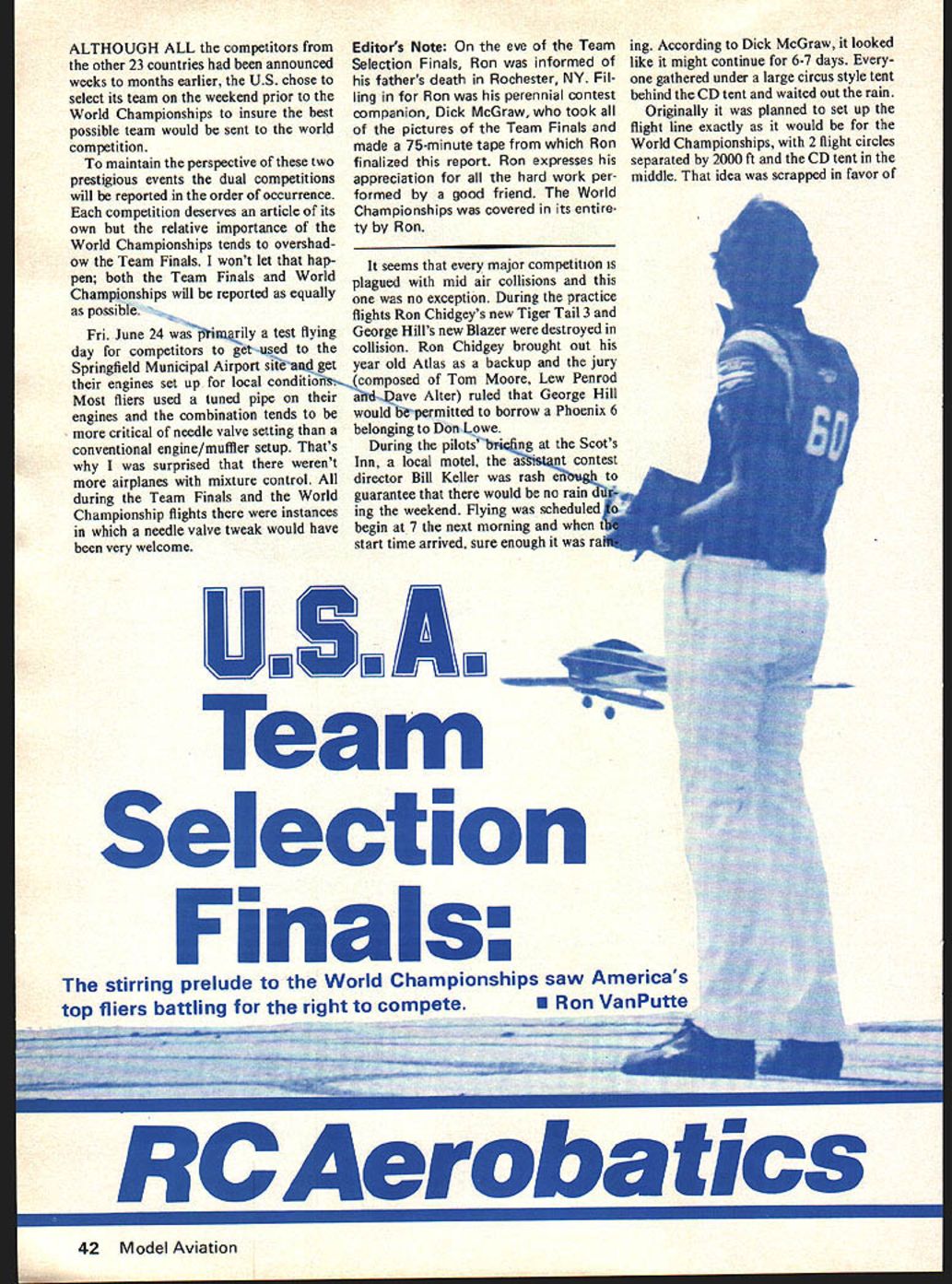
ALTHOUGH ALL the competitors from the other 23 countries had been announced weeks to months earlier, the U.S. chose to select its team on the weekend prior to the World Championships to insure the best possible team would be sent to the world competition.
To maintain the perspective of these two prestigious events the dual competitions will be reported in the order of occurrence. Each competition deserves an article of its own but the relative importance of the World Championships tends to overshadow the Team Finals. I won't let that happen; both the Team Finals and World Championships will be reported as equally as possible.
Fri. June 24 was primarily a test flying day for competitors to get used to the Springfield Municipal Airport site and get their engines set up for local conditions. Most fliers used a tuned pipe on their engines and the combination tends to be more critical of needle valve setting than a conventional engine/muffler setup. That's why I was surprised that there weren't more airplanes with mixture control. All during the Team Finals and the World Championship flights there were instances in which a needle valve tweak would have been very welcome.
Editor's Note:
On the eve of the Team Selection Finals, Ron was informed of his father's death in Rochester, NY. Filling in for Ron was his perennial contest companion, Dick McGraw, who took all of the pictures of the Team Finals and made a 75-minute tape from which Ron finalized this report. Ron expresses his appreciation for all the hard work performed by a good friend. The World Championships was covered in its entirety by Ron.
It seems that every major competition is plagued with mid-air collisions and this was no exception. During the practice flights Ron Chidgey's new Tiger Tail 3 and George Hill's new Blazer were destroyed in a collision. Ron Chidgey brought out his year-old Atlas as a backup and the jury (composed of Tom Moore, Lew Penrod and Dave Alter) ruled that George Hill would be permitted to borrow a Phoenix 6 belonging to Don Lowe.
During the pilots' briefing at the Scot's Inn, a local motel, the assistant contest director Bill Keller was rash enough to guarantee that there would be no rain during the weekend. Flying was scheduled to begin at 7 the next morning and when the start time arrived, sure enough it was raining. According to Dick McGraw, it looked like it might continue for 6-7 days. Everyone gathered under a large circus style tent behind the CD tent and waited out the rain.
Originally it was planned to set up the flight line exactly as it would be for the World Championships, with 2 flight circles separated by 2000 ft and the CD tent in the middle. That idea was scrapped in favor of
U.S.A. Team Selection Finals:
The stirring prelude to the World Championships saw America's top fliers battling for the right to compete. ■ Ron VanPutte putting a single circle with 2 flight lines directly in front of the CD tent, so that adequate cover would be available for people and airplanes. Fortunately the rain only lasted for an hour or so. It continued to be cool, overcast and windy for much of the rest of the day, with the sun finally breaking through in the late afternoon.
When the 1st round was over no one had an outstanding score. Rhett Miller, Dave Brown, Mark Radcliff, Steve Helms, Dean Koger and Jim Kimbro were up around the top, all within striking distance.
However, during the 2nd round most scored well; Jim Kimbro had a barnburner. Not all fliers were fortunate though; Phil Giesiking's engine flamed out and in his attempt to turn back to the runway from low altitude, his airplane went between some campers, bounced off 2 cars and hit a 3rd car. Damage to the airplane was extensive and Phil was finished in the competition since he didn't have a backup airplane.
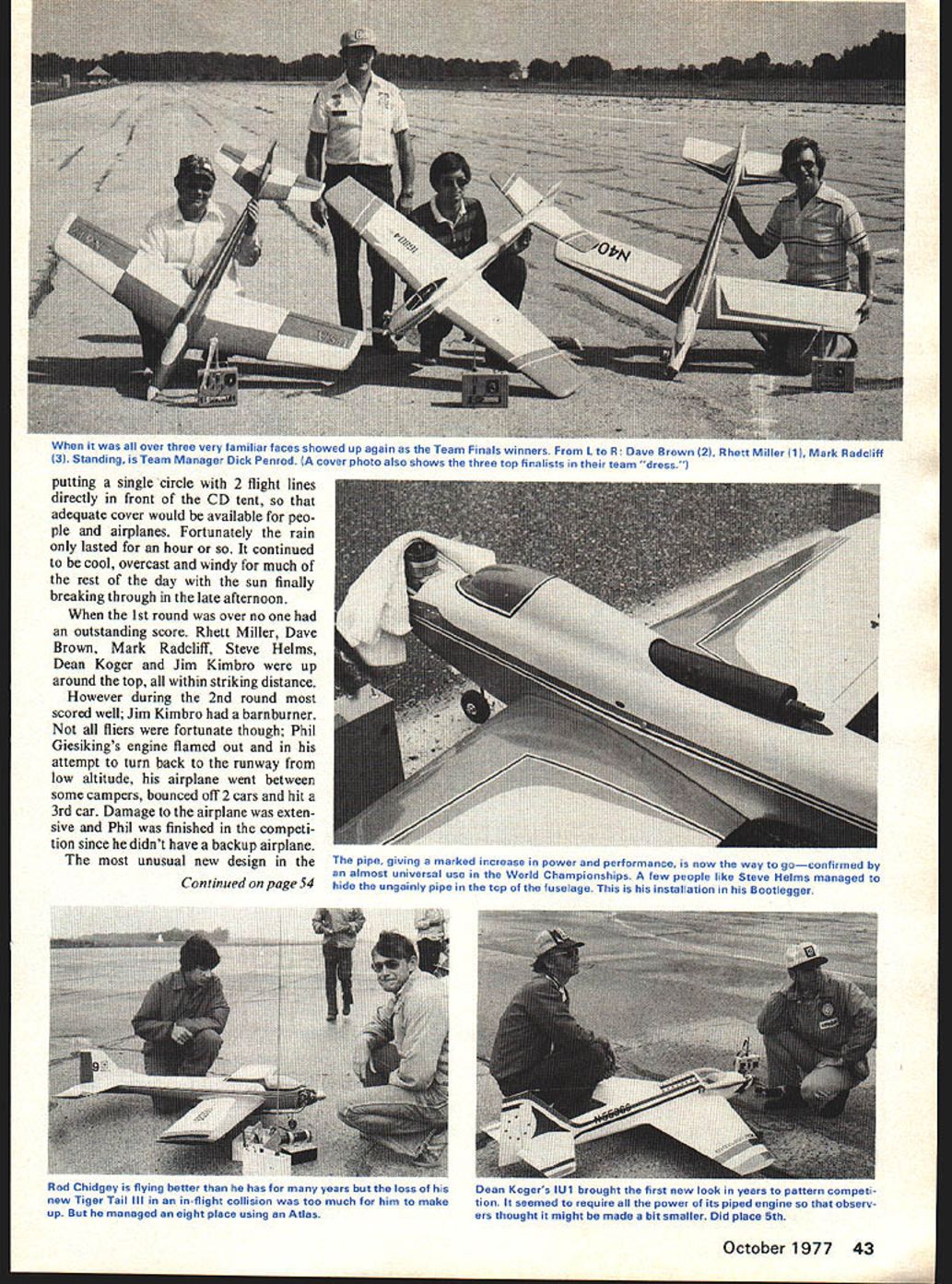
The most unusual new design in the competition was the IU1, flown by Dean Koger. It continued to fly well and kept Koger in contention. The IU1 was designed by Wayne Ulery, an old friend from Springfield OH whom I met years ago when I was a member of the Western Ohio Radio Control Society. Wayne's design has an unusual triangular shaped wing which is 3⅜ in. thick at the root chord. The IU1 has a very large wing of approximately 1,000 sq in and it requires all the power a Rossi/Rossi pipe combination can deliver to haul its 11-4 weight around. In a discussion with Don Lowe, Don suggested that a slightly smaller version of the design would probably fly even better than the original.
At the end of the 2nd round Rhett Miller was solidly in the lead with Dave Brown 2nd and Mark Radcliff 3rd. Mark was closely chased by Helms, Koger and Kimbro.
The Sat. night banquet was one of the less satisfactory parts of the Team Finals, partly because the room was very hot. A roast was scheduled and almost everyone assumed that a few well-known R/C personalities would be involved, but nearly everyone there ended up being roasted and it took a long time.
Sun. morning's 3rd round was blessed with a clear blue sky, cool temperatures and winds that were virtually nonexistent. Mark Radcliff was one of the 1st to go up and he put in a very high scoring flight. After the flight he was heard to remark, "That was the most beautiful air I've ever flown in." Almost everyone improved their scores. Jim Kimbro had a great flight going until he ran out of time in the landing roll, which zeroed his landing and spot landing points. With a few more secs he would have moved up 2 to 3 places in the standings; that's how close the scoring was for 3rd through 6th place.
Mike Mueller was plagued with bad luck on the 3rd round. A screw holding the bracket on the pipe was lost causing the pipe to slide back on takeoff and zero out the flight despite the efforts of a lot of people who tried to get him into the air.
The highlight of the 4th round was a great flight by Fred Kugel, the perpetual bridesmaid. The flight temporarily put Fred into 10th place until a tabulation error was discovered on one of Denis Donohue's flights which moved him ahead of hapless Kugel. The significance of 10th place is that the top 10 finishers in the Team Finals will be invited to the Tournament of Champions in Las Vegas. Fred Kugel became the bridesmaid again.
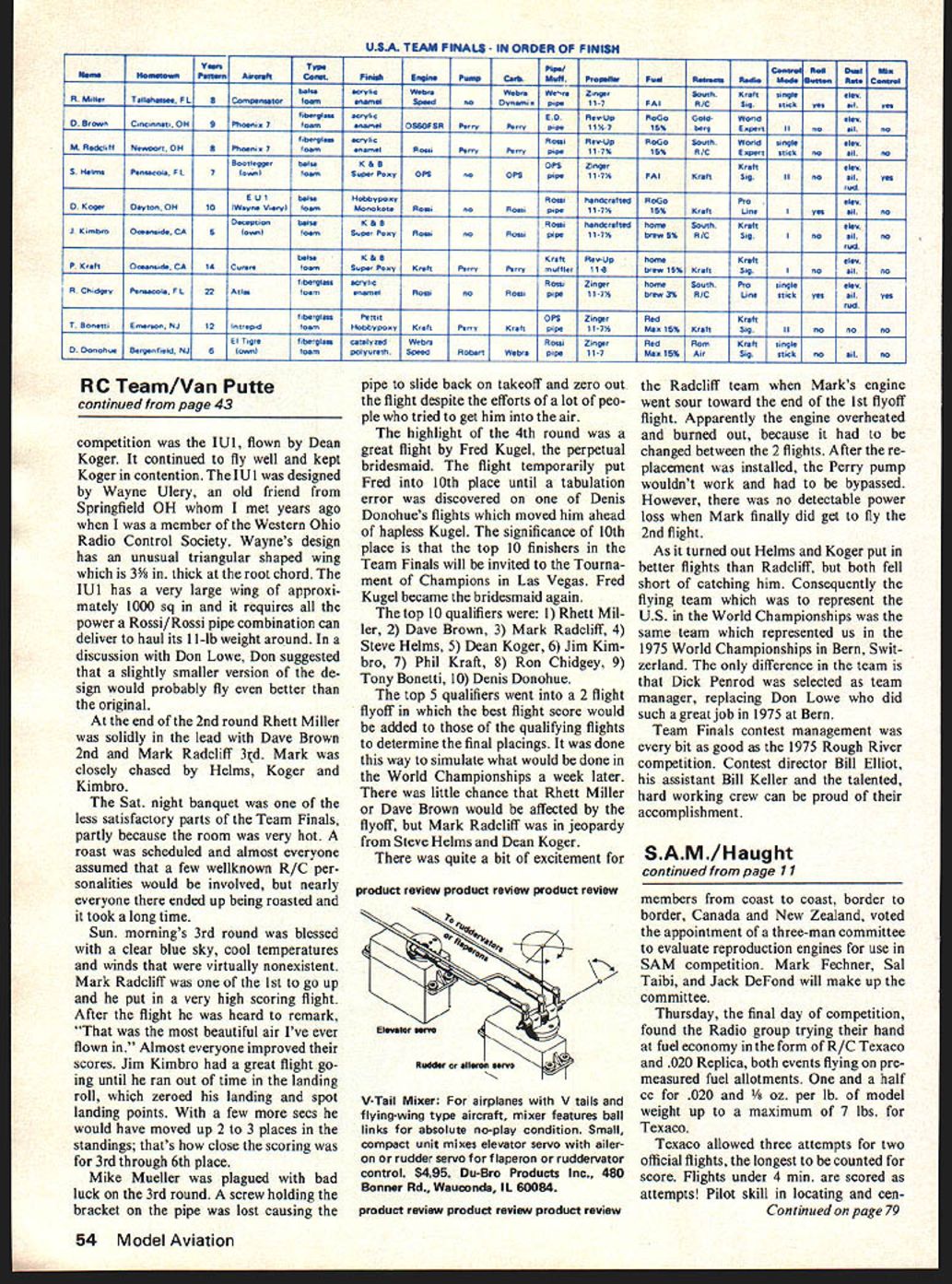
The top 10 qualifiers were: 1) Rhett Miller, 2) Dave Brown, 3) Mark Radcliff, 4) Steve Helms, 5) Dean Koger, 6) Jim Kimbro, 7) Phil Kraft, 8) Ron Chidgey, 9) Tony Bonetti, 10) Denis Donohue.
The top 5 qualifiers went into a 2 flight flyoff in which the best flight score would be added to those of the qualifying flights to determine the final placings. It was done this way to simulate what would be done in the World Championships a week later. There was little chance that Rhett Miller or Dave Brown would be affected by the flyoff, but Mark Radcliff was in jeopardy from Steve Helms and Dean Koger.
There was quite a bit of excitement for the Radcliff team when Mark's engine went sour toward the end of the 1st flyoff flight. Apparently the engine overheated and burned out, because it had to be changed between the 2 flights. After the replacement was installed, the Perry pump wouldn't work and had to be bypassed. However, there was no detectable power loss when Mark finally did get to fly the 2nd flight.
As it turned out Helms and Koger put in better flights than Radcliff, but both fell short of catching him. Consequently the flying team which was to represent the U.S. in the World Championships was the same team which represented us in the 1975 World Championships in Bern, Switzerland. The only difference in the team is that Dick Penrod was selected as team manager, replacing Don Lowe who did such a great job in 1975 at Bern.
Team Finals contest management was every bit as good as the 1975 Rough River competition. Contest director Bill Elliot, his assistant Bill Keller and the talented, hard working crew can be proud of their accomplishment.
Transcribed from original scans by AI. Minor OCR errors may remain.

