
USFFC
John Oldenkamp
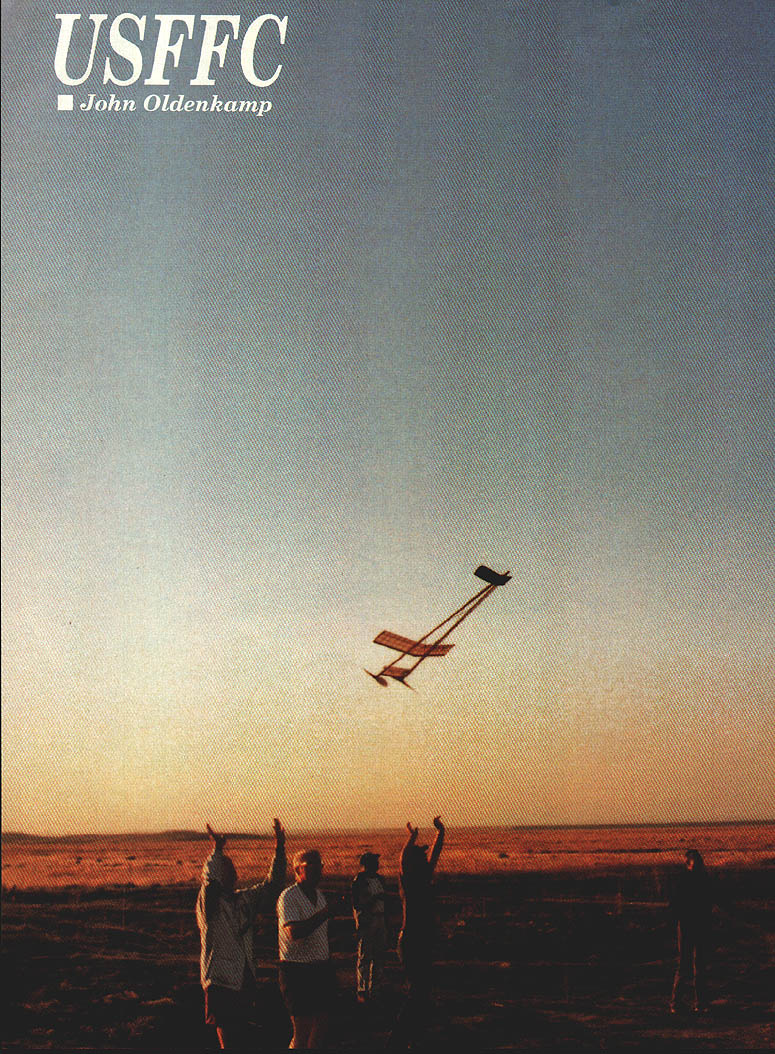
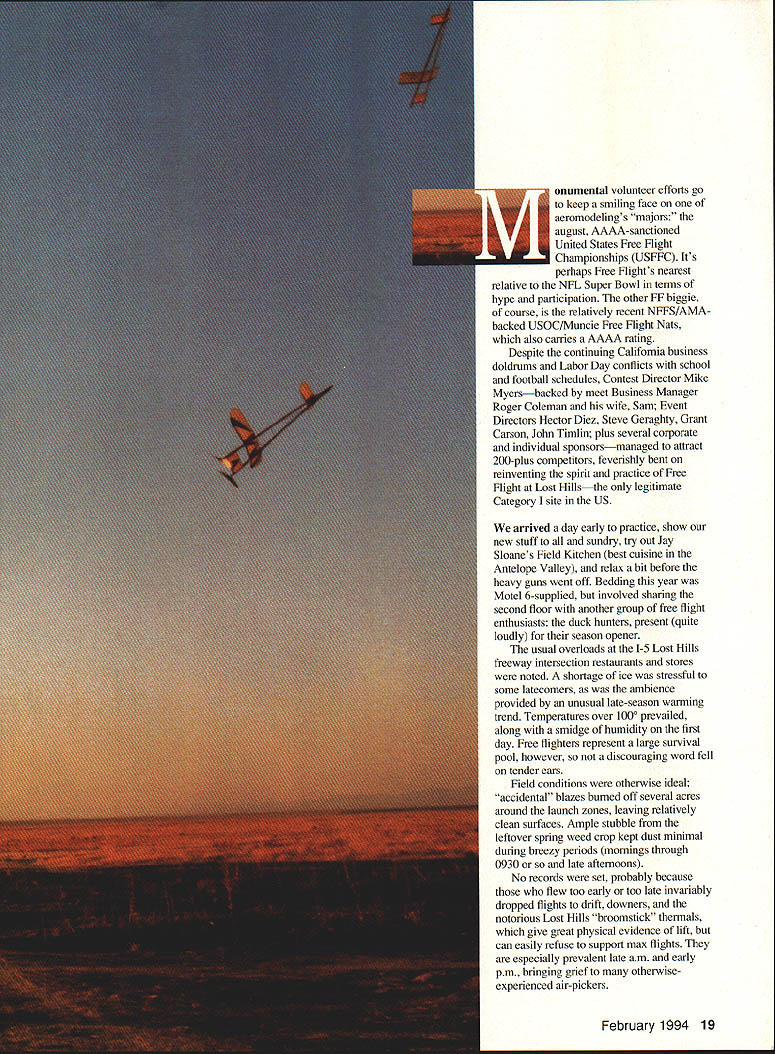
Monumental volunteer efforts go into keeping a smiling face on one of aeromodeling's "majors," the August, AAAA‑sanctioned United States Free Flight Championships (USFFC). It's perhaps Free Flight's nearest relative to the NFL Super Bowl in terms of hype and participation. The other FF biggie, of course, is the relatively recent NFFS/AMA‑backed USOC/Muncie Free Flight Nats, which also carries a AAAA rating.
Despite continuing California business doldrums and Labor Day conflicts with school and football schedules, Contest Director Mike Myers—backed by meet Business Manager Roger Coleman and his wife Sam; Event Directors Hector Diez, Steve Geraghty, Grant Carson, and John Timlin; plus several corporate and individual sponsors—managed to attract 200‑plus competitors, feverishly bent on reinventing the spirit and practice of Free Flight at Lost Hills—the only legitimate Category I site in the U.S.
We arrived a day early to practice, show our new stuff to all and sundry, try out Jay Sloane's Field Kitchen (best cuisine in the Antelope Valley), and relax a bit before the heavy guns went off. Bedding this year was Motel 6‑supplied, but involved sharing the second floor with another group of free flight enthusiasts: the duck hunters, present (quite loudly) for their season opener.
The usual overloads at the I‑5 Lost Hills freeway intersection restaurants and stores were noted. A shortage of ice stressed some latecomers, as did the ambience provided by an unusual late‑season warming trend. Temperatures over 100° prevailed, along with a smidge of humidity on the first day. Free fliers represent a large survival pool, however, so not a discouraging word fell on tender ears.
Field conditions were otherwise ideal: "accidental" blazes burned off several acres around the launch zones, leaving relatively clean surfaces. Ample stubble from the leftover spring weed crop kept dust minimal during breezy periods (mornings through about 0930 and late afternoons).
No records were set, probably because those who flew too early or too late invariably dropped flights to drift, downers, and the notorious Lost Hills "broomstick" thermals, which give great physical evidence of lift, but can easily refuse to support max flights. They are especially prevalent late a.m. and early p.m., bringing grief to many otherwise‑experienced air‑pickers.
Participation and events
In terms and stats, USFFC XXIII maintained acceptable levels, including special events. 527 entries were processed, among an almost even split—168–167—between Modern A/1/A events and the Old‑Timer slate; plus 46 Nostalgia Gas fliers. Seventy‑eight entered FAT events, the latter a new high since the meet. Select contest semi‑finals attempted to qualify the '94 Junior USA team and '95 USA FAT slots.
Wakefield showed impressive strength with 26 participants, followed closely by P‑30 with 23 and the Gas classes logging 20.
Official numbers aside, thousands of flights were witnessed—people reveled, learned, and simply enjoyed their part of the sport. Compassion, of course, must be dealt in large doses: builders' and pilots' new machinery went off track, crashed, smushed, flew out of sight, or otherwise failed. Large contests generate larger‑than‑usual expectations; the difference between awkward test flights and perfect official flights can be quite humbling.
Pre‑meet trimming and atmosphere
Brisk winds curtailed trimming sessions Friday afternoon and evening, but ample hangar talk went on among old and new faces. Against a growing line of cars, vans, and RVs—other conveyances ultimately went past a half‑mile—three‑deep tents and awnings formed a solid front. Chez Sloane provided refuge; others turned up wicks and Coleman lanterns to better see repairs. Whatever the activities, light old‑moon fun began zero‑dark‑hundred Saturday. Hondas chirped; the I‑can't‑wait types gassed two‑runups while the rest, road‑weary, refreshed and eager, prepared for the meet.
Competition highlights
USFFC '93 was a trifle different, since wind conditions frowned out some power and Nordic segments. The FAT contingent kicked their extravaganza off at the starting line at 0700. Maxes were around early; others began to venture out about 0900 as breezes slacked off and insignificant fair‑weather thermals produced a frenzy of launches. Flying conditions stayed nearly perfect that day, although true boomer‑type thermals proved hard to pick reliably.
Multiple‑event fliers found themselves conserving max strings and later ran afoul of late‑afternoon flat spots accompanied by disappointing drift. Nevertheless several maxouts were recorded. Among them:
- Randy Archer, reigning World F/M Power Champion, cruised yet another perfect string of maxes.
- Nordic glider ace Randy Weiler topped flyoff rounds, supported by a crew of Martyn Cowley, Ken Bauer, Don Zink, and Pierre Brun.
- The 1/2A gang was ambushed by Tom Carman with five maxes.
- At the B Gas launch pad, Terry Kerger and Terry Thorkildsen posted scores of 2025 and 3000 seconds respectively—the latter good enough to win the Ocie Randall Trophy for USFFC High Time.
- In Mulvihill, Bud Romak sat unchallenged on three early maxes, with Al Hotard a scant nine seconds behind, eliminating the need for a flyoff.
Saturday's weather set the pattern for the rest of the weekend, with early drift (unsettling to some), midmorning warming and nearly calm periods, and return of the breezes in late afternoon.
Monday: Mini‑FAI events
Monday was really spectacular from the get‑go. The Mini‑FAI events (Coupe d'Hiver, F1J Power, A‑1 Towline Glider) drew special attention.
Thermals were relatively easy to snag right at the 0700 starting horn and continued all morning through the regulation five rounds. Results included:
- Martyn Cowley won his twelfth consecutive USFFC A‑1 glider event with a maxout.
- Bob Isaacson dropped only two seconds in winning Coupe.
- The F1J field went through three flyoff rounds before Bill Lynch pulled away at 1020 seconds, with Joe Foster in second place.
Trimming, techniques, and indicators
USFFC '93 was a kind of textbook presentation of contest strategy, air‑picking basics, and a reaffirmation of time‑honored trimming skills necessary to gain an edge. Nothing seemed to fly perfectly out of the box, probably because the Lost Hills site has air‑density numbers quite different from those of many home fields. It is also hotter and drier, which can do funny things to fragile creations.
At the very least, most airplanes required a trifle of up trim to the rear, lest they glide like stones; pilots who neglected this vital trim check found themselves on the short list real fast. Old‑fashioned cattails appeared to be the best indicators of rising air all weekend—if one was flightless, one was often luckless. In short, pilots with good seat‑of‑the‑pants sensibilities, who came prepared, showed the best results.
Electronics and rules
No particular advantage was to be had in advanced electronics on the field, save for the auto‑stuff that dominates certain power‑run events. Beepers and recording gadgets were not exactly mandatory. The Old‑Timer rulebooks specifically outlawed devices to assist in thermal detection, and so were vindicated in their choice this time.
Awards and honors
Despite air‑picking quirks, the heat, and long chases, outstanding performances abounded and were duly noted at the various awards ceremonies by CD Mike Myers. Highlights and honors included:
- Jay Sloane: received a plaque and applause for his round‑the‑clock commitment delivering the field kitchen.
- Iron Men: John Bortnak (27‑time Canadian Nats Champ) and Sal Taibi—honored for flying in 13 and 11 events respectively. Sal was attending his 23rd USFFC.
- Iron Woman: Lynn Wainfan—beat out many men in P‑30 despite a nasty ankle sprain.
- Team Championship winners: Dave Dawson, Beau Moffatt, and Lynn Pulley, representing the Blacksheep Exhibition Squadron (second‑place Taft Regulars trailed by a mere point).
- Overall Sweepstakes: Dave Dawson.
- Junior Sweepstakes: Phil Jensen.
- Tom Hutchinson Memorial Trophy: Randy Weiler (F1A winner).
- Loren Williams Jumbo Rubber Scale plaque: Mik Mikkelsen.
- Lee Norcross perpetual Old‑Timer award (Texaco, first place): Eric Strengel.
Women's awards:
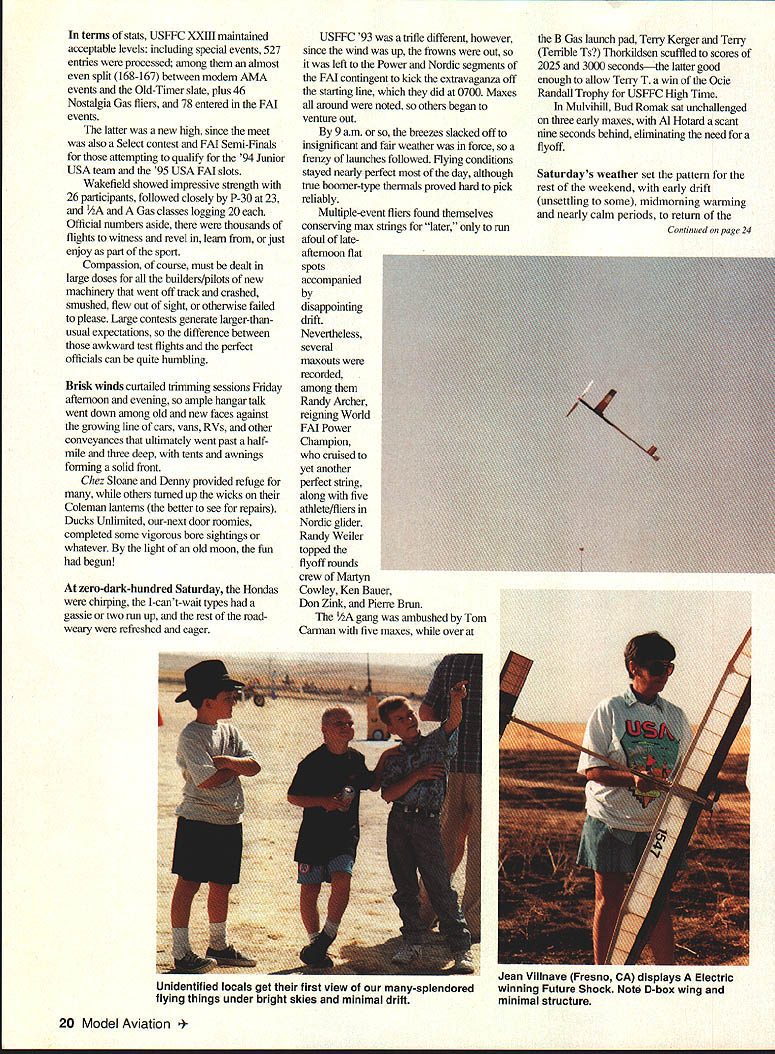
- Newcomer Jean Villanue: very competitive in AMA Electric and won Class A; second in the One Flight Sunrise Shootout Electric at 202 seconds; second in Class B (eight seconds behind Don Berry).
- Dorothy Fee (Junior in Wakefield): flew seven of eight maxes, posted High Time on the distaff side, and took home the San Diego Orbiters Women's Trophy.
Looking ahead
Whither the "majors"? Since de facto abandonment of the unified Nats concept (all flight disciplines competing at one site), it appears free fliers will have one of two AAAA‑sanctioned venues on which to seek "National" Championships: the USFFC and the NFFS‑AMA aligned USOC (United States Outdoor Championships), both (for the moment) staged over the Labor Day holiday weekend.
Some are bothered by this coincidence and are lobbying for a return of the USFFC to the Memorial Day slot, where it held sway for its first 20 years. Such a move would, however, risk poor weather associated with that time of year, even in sunny southern California.
Can there be two kinds of "champions," and if so, what's the worth of arguing? Preservation of sanity in the free flight movement is of the utmost importance, so wise fliers will support both events, choosing, as it now stands, on style of contest interest (Category I vs. II), followed by logistical and economic concerns.
For those who opt for the wide‑open spaces and the thrill of the only viable Category I site in the USA, the welcome mat is always out at Lost Hills. Bring hats, ice, stout shoes, and your best stuff. That's entertainment!
Transcribed from original scans by AI. Minor OCR errors may remain.

