
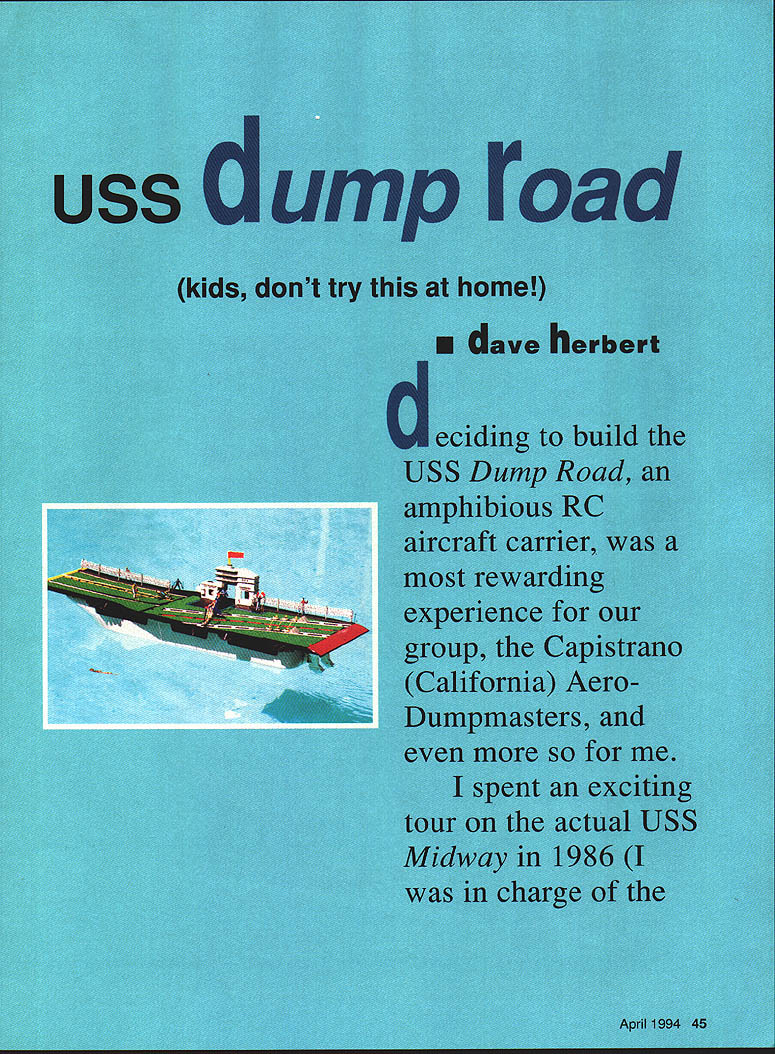
USS Dump Road
(kids, don't try this at home!)
Dave Herbert
Deciding to build the USS Dump Road — an amphibious RC aircraft carrier — was a rewarding project for our group, the Capistrano (California) Aero‑Dumpmasters, and especially for me. I spent an exciting tour on the actual USS Midway in 1986 in charge of shipboard electrical maintenance and got a private tour of three Marine Corps RF‑4B Phantom jets just before they were decommissioned. That experience, combined with a few innovative ideas born of necessity and lessons from other clubs, started the project.
Project guidelines
We established a few basic guidelines at the outset:
- The carrier had to be amphibious — able to float on a lake and be towed to various flying sites.
- It had to be transportable behind a standard pickup truck and be launchable from a marina. Limiting dimensions and a fold-up assembly were required to keep it road‑legal.
Our club had been flying for more than 17 years in a small area with a fairly constant 10‑knot crosswind and a tiny landing zone surrounded by poison oak and cacti. Confident in our ability to hit a landing spot, we set up a pseudo‑carrier to practice takeoffs and landings, measured the distances required for launch and recovery, and converted those numbers into requirements for a full‑size carrier.
Model testing and arresting hook
We used a 60‑inch‑span Bill Evans–designed Zippity Do Da flying wing for initial testing because it hovers and flies very slowly with benign stall characteristics. Modifications for carrier use included:
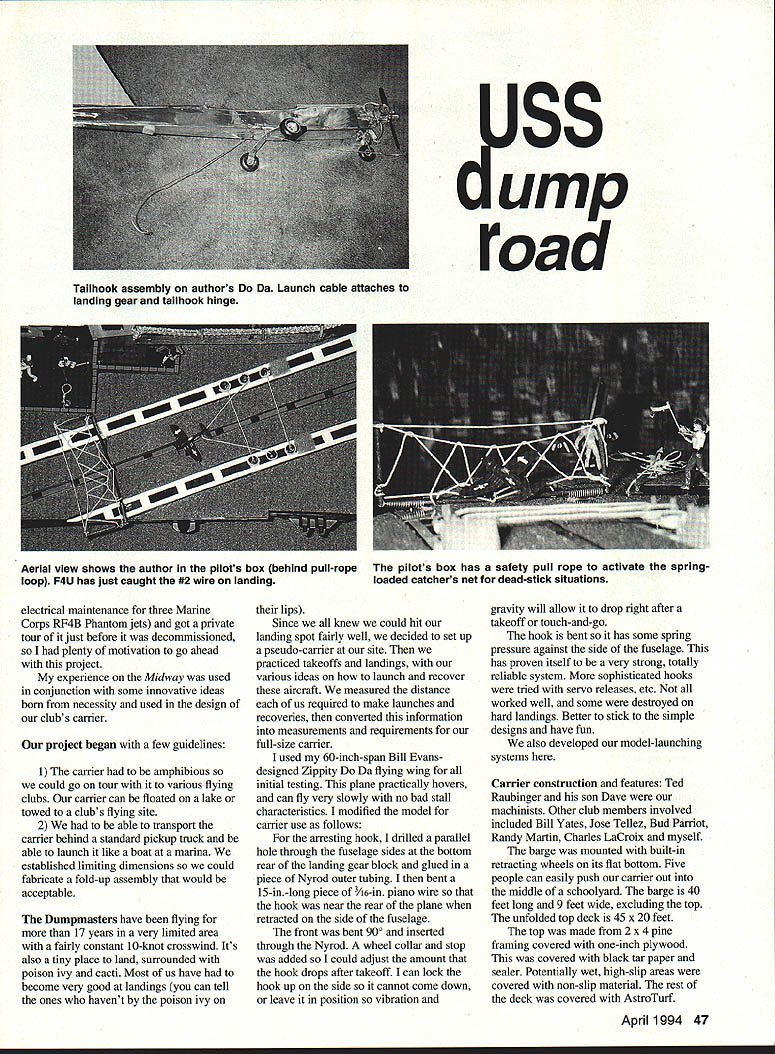
- Arresting hook: drilled parallel holes through the fuselage sides beneath the rear landing‑gear block and glued in a piece of Nyrod outer tubing. A 15‑inch piece of 3/16‑inch piano wire was bent into a hook. The rear of the hook retracts inside the side of the fuselage; the front is bent 90° and inserted through the Nyrod. A wheel collar stop was added to adjust how far the hook drops.
- Hook operation: the hook can be locked up for touch‑and‑go work or left free so vibration and gravity allow it to drop right after takeoff. The hook is bent to exert spring pressure against the fuselage side; it proved strong and reliable.
- We tried some sophisticated servo‑release hooks but found simple, robust designs survived hard landings better.
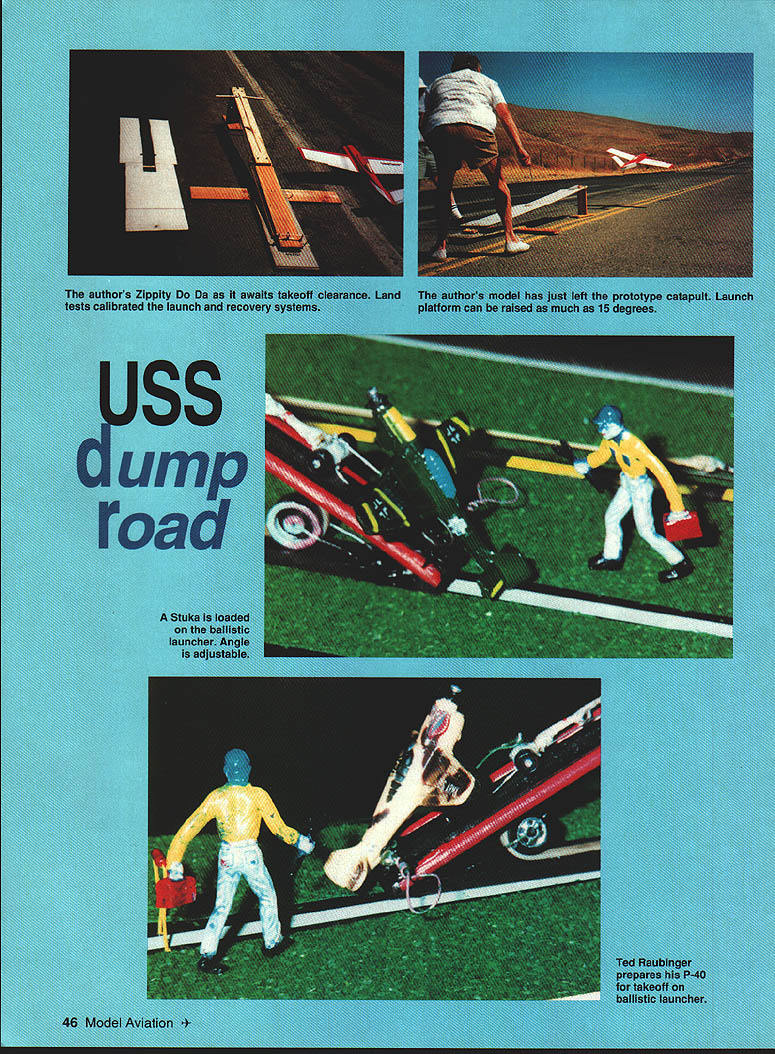
We also developed model‑launching systems during this testing phase.
Carrier construction and features
Key builders: Ted Raubinger and his son Dave were our machinists. Other club members included Bill Yates, Jose Tellez, Bud Parriott, Randy Martin, Charles LaCroix and myself.
Major features:
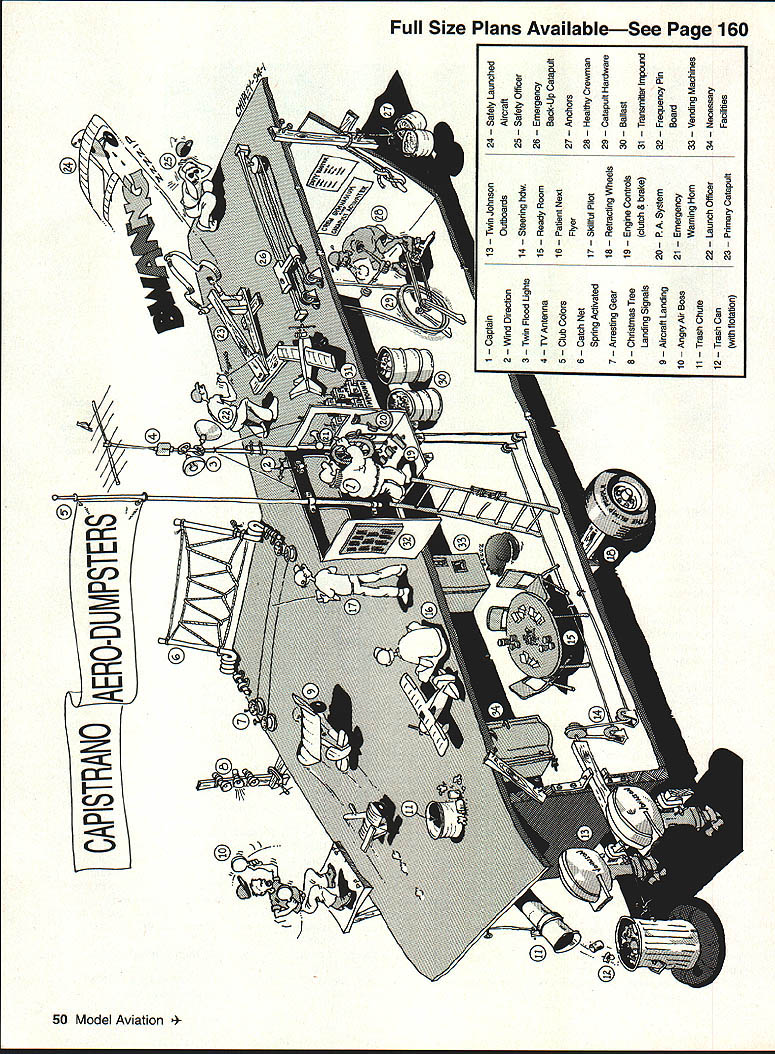
- Hull and deck: the barge hull has a flat bottom with built‑in retracting wheels so five people can push the carrier out of a schoolyard. The barge is 40 ft long and 9 ft wide (excluding the top). The unfolded top deck is 45 x 20 ft, built from 2 x 4 pine framing covered with 1‑inch plywood and sealed with black tar paper. High‑slip areas receive non‑slip material; most of the deck is covered with AstroTurf. Taxi strips are left uncovered for visual reference.
- Deck protection: high‑wear areas have rubber mats. Railings and stairwells are spruce and pine; hand railings are cable on steel poles. Anchors are paint cans filled with cement.
- Folding and transport: the deck folds to road‑legal dimensions and can be loaded on a flatbed truck for long trips or on a special boat dolly for short lake launches.
- Captain’s island and instrumentation: a hollow shed serves as the island captain’s station with full engine controls, compass, wind speed/direction indicators, a marine radio and weather radio, outside speakers, and a PA system for the Air Boss. Running lights, deck landing lights and two spotlights are installed for potential night operation.
- Propulsion and stability: the carrier is powered by two Johnson outboard motors capable of more than 20 knots, providing ample headwind for takeoffs. The hull is attached to the landing top with large hard‑rubber supports to reduce vibration.
Launching and arresting systems
Launch and recovery are under Air Boss control. Launching features:
- Launch cable system: a cable attached to two fixed points on the deck. A two‑wheel Delrin dolly with an angled pin grabs the cable and attaches to the plane’s main gear. The dolly slides along a guide cable; a shock absorber at the guide‑cable end stops the dolly as the plane continues on.
- Launch power: the dolly is pulled by surgical tubing loaded to about an 8‑pound force. Hydraulic jacks can raise the bow and launching platform by 15 inches for larger planes or stronger winds.
- Alternate short‑takeoff: a missile‑launcher style system with adjustable angle and thrust depending on plane weight.
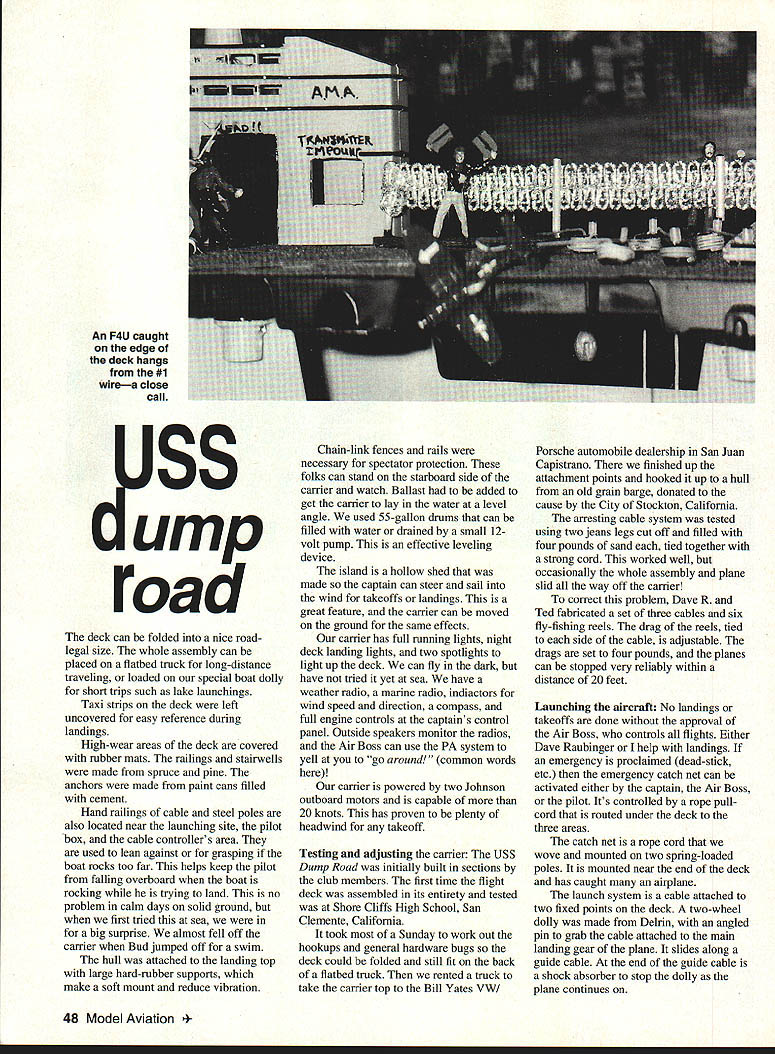
- Arresting system: initial testing used jeans legs filled with sand, but we later fabricated three cables with six fly‑fishing reels. Reel drag, tied to each side of the cable, is adjustable (set to about 4 pounds) and reliably stops planes within ~20 ft.
- Emergency catcher: a spring‑loaded catch net mounted near the end of deck can be activated by the captain, Air Boss, or pilot via a safety pull rope routed to three areas.
No launch or landing is performed without Air Boss approval. The pilot’s box is located just to port of the island; flagmen assist approaches when needed.
Safety and water operations
- Flotation device: any plane without floats must carry one of our flotation devices when flying over water. It consists of a CO2 cartridge attached to a rubber balloon that inflates to about 2 ft diameter. A 30‑second water‑delay switch activates if the plane sinks; the device pings every 15 seconds after inflation.
- Floats: many planes operate with floats; wet AstroTurf provides good traction.
- Spectator areas: chain‑link fences and rails protect spectators, who can stand on the starboard side to watch. Benches in the hull provide shaded seating below the flight deck and serve as our meeting space.
- Water recovery: Bud Parriott runs water‑recoveries using a small dinghy and outboard motor.
Testing, adjustments and anecdotes
- Assembly and testing: the USS Dump Road was built in sections. The first full assembly and checkout took place at Shore Cliffs High School, San Clemente, California. We spent a Sunday ironing out fold and attachment points so the deck would fit on a flatbed truck, then transported the top to a hull donated by the City of Stockton.
- Close calls: we had a close call when an F4U caught the edge of the deck and hung on the number‑one wire. The first time we tried at sea, the rocking nearly sent us overboard — Bud jumped off and swam.
- Ballast and leveling: we add ballast (55‑gal drums that can be filled or drained) and use a small 12‑volt pump as an effective leveling device.
- Pontoons: six outrigger pontoons were added for stability in bad weather. Made from hollow fiberglass canoe tubes, buoyant masses and truck‑tire inner tubes, they hinge fore/aft on two bolts and are effective though not always necessary.
- Damage and fun: the aft hull has extra rubber to soften impacts — we’ve had many airplanes hit the back. Part of the fun is taking the risk; if you can’t hit the deck, don’t blame us.
We can take 10 pilots with airplanes and equipment when at sea. The area behind the captain is the flight‑deck entrance; a smaller aft area is for special spectators and camera crews. The carrier draws large crowds wherever we go — we even got interest from the mayor of Los Angeles about putting the USS Dump Road in the Dodger Day Parade.
Final notes
With a working prototype that includes full‑size arrested landing and launching systems, we believe the USS Dump Road is a viable alternative flying site when operated with the AMA safety code in mind. If your club would like our carrier and crew to visit your flying site, write the Dumpmasters about your upcoming event. Only $40.00 more is needed to complete this project so club towing can be scheduled.
Keep trying for that number‑two wire, and don't fall off!
Happy flying!
Editor's note: Why does the word NOT! seem to be so appropriate here?
Transcribed from original scans by AI. Minor OCR errors may remain.

