
Utah Flying Site
By Boyd Newman
AMA has always assigned a high priority to obtaining and retaining flying sites. But why should local club members be concerned when they have an "ideal" site? Often the definition of the "ideal flying site" is: "We have a place to fly today—why worry about tomorrow?"
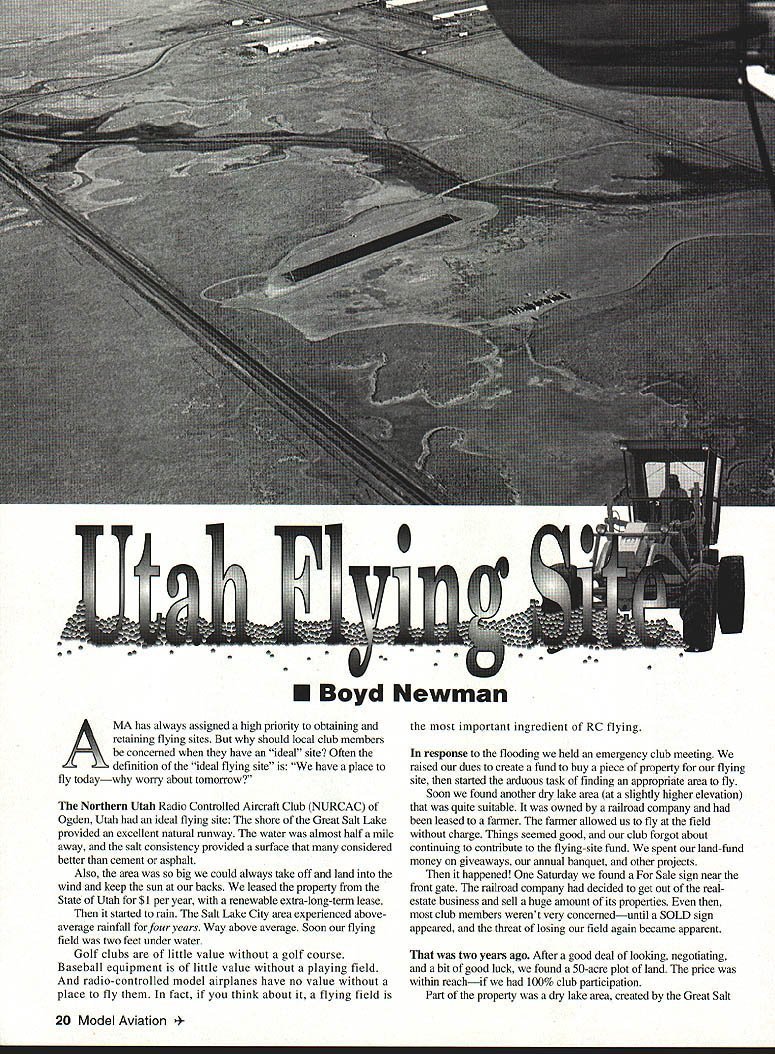
The Northern Utah Radio Controlled Aircraft Club (NURCAC) of Ogden, Utah had an ideal flying site: the shore of the Great Salt Lake provided an excellent natural runway. The water was almost half a mile away, and the salt consistency provided a surface that many considered better than cement or asphalt. The area was so big we could always take off and land into the wind and keep the sun at our backs. We leased the property from the State of Utah for $1 per year, with a renewable, extra-long-term lease.
Then it started to rain. The Salt Lake City area experienced above-average rainfall for four years—way above average. Soon our flying field was two feet under water.
Golf clubs are of little value without a golf course. Baseball equipment is of little value without a playing field. And radio-controlled model airplanes have no value without a place to fly them. In fact, if you think about it, a flying field is the most important ingredient of RC flying.
In response to the flooding, we held an emergency club meeting. We raised our dues to create a fund to buy a piece of property for our flying site, then started the arduous task of finding an appropriate area to fly.
Soon we found another dry lake area (at a slightly higher elevation) that was quite suitable. It was owned by a railroad company and had been leased to a farmer. The farmer allowed us to fly at the field without charge. Things seemed good, and our club forgot about continuing to contribute to the flying-site fund. We spent our land-fund money on giveaways, our annual banquet, and other projects.
Then it happened! One Saturday we found a For Sale sign near the front gate. The railroad company had decided to get out of the real-estate business and sell a huge amount of its properties. Even then, most club members weren't very concerned—until a SOLD sign appeared, and the threat of losing our field again became apparent.
That was two years ago. After a good deal of looking, negotiating, and a bit of good luck, we found a 50-acre plot of land. The price was within reach—if we had 100% club participation.
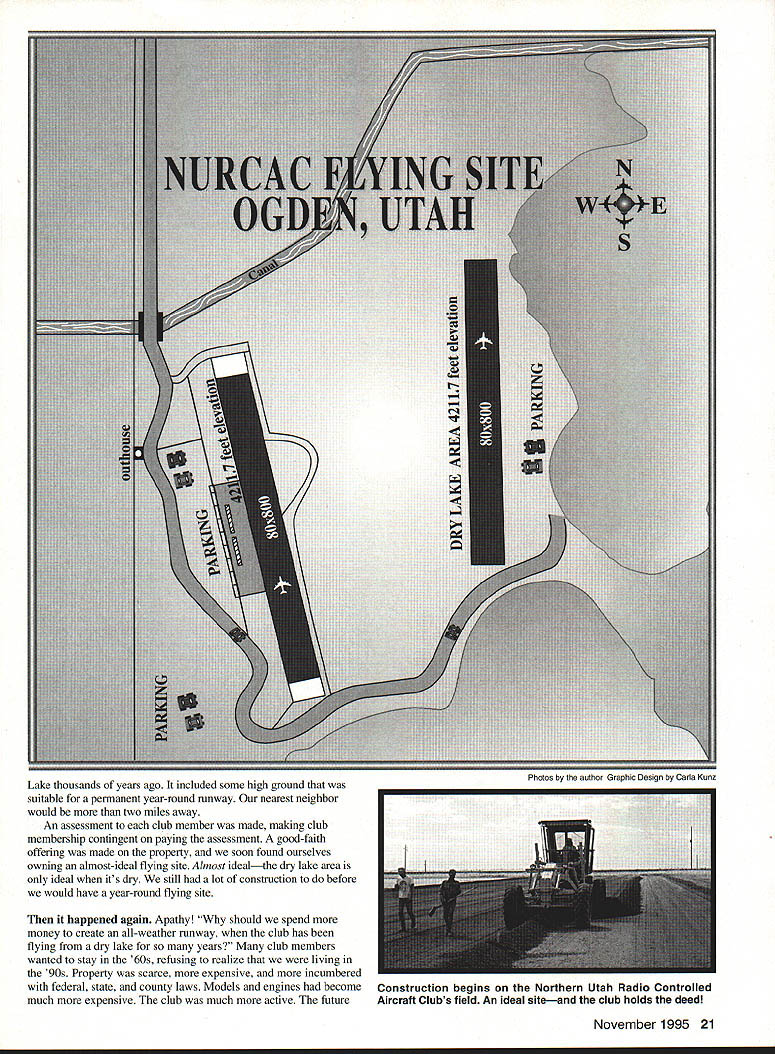
Part of the property was a dry lake area created by the Great Salt Lake thousands of years ago. It included some high ground that was suitable for a permanent year-round runway. Our nearest neighbor would be more than two miles away.
An assessment was made to each club member, and club membership was made contingent on paying the assessment. A good-faith offer was made on the property, and we soon found ourselves owning an almost-ideal flying site. Almost ideal—the dry lake area is only ideal when it's dry. We still had a lot of construction to do before we would have a year-round flying site.
Then it happened again. Apathy! "Why should we spend more money to create an all-weather runway, when the club has been flying from a dry lake for so many years?" Many club members wanted to stay in the '60s, refusing to realize that we were living in the '90s. Property was scarce, more expensive, and more encumbered with federal, state, and county laws. Models and engines had become much more expensive. The club was much more active. The future required a long-term viewpoint.
In spite of the negativity and apathy, the club leadership pushed forward. Written permission for construction had to be obtained from the U.S. Army Corps of Engineers because of the site's "wetlands" designation. The property was fenced, and a road was built (including a bridge over a canal) to provide access. The high ground was leveled. An island was removed, and the material was used to fill the jagged edges of the high ground. A parking area was made, and parking boundaries were designated with cement and railroad-tie curbs. Grade was set to provide drainage for the permanent runway. Then the inevitable happened—we ran out of money.
We needed an additional large sum of money to place the asphalt. Would we have club support? Would the members be willing to give more? If so, how much more? Would it cause a split in the membership and take the fun out of our sport? There were so many tough, unanswered questions.
To me it was puzzling—some club members pleaded poverty when they were asked for the purchase of a couple of hundred dollars to first buy the property, then a couple of hundred more for the permanent runway. The ones who complained the most were the ones who had thousands of dollars invested in model airplanes. Why is it so easy for some to pay $500 for an airplane, then be unwilling to pay the same amount for a place to fly?
It was decided to ask for a "suggested donation" instead of an assessment. A letter explaining the reasons and the cost to the membership was sent, and we waited for the inevitable good/bad response. To my surprise, the response was overwhelmingly positive—86% of the members dug into their pockets and gave the suggested amount. Some gave more, and a few made a pledge. The remaining 14% of members were either college students, were undergoing financial hardship, or expressed a desire to pay their fair share as soon as possible. Only two members opposed the action. After all of the complaining, the club membership came through with "flying" colors.
On August 16, 1994 the asphalt was laid—now we had a permanent flying field 650 by 70 feet, with 15 feet of road base on each side for safety, and about 50 feet of road-base run-out on each end. It's a world-class flying facility—and it's all paid for.
We still have a lot we want to accomplish:
- Install a gas-powered water pump and sprinkler system and plant grass on the infield area.
- Install cement taxiways and pit areas.
- Provide shade areas and safety fences.
- Expand and improve the parking area (this will require additional construction).
We continue to dream and plan, but we've done it—we hold the deed to our own flying site. The fun part is that many of the club members who complained the most are now the most vocal advocates of our flying field.
Good luck, good leadership, willing donations from members, as well as private corporations that donated time, equipment, and money—all made it happen.
My message to RC clubs that don't own their own flying site: Don't wait for AMA to purchase and build your field. They will provide you with how-to instructions and materials, even a possible loan to help finance it, but you can't afford to wait. Start raising money, start looking for property, and start realizing that the site you are using can be taken away from you.
Arnold Palmer was once told he must be the luckiest golfer in the world. He thought for a minute and replied, "That may be so, but I also find that the more I practice, the luckier I become." Good luck happens most often when a positive attitude, good leadership, and long-term planning are mixed with a little money and some real energy. Remember, RC models are of little value without a place to fly.
I'm going flying this afternoon. The sun is out, the temperature is about 72°, the wind is from the south at about 5 mph. Perfect. By the way, it rained hard a couple of weeks ago, and the dry lake area is under almost six inches of water—it has been for almost two weeks now.
It's strange how enthusiastic everyone is about our new asphalt runway and flying site. Happy flying!
For more information, please contact:
- Royce Jorgensen, Club President: (801) 479-0848
- Boyd Newman: (801) 976-1177
Transcribed from original scans by AI. Minor OCR errors may remain.

