
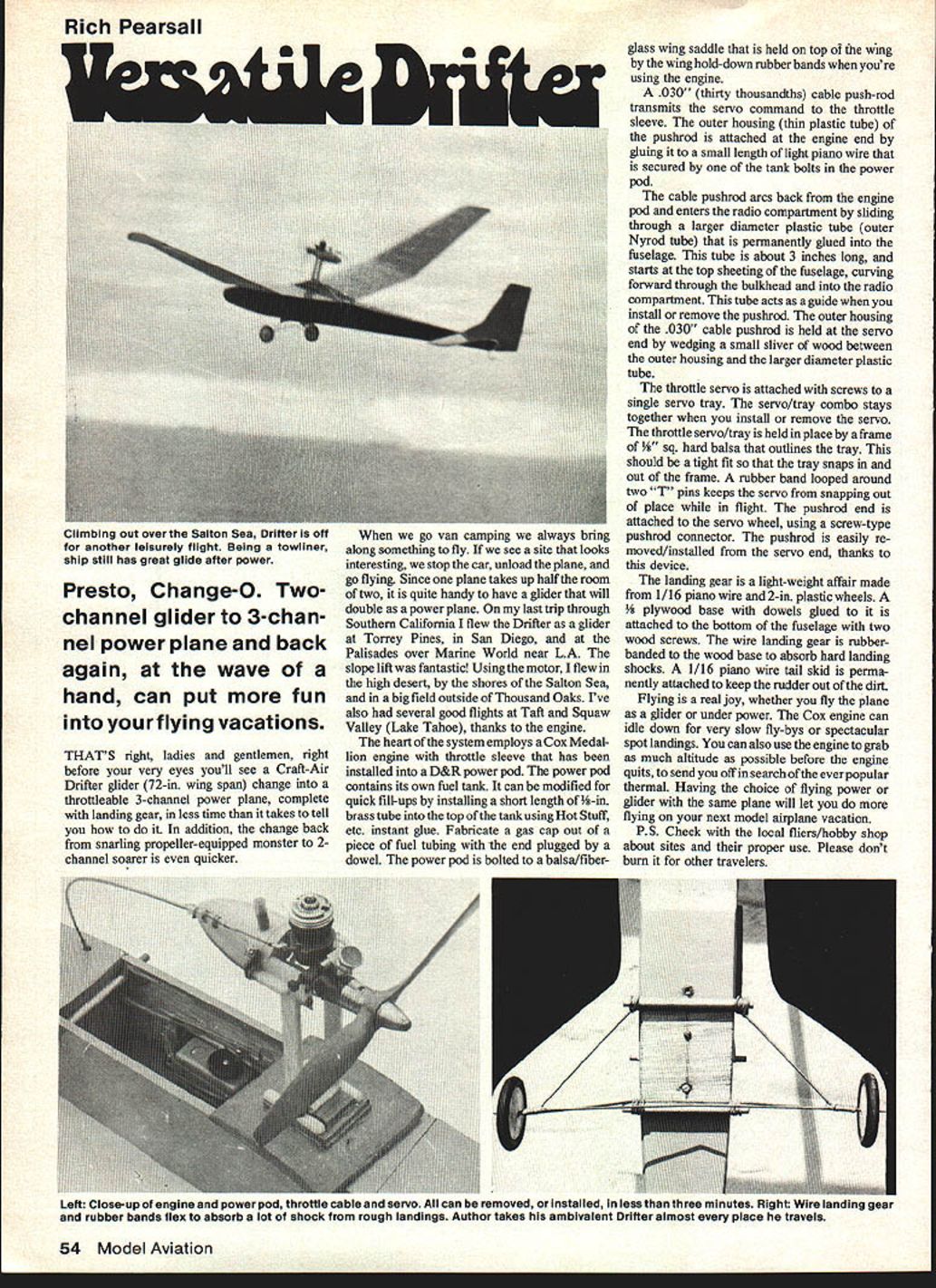
Versatile Drifter
By Rich Pearsall
Presto, change-o. A two-channel glider that converts to a three-channel power plane and back again at the wave of a hand can add a lot of fun to your flying vacations.
That's right — right before your very eyes you'll see a Craft-Air Drifter (72-inch wingspan) change into a throttleable three-channel power plane, complete with landing gear, in less time than it takes to tell you how to do it. Converting back from a snarling propeller-equipped two-channel soarer is even quicker.
Traveling and flying sites
When we go van camping we always bring something to fly. If we see a site that looks interesting, we stop the car, unload the plane, and go flying. Since one plane takes up half the room of two, it's handy to have a glider that doubles as a power plane.
On my last trip through Southern California I flew the Drifter as a glider at:
- Torrey Pines, San Diego
- the Palisades over Marine World near L.A.
Using the motor I flew in:
- the high desert
- by the shores of the Salton Sea
- a big field outside Thousand Oaks
I've also had several good flights at Taft and Squaw Valley (Lake Tahoe), thanks to the engine. The slope lift was fantastic.
Power system
The heart of the system is a Cox Medallion engine with a throttle sleeve installed in a D&R power pod. The power pod contains its own fuel tank.
Modifications and notes:
- For quick fill-ups, install a short length of 1/8-inch brass tube into the top of the tank using instant glue (Hot Stuff, etc.).
- Fabricate a gas cap from a piece of fuel tubing with the end plugged by a dowel.
- The power pod is bolted to a balsa/fiberglass wing saddle that sits on top of the wing and is held in place by the wing hold-down rubber bands when using the engine.
Throttle linkage
A 0.030-inch (thirty thousandths) cable pushrod transmits the servo command to the throttle sleeve. The outer housing (thin plastic tube) of the pushrod is attached at the engine end by gluing it to a small length of light piano wire, which is then secured by one of the tank bolts in the power pod.
The cable pushrod arcs back from the engine pod and enters the radio compartment by sliding through a larger diameter plastic tube (outer Nyrod tube) that is permanently glued into the fuselage. This tube is about 3 inches long and starts at the top sheeting of the fuselage, curving forward through the bulkhead into the radio compartment. It acts as a guide when you install or remove the pushrod.
At the servo end, the outer housing of the 0.030-inch cable pushrod is held by wedging a small sliver of wood between the outer housing and the larger diameter plastic tube, making removal and installation straightforward.
Radio and servo installation
The throttle servo is attached with screws to a single servo tray. The servo/tray combo stays together when you install or remove the servo. The servo/tray is held in place by a frame of 1/8-inch square hard balsa that outlines the tray; this should be a tight fit so that the tray snaps in and out of the frame. A rubber band looped around two T-pins keeps the servo from snapping out of place in flight. The pushrod end is attached to the servo wheel using a screw-type pushrod connector, allowing easy removal and installation of the pushrod at the servo end.
Landing gear
The landing gear is a lightweight arrangement made from 1/16-inch piano wire and 2-inch plastic wheels.
- A 1/8-inch plywood base with dowels glued to it is attached to the bottom of the fuselage with two wood screws.
- The wire landing gear is rubber-banded to the wood base to absorb hard landing shocks.
- A 1/16-inch piano wire tail skid is permanently attached to keep the rudder out of the dirt.
Flying characteristics
Flying is a real joy, whether you use the plane as a glider or under power. The Cox engine can idle down for very slow fly-bys or spectacular spot landings. You can also use the engine to gain as much altitude as possible before the engine quits, then set off in search of thermals. Having the choice of power or glider with the same plane lets you do more flying on your next model airplane vacation.
P.S. Check with local fliers or the hobby shop about sites and their proper use. Please don't burn a site for other travelers.
Transcribed from original scans by AI. Minor OCR errors may remain.

