
VERTICAL TAIL SIZE FOR MODELS
Part One of a two-part article.
William F. McCombs
Modelers know that the vertical tail is a necessary item for conventional full-scale airplanes and models, but they are often not aware of the effects of its size. This can be unfortunate, because its size can make or break the good flying ability of any airplane or model.
There are two kinds of effects. Too small a tail will cause Dutch roll troubles for any airplane and also controllability troubles for piloted types. Too large a tail will cause either a slower recovery from lateral upsets by gusty air or, worse, no recovery. This means a spiral dive for models with little or no dihedral (Free Flight Scale models) and the inability to climb very steeply and achieve good duration for the high-powered Gas or Rubber Duration model.
To understand this better, one must know the difference between trim and stability, since they are completely different things.
Trim
Trim refers to the angular settings, or incidences, including twisting, of the flight surfaces (wings, vertical tail, horizontal tail, control surfaces, and tabs) and of the prop shaft (downthrust and side thrust). For a given engine power setting and center-of-gravity (CG) location, the trim prescribes the flight path along which the model wants to fly, but only if it is stable. If stable, it will get on and stay on the trimmed flight path in spite of disturbances, such as a poor launching or air gusts which continually upset it in various amounts. It will fly the same pattern flight after flight (i.e., "in the groove") as long as the power and trim are the same.
With a rubber model the power is continually decreasing, so the flight path continually changes; but successive flights follow the same pattern if nothing else is changed.
Stability
Stability is the ability to get back to the trimmed flight path. If the model is unstable it will not be able to get on and stay on the trimmed flight path, and this usually results in a crash, depending upon how severe the instability is. For practical purposes, stability does not depend upon trim. Instead, it depends upon the size, location, and shape of the wings and tail surfaces; the prop and fuselage location; the CG and thrust line; the amount of power; and the climb angle. This is why trim changes cannot correct stability troubles (although modelers often try). Another way to think of instability is that it allows an "evil creature" to enter the model and change its trim in a harmful manner during flight; eliminating the instability removes the evil creature.
For the modeler's purposes there are three kinds of stability, or instability:
- Longitudinal stability refers to pitching (nose-up/nose-down) motion about the lateral axis of the airplane for a given model and CG location — forward CG provides more stability, aft CG less; either too much or too little is bad.
- Dutch-roll instability refers to a persistent undesired tail-swinging motion, a side-to-side oscillation which, if excessive, causes a crash.
- Spiral instability refers to a persistent undesired spiraling motion which either reduces altitude and duration achieved or causes a spiral dive and a crash.
For a given model (having some dihedral), Dutch roll and spiral instability are controlled by the vertical tail size.
This article is concerned with Dutch roll and spiral troubles and how the vertical tail size (and dihedral) affects these. For longitudinal stability and trim, see the recommended books at the end of the article.
Dutch roll
For any airplane, the smallest acceptable vertical tail size is that which will prevent any noticeable Dutch roll. Being only slightly (about 5%) larger than this size is all that is required for Free Flight (FF) models. In fact, this is the ideal size for any FF model, including most Duration-type FF models, and is found as discussed later.
For piloted airplanes (full-scale or RC), a much larger vertical tail is needed for good controllability, and this can cause spiral instability trouble for Free Flight Scale (FFS) models.
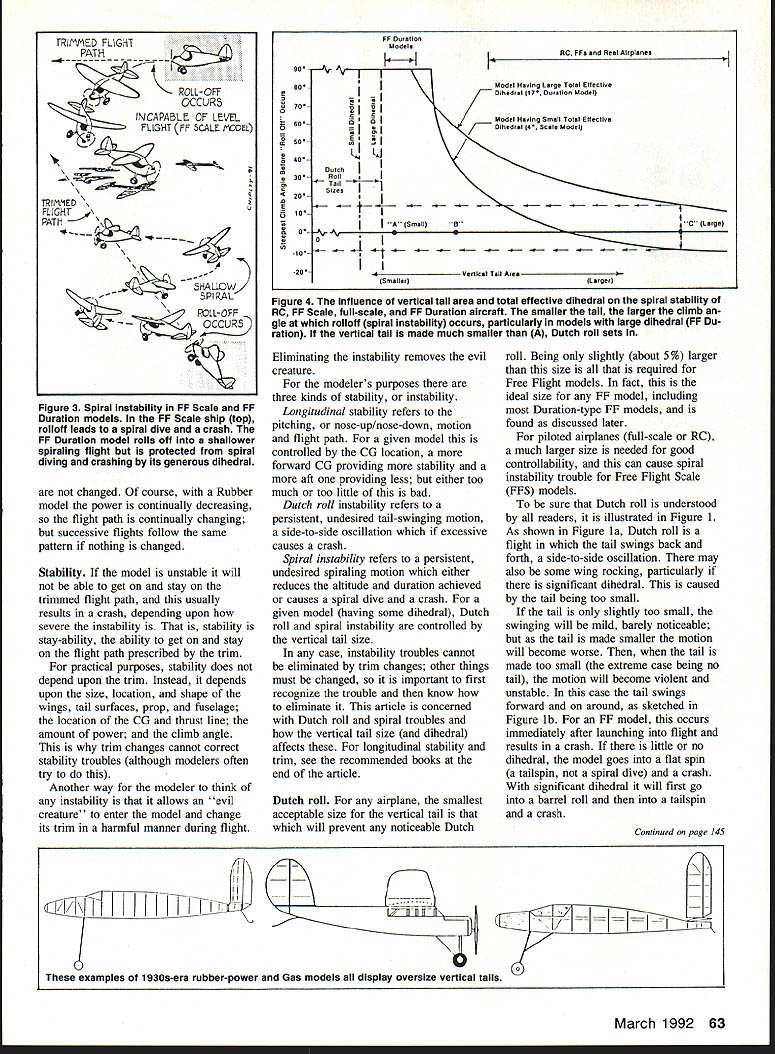
To be sure that Dutch roll is understood by all readers: Dutch roll is a flight in which the tail swings back and forth, a side-to-side oscillation. There may also be some wing rocking, particularly if there is significant dihedral. This is caused by the tail being too small.
If the tail is only slightly too small, the winging will be small but noticeable; as the tail is made smaller the motion becomes worse. When the tail is made very small (the extreme case being no tail), the motion becomes violent and unstable: the tail swings forward and on around. For an FF model this occurs immediately after launching and results in a crash. If there is little or no dihedral, the model goes into a flat spin (a tailspin, not a spiral dive) and crashes. With significant dihedral it will first go into a barrel roll and then into a tailspin and a crash.
These effects, mild to violent Dutch roll, are easily produced and observed experimentally with a simple stick-fuselage rubber model having moderate wing dihedral—about 9°. First trim it to fly well, then between successive flights cut away tail area in small amounts—about 5% of the existing area—and watch the Dutch roll set in, become worse, and finally become violent, causing a crash. This can also be seen using a simple all-balsa glider.
The smallest size tail for no Dutch roll will be larger for a model having a tractor (up-front) prop than for no prop (a glider), and smaller for a pusher (rear) prop. The reason is that a spinning prop acts like a small vertical tail, so if it is up front it cancels out some of the tail's effect, requiring a larger tail. If at the rear, it adds tail area, so the tail can be smaller (even nonexistent). A spinning prop also acts like a small horizontal tail. The larger the prop, the greater the effect (largest on rubber models).
Even if the vertical tail is not quite small enough to cause noticeable Dutch roll, it can still be small enough to cause two other minor troubles. The model might wander around in flight rather than staying in the groove. Or small side thrust and vertical tail incidence adjustments might not be very effective in controlling the turn in flight. In either case a small increase in vertical tail area will eliminate the trouble.
Controllability during flight
Controllability is of no concern for FF models, but it is for piloted airplanes. That's why piloted types have relatively large tails. The tail must be large enough to allow good turns with the ailerons and rudder properly coordinated, good sideslipping ability for landing in crosswinds and short fields, the ability to maintain heading if high power is suddenly applied during low-speed (landing) flight, and good control while taxiing.
To achieve the above, the rudder portion (Figure 2a) is usually from 30% to 60% of the tail area and can be deflected about 30–35° to either side. It is for low-speed (and taxiing) control, not high-speed flight, that the large rudder deflections are needed.
On many early-day airplanes, such as the WW I Nieuport 11, 12, and 17, Morane-Saulnier L, Bristol Scout D, Fokker E-III and Triplane, and Pfalz E-1, the entire tail was all-movable. This required considerable aerodynamic balance area forward of the hinge line (Figure 2c) to keep the pilot's effort reasonably small. Such all-movable tails were smaller than when a fin and rudder were used.
For most piloted airplanes the tail is so large that during low-speed flight the airplane is spirally unstable. This improves as speed increases (i.e., as the lift coefficient decreases), and the airplane becomes more stable during high-speed flight. This is generally no problem, since the pilot can correct the motion (except when flying "blind"). For FFS models of such airplanes, however, any spiral instability is unacceptable and must be eliminated as described later.
Spiral instability
If too large, the vertical tail will cause spiral instability or related troubles in flight.
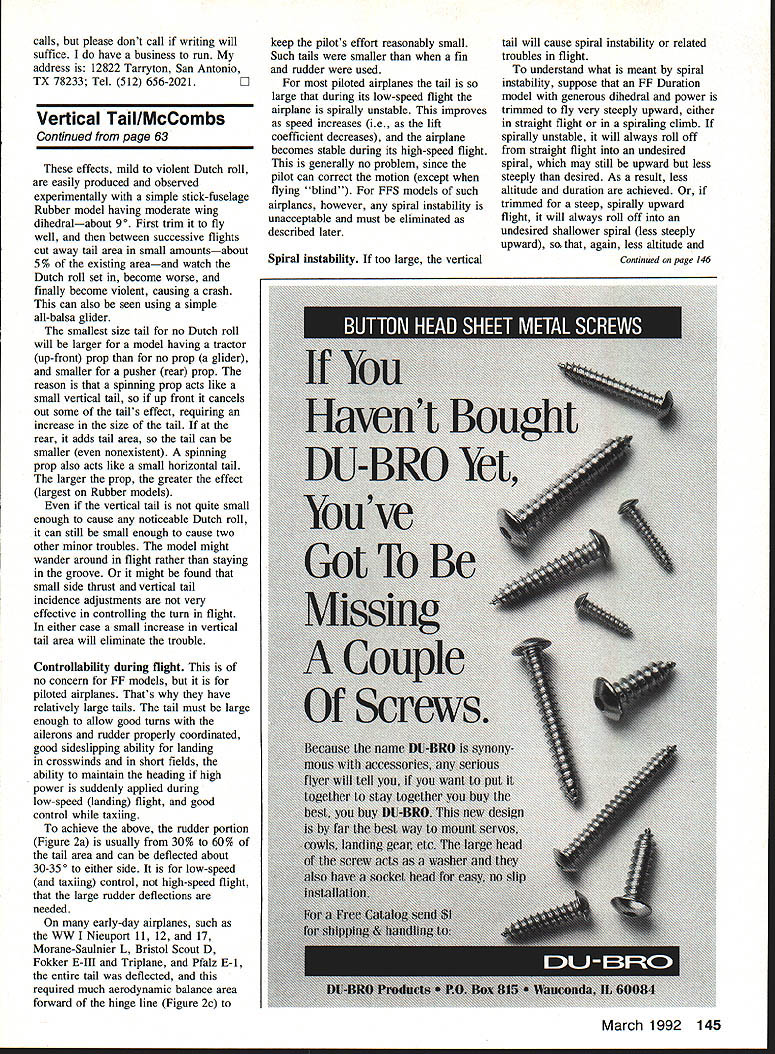
Suppose an FF Duration model with generous dihedral and power is trimmed to fly very steeply upward, either in straight flight or in a spiraling climb. If spirally unstable, it will always roll off from straight flight into an undesired spiral, which may still be upward but less steeply than desired. As a result, less altitude and duration are achieved. Or, if trimmed for a steep spirally upward flight, it will always roll off into an undesired shallower spiral, again reducing altitude and duration.
If the model has little dihedral (FF Scale models), it will always roll off into a downward spiral and a crash.
This persistent, undesired rolloff cannot be prevented by trim changes such as side thrust or rudder setting, since it is due to an instability (like a pencil balanced on its point). If it rolls off to the right, trying to prevent it with left trim changes will only cause it to roll off to the left, and vice versa.
There are two main types of FF contest models relevant here:
- FF Duration models: generous dihedral (12° or more) and lots of power so that they can climb very steeply, even straight up. This includes the rubber model during the first few seconds of the burst of power from a strong, tightly wound motor.
- FF Scale models: relatively little or no wing dihedral and not highly powered.
Figure 3 illustrates spiral instability for each of these as caused by too large a vertical tail. An FF Scale model cannot even be made to fly level; it will always roll off into a spiral dive and crash. The larger the tail, the more quickly and violently this occurs. When the tail is made small enough, this trouble disappears.
However, there must be some minimum amount of wing dihedral for reasonable flying ability in moderately gusty air—typically:
- about 0.2° for high-wings,
- 2–4° for mid-wings,
- 4–6° for low-wings,
- 2–4° for biplanes.
These differences are not due to any so-called pendulum effect. They are due to the relatively large nose, or front end (forward of the wing), on most FF Scale fuselages, which affects the sideslipping airflow over the wing during spiraling flight. More wing dihedral is desirable for better duration and less crash damage risk, particularly outdoors; but that is a noticeable scale deviation, so making the tail smaller is another way to achieve good flying.
Another way of accomplishing the effect of a smaller tail without reducing its size is to hinge the rudder portion so that it can float freely (no friction or binding) about 30° or more in both directions. The effect is about the same as removing the rudder portion and is often sufficient for FF Scale models having large fins and rudders. The rudder is kept light and the fin incidence is adjusted to trim the gliding turn. If spiral trouble remains, also reduce the fin area. If Dutch roll occurs, attach any horn balance area to the fin and increase the fin area.
Full-scale airplanes having all-movable tails must have their tails fixed in place as FF Scale models; but if too large, either reduce their area as needed or hinge a portion of them. Even if not so large as to cause spiral instability, too large a tail will slow down the recovery from lateral upsets by gusty air, and hence reduce duration.
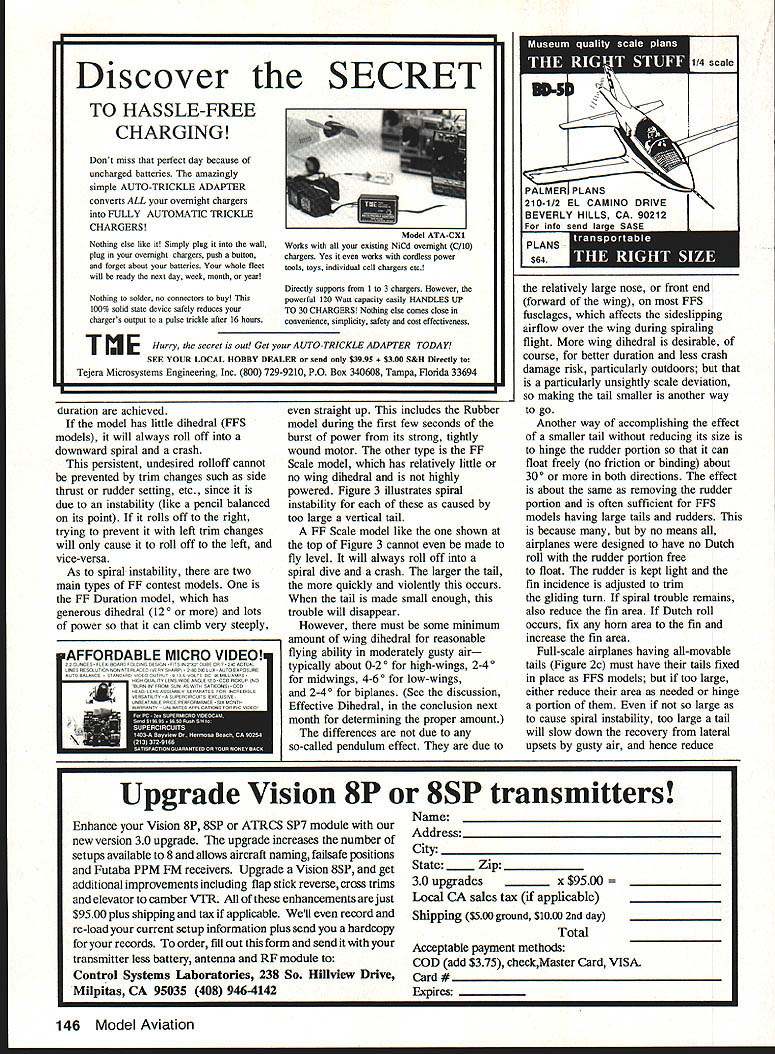
Figure 4 shows how tail size affects flight for two extreme cases (large and small tail effective dihedral). Studying the graph, we see that:
- With small dihedral (lower curve) and a large tail, the model cannot even fly level. At more upward than about 8° it is unstable. But with large dihedral (upper curve), it can climb steadily at a climb angle of up to about 14° before spiral instability (rolloff) occurs. Most early-day Gas and Rubber models were like the latter, their tails often two or three times the small size that would be needed for very steep climbing.
- As the tail is made smaller, the steady climb angle at which spiral instability occurs becomes larger.
- When the tail is made small enough, near size A, the model can be trimmed to climb straight up—a 90° climb angle—without rolloff.
- If the tail is made too small, significantly less than size A, Dutch roll will occur and become worse, eventually becoming violent if the tail is made even smaller.
Note that in the very steep climb region (70–90°), large dihedral is of no help; but it is desirable for the glide, for the transition from steep climb to glide for Gas models, for the flight of a Rubber model after its initial steep climb is over, and for better duration and less crash risk in gusty air.
About very steep climbing: this is necessary for FF Duration models, including rubber models during their initial burst-of-power period. For gaining most altitude this climb should be straight, not spiraling, with perhaps one roll during a Gas model's straight-up climb. To achieve this straight-up climb there must be no directional stability (i.e., no weathercock stability); actually, a slight instability is needed.
With tractor models this is achieved simply by having a sufficiently small tail—just enough area to ensure no hint of Dutch roll in the glide and slow level cruise of rubber models. Then, during the very steep climb, the front-fin effect of the fast-spinning prop is just enough to slightly overcome the small tail's effect and cause the slight directional instability required.
This cannot be accomplished with a pusher model, since the rear prop adds rather than subtracts tail area and thus increases directional stability. This is why pusher models (and jet-powered models) cannot be made to climb steadily very steeply or straight up. If the tail were made small enough to do this, there would be a bad Dutch roll in gliding flight when the rear prop stopped spinning or folded. This could be accomplished only by providing a properly sized front fin which either retracted or floated freely when the steep climb was over; but this is undesirable gadgetry for an FF model (also applies to jet-powered models). Hence, tractor models are best, as is well known. In the very steep climb, a model is essentially a helicopter rather than an airplane.
Conclusion and next steps
The conclusion next month discusses how to adjust vertical tail size to correct problems that show up in flight, as well as how to achieve the right tail size in a model that has not yet been flown.
Part Two also explains turning trim, wing dihedral, and effective dihedral and gives a formula that can be used to estimate a reasonable vertical tail area for a particular model.
For further discussion and data about trim and stability (and numerous other topics), see the books Flying and Improving Scale Model Airplanes (Air Age, now out of print) and Making Scale Model Airplanes Fly, Revised Edition, available for $13.95 postpaid from Aircraft Data, Box 763576, Dallas, TX 75224.
And remember: "Knowledge is power."
Transcribed from original scans by AI. Minor OCR errors may remain.

