
Vickers Vimy
OPEN-COCKPIT biplanes are for fun. Like Pitts Specials for aerobatics, and Wacos and Stearmans for nostalgic short hops from your airport to the next one. But for serious flying from where you are to where you'd rather be, sensible people prefer airplanes with tops to keep out the wind and the rain and the cold.
Of course, it hasn't always been that way. Time was, when flying men knew it wasn't safe to sit inside where you were protected from the wind. Because it was the wind that told them when things were going right and when they were going wrong, since instruments were rarely right, and electronic navigation aids hadn't even broken into science fiction.
And even today, otherwise rational people do some funny things in thoroughly uncomfortable airplanes. Why, we've got one jolly friend who has racked up well over 5000 miles of cross-country flying in his open-everything "Breezy." But that's been mostly in the summer and mostly in dry weather. As for people who intentionally go places in bad weather without the protection of at least a canopy, they're either gluttons for punishment, or doing the best they can with what they've got.
And so it was for two young Britishers who set out to become the first to fly the forbidding Atlantic Ocean non-stop. They weren't the first to try it, for others had embarked before: Harry Hawker and Mackenzie-Grieve got halfway in their Sopwith "Atlantic" before landing in the drink. Raynham and Morgan didn't even get their Martinsyde to the far end of the runway. Still others hadn't gotten that far with their plans.
But these failures did nothing to discourage those to whom the vast, mysterious, icey Atlantic was then the greatest of all challenges.
The Atlantic wasn't completely unknown, for ships had been plying it for hundreds and perhaps thousands of years. But to climb above it in a rickety airplane having only crude radio and few instruments would clearly involve bravery and skill and luck in unprecedented quantities.
As John Alcock and Arthur Whitten Brown proceeded with their plans to fly a converted Vickers Vimy bomber from Canada to Ireland, their rivals were trying to put their plans into action, as well. For this was no strictly-for-glory stunt: Lord Northcliffe, a towering figure in the British newspaper industry, had offered a prize of £10,000 for the first direct crossing between Great Britain and North America. In the calm aftermath of the Great War, such a prize stirred the hearts of many a bored aviator.
Early in May of 1919, Alcock and Brown and their airplane arrived by ship in Newfoundland. Already on the scene was Harry Hawker (later to gain fame with his classic fighter planes), and the Martinsyde crew. On May 8, a flight of four Curtiss NC flying boats left New York bound for England; after 23 days and eight stops they actually waddled into Plymouth. The Atlantic had indeed been crossed by air, but the long, close failures didn't seem to offer much advantage over sea crossing. The challenge remained.
May 18 the Curtiss boats were on their way. Hawker got halfway across before having to ditch. Alcock and Brown's Vickers Vimy was loaded with 1,000 gallons of fuel and 50 gallons of oil. Its Rolls-Royce Eagle V-12 engines were ready to deliver their normal 360 hp. Pilot Alcock and navigator Brown were ready. Two men could make such a trip.
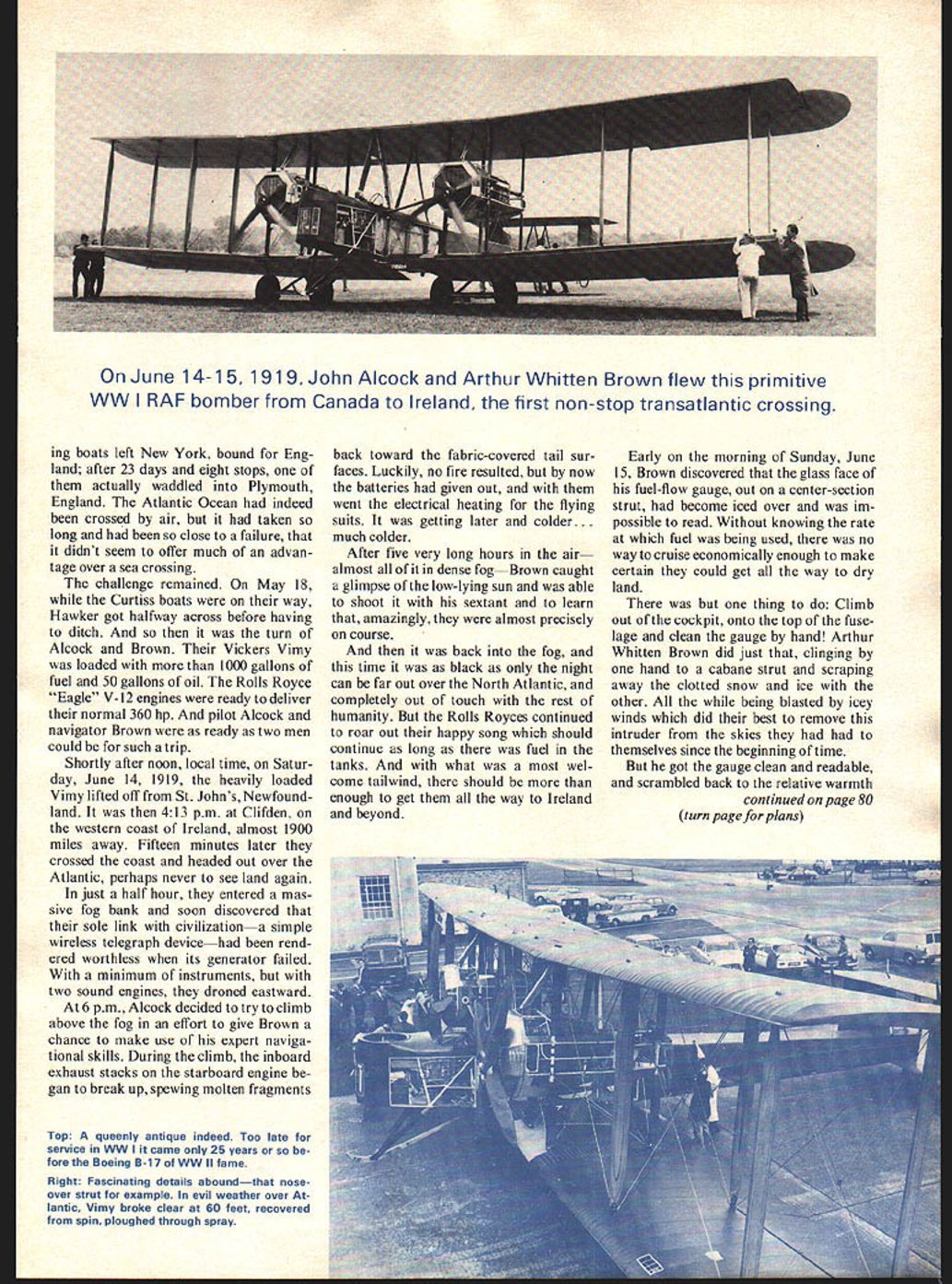
Shortly after noon local time, Saturday, June 14, 1919, the heavily loaded Vimy lifted off St. John's, Newfoundland. At 4:13 pm it landed at Clifden on the western coast of Ireland, almost 1,900 miles away. Fifteen minutes later they had crossed the coast and headed out over the Atlantic, perhaps never to see land again. Just a half hour later they entered a massive fog bank and soon discovered their sole link with civilization — a simple wireless telegraph device — had been rendered worthless; its generator had failed. With minimum instruments and two sound engines droning eastward, at 6 pm Alcock decided to try to climb above the fog in an effort to give Brown a chance to make use of his expert navigational skills.
During the climb the inboard exhaust stacks of the starboard engine broke up, spewing molten fragments. The Vimy broke clear at about 60 feet, recovered from a spin, ploughed through spray and headed back toward its fabric-covered tail surfaces. Luckily no fire resulted. Now the batteries had given out and the electrical heating for the flying suits went; it became, later, colder and much colder.
After five very long hours in almost dense fog, Brown caught a glimpse of the low-lying sun and was able to shoot the sextant, learning amazingly a and were almost precisely on course.
And then it was back into the fog, and this time it was as black as only the night can be far out over the North Atlantic, and completely out of touch with the rest of humanity. But the Rolls Royces continued to roar out their happy song which should continue as long as there was fuel in the tanks. And with what was a most welcome tailwind, there should be more than enough to get them all the way to Ireland and beyond.
Early on the morning of Sunday, June 15, Brown discovered that the glass face of his fuel-flow gauge, out on a center-section strut, had become iced over and was impossible to read. Without knowing the rate at which fuel was being used, there was no way to cruise economically enough to make certain they could get all the way to dry land.
There was but one thing to do: climb out of the cockpit, onto the top of the fuselage and clean the gauge by hand! Arthur Whitten Brown did just that, clinging by one hand to a cabane strut and scraping away the clotted snow and ice with the other. All the while being blasted by icy winds which did their best to remove this intruder from the skies they had had to themselves since the beginning of time.
But he got the gauge clean and readable, and scrambled back to the relative warmth.
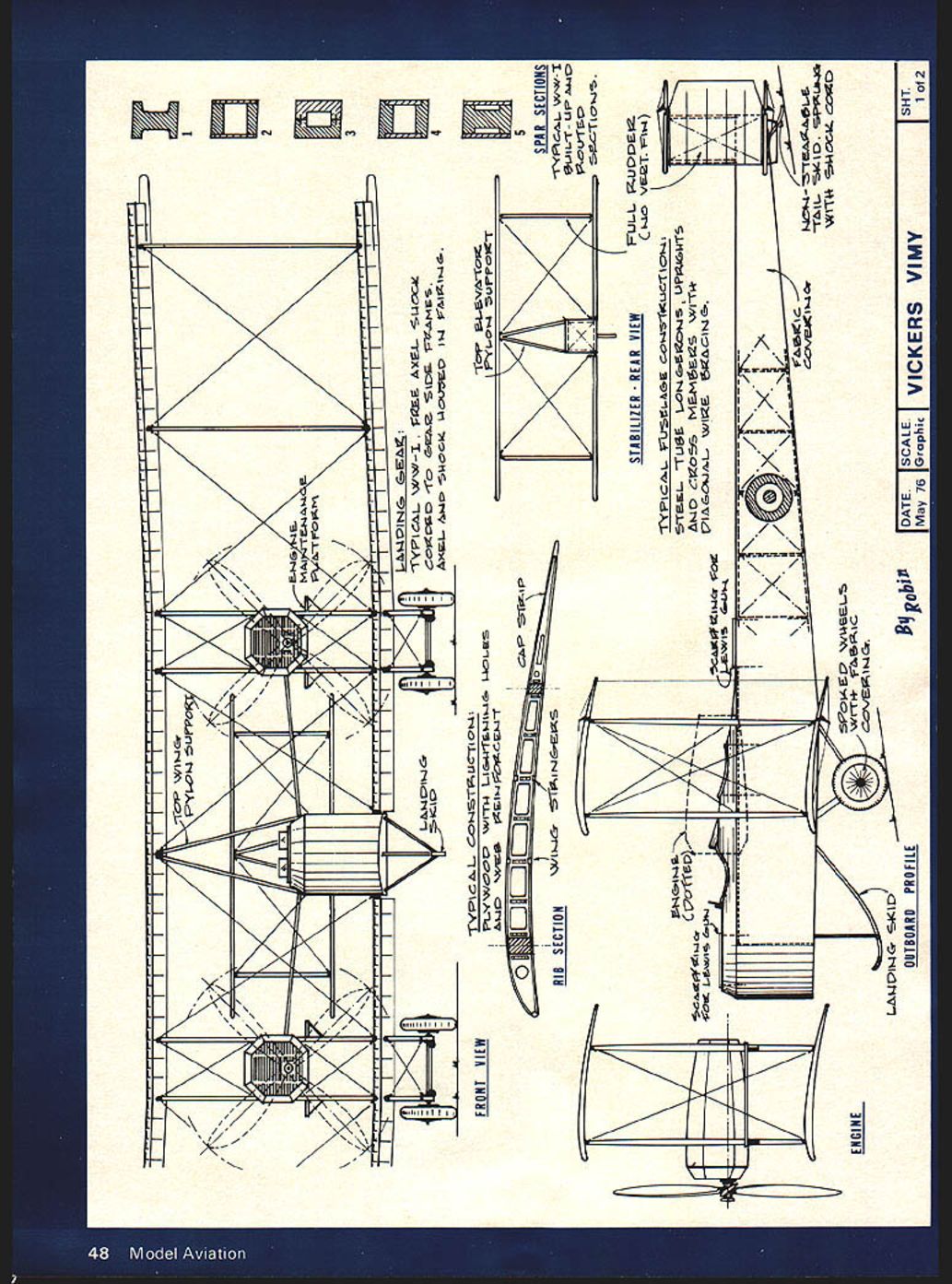
Vickers Vimy
TOP VIEW
ENGINE
FRONT VIEW
LANDING GEAR
TYPICAL LANDING GEAR — W-W.I. FIBRE AXLE, WOOD SHOCK LINKS AXLE AND SHOCK MOUNTED IN MANGAN.
LANDING SKID
LANDING SKID OUTBOARD PROFILE
RIB SECTION
CAP STRIP
WING STRINGERS
TYPICAL CONSTRUCTION — WOOD WING RIBS AND SPAR SECTIONS
STABILIZER — REAR VIEW
FULL RUDDER (NO VENT TRIM)
TYPICAL FUSELAGE CONSTRUCTION — STEEL TUBE FUSELAGE FRAME, LONGERONS, UPRIGHTS AND CROSS MEMBERS, WITH DIAGONAL WIRE BRACING
SPOKED WHEELS WITH FABRIC COVERING
(By Robin)
DATE: May '76 SCALE: Graphic
(Note: page contains drawings and component labels for the Vickers Vimy.)
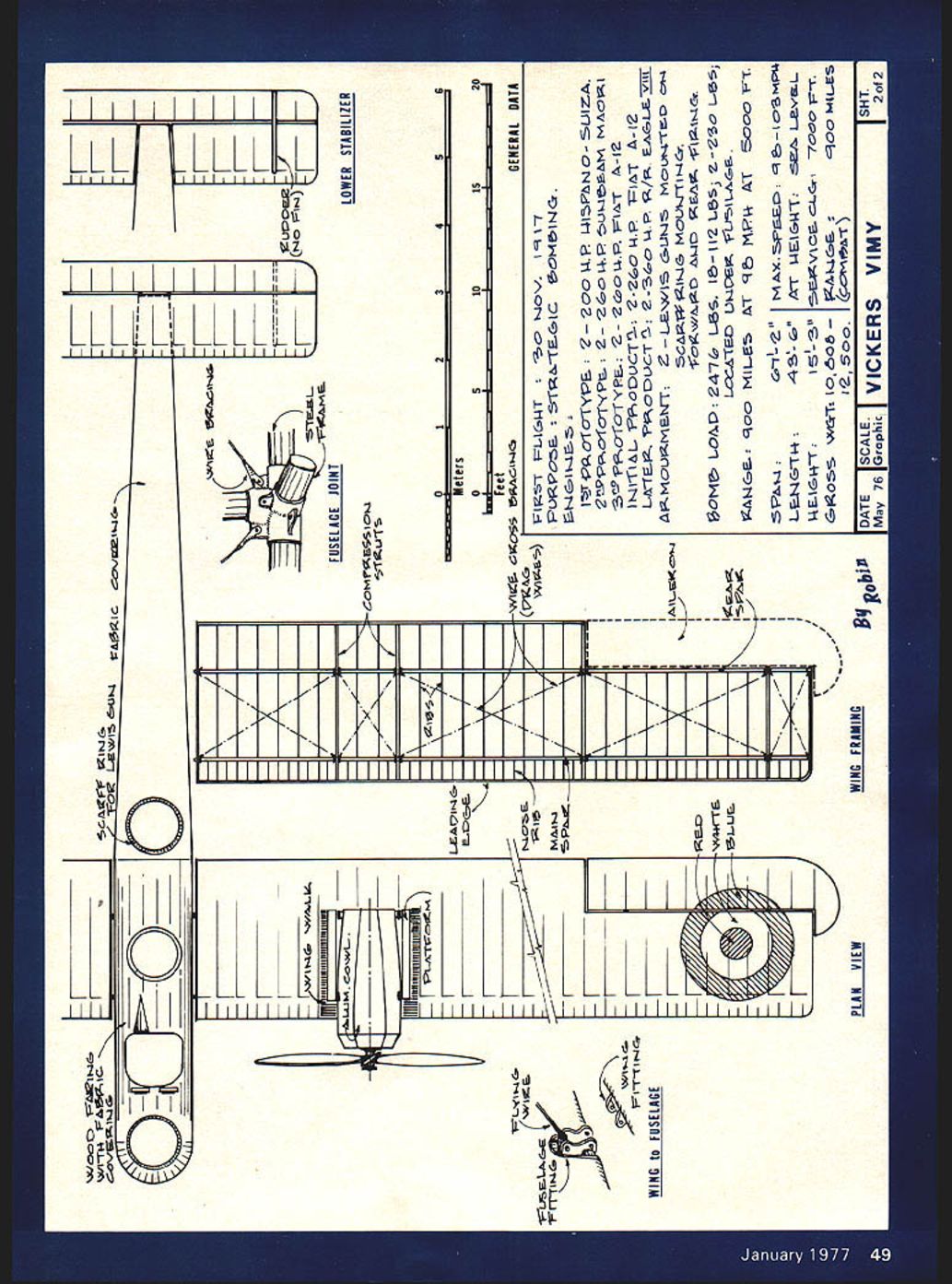
VICKERS VIMY
GENERAL DATA
FIRST FLIGHT 30 NOV. 1917
PLAN VIEW
WING FRAMING
WING TO FUSELAGE
FUSELAGE JOINT
COMPRESSION STRUTS
WIRE CROSS BRACING (VARIES)
LEADING EDGE
LOWER STABILIZER
By Robin and comfort of the open cockpit. And then he had to do it all over again, and again, and again, as long as the storm lasted, which seemed forever. While many accounts tell of Brown also cleaning the snow and ice from the shutters in front of the engine radiators, his own story mentions nothing of the sort.
At three in the morning, while they were still a good 600 miles from land, the Vimy suddenly broke free of the clouds and fog, and emerged into clear skies. But before the two weary men could begin to appreciate their sudden good fortune, they were plunged headlong into a violent storm, tossing and turning far too wildly for their crude instruments to cope with.
At one point, some 4000 feet above the waves, the Vimy slowed, shuddered and stalled! And went into a spin! In a rapid spiral it headed for the water at a frightening rate, even though Alcock had coolly throttled back as soon as he realized what was happening. Not until they were within 60 feet of the Atlantic did they break free of the ugly storm clouds. And with no more than a few feet to spare, Alcock pulled the big bomber out of the spin and back to level flight, its wings ploughing through the salty spray! On its way back to Canada!
After making a "180," Alcock climbed back up to 6500 feet, where he could finally relax his death grip on the controls and catch his breath. But not for long. Into a heavy rain storm they charged, and the rain turned to hail and then to snow, which built up dangerously on the wings and struts and anything else that stuck out.
Shortly after seven in the morning, when less than 100 miles from the Irish coast, the build-up of snow was so bad that Alcock was forced to descend through a thick cloud layer to just 500 feet, where the warmer air did what many years later would be done by pushing a button marked "De-icer." The ice was gone, and the goal was almost within sight, and the feeling of doom began slipping farther and farther behind.
First, the sun appeared, and not for just a teasing moment. Then they could see, on the horizon, a beautiful mountain called the "Twelve Pins," reaching almost a half mile above the green Irish countryside. At 8:15 a.m., the Vimy and its two exhausted men were over land for the first time in what must have seemed like years, but was actually just 16 hours.
At 8:25 they were flying over Clifden, a small village near the coast, and at 8:40 they were down and stopped and dragging themselves out... into a soggy, sticky peat bog. To Alcock's very tired eyes, it had looked like a reasonably smooth field in which to land his great beast. Too late, he realized it was wet and soggy and thoroughly treacherous. The Vimy touched, lurched and shoved its nose deep into the muck, coming to a complete stop entirely too soon.
But while the men were totally drained by the battle with the elements, and the Vimy was such a mess that its own mother might not have recognized it, they had made it! Alcock and Brown had flown, non-stop, all the way across the Atlantic Ocean. They had taken off from the New World and had not landed until they got to the Old World. No one had ever done that before, and certainly no one would ever forget who had done it first.
John and Arthur were met by a curious shopkeeper who took a close look and cried, "By thunder, it really is them!" The great news exploded through the nearby town, to London and to the world. They were welcomed in true heroes' fashion in Dublin and then in London, where they dined and were awarded more than $65,000 in prizes and then whisked off to Windsor Castle to be knighted by King George V.
It was a triumph of piloting, navigation and mechanics. On the piloting side of things, Sir John Alcock saw the future in a prophetic light. "The next time I cross the ocean," he said, "it will be in a flying boat." Sir Arthur Whitten Brown saw his part in the operation as quite a success. "So far as weather was concerned, it could not have been worse... for after the first hour, we were smothered in fog until we landed in Ireland. Nevertheless, with only a sextant and compass, and a special device for determining the machine's speed and drift, we came through. And I am sure we could do it again."
But being able to stagger across the Atlantic in extreme discomfort did not mean that dependable commercial airline service was right around the corner, as many predicted after the epic flight. Fare-paying passengers want some assurance they'll get where they're going... and in reasonably good condition. For that reason, it would be a full 20 years before the Atlantic was crossed by scheduled airlines.
By then, sadly, John Alcock was long gone. He perished, in fact, just a few months after his historic voyage, in the crash of a Viking flying boat, in bad weather over France. Arthur Brown was so shaken by this that he never again flew, living out the rest of his life as a minor public official until he died quietly in 1948.
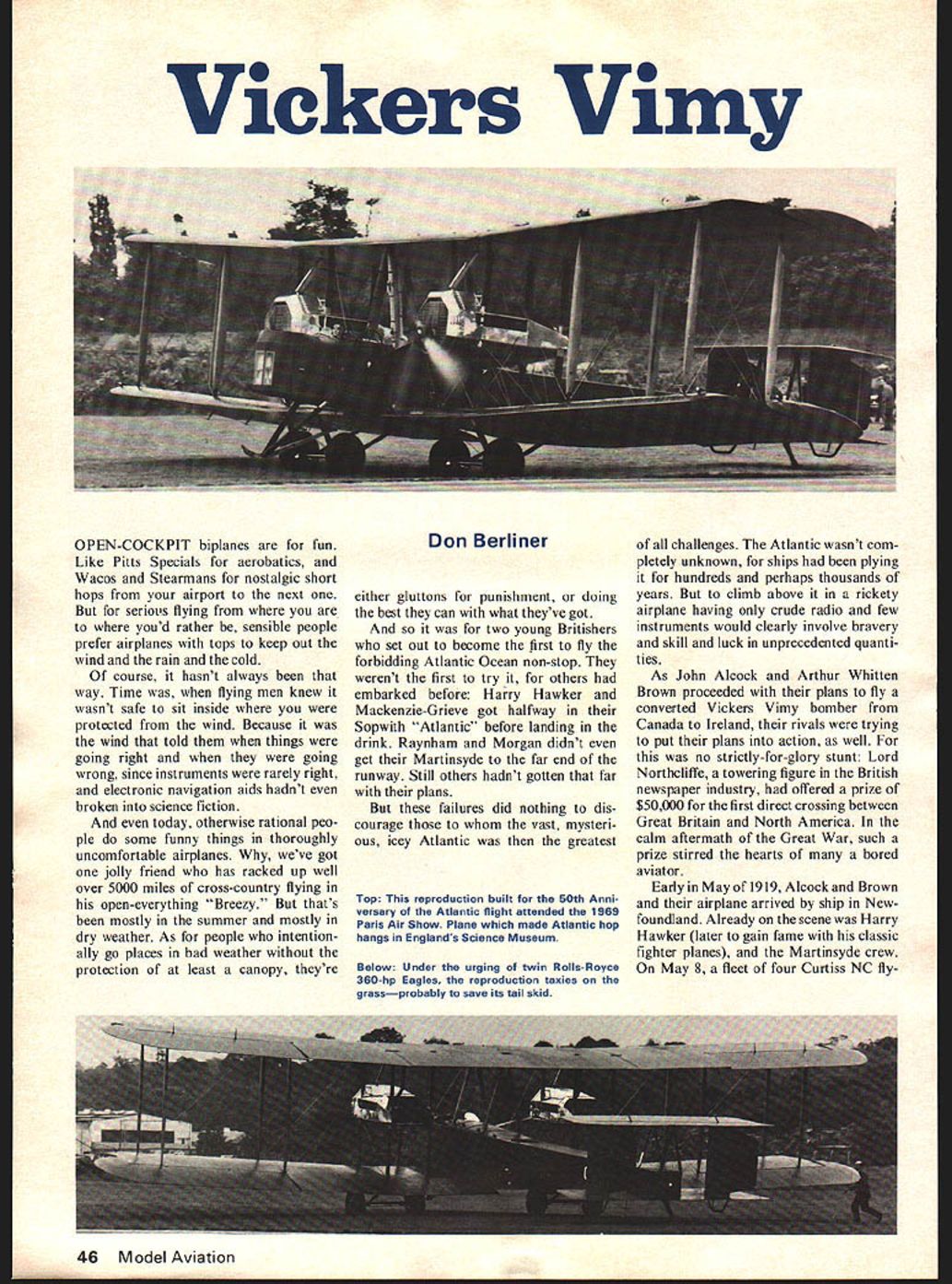
Their Vimy, however, lives on. It hangs proudly from the ceiling of the Science Museum in the South Kensington section of London, in the same hall as the Supermarine S-6B Schneider Trophy winner and Britain's first jet, the Gloster E.28/39. It lives in another form, as well. In 1969, for the 50th anniversary of the Atlantic flight, an exact reproduction of the Vimy was built by the Vintage Aircraft and Flying Association, at Weybridge, England. It was flown across the English Channel to the 1969 Paris Air Show, but was later severely damaged by a fire. Repaired, it was retired to the RAF Museum at Hendon, north of London.
Specifications of the transatlantic Vimy:
- Length — 42'8"
- Wingspan (both) — 67'
- Height — 15'3"
- Total wing area — 1330 sq. ft.
- Empty weight — about 7100 lbs.
- Gross weight — about 12,500 lbs.
- Fuel capacity — 865 Imp. Gal. (1038 U.S. gal.)
- Maximum speed — about 100 mph.
- Cruising speed — about 90 mph
- Landing speed — 45 mph
- Maximum range with record fuel load — 2400 mi.
The Vickers Vimy was the standard heavy bomber of the RAF from its introduction at the very end of the First World War until 1924, and remained in service until 1929. Of about 300 built, only one was converted to this special use.
It took Alcock and Brown 16 hours and 12 minutes to fly the 1880 miles from Newfoundland to Ireland, with the help of a good tailwind. They averaged 116 mph ground speed, and later, the same pilots suggested that such a crossing could be made in an aircraft like the Vickers product — the Concorde SST — in about 90 minutes, and in almost shameful comfort. But not if the Vimy hadn't done it first.
Transcribed from original scans by AI. Minor OCR errors may remain.

