
Vintage Stunt Championships
Great flying, good fun, and fond remembrances mark the 14th annual affair
Bob Hunt
Everyone who attends the Vintage Stunt Championships (VSC) has a personal reason for doing so. This year I made my 13th trip to Tucson, Arizona, where I attended the 14th edition of this fantastic meet, held March 21–24 at Christopher Columbus Park. I missed the inaugural event, which was contested in Riverside, California. And, yes, I have my own reasons for continuing to make that trek; I'll reserve them for a bit later.
As I've mentioned before in reports about this meet, Mike Keville had a dream in which all of his childhood "Stunt Heroes" would come to his "back yard" in Riverside and fly just for him. It seemed impossible, but to Mike's amazement several well-known stunt fliers attended when he started VSC. The word about the unique and fun contest quickly spread from coast to coast and beyond. When the Keville family moved to Tucson later that year, Mike figured his dream meet was destined to be a one-time affair. After all, who would travel to Tucson in early spring to attend a model contest for only vintage Control Line (CL) models? Mike's dream has been flourishing in the desert for the past 13 years, and hundreds of modelers from around the globe have gleefully attended to be part of the VSC family and to experience the special magic for which this contest is famous.
This edition of VSC came in the wake of several losses to the stunt community this past year. Among the many who are no longer with us in body are George Aldrich, John Davis, Mike Garmon, Jim Kostecky, John Laws, Lee Lorio, and Joe Ortiz. Adding to the grief we all were feeling, Tucson stunt legend Ted Snow passed away during the week of the contest.
Ted designed the popular Old‑Time Stunt (OTS) design the Humongous, and several were flown in competition at the meet. It was poignant to watch these models fly knowing that Ted had just left us.
Members of the host club—the Cholla Choppers—conducted an emotion-filled farewell flight for Joe Ortiz, who was a member. They flew one of Joe's stunt models during a break in the Classic event, and each took a turn at the handle for a few laps. I think many felt the combined presence of the spirits of all our fallen brethren.
The passing of George Aldrich hit especially hard. He will forever be remembered as one of the most successful stunt fliers and as one of the most giving personalities this event and this hobby have ever known. To list his accomplishments here would be impossible, but modelers the world over owe George a great debt of gratitude for his caring involvement.
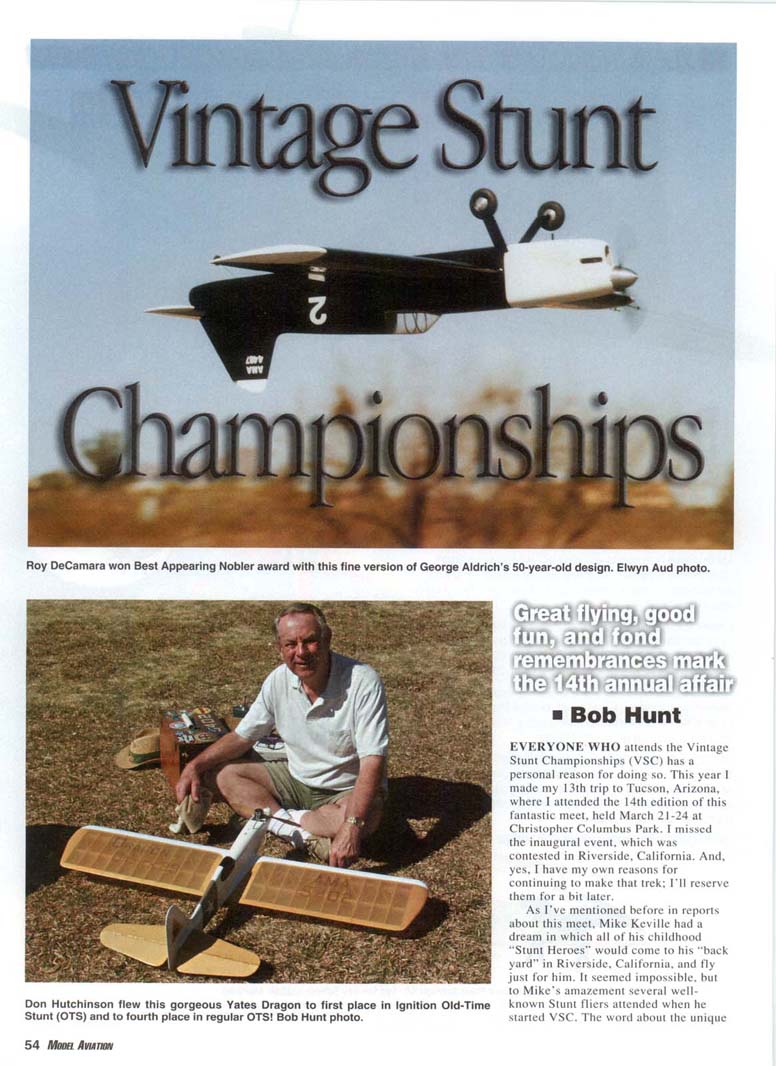
In celebration of George's life in modeling and in recognition of the Nobler's 50th anniversary, two new awards were given at the contest. John "Doc" Holliday captured the GMA Memorial Award with his great-flying 1952 Nobler. The Best Appearing Nobler award went home with Roy DeCamara, who flew a faithful and beautifully finished rendition of George's original model.
Julie Aldrich, George's widow, was in attendance to witness and accept the outpouring of emotion and love felt for George. He will certainly never be forgotten, and his spirit will live on everywhere in this sport—especially in Tucson at each VSC and whenever and wherever a Nobler is flown.
At each VSC there are a number of models that no one has ever seen before and many that are rarely seen. That's one of the neatest things about this contest: seeing what everyone else has built for the affair! This year there were many surprises.
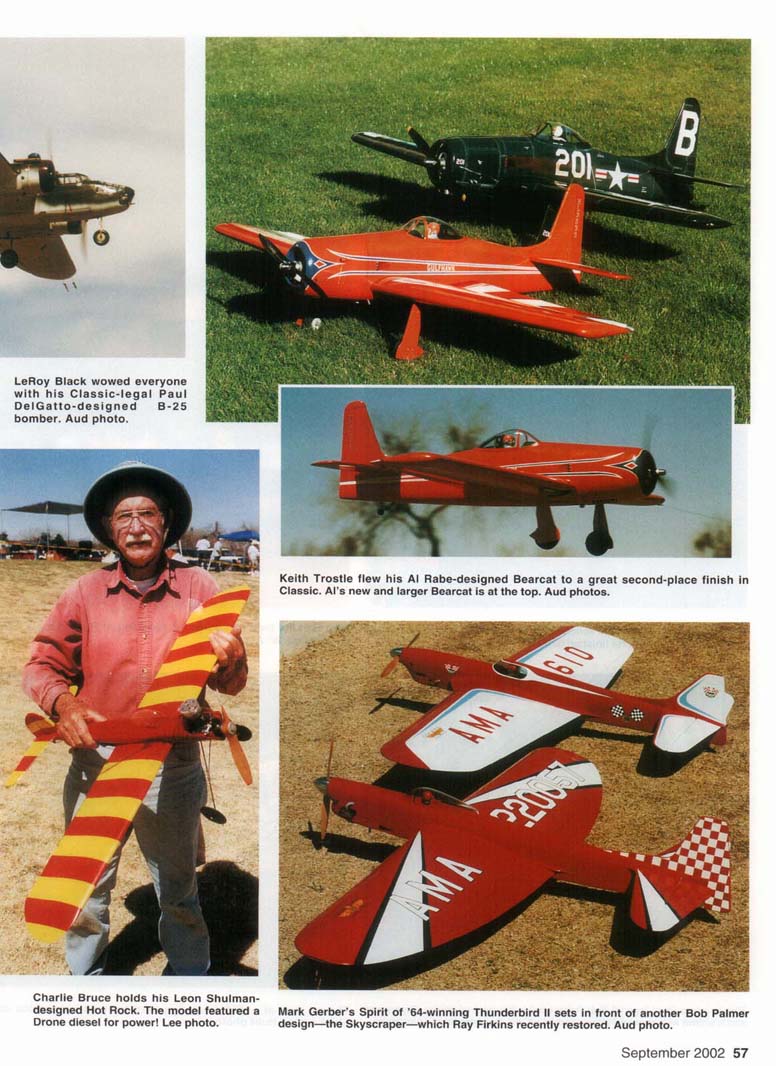
Topping the list for me was LeRoy Black's spectacular rendition of Paul DelGatto's B-25. Although it's not really a competitive contest stunt model, it was featured in the October/November 1963 Flying Models magazine as a CL stunt version of the famous bomber. It features a symmetrical airfoil and stunt flaps. LeRoy flew two exciting patterns with the Mitchell and had everyone's attention. He won the Most Unusual Model award for his efforts.
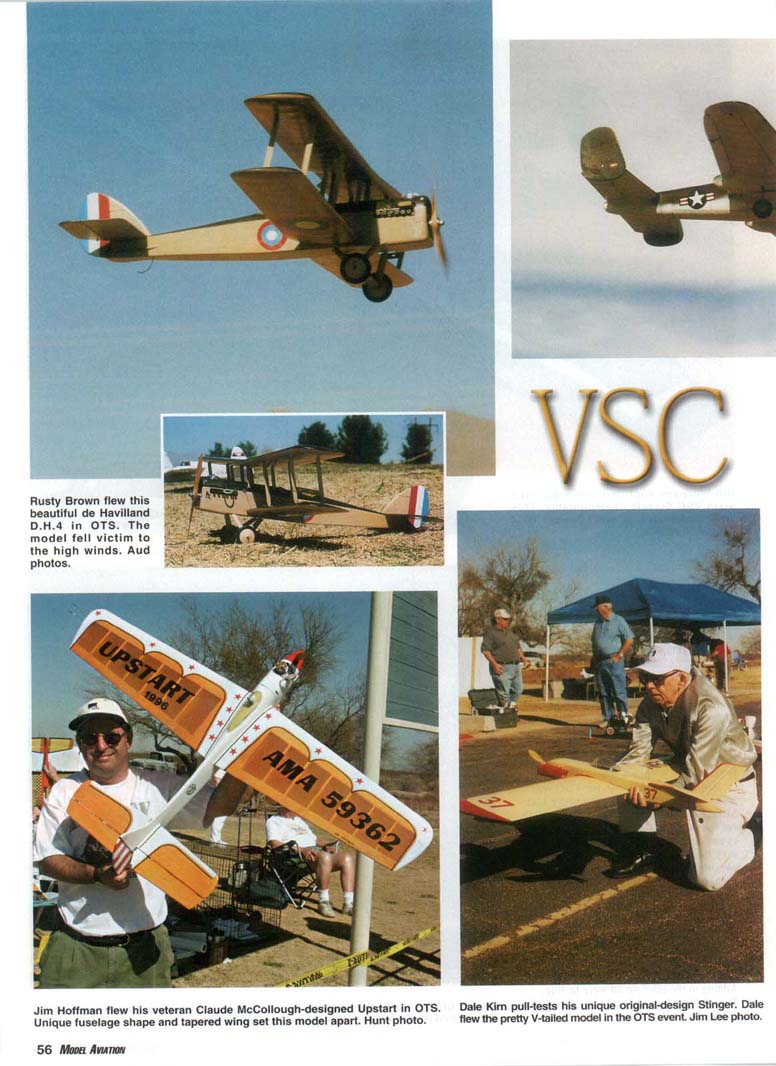
Another surprise was Rusty Brown's de Havilland D.H.4 biplane. It looked like a competition CL scale model, and when I first saw it setting on the field I wondered what it was doing at a stunt meet. Surely no one would attempt the OTS pattern with that! But Rusty did; in fact, he flew it convincingly. However, the wind was extremely high during Rusty's flight, and the lovely biplane fell victim to a nasty gust. It's too bad; Rusty may have placed with the model had the mishap not occurred. It was an outstanding effort.
Another unusual OTS choice was the V‑tailed Stinger entered and flown by an equally surprising pilot: Dale Kirn. It's surprising because Dale is world renowned in the Speed event, and he is one of the major proponents of the Stanzel Mono‑Line control system. In all the years I've known Dale, I've never seen him fly a normal two-line CL model—until now! Dale, too, fell prey to the gusty wind, and the result was a totaled model. Still, I think he had a ball seeing the surprised look on everyone's face when he showed up with that aircraft.
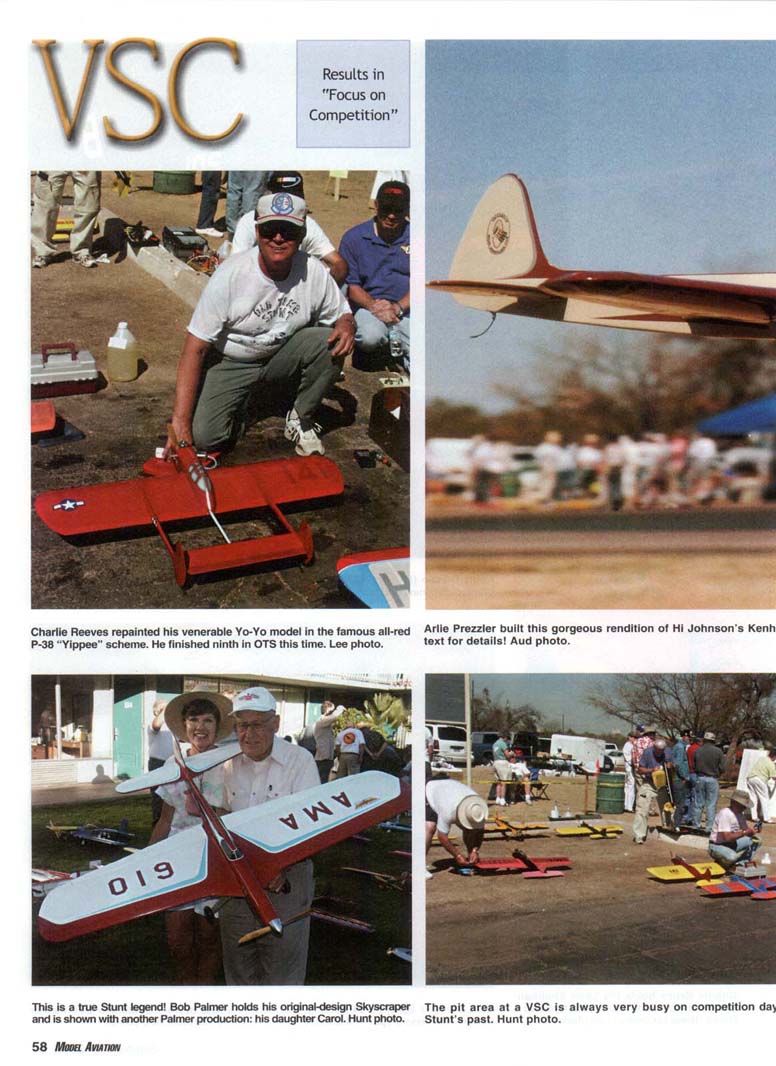
Although he's not a VSC first-timer, Arlie Prezzler's Kenhi Panther was a favorite of mine. I've liked that design since I first watched the late "Big Ed" Mahler build one in my parents' basement.
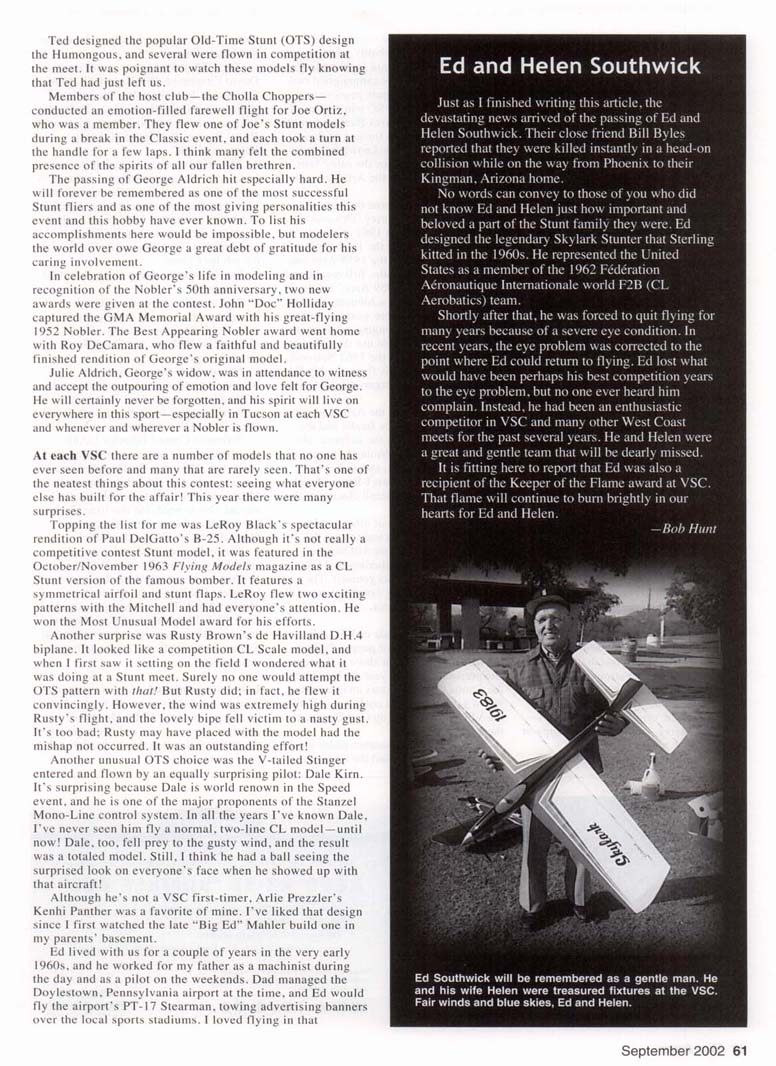
Ed lived with us for a couple of years in the very early 1960s, and he worked for my father as a machinist during the day and as a pilot on the weekends. Dad managed the Doylestown, Pennsylvania airport at the time, and Ed would fly the airport's PT‑17 Stearman, towing advertising banners over the local sports stadiums. I loved flying in that Stearman with him and in his pristine AT‑6 Texan.
Ed was a member of the famous Skyscrapers Free Flight club in New York in his early years, and he even won a free-flight event at the 1954 Nationals. He loved to fly stunt—CL and the real thing. He was killed in his PJ‑300 biplane while promoting an air show that was to be held on Long Island in the mid‑1970s.
I would watch Ed work on his Panther each evening, and he patiently answered hundreds of questions for me as he proceeded. I'll never forget him or his Panther, and that's why Arlie's model was so dear to me. It's also one of the many reasons I love to attend VSC each year: to see the stunt models that I revere from my youth. A Kenhi Panther design, flown by the "Ice Man" Bob Whitely, won the first VSC!
Very few modelers at VSC can fly models of their own design in OTS or Classic. The cutoff date for OTS is December 31, 1952, and for Classic it's December 31, 1969. The newest of these designs are at least 32 years old!
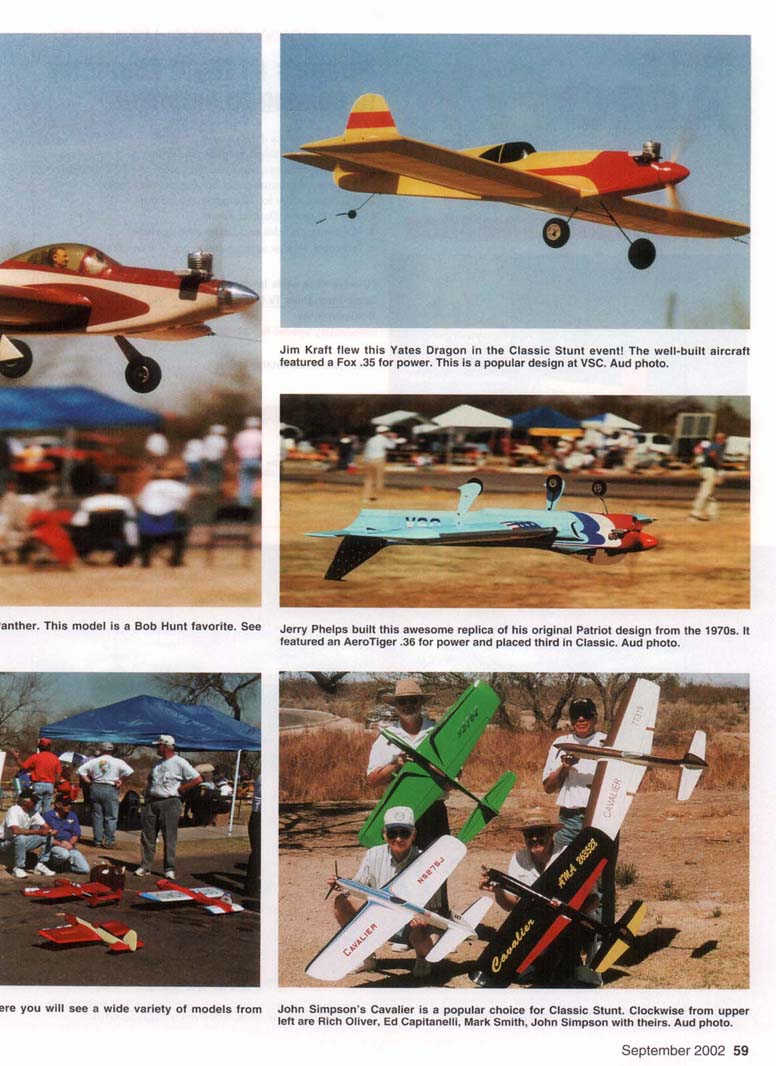
One who can use his own "stuff" is Jerry Phelps. He was a member of two United States world teams (1970 and 1972), and at both World Championships he flew versions of his own‑design Patriot.
Jerry is the first to admit that the Patriot was heavily influenced by Jim Kostecky's Formula S design. However, the two are significantly different in many areas, including airfoil shape and wing area. The fuselage profile is similar, but it differs enough to allow the Patriot to stand alone on the field as a unique model.
The replica Patriot was new and unflown at the time of Jerry's arrival at VSC 14, but in the end he sent a clear message that he is comfortable with his old steed; he placed a strong third in Classic and captured the Concours trophy. The model was a flawless rendition of the original. Team Phelps—Jerry and Merry—looked pretty happy at the end of the meet.
Another competitor who can use his own design in Classic events is Bill Werwage. He has probably a half dozen or more designs that are legal under the current rules! Bill has campaigned two of these originals in past years to an unprecedented five VSC wins; he used his legendary 1959 Ares (featured in Model Aviation) for one of these victories and his little‑known but very competitive Vulcan for the other four. The Vulcan predates the Ares series by a couple of years.
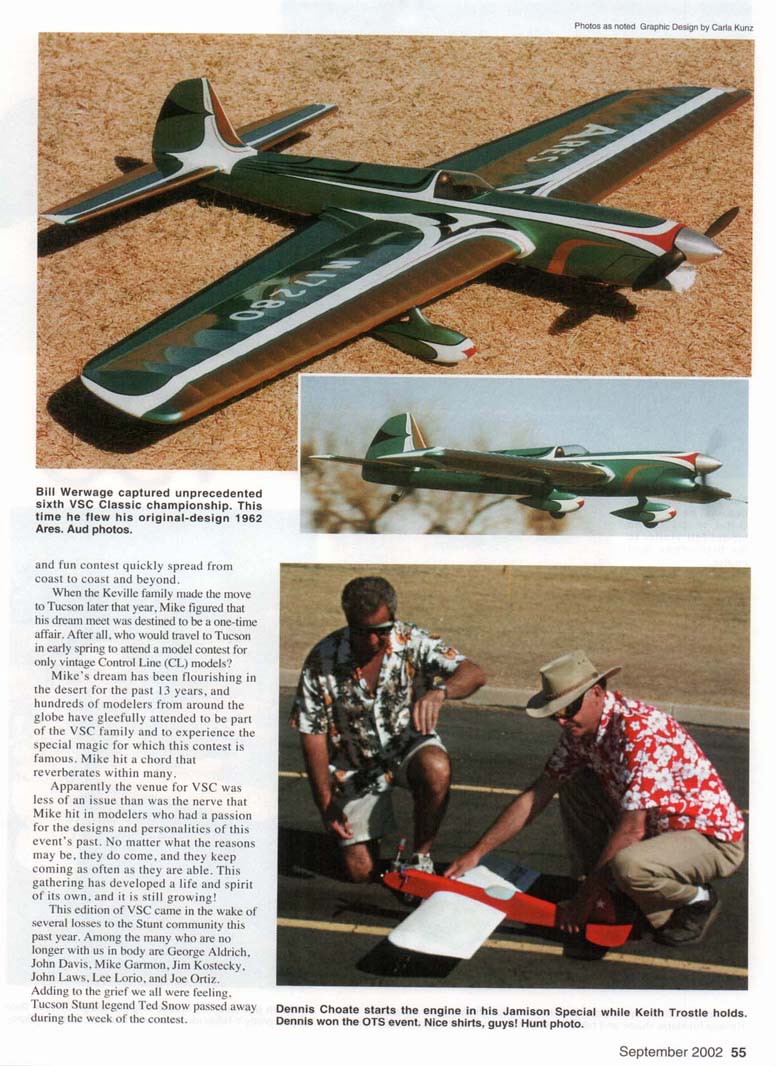
This year Bill showed up with yet another of the Ares series. This one was originally designed in 1961 and built during that winter for the 1962 Nationals. It is a bit bigger than the 1959 Ares and has a higher aspect ratio. Bill mentioned this variant in his "1959 Ares" article. It was developed to use a Johnson .35 that he and H. Johnson were working on for the stunt event. The engine never panned out, and Bill decided to use the older, smaller Ares again at the 1962 Nationals. He won with it, but his flying buddy Ed Kamerer used the larger, newer design Ares to place second.
With the advent of the AeroTiger .36 engine, Bill said that he finally had the proper horsepower for the airframe. His replica 1962 Ares is absolutely gorgeous in metallic mint green, and with it he captured this year's Best I‑Beam Model award and his sixth overall championship in Classic at VSC!
There were dozens of other notable models at VSC; if you want to get the story on all of them, you will have to attend one of these gatherings and talk with their owners and pilots yourself. The models I've mentioned are my favorites; you will, no doubt, have your own.
A contest the magnitude of VSC relies on lots of help from lots of people. Perhaps the least‑thought‑about chore is the actual site preparation. Each year the host club, the Cholla Choppers, does an outstanding job of getting the field ready not only for the VSC, but for the Top Gun Combat meet that precedes it.
This year veteran number‑adder‑upper Shareen Fancher handled the tabulating and was ably assisted by Elaine Brookins and Ginny Emmett.
The OTS judging crew consisted of David Fitzgerald, Bill Heyworth, Mark Smith, and Bob Whitely. The Ignition critics were De Hill and Doug Taffinder. Classic number scoring was by Joe Foster, and the Classic number scribing was by Rusty Brown, Bob Emmett, Larry Foster, and others.
The pit boss job is critical at this meet because of the large number of entrants. A good pit boss has to keep the ready line filled and the contests running on schedule. We were fortunate to have two excellent people in these posts: Linda Gleason handled the OTS pits and Ray Firkins did the job for Classic.
De Hill was the event director for Old‑Time Ignition.
The scores were collected and brought to the scoring tent by runners John Ashford, Gary Munstow, Gary Minor, Jim Phillips, and Dave Rice.
Tugs for the pull‑test were carefully applied by Richard Kirk, Rene Berger, and Glen Allison.
Perennial Contest Director JoAnn Keville had to be out of town during the contest, so Mike was finally called upon to do some actual work! All kidding aside, Mike is always there to help JoAnn and anyone else in need, but this time he also handled the contest director's chores. Many thanks for all you do, Mike!
The real heroes of the administrative staff this year were Jim and Sharon Hoffman, who arranged for the annual banquet to be held at the downtown Marriott. This was a huge upgrade from the facilities and vittles of the past, and a great big thank you goes to Jim and Sharon for their efforts. Do it again next year, please!
I already mentioned a few of the special awards that are given out each year. New awards, such as the GMA Memorial, are added as time goes on, and that is one of the things that makes this gathering such a growing tradition.
Following is a list of the other special‑award recipients:
- Spirit of ’46 (Ignition): De Hill (by vote of the fliers)
- Spirit of ’52 (OTS): Jerry Silver with his Zilch X
- Spirit of ’64 (Classic): Mark Gerber with his Thunderbird II
- Best Appearing OTS: Keith Trostle’s Pagan
- High Point Nobler: Roy DeCamara
- Most Fun (sponsored by Tom Lay): Josh Condon
- Pachyderm Award: Bob Whitely
- Best Buns (don’t ask): Scott Condon
- Bob Gildadini Sportsmanship Award: Doug Taffinder
- Keeper of the Flame (the most coveted award at VSC): Roy DeCamara
A very special congratulations from the entire VSC family to these dedicated modelers.
I’ve reported on this special meet for most of the 13 years I’ve attended it. I’ve written many stories about it and have produced videotapes about it, trying in any way I could to promote it and get modelers to attend. Mike Keville tells me that many who do attend mention that the reason they are there is because they’ve read one of my reports or have seen one of the videos.
I mention this not to pat myself on the back or take credit in any way for the success of VSC, but rather to establish that I am at least entitled to voice an opinion on some matters that have been on my mind concerning this contest.
VSC has garnered a reputation as a “fun” meet, where competition is not necessarily stressed. There are plenty of fun‑type activities there for those who are not competitively minded. You can come and fly at a VSC and not be even the slightest bit concerned with where you place, and you won’t be thought any less of for that attitude. In fact, it’s encouraged. I’ve often referred to this meet as one at which you are allowed to compete, but it’s frowned upon. That’s a cute saying, but it is starting to become a serious concern for many.
Several fliers come to VSC for the sole purpose of flying against others of similar mind in a competitive battle for the win. In recent years there has been some grumbling from the “fun” contingent that fliers with this attitude don’t belong at a VSC—or at least shouldn’t come with a competitive attitude.
Let’s examine what Mike had in mind for this meet. He wanted to bring together the modelers he had long admired and had read about in the magazines, and have them fly the models for which they were famous. He also wanted to bring in others who, like him, admired these models and modelers.
The modelers in question were famous, and were written about in the magazines, because of their competitive prowess. Their models were famous for being warriors in the competitive arena. Is it right to expect these competitors and their aerobatic weapons to come together in an ideal setting for a contest then be expected not to take competition seriously?
For the past few years I have been asking Mike and JoAnn to incorporate some sort of a flyoff system for the top five or six fliers in OTS and Classic Stunt. This contest is billed as a "Championships" after all, and it is impossible to pick a true champion with the existing format. The current arrangement has the entire entry split up into two circles. You get one flight on circle one on the first day of competition in each event and one flight on circle two the next day, or vice versa if you start the meet on circle two.
With the normal 60‑plus fliers, that works out to 30 or more flights per circle, per day. Any longtime competitor will tell you that it is difficult at best to pick the true champion under those conditions.
A one‑flight, winner‑take‑all flyoff format for the top six (the top three from circle one and the top three from circle two) would take one extra hour. With so much being offered at VSC for the fun flier during the four‑day schedule, is it out of line to suggest that the hard‑core competitors get one hour to enjoy what they like best, which is head‑to‑head, equitable competition for the win? This is how they have fun!
Some have said that this would ruin the spirit of the meet. I say that it would validate the reason for the gathering. Let’s not exclude those whose competitive natures, and the competition models they fly, have brought the stunt event to where it is today.
This year Mike relented and agreed to try a flyoff among the top‑five‑placing modelers after the two‑day Classic event. The atmosphere during that flyoff was electric. I have never seen as many spectators watch any flight at VSC as there were watching those magnificent performances.
If you think about it, that is logical. Many modelers who are entered in the contest are too busy practicing or getting ready for their own flights to allow them time to watch the performances of the more accomplished fliers. Many never get to see any of the winning or placing flights.
In the flyoff format, everyone gets to see the top pilots fly and make up his or her own mind about who is flying best. The judges also get to see the top fliers in a back‑to‑back fashion, with basically the same weather conditions. This is a fair way to end a Championships and pick a true Champion.
I was there and was one of the judges for the flyoff. This was very exciting, and it was a fantastic showcase for the great competitive models and modelers who flew in it. The huge gallery of enthusiastic spectators behind the judges’ panel was proof that many others felt the same way!
I applaud Mike for having the courage to give the flyoff a try, and I only hope that he will tweak the makeup of it a bit and make it a regular part of the VSC experience. I’ll bet that the OTS people would also like to get in on this action!
Whether you are a fun‑oriented or competition‑oriented stunt enthusiast, please make it a point to come to a VSC soon. Once you do, you’ll be a part of a great and growing tradition and a member of an ever‑expanding vintage stunt family.
Bob Hunt
Transcribed from original scans by AI. Minor OCR errors may remain.

