
VISALIA SOARING FESTIVAL
Dave Garwood
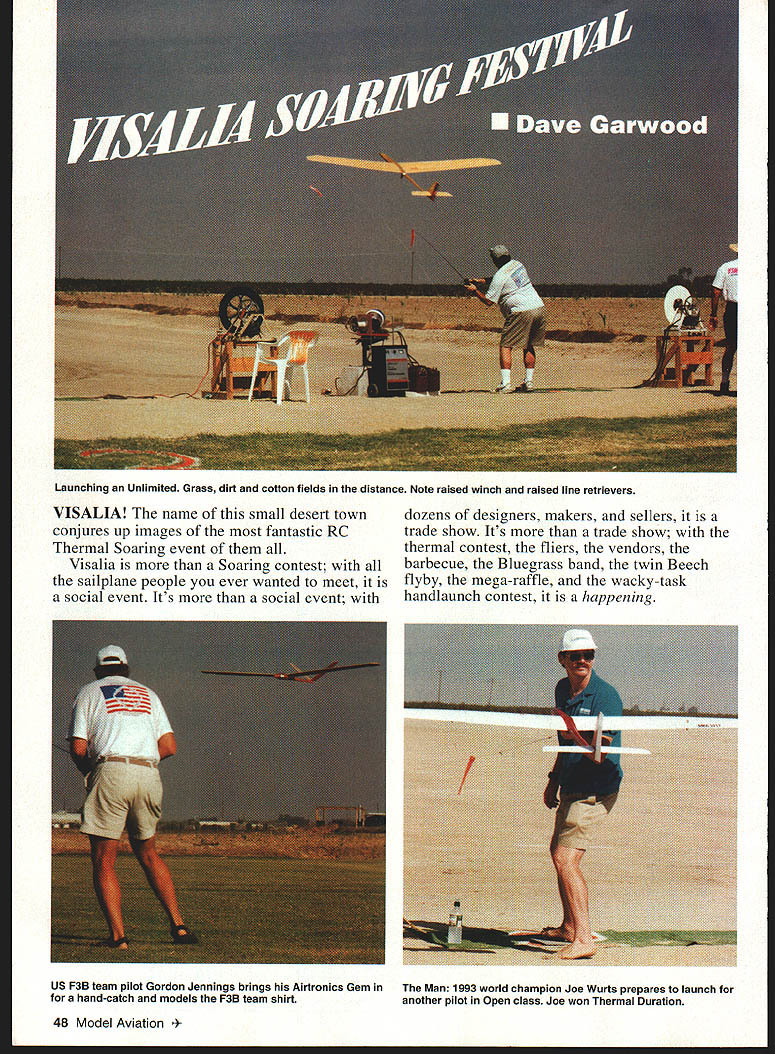
VISALIA! The name of this small desert town conjures up images of the most fantastic RC thermal soaring event of them all. Visalia is more than a soaring contest — with all the sailplane people you ever wanted to meet, it is a social event. It's more than a social event — with dozens of designers, makers, and sellers, it is a trade show. With the thermal contest, the fliers, the vendors, the barbecue, the Bluegrass band, the twin Beech flyby, the mega-raffle, and the wacky-task hand-launch contest, it is a happening.
Central Valley RC Club's 23rd Annual Fall Soaring Festival, held October 5–6, 1996, in Visalia, California, had 275 pilots registered and brought 600-plus sailplanes.
The Venue
Part of the Visalia experience is the stark contrast in land use. We launched and landed from a small plot of cultivated grass surrounded by desert and scattered plots of irrigated farmland. There is no place like this in New York, and there may not be a place like this east of the Mississippi.
This desert is a cradle of aviation innovation. On the drive up from Los Angeles you pass through Mojave, where Voyager — piloted by Jeana Yeager and Dick Rutan — was built. Voyager was the first airplane to fly around the world nonstop and unrefueled. You also drive past Edwards Air Force Base, a test site for highly advanced military aircraft. In my mind's eye I could easily see the U-2 spyplane — the "glider with a jet engine" — lifting off the Edwards runway.
The People
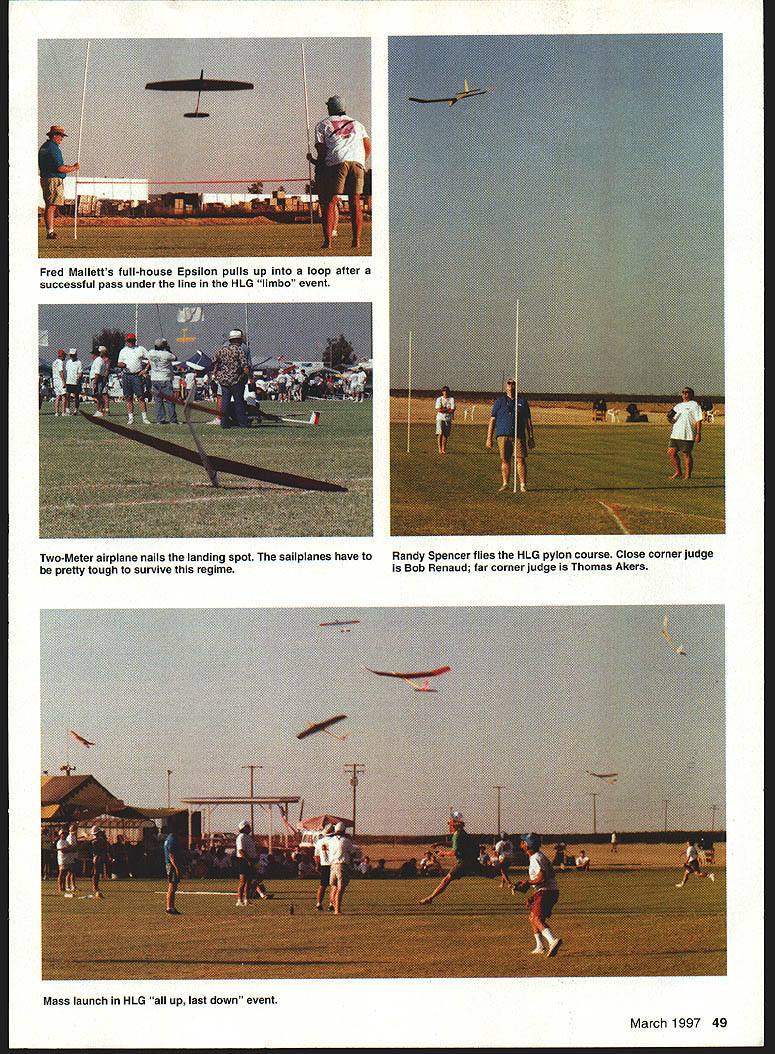
Starting at Friday night check-in, you could meet the legends and luminaries of the American RC sailplane scene. This year's list included three USA F3B Team pilots: Joe Wurts, Randy Spencer, and Gordon Jennings, with alternate pilot B.J. Weisman. Fred Mallett, last year's Visalia HLG winner, was also present.
Designers flying at the event included:
- Mark LeVoe (Super-V)
- Ben Clerx (Mako)
- Tom Finch (Vaquero)
- Keith Schwemer (Genesis)
- Bob Sliff (Sensor)
- Larry Jolly (LJMP)
- Rick Spicer (R&R Products)
- David Layne (David Layne Designs)
- Brian Laird (Slope Scale)
- Ed Slobod (Pierce Aero)
- Mark Hambleton (DCU)
- Chuck Anderson (winglets)
- Norm Timbs (winches)
Two dozen makers and suppliers of soaring products were present, as well as representatives from eight modeling publications.
The Main Event
The centerpiece of the Fall Soaring Festival was the Thermal Duration contest, though some top pilots also flew HLG. CVRC organized the competition into five classes to reduce congestion and intimidation.
Classes included:
- Open (Unlimited)
- Two‑Meter
- Nostalgia (old designs)
- Junior (by pilot age)
- Old Timer (by pilot age)
Thermal Duration Contest Director Phil Hill called four rounds on Saturday — three-, five-, seven-, and four-minute rounds — and three rounds on Sunday — three-, six-, and eight-minute rounds. Three-minute rounds? Yep — Soaring California style.
Airplanes blasted into the sky, streaked across the dirt to find lift over the cotton fields, and landed hot. The landing task was distinctive — a cross between shuffleboard and pinball: start at the triangle (base toward the airplane, apex toward the pilot) with rungs marked for differential point areas, plus a bonus circle a few feet beyond the triangle for the highest points. To get the top landing score you had to pass up the triangle and land in the circle. Miss the pie plate and you scored zero.
Both days presented downwind launches and downwind landings. AMA rules require the airplane to come to rest upright, so inverted landings were common. Hundreds of inverted landings happened; nobody complained — this is big fun. Skill and consistency count: many pilots walked the walk of shame into the cotton fields after venturing too far for lift. Joe Wurts won the Thermal Duration contest, flying an Airtronics Sapphire.
The Hand Launch Contest
The Hand Launch (HL) contest is notable for its innovation and spectacular flying. Skillfully CD'ed by Henry Bostick of the Soaring League of North Texas (and a CVRC member), the field of 50 HL contenders flew four unusual tasks. After each round the lowest-scoring pilots were cut.
Tasks included:
- Loop and 20-second flight with a hand-catch — run twice; failures were dropped.
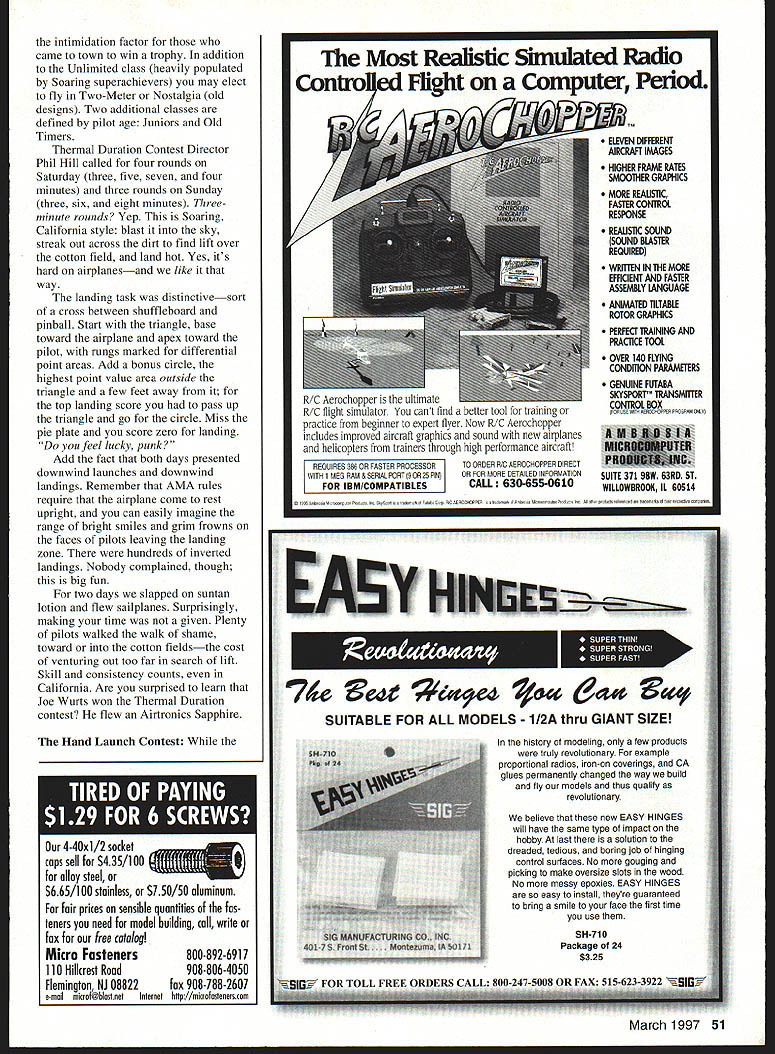
- All-Up, Last Down — last to land advances; early landings were scrubbed.
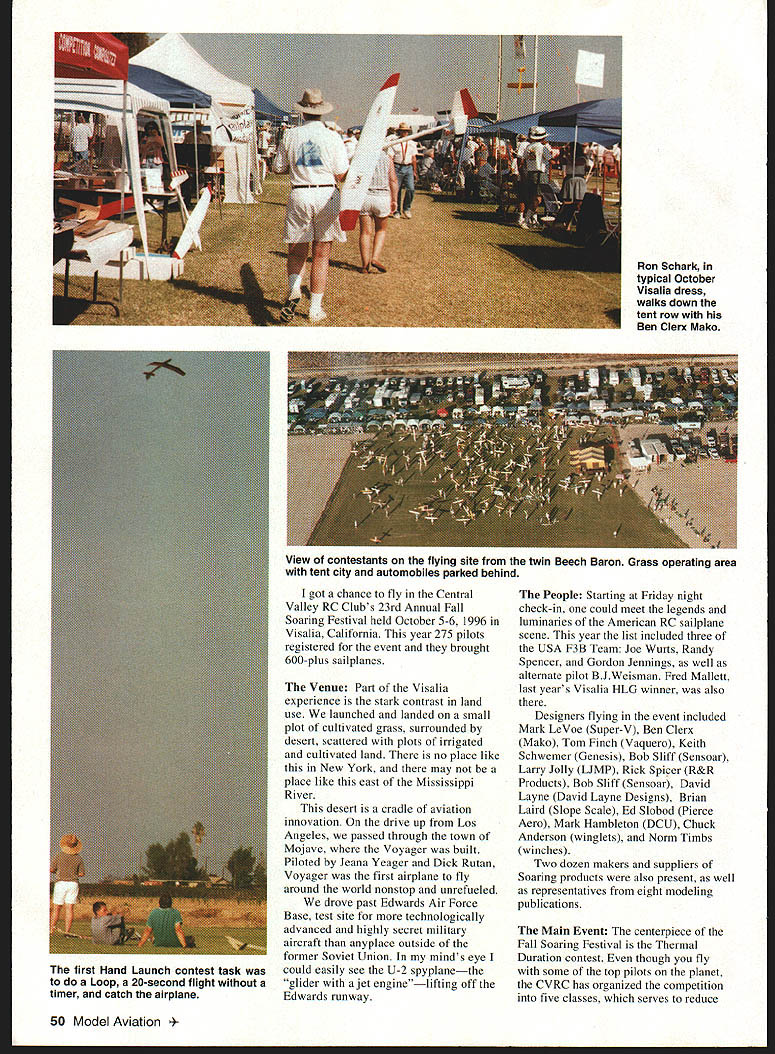
- Pylon course — launched inside a 100-foot square; judges at corners recorded legs completed; the pilot had to catch inside the square for the score to count.
- Limbo — an ever-lowering bar; flights repeated until only one pilot could fly under the line and still catch the airplane.
The limbo final allowed the best pilots to show their best moves. Most memorable was Fred Mallett launching his own-design Epsilon into an outside loop and then flying under the limbo line. Gordon Jennings won the HL contest flying an Airtronics Gem.
Festival Highlights
The Fall Soaring Festival really is a festival. Main street was lined with dozens of colorful tents and awnings, populated by makers, vendors, and soaring clubs. Hundreds of sailplanes, components, radios, and accessories were available for purchase. The commerce was lively and the opportunity to meet and exchange ideas with the folks who keep this sport going is one of the best parts of the Visalia experience.
Activities included:
- A catered barbecue dinner with wine-tasting
- Music by a Bluegrass band on the field
- Saturday evening demonstrations: hand launch, bungee launch, and electric flying
- A low morning flyby by a twin-engine Beech Baron, carrying camera-clicking journalists for a group photo
- A mega-raffle with hundreds of items (prizes included sailplanes, a mountain bike, a gas BBQ grill, a case of motor oil, and a state-of-the-art computer radio). Proceeds support the contest, maintain the field, and include a $1,000 donation to the Make-A-Wish Foundation
Movers and Shakers
You don't stage a gathering of this size without industrial-strength planning and a large crew of dedicated workers. The CVRC looked mighty sharp throughout the event.
Key volunteers:
- Launch director: Steve George and crew — presided over 1,900 launches
- Landing director: Jason George and crew — handled the same number of landings
- Raffle: Chris George
- Scoring: Harlan Collins
- Event Director: Phil Hill
Thanks to all named and unnamed volunteers.
Winners
Open
- Joe Wurts
- Greg Johns
- Steve Condon
- Keith Kindrick
- Arthur Markiewicz
Two‑Meter
- Jerry Robertson
- David Layne
- Brian Laird
- Geary Keilman
- Rick Shelby
Junior
- Ali Khani
- Thomas Akers
- Chris Jolly
Old Timer
- Keith Finkenbiner
- Nick Buzolich
- Ron Brown
- Don Vickers
- Jerry Keenan
Nostalgia
- Don McNamee
- Bob Sliff
- Phil Bauer
- David Farless
- Mike Clancy
Dave Garwood 5 Birch Ln. Scotia, NY 12302
Transcribed from original scans by AI. Minor OCR errors may remain.

