
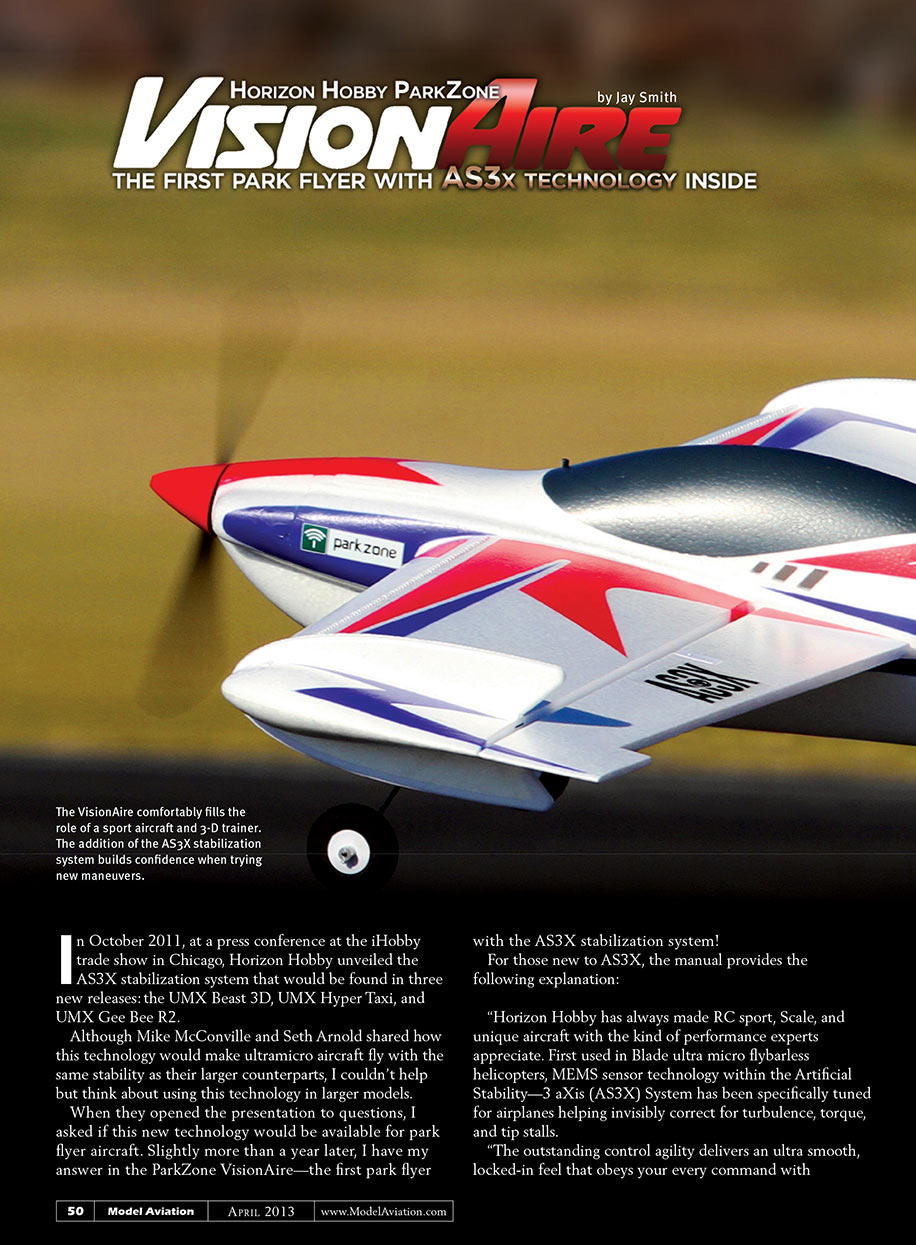
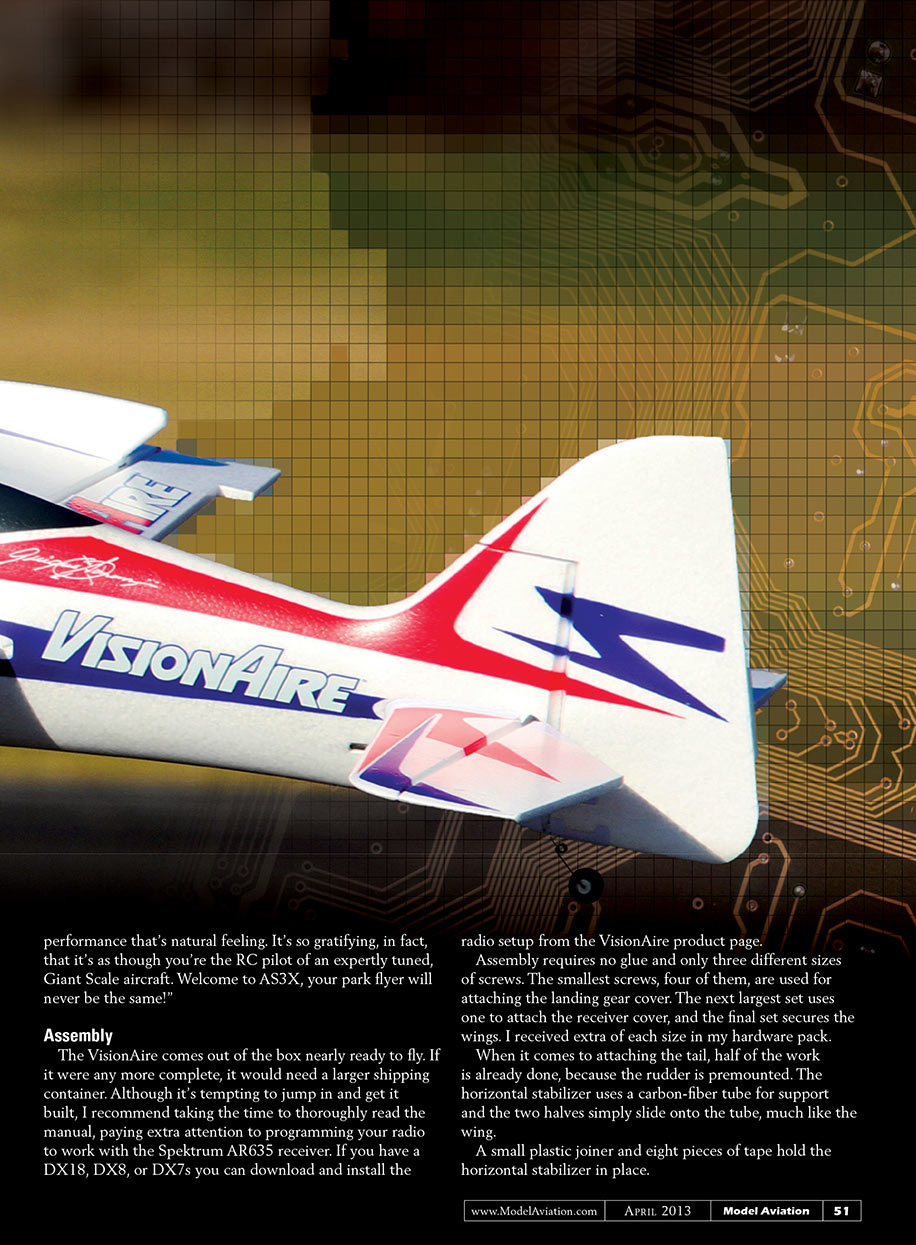
VisionAire
by Jay Smith
In October 2011, at a press conference at the iHobby trade show in Chicago, Horizon Hobby unveiled the AS3X stabilization system that would be found in three new releases: the UMX Beast 3D, UMX Hyper Taxi, and UMX Gee Bee R2.
Although Mike McConville and Seth Arnold explained how this technology would make ultra-micro aircraft fly with the same stability as their larger counterparts, I couldn't help but think about using this technology in larger models.
When they opened the presentation to questions, I asked if this new technology would be available for park flyer aircraft. Slightly more than a year later, I have my answer in the ParkZone VisionAire—the first park flyer with the AS3X stabilization system!
For those new to AS3X, the manual provides the following explanation:
"Horizon Hobby has always made RC sport, scale, and unique aircraft with the kind of performance experts appreciate. First used in Blade ultra-micro flybarless helicopters, MEMS sensor technology within the Artificial Stability—3-aXis (AS3X) System has been specifically tuned for airplanes, helping invisibly correct for turbulence, torque, and tip stalls.
"The outstanding control agility delivers an ultra-smooth, locked-in feel that obeys your every command with performance that's natural feeling. It's so gratifying, in fact, that it's as though you're the RC pilot of an expertly tuned, Giant Scale aircraft. Welcome to AS3X; your park flyer will never be the same!"
Assembly
The VisionAire comes out of the box nearly ready to fly. If it were any more complete, it would need a larger shipping container. Although it's tempting to jump in and get it built, I recommend taking the time to thoroughly read the manual, paying extra attention to programming your radio to work with the Spektrum AR635 receiver. If you have a DX18, DX8, or DX7s you can download and install the radio setup from the VisionAire product page.
Assembly requires no glue and only three different sizes of screws.
- The smallest screws (four) are used for attaching the landing-gear cover.
- The next-largest set uses one screw to attach the receiver cover.
- The largest set secures the wings.
I received extra of each size in the hardware pack.
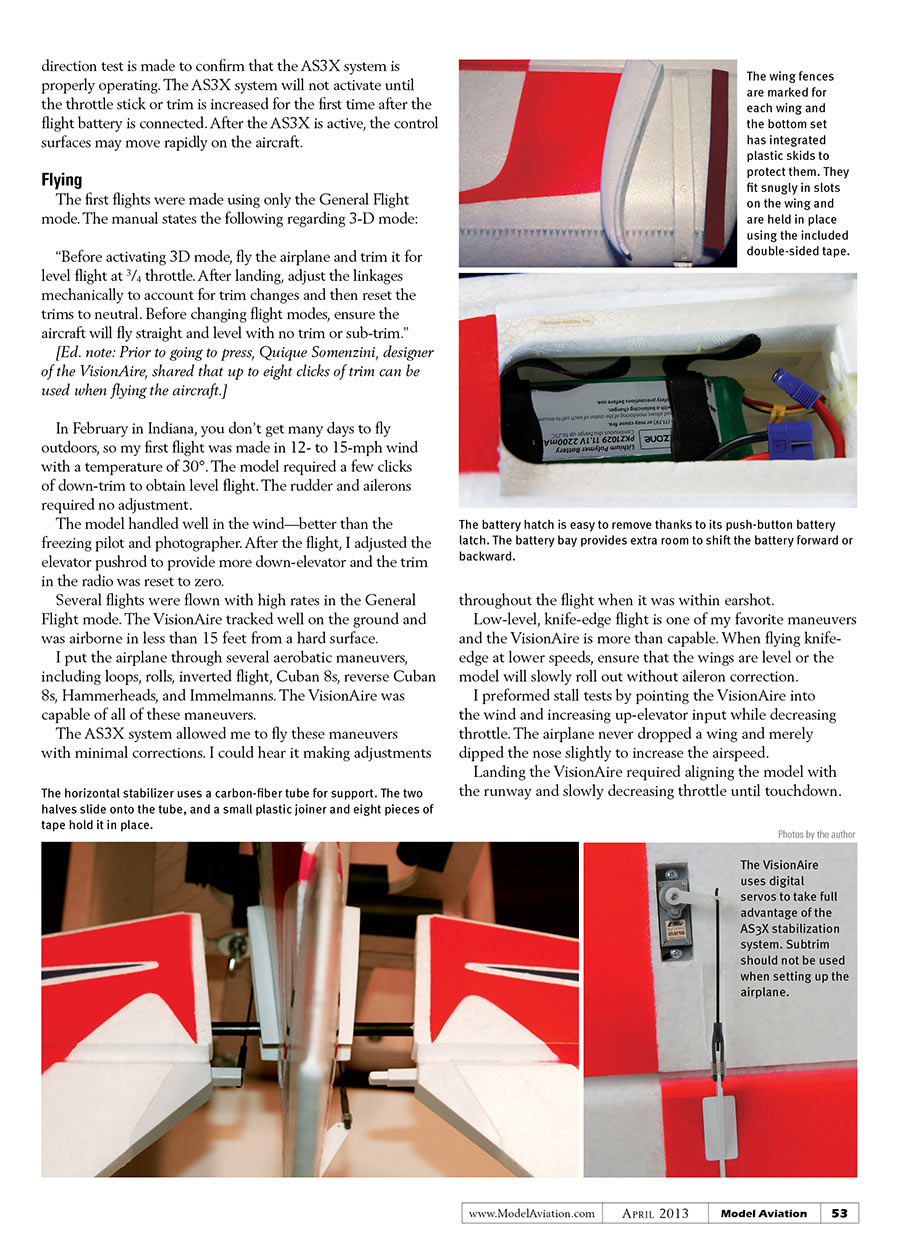
When it comes to attaching the tail, half of the work is already done because the rudder is premounted. The horizontal stabilizer uses a carbon-fiber tube for support and the two halves simply slide onto the tube, much like the wing. A small plastic joiner and eight pieces of tape hold the horizontal stabilizer in place.
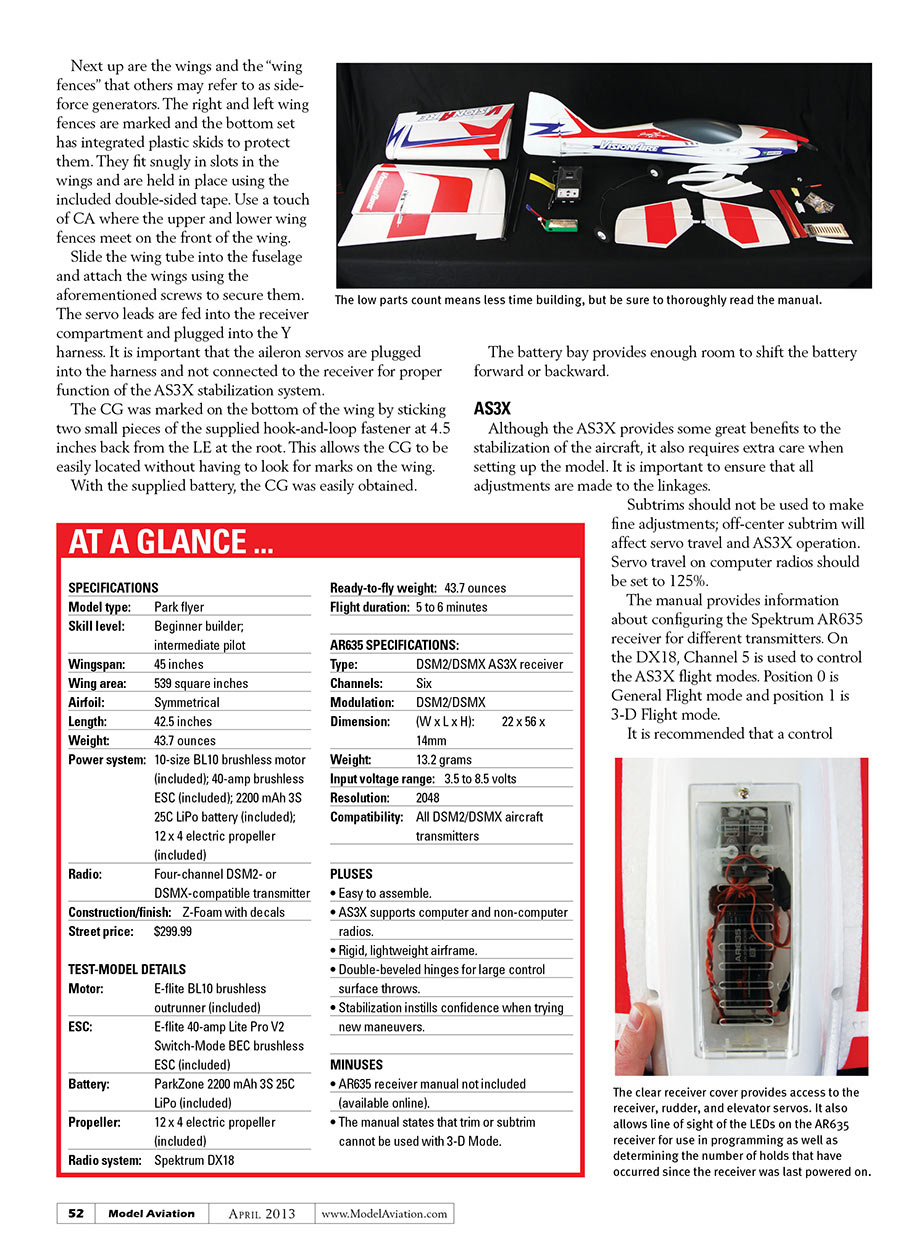
The clear receiver cover provides access to the receiver, rudder, and elevator servos. It also allows line of sight to the LEDs on the AR635 receiver for programming and for determining the number of holds that have occurred since the receiver was last powered on.
Next are the wings and the "wing fences" (also called side-force generators). The right and left wing fences are marked and the bottom set has integrated plastic skids to protect them. They fit snugly in slots in the wings and are held in place using the included double-sided tape. Use a touch of CA where the upper and lower wing fences meet at the front of the wing. Slide the wing tube into the fuselage and attach the wings using the screws mentioned above. The servo leads are fed into the receiver compartment and plugged into the Y-harness.
Important: the aileron servos must be plugged into the harness and not directly into the receiver for proper function of the AS3X stabilization system.
The CG was marked on the bottom of the wing by sticking two small pieces of the supplied hook-and-loop fastener at 4.5 inches back from the leading edge at the root. This allows the CG to be easily located without having to search for marks on the wing. With the supplied battery, the CG was easily obtained. The battery bay provides enough room to shift the battery forward or backward.
AS3X
Although AS3X provides great benefits to the stabilization of the aircraft, it also requires extra care when setting up the model. It is important to ensure that all adjustments are made mechanically to the linkages.
- Do not use subtrim to make fine adjustments; off-center subtrim will affect servo travel and AS3X operation.
- Servo travel on computer radios should be set to 125%.
The manual includes information about configuring the Spektrum AR635 receiver for different transmitters. On the DX18, Channel 5 is used to control the AS3X flight modes: position 0 is General Flight mode and position 1 is 3-D Flight mode.
It is recommended that a control-direction test be made to confirm that the AS3X system is properly operating. The AS3X system will not activate until the throttle stick or trim is increased for the first time after the flight battery is connected. After AS3X is active, the control surfaces may move rapidly on the aircraft.
Flying
The first flights were made using only General Flight mode. The manual states the following regarding 3-D mode:
"Before activating 3D mode, fly the airplane and trim it for level flight at 3/4 throttle. After landing, adjust the linkages mechanically to account for trim changes and then reset the trims to neutral. Before changing flight modes, ensure the aircraft will fly straight and level with no trim or sub-trim."
(Ed. note: Prior to going to press, Quique Somenzini, designer of the VisionAire, shared that up to eight clicks of trim can be used when flying the aircraft.)
In February in Indiana, you don't get many days to fly outdoors, so my first flight was made in 12–15 mph wind with a temperature of 30°F. The model required a few clicks of down trim to obtain level flight. The rudder and ailerons required no adjustment.
The model handled well in the wind—better than the freezing pilot and photographer. After the flight, I adjusted the elevator pushrod to provide more down elevator and reset the trim in the radio to zero.
Several flights were flown with high rates in General Flight mode. The VisionAire tracked well on the ground and was airborne in less than 15 feet from a hard surface.
I put the airplane through several aerobatic maneuvers, including loops, rolls, inverted flight, Cuban 8s, reverse Cuban 8s, hammerheads, and Immelmanns. The VisionAire was capable of all of these maneuvers. The AS3X system allowed me to fly these maneuvers with minimal corrections. I could hear it making adjustments throughout the flight when it was within earshot.
Low-level knife-edge flight is one of my favorite maneuvers and the VisionAire is more than capable. When flying knife-edge at lower speeds, ensure that the wings are level or the model will slowly roll out without aileron correction.
I performed stall tests by pointing the VisionAire into the wind and increasing up-elevator input while decreasing throttle. The airplane never dropped a wing and merely dipped the nose slightly to increase airspeed.
Landing the VisionAire required aligning the model with the runway and slowly decreasing throttle until touchdown. I like to keep a little power all the way to touchdown so that the control surfaces remain responsive.
3-D Flight
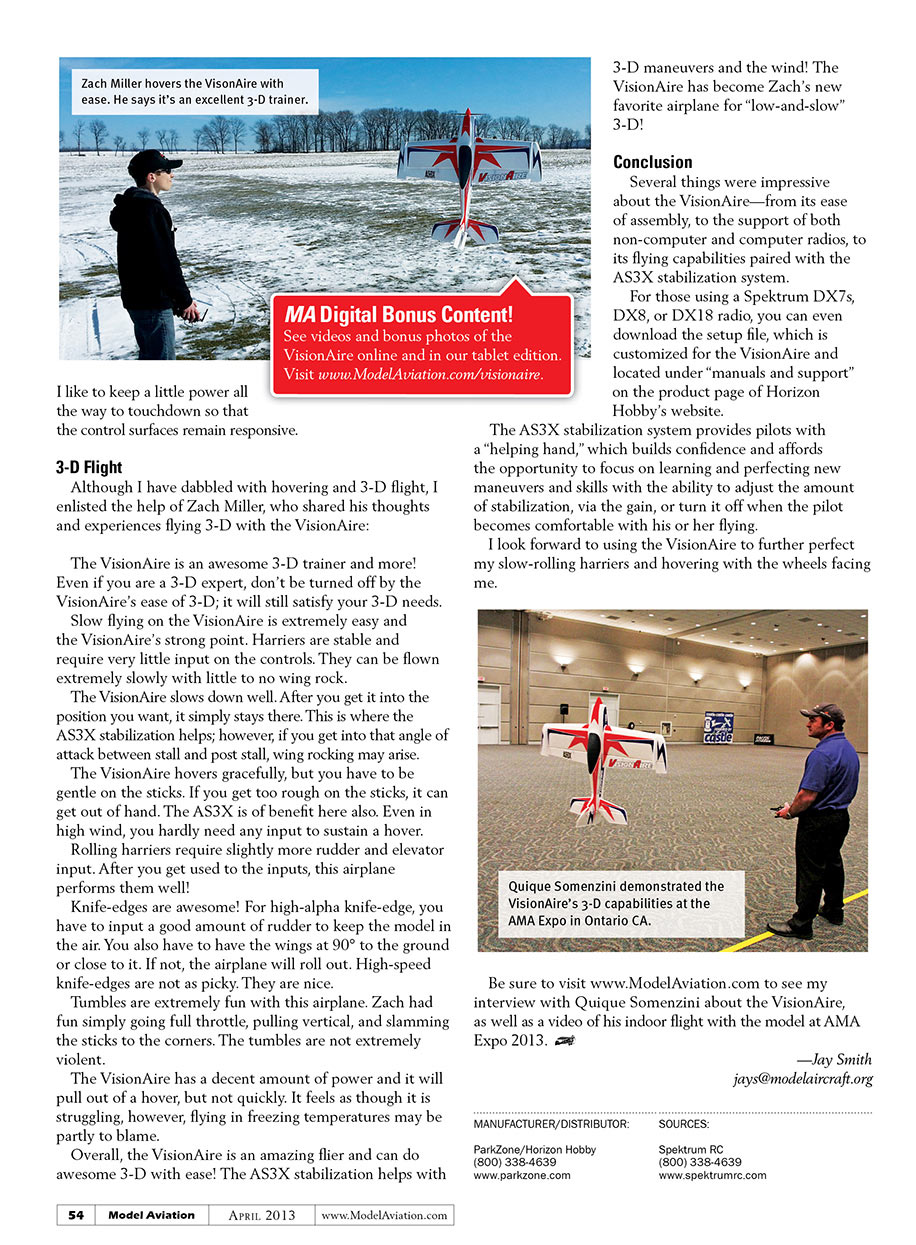
I enlisted the help of Zach Miller, who shared his thoughts and experiences flying 3-D with the VisionAire:
- The VisionAire is an excellent 3-D trainer and more. Even if you are a 3-D expert, don't be turned off by the VisionAire's ease of 3-D; it will still satisfy your 3-D needs.
- Slow flying on the VisionAire is extremely easy. Harriers are stable and require very little input on the controls. They can be flown extremely slowly with little to no wing rock.
- The VisionAire slows down well. After you get it into the position you want, it simply stays there. This is where AS3X stabilization helps; however, if you get into that angle of attack between stall and post-stall, wing rocking may arise.
- The VisionAire hovers gracefully, but you have to be gentle on the sticks. If you're too rough, it can get out of hand. AS3X helps a lot here—even in high wind, you hardly need any input to sustain a hover.
- Rolling harriers require slightly more rudder and elevator input. After you get used to the inputs, this airplane performs them well.
- Knife-edges are excellent. For high-alpha knife-edge, you must input a good amount of rudder to keep the model in the air, and you should have the wings at or close to 90° to the ground. If not, the airplane will roll out. High-speed knife-edges are less picky.
- Tumbles are extremely fun. Full throttle, pull vertical, and slam the sticks to the corners—the tumbles are not extremely violent.
- The VisionAire has a decent amount of power and will pull out of a hover, but not quickly. It may feel as though it is struggling; freezing temperatures may be partly to blame.
Overall, the VisionAire is an amazing flier and can do outstanding 3-D with ease. The AS3X stabilization helps with 3-D maneuvers and handling in the wind. The VisionAire has become Zach's new favorite airplane for "low-and-slow" 3-D.
Conclusion
Several things impressed me about the VisionAire—from its ease of assembly, to the support of both non-computer and computer radios, to its flying capabilities paired with the AS3X stabilization system.
For those using a Spektrum DX7s, DX8, or DX18 radio, you can download the setup file customized for the VisionAire from the "Manuals and Support" section on the product page at Horizon Hobby's website.
The AS3X stabilization system provides pilots with a "helping hand," which builds confidence and affords the opportunity to focus on learning and perfecting new maneuvers and skills. You can adjust the amount of stabilization via the gain or turn it off when the pilot becomes comfortable.
I look forward to using the VisionAire to further perfect my slow-rolling harriers and hovering with the wheels facing me.
Be sure to visit www.ModelAviation.com to see my interview with Quique Somenzini about the VisionAire, as well as a video of his indoor flight with the model at AMA Expo 2013.
— Jay Smith jays@modelaircraft.org
Manufacturer / Distributor
- ParkZone / Horizon Hobby
- (800) 338-4639
- www.parkzone.com
Sources
- Spektrum R/C
- (800) 338-4639
- www.spektrumrc.com
Transcribed from original scans by AI. Minor OCR errors may remain.

