
VISION - PARTNERSHIP OF YOUTH AND COMMUNITY
By Leo Greenwald
Glimmers of Hope
As Los Angeles and surrounding communities experienced some of the darkest moments in their histories last April, two men of vision and a small group from the Compton Tail Spinners R/C Club were working with students from two archrival high schools in the nearby Orange County city of Anaheim. They were putting the finishing touches on a seven-month Saturday Enrichment Academy that gave young people academic and practical experience in aerodynamics, engineering, and model building.
The program was the brainchild of Charles Kelley and his longtime friend Prentiss Ellis, assistant principal at Savanna High School. It culminated in what quickly became known as the first annual Top Gun Competition between Magnolia and Savanna High Schools.
Kelley and Ellis submitted a plan for the Saturday Enrichment Academy in 1992 and convinced the Anaheim Union School District that the program would enrich students by providing academic and practical knowledge as well as social skills to help them in school and later in life.
Community and Industry Support
The Compton Tail Spinners agreed to help the academy by purchasing equipment; additional donations came from industry and hobby shops:
- Compton Tail Spinners: K&B .40 engines and general support
- Joe Bridi: donated two Bridi 4-Seasons .40 trainer kits
- Airtronics and Futaba: each donated a radio
- John Eaton (The Model Center, Gardena): technical and professional support for Savanna students
- Larry Wolfe (Jet Hangar Hobbies, Hawaiian Gardens): support for Magnolia students
Special thanks to these generous people and organizations.
Student Commitment and Program Structure
Twenty-five interested students were required to commit to attend the academy; parents were asked to guarantee transportation and support to keep students enrolled.
The plan for the academy was twofold:
- Students built kit airplanes of a single-group design, built original trainers, and competed in a fly-off competition. Kelley and Ellis, despite limited backgrounds in aerodynamics, prepared weekly academic materials and handouts so students could reach the design goals and pass an oral quiz on aerodynamics at Top Gun.
- Students participated in practical demonstrations and heard guest speakers to broaden their exposure to aeromodelling and related careers.
Guest speakers and demonstrations included the California Air Show Team (CAST) and RC demonstrations featuring ducted fans provided by Jet Hangar Hobbies. Students viewed videotape and a special-effects movie on RC ducted fans. Interest levels were high, and students asked intelligent questions about the principles of flight.
By March 1 the kit trainers were finished and MonoKoted in the schools' respective colors, leaving limited time to complete Phase II: the original aircraft designs.
Design Phase
Excitement built as students from the two schools worked in separate classrooms under a seal of secrecy to apply their newly acquired aerodynamics knowledge. Rules for the original models were given: length, wingspan, high wing, and tricycle gear.
- Under John Eaton’s guidance, Savanna students chose a Göttingen 398 airfoil for the wing.
- Larry Wolfe’s Magnolia group chose a modified Clark Y with a Phillips entry leading edge.
Because of time constraints, students completed full-size drawings of the aircraft in about two weeks. The Compton Tail Spinners then built the models.
Graduation and Top Gun Competition
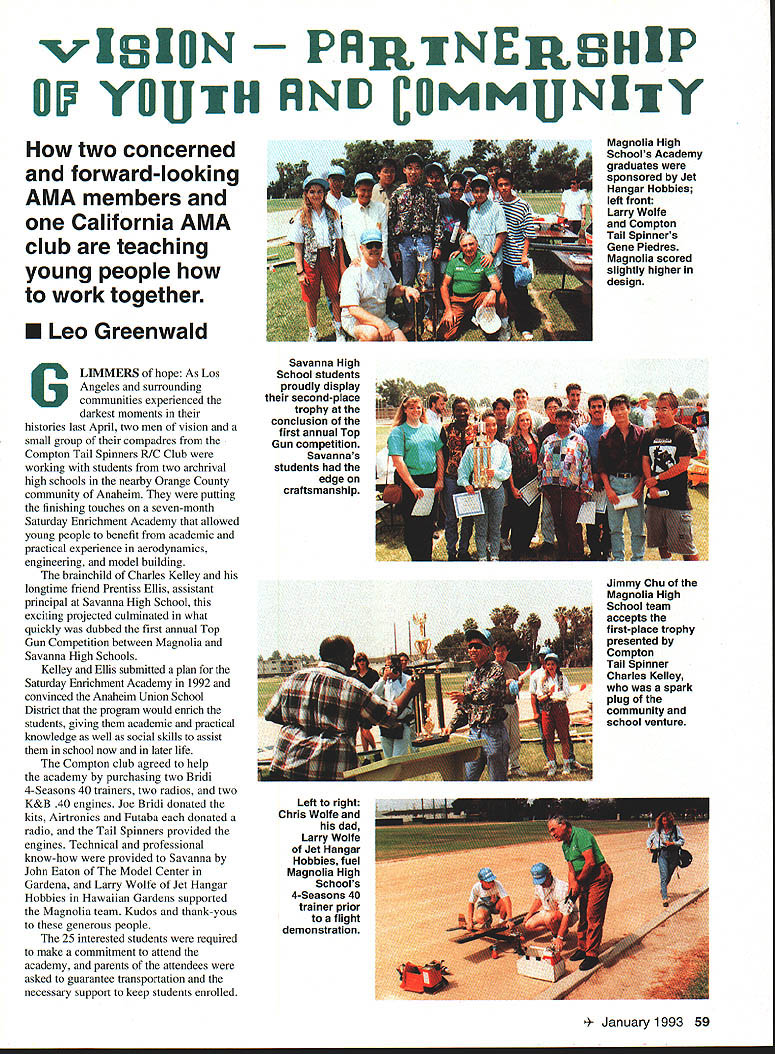
The graduation ceremony for the Saturday Enrichment Academy took place Friday, May 22, 1992, at Savanna High School. The question “Would we do it again?” was answered overwhelmingly in the affirmative.
On May 22, 1992, both teams made last-minute preparations, applying emblems and MonoKote and worrying about weight and flight performance. Neither team wanted to fail; it was a matter of pride.
Attendance by parents, school dignitaries, student spectators, modelers, hobby industry representatives, and aerospace professionals was heartwarming. The event received coverage in three local newspapers and on local television.
Charles Kelley arranged additional flight demonstrations and static displays:
- The Soaring Union of Los Angeles (SULA) flew two gliders.
- The California Air Show Team provided a helicopter demonstration.
- Jerry Kitchin flew a giant-scale F4U Corsair with smoke.
The activities began with John Eaton and Larry Wolfe flying the Bridi 4-Seasons trainers to the applause of onlooking students.
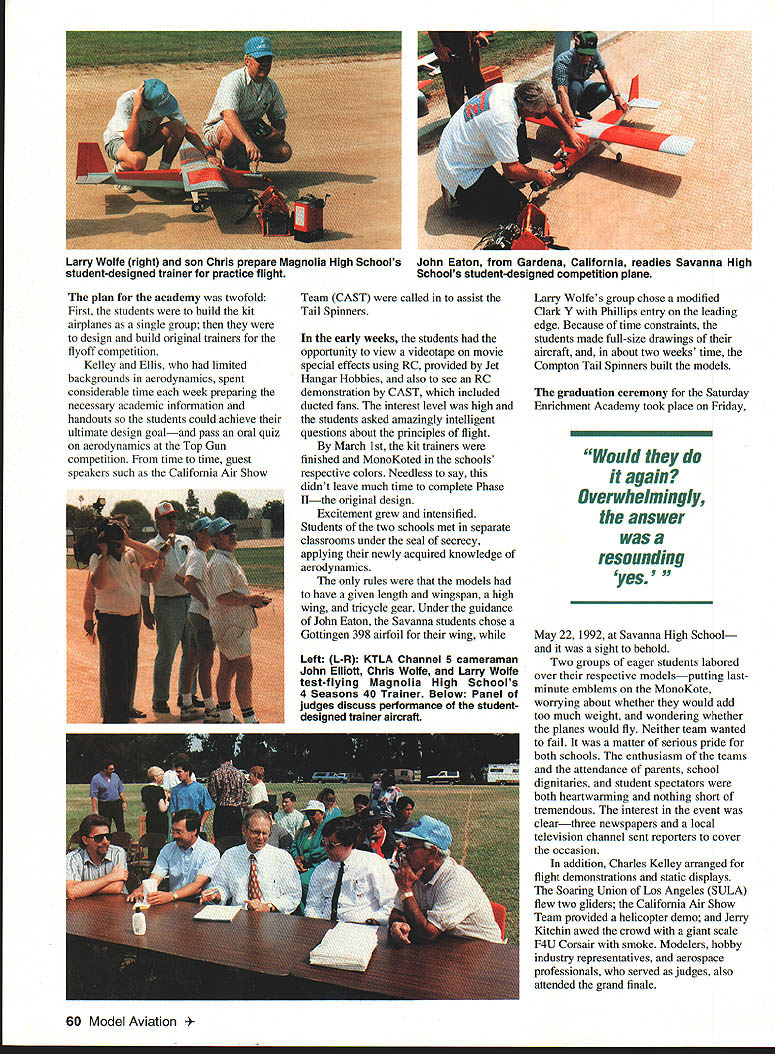
Then the competition began. Judges quizzed each group on aerodynamics topics covered in the Saturday classes; neither group incurred deductions. The original aircraft were judged on design (Magnolia scored slightly higher) and craftsmanship (Savanna had the edge). Going into the flight competition, the schools' scores were tied.
Pilots flew required maneuvers as announced by John Elliot of Cox Hobbies. Magnolia’s plane, flown by Larry Wolfe, performed a loop, a slow roll, a half-throttle figure eight, an Immelmann, a slow-speed flyby, full-throttle acceleration, and a landing. John Eaton then flew the red-and-gray Savanna aircraft, executing the same maneuvers to cheers from his group.
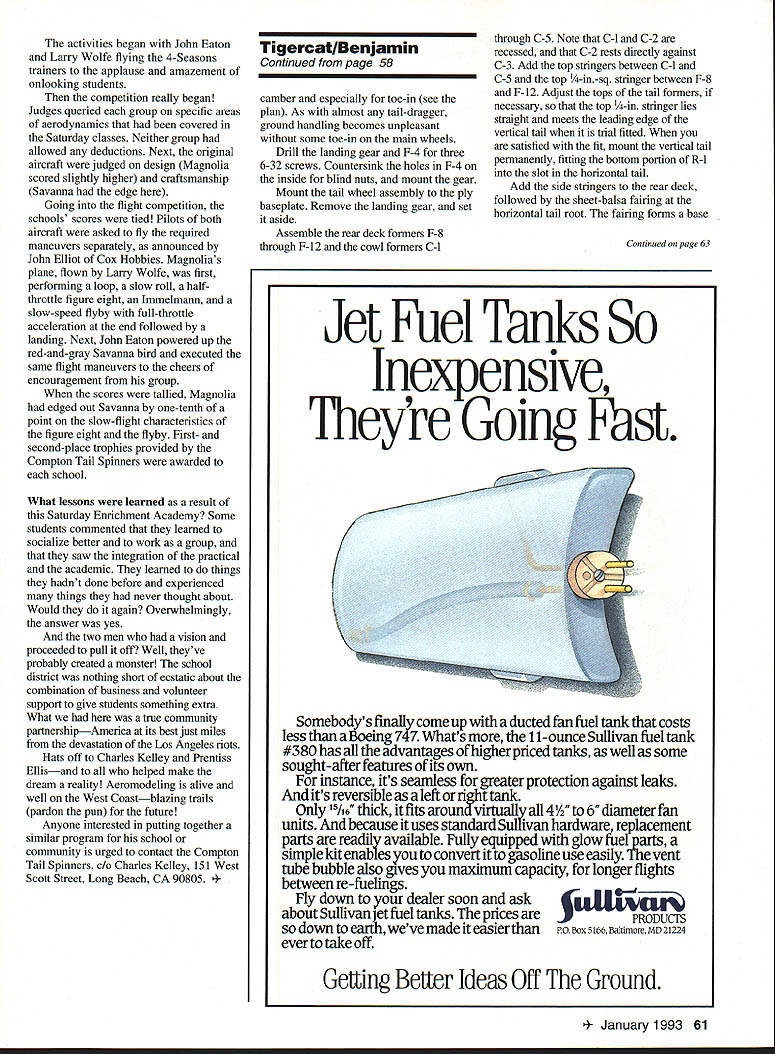
When scores were tallied, Magnolia edged out Savanna by one-tenth of a point on slow-flight characteristics in the figure eight and the flyby. First- and second-place trophies provided by the Compton Tail Spinners were awarded to each school.
Lessons Learned and Legacy
Students reported they had learned to socialize better, to work as a group, and to integrate practical and academic knowledge. They experienced activities they had never tried before and discovered new interests. When asked if they would do it again, the answer was overwhelmingly yes.
The school district was ecstatic about the combination of business and volunteer support. What emerged was a true community partnership—an example of America at its best, just miles from the devastation of the Los Angeles riots.
Hats off to Charles Kelley and Prentiss Ellis—and to all who helped make the dream a reality. Aeromodeling is alive and well on the West Coast, blazing trails for the future.
Contact
Anyone interested in creating a similar program for their school or community is urged to contact the Compton Tail Spinners: Charles Kelley 1517 West Scott Street Long Beach, CA 90805
Transcribed from original scans by AI. Minor OCR errors may remain.

