
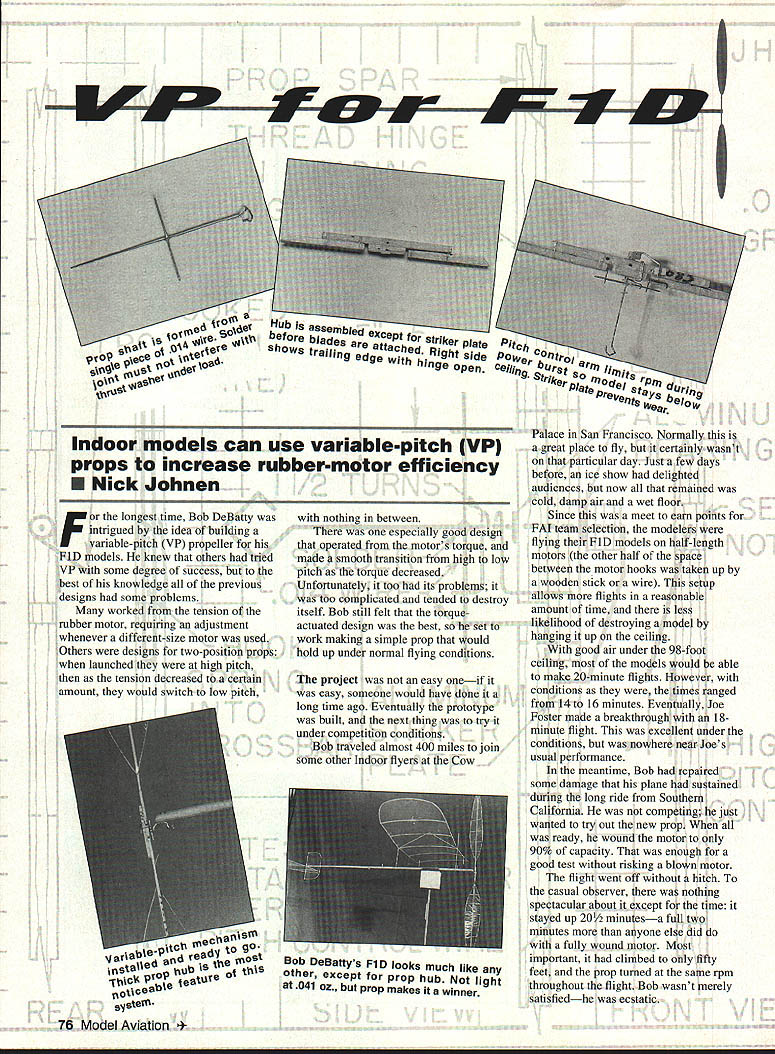
VP for F1D
Nick Johnen
Background
For the longest time, Bob DeBatty was intrigued by the idea of building a variable-pitch (VP) propeller for his F1D models. He knew that others had tried VP with some degree of success, but all of the previous designs had shortcomings. Many relied on rubber tension and required adjustment when a different-size motor was used. Others were two-position props: high pitch at launch, then a sudden switch to low pitch as tension decreased, with nothing in between.
There was one especially good design that operated from the motor's torque and made a smooth transition from high to low pitch as torque decreased. Unfortunately, it was too complicated and tended to destroy itself. Bob felt the torque-actuated concept was the best, so he worked to make a simple prop that would hold up under normal flying conditions.
Competition test at the Cow Palace
Bob traveled almost 400 miles to join other indoor flyers at the Cow Palace in San Francisco. A few days earlier an ice show had left the building cold and damp; the floor was wet and the air unhelpful. Since the meet was for FAI team selection points, modelers were flying their F1D models on half-length motors (the other half of the space between motor hooks was taken up by a wooden stick or wire). This allowed more flights and reduced the risk of destroying a model by hanging it on the ceiling.
With good air under the 98-foot ceiling, most models would normally make 20-minute flights. Under the poor conditions that day, times ranged from 14 to 16 minutes; Joe Foster managed an 18-minute flight, excellent for the day but below his usual performance.
Bob was not competing; he wanted only to try out the new prop. After repairing some damage from the long ride, he wound the motor to 90% of capacity—enough to test without risking a blown motor. The flight went off without a hitch: the model stayed aloft 20-1/2 minutes, two full minutes longer than anyone else achieved with a fully wound motor. Most important, it climbed only to about fifty feet and the prop turned at the same rpm throughout the flight. Bob was ecstatic.
Design and mechanism
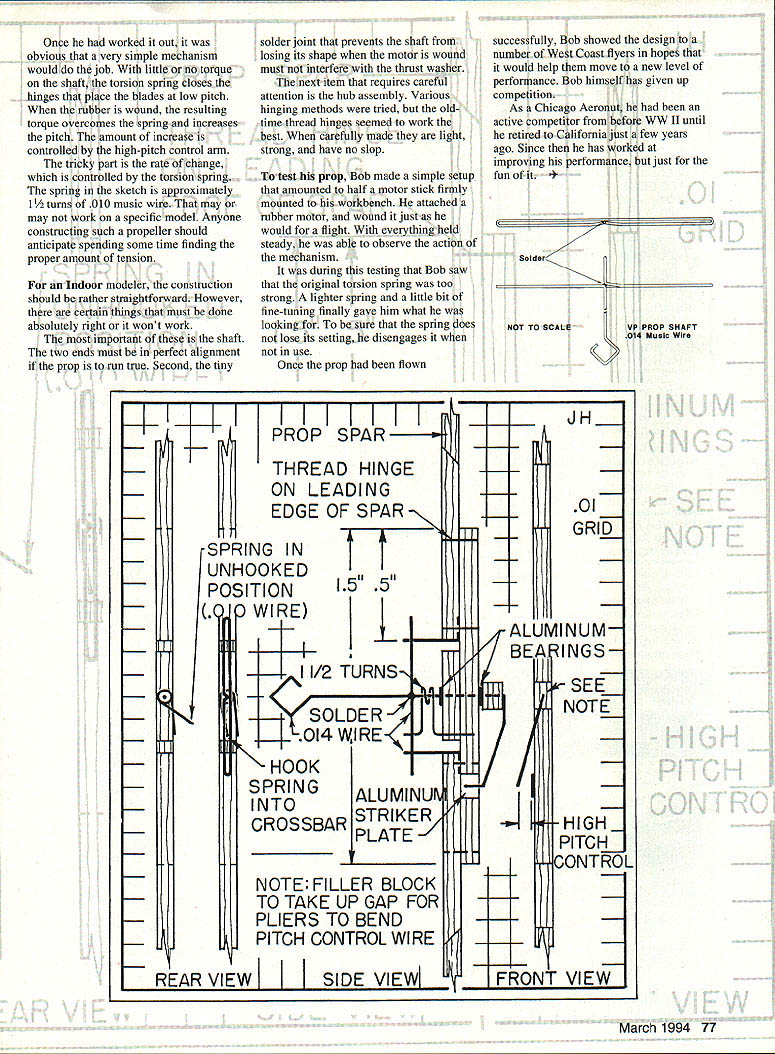
Once worked out, the mechanism proved very simple. Key features:
- A torsion spring holds the hinges closed, placing the blades at low pitch when there is little or no torque on the shaft.
- When the rubber is wound, the resulting torque overcomes the spring and increases the blade pitch.
- The amount of pitch increase is controlled by a high-pitch control arm.
- The rate of change (how the pitch moves from high to low as torque decreases) is controlled by the torsion spring.
The spring shown in the sketch is approximately 1-1/2 turns of .010 music wire. This dimension may not work on every model; constructing such a propeller typically requires time spent finding the proper amount of spring tension.
Construction details
For an indoor modeler the construction is straightforward, but certain details must be done absolutely right:
- Shaft alignment: The two shaft ends must be in perfect alignment so the prop runs true.
- Solder joint: A tiny solder joint prevents the shaft from losing its shape when the motor is wound; it must not interfere with the thrust washer.
- Motor wind: Ensure the motor wind does not interfere with the thrust washer.
- Hub assembly and hinges: Various hinging methods were tried; old-time thread hinges worked best. When carefully made they are light, strong and have no slop.
Testing and tuning
Bob made a simple test setup: half a motor stick firmly mounted to his workbench with a rubber motor attached and wound just as for flight. With everything held steady he observed the mechanism in action.
- During testing he found the original torsion spring was too strong.
- A lighter spring, with a bit of fine-tuning, produced the desired behavior.
- Be sure the spring does not lose its setting; Bob disengages it when not in use.
Anyone constructing such a prop should anticipate some trial and error to find the proper spring tension and settings.
Aftermath and notes on Bob DeBatty
Once the prop was flown successfully, Bob showed the design to a number of West Coast flyers in hopes it would help move models to a new level of performance. Bob himself has given up competition. As a Chicago Aeronut, he had been an active competitor from before WWII until retiring to California a few years ago. Since then he has worked on improving performance for fun.
Transcribed from original scans by AI. Minor OCR errors may remain.

