
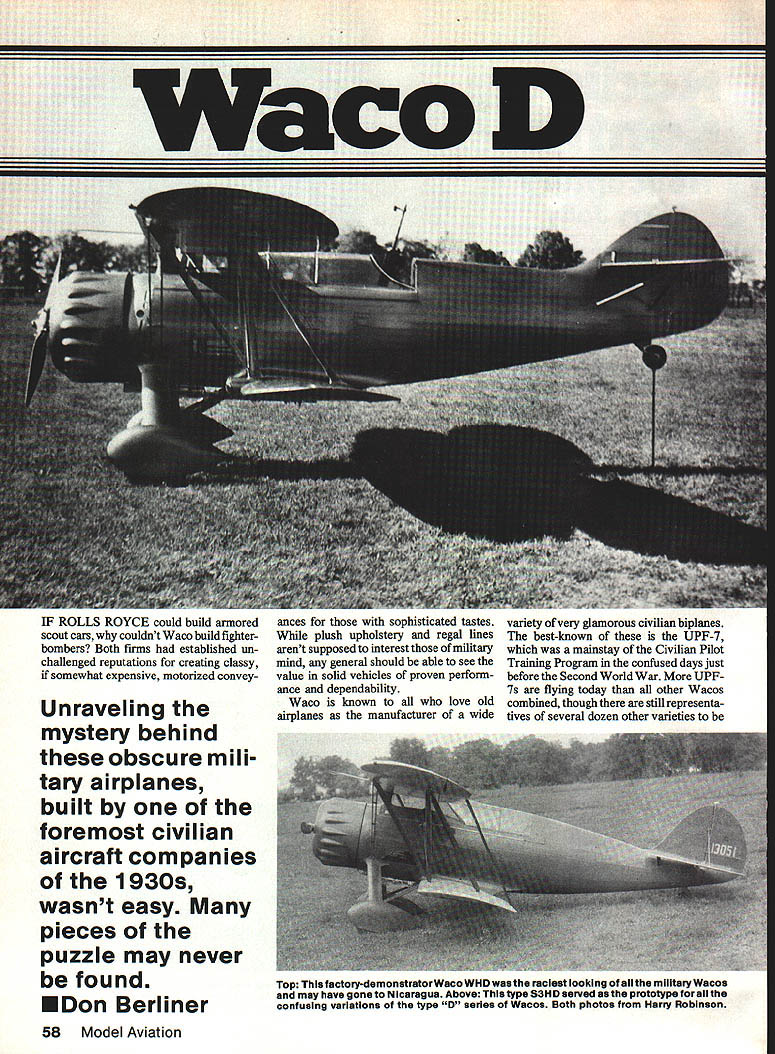
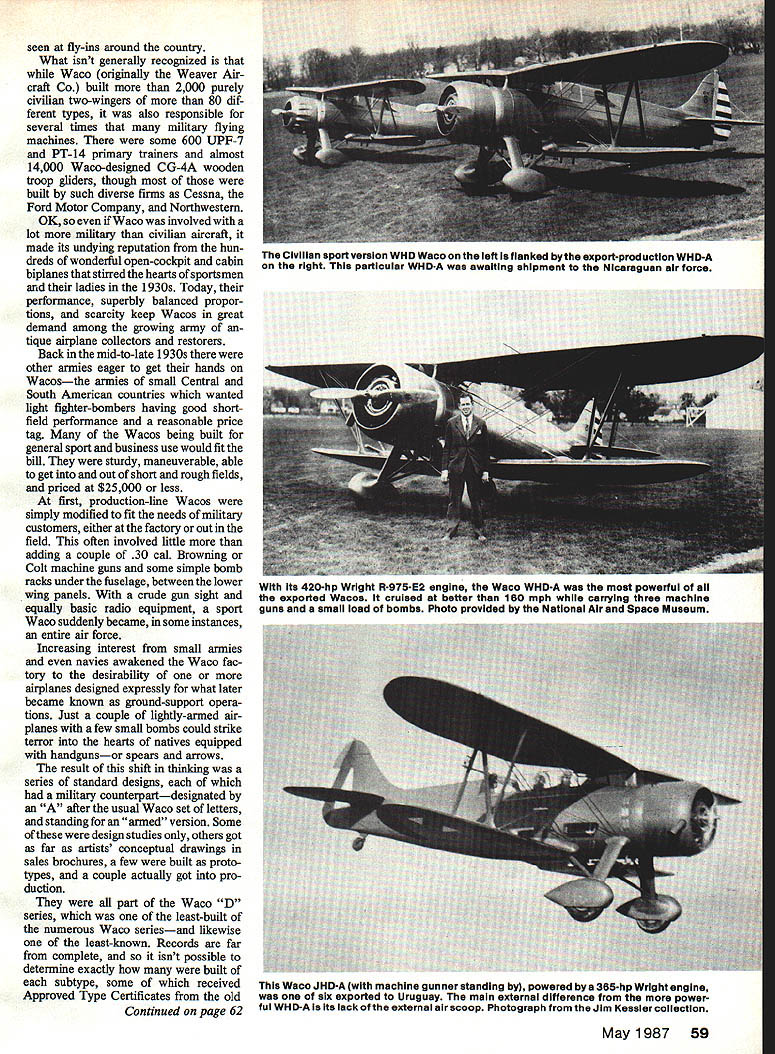
Waco D
If Rolls-Royce could build armored scout cars, why couldn't Waco build fighter-bombers? Both firms had established unchallenged reputations for creating classy, if somewhat expensive, motorized conveyances for those with sophisticated tastes. While plush upholstery and regal lines aren't supposed to interest those of military mind, any general should be able to see the value in solid vehicles of proven performance and dependability.
Waco: civilian reputation and military work
Waco is known to all who love old airplanes as the manufacturer of a wide variety of very glamorous civilian biplanes. The best-known of these is the UPF-7, which was a mainstay of the Civilian Pilot Training Program in the confused days just before the Second World War. More UPF-7s are flying today than all other Wacos combined, though there are still representatives of several dozen other varieties to be found.
What isn't generally recognized is that while Waco (originally the Weaver Aircraft Co.) built more than 2,000 purely civilian two‑wingers of more than 80 different types, it was also responsible for several times that many military flying machines. There were some 600 UPF-7 and PT-14 primary trainers and almost 14,000 Waco-designed CG-4A wooden troop gliders, though most of those were built by such diverse firms as Cessna, the Ford Motor Company, and Northwestern.
Waco made its undying reputation from the hundreds of wonderful open-cockpit cabin biplanes that stirred the hearts of sportsmen and their ladies in the 1930s. Today, their performance, superbly balanced proportions, and scarcity keep Wacos in great demand among the growing army of antique-airplane collectors and restorers.
Back in the mid-to-late 1930s there were other armies eager to get their hands on Wacos — the armies of small Central and South American countries which wanted light fighter-bombers having good short-field performance and a reasonable price tag. Many of the Wacos being built for general sport and business use would fit the bill: they were sturdy, maneuverable, able to get into and out of short and rough fields, and priced at $25,000 or less.
Civilian Wacos adapted for military roles
At first, production-line Wacos were simply modified to fit the needs of military customers, either at the factory or out in the field. This often involved little more than adding a couple of .30-cal. Browning or Colt machine guns and some simple bomb racks under the fuselage, between the lower wing panels. With a crude gun sight and equally basic radio equipment, a sport Waco suddenly became, in some instances, an entire air force.
Increasing interest from small armies and even navies awakened the Waco factory to the desirability of one or more airplanes designed expressly for what later became known as ground-support operations. Just a couple of lightly armed airplanes with a few small bombs could strike terror into the hearts of natives equipped with handguns — or spears and arrows.
The result of this shift in thinking was a series of standard designs, each of which had a military counterpart — designated by an "A" after the usual Waco set of letters, standing for an "armed" version. Some of these were design studies only, others reached artists' conceptual drawings in sales brochures, a few were built as prototypes, and a couple actually went into production.
The D series overview
The Waco "D" series was one of the least-built and least-known of the numerous Waco series. Records are far from complete, and it isn't possible to determine exactly how many were built of each subtype; some of the subtypes received Approved Type Certificates from the old Civil Aeronautics Authority. Of the at least 10 airplanes built of the various D models, only one is known to exist today — the sole S3HD Super Sport manufactured in 1934.
S3HD Super Sport (1934)
The sole S3HD Super Sport was manufactured in 1934 for a businessman who kept the airplane until 1951. It passed through owners until being acquired by antiquarian John Church in 1963, by which time it was thoroughly dilapidated. A full restoration job was completed in less than a year, and the gleaming yellow-and-black airplane can still be seen at fly-ins around the country.
- Engine: 400-hp Pratt & Whitney Wasp Jr. TB
- Top speed: 180 mph
- Normal cruising speed: 150 mph
- Initial rate-of-climb: 1,350 ft./min.
- Upper (longer) wingspan: 32 ft. 8 in.
- Length: 25 ft.
- Height: 8 ft. 11½ in.
- Empty weight: 2,130 lb.
- Gross weight: 3,800 lb.
- New price (when new): $18,395
When new it sold for just $18,395; today, even in poor condition, one would bring several times that much.
S3HD-A: armed variant
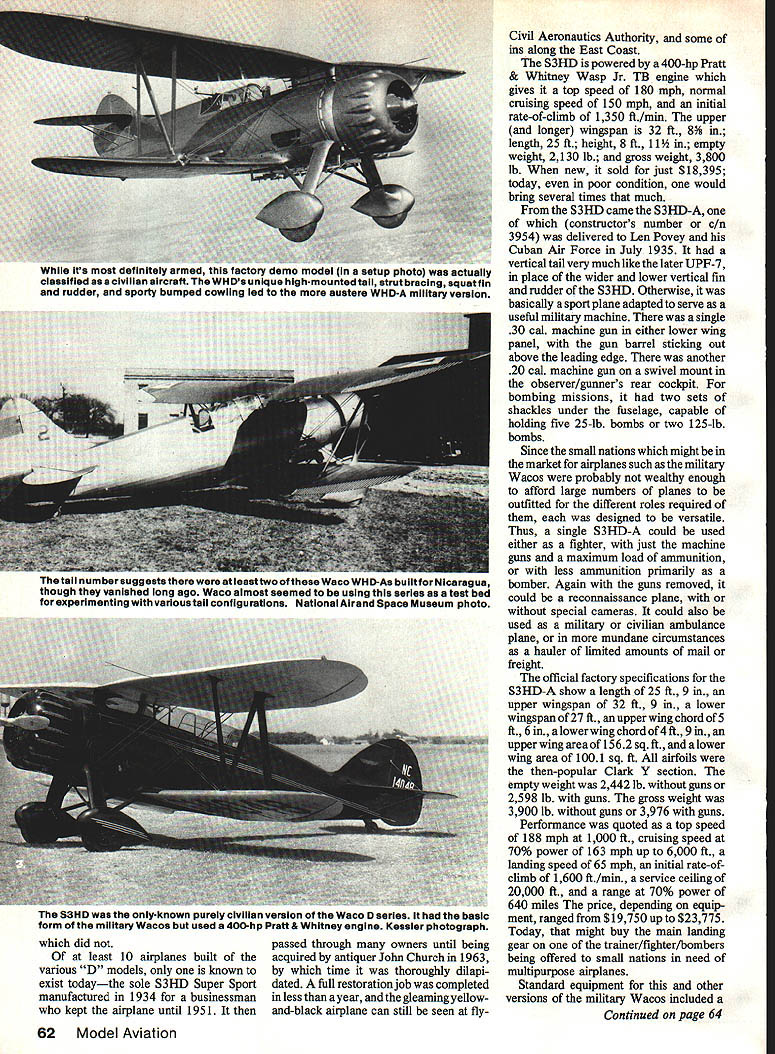
From the S3HD came the S3HD-A, an armed adaptation. One S3HD-A (constructor's number or c/n 3954) was delivered to Len Poveny and his Cuban Air Force in July 1935. It had a vertical tail very much like the later UPF-7, in place of the wider and lower vertical fin and rudder of the S3HD. Otherwise, it was basically a sport plane adapted to serve as a useful military machine.
- Armament:
- Single .30-cal. machine gun in either lower wing panel (barrels protrude above the leading edge)
- One .20-cal. machine gun on a swivel mount in the observer/gunner's rear cockpit
- Two sets of shackles under the fuselage: can carry five 25-lb. bombs or two 125-lb. bombs
- Roles:
- Fighter (maximum ammunition load)
- Bomber (reduced ammunition, bomb load)
- Reconnaissance (with/without cameras)
- Military or civilian ambulance
- Light cargo/mail hauler
Official factory specifications for the S3HD-A:
- Length: 25 ft. 9 in.
- Upper wingspan: 32 ft. 9 in.
- Lower wingspan: 27 ft.
- Upper wing chord: 5 ft. 6 in.
- Lower wing chord: 4 ft. 9 in.
- Upper wing area: 156.2 sq. ft.
- Lower wing area: 100.1 sq. ft.
- Airfoil: Clark Y section
- Empty weight: 2,442 lb. (without guns); 2,598 lb. (with guns)
- Gross weight: 3,900 lb. (without guns); 3,976 lb. (with guns)
- Performance:
- Top speed: 188 mph at 1,000 ft.
- Cruising speed (70% power): 163 mph up to 6,000 ft.
- Landing speed: 65 mph
- Initial rate-of-climb: 1,600 ft./min.
- Service ceiling: 20,000 ft.
- Range (70% power): 640 miles
- Price (1930s): $19,750–$23,775 depending on equipment
Standard and optional equipment
Standard equipment for the military Wacos included:
- Ground-adjustable propeller
- Full electrical system with starter and navigation lights
- Dual controls
- Wheel brakes
- Wheel pants
- Fairly complete instrument panel
Optional equipment included:
- Hamilton-Standard controllable-pitch propeller
- Fairchild aerial camera
- Two-way radio
- Landing lights
- Auxiliary fuel tank
- Twin floats for water operations
Other D-series variants
- JHD-A
- Appearance: slimmer vertical tail, smooth engine cowling with distinctive bumps/dishes
- Certification: CAA Approved Type Certificate in 1937
- Production: Six built for the army of Uruguay and delivered in January 1938; possible sales to Nicaragua
- Engine: Wright R-975-E1, 365 hp at 2,100 rpm (sea level)
- Performance: Top speed ~175 mph; cruising speed (70% power) 153 mph up to 6,500 ft.; initial climb 1,350 ft./min.
- Weights: same dimensions as S3HD, empty weight ~2,435 lb. (trainer) and 2,543 lb. (bomber); gross weights 3,436 lb. (trainer) and 3,725 lb. (fighter/bomber)
- SHD-A / S2HD-A
- Paper variants of the S3HD-A with alternate engines:
- SHD-A: 320-hp Pratt & Whitney Wasp Jr. T1B (none known built)
- S2HD-A: 450-hp Pratt & Whitney Twin Wasp Jr. SB (none known built)
- WHD-A
- Differences: vertical tail like the JHD-A rather than the WHD's low-profile, high stabilizer arrangement
- Prototype: unlicensed registration #14130, c/n 3837
- Production: unknown number produced for Nicaragua
- Engine: Wright R-975-E2, 450 hp
- Reported performance: top speed about 180 mph at sea level and close to 170 mph at 16,500 ft.; initial climb 1,200 ft./min.; service ceiling 18,000 ft.
Legacy and concluding remarks
Modern jet trainer/fighter/bombers like the British Aerospace Hawk and the Macchi MB.339 are far more efficient, better-equipped, and more deadly than an armed Waco. But when the fighting was over — say, in a few days, after insurgents had been frightened back into the bush — the Waco could easily be converted into a plush personal plane for some ribbon-bedecked general to impress his lady-friends and golfing pals. The 1987 counterpart of this old technique for developing a low-cost versatile weapon just doesn't have the same utility — or the class — once the shooting has stopped.
The D series remains one of the more obscure chapters in Waco history: a small family of multipurpose, export-orientated biplanes that bridged the line between sport aircraft and military utility. Only one known example of the S3HD survives and flies today, a reminder of the versatility and style that helped make Waco a household name among vintage-airplane enthusiasts.
Transcribed from original scans by AI. Minor OCR errors may remain.

