
Want to be an Early Bird?
By Patricia T. Groves
What's an "Early Bird"?
When the Hill Country Flyers of California initiated Early Bird License Trials for pre-1916 RC scale models, they may have turned on fliers all over the map. The rules are a gas — we love them. Enjoy.
An "Early Bird" in the full-sized world of flying is a pioneer in aeronautics who flew solo before December 17, 1916. Not all early-day fliers, however, were licensed. It wasn't until the mid-1920s that federal laws governed the licensing of pilots.
Airborne operations have been monitored since 1905, when representatives of 38 nations grouped themselves under a single organization called the Fédération Aéronautique Internationale (FAI). It became the sole governing body having jurisdiction over aerial sporting events and competitions. At that time, most regulations pertained to ballooning, the conduct of aeronauts, the "do's" and "don'ts" of aerial navigation, and the certification of record flights. The FAI was soon recognized by governments and international law, and as time went on, the FAI (through its member clubs) imposed more stringent rules.
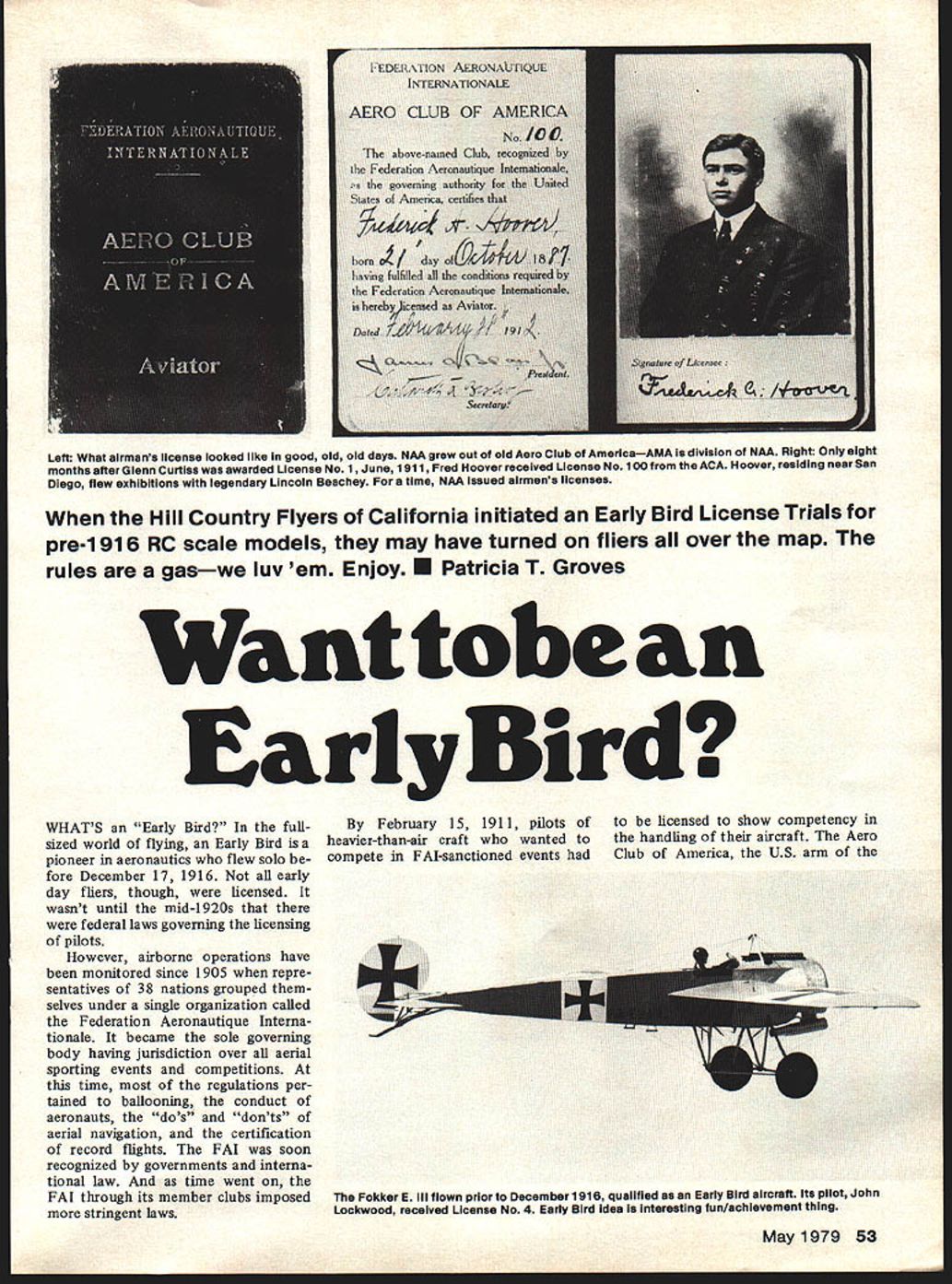
By February 15, 1911, pilots of heavier-than-air craft who wanted to compete in FAI-sanctioned events had to be licensed to show competency in handling their aircraft. The Aero Club of America, the U.S. arm of the FAI, issued its first license to Glenn Curtiss on June 8, 1911. By February 28, 1912, licensed pilots in the U.S. reached 100 with the issuing of a license to Frederick A. Hoover.
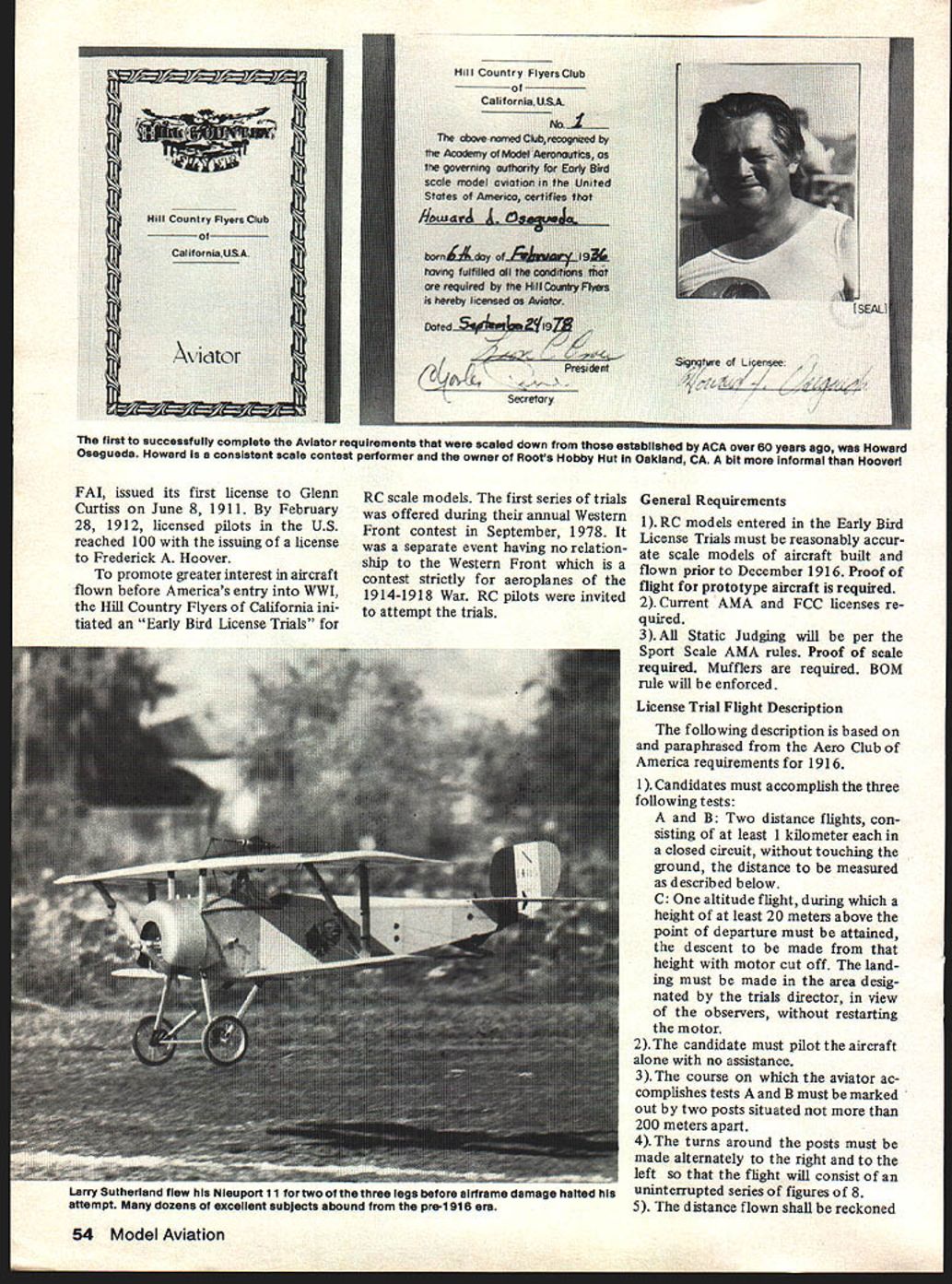
To promote greater interest in aircraft flown before America's entry into World War I, the Hill Country Flyers of California initiated "Early Bird License Trials" for RC scale models. The first series of trials was offered during their annual Western Front contest in September 1978. It was a separate event having no relationship to the Western Front contest, which is strictly for aeroplanes of the 1914–1918 war. RC pilots were invited to attempt the trials.
General Requirements
- RC models entered in the Early Bird License Trials must be reasonably accurate scale models of aircraft built and flown prior to December 1916. Proof of flight for prototype aircraft is required.
- Current AMA and FCC licenses are required.
- All static judging will be per the Sport Scale AMA rules. Proof of scale required. Mufflers are required. BOM rule will be enforced.
License Trial Flight Description
The following description is based on and paraphrased from the Aero Club of America requirements for 1916.
- Candidates must accomplish the three following tests:
- A and B: Two distance flights, consisting of at least 1 kilometer each in a closed circuit, without touching the ground. The distance is to be measured as described below.
- C: One altitude flight, during which a height of at least 20 meters above the point of departure must be attained. The descent is to be made from that height with the motor cut off. The landing must be made in the area designated by the trials director, in view of the observers, without restarting the motor.
- The candidate must pilot the aircraft alone with no assistance.
- The course on which the aviator accomplishes tests A and B must be marked out by two posts situated not more than 200 meters apart.
- The turns around the posts must be made alternately to the right and to the left so that the flight will consist of an uninterrupted series of figures of eight.
- The distance flown shall be reckoned as the straight line between the two posts.
- The landing after the two distance flights (tests A & B) shall be made with the motor stopped before touching the ground.
- Landings must be made in a normal manner; observers must report irregularities.
- Finally, the Hill Country Flyers caution: deportment and bearing of the candidate will be observed continuously during the trials. Any inelegance unbecoming an aviator will be noted and registered. The candidate shall at all times—and under all distress—conduct himself in a genteel and calm manner. Moreover, he will keep his tie straight and his socks up. The issuance of the certificate is always optional.
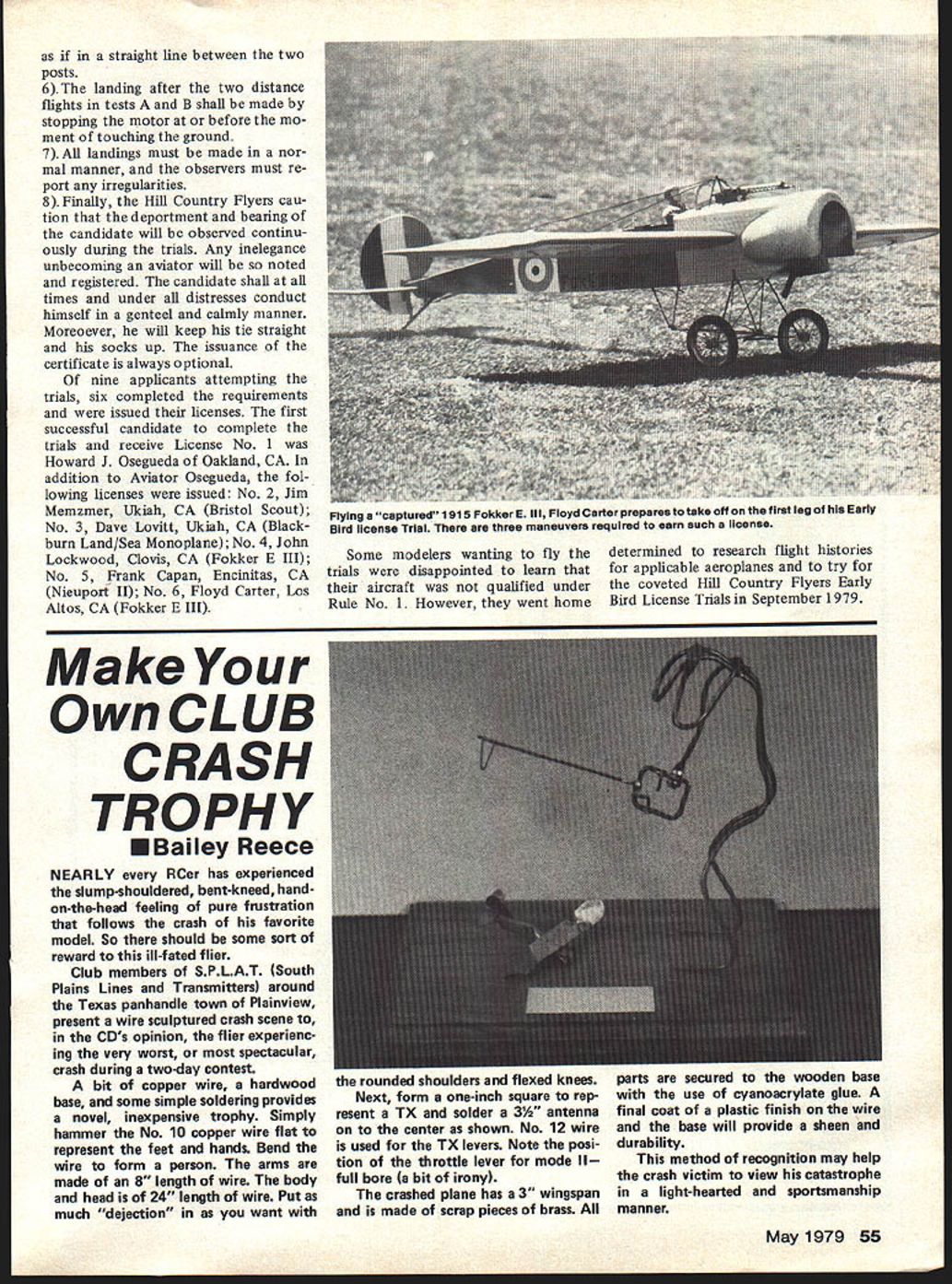
Of nine applicants attempting the trials, six completed the requirements and were issued their licenses. The first successful candidate to complete the trials and receive License No. 1 was Howard J. Osegueda of Oakland, CA. In addition to Aviator Osegueda, the following licenses were issued:
- License No. 2: Jim Memzmer, Ukiah, CA (Bristol Scout)
- License No. 3: Dave Lovitt, Ukiah, CA (Blackburn Land/Sea Monoplane)
- License No. 4: John Lockwood, Clovis, CA (Fokker E III)
- License No. 5: Frank Capan, Encinitas, CA (Nieuport II)
- License No. 6: Floyd Carter, Los Altos, CA (Fokker E III)
Some modelers who wanted to fly the trials were disappointed to learn that their aircraft did not qualify under Rule No. 1. However, they went home determined to research flight histories for applicable aeroplanes and to try for the coveted Hill Country Flyers Early Bird License Trials in September 1979.
Transcribed from original scans by AI. Minor OCR errors may remain.

