
War Birds over Delaware
Wally Zober
Event and site
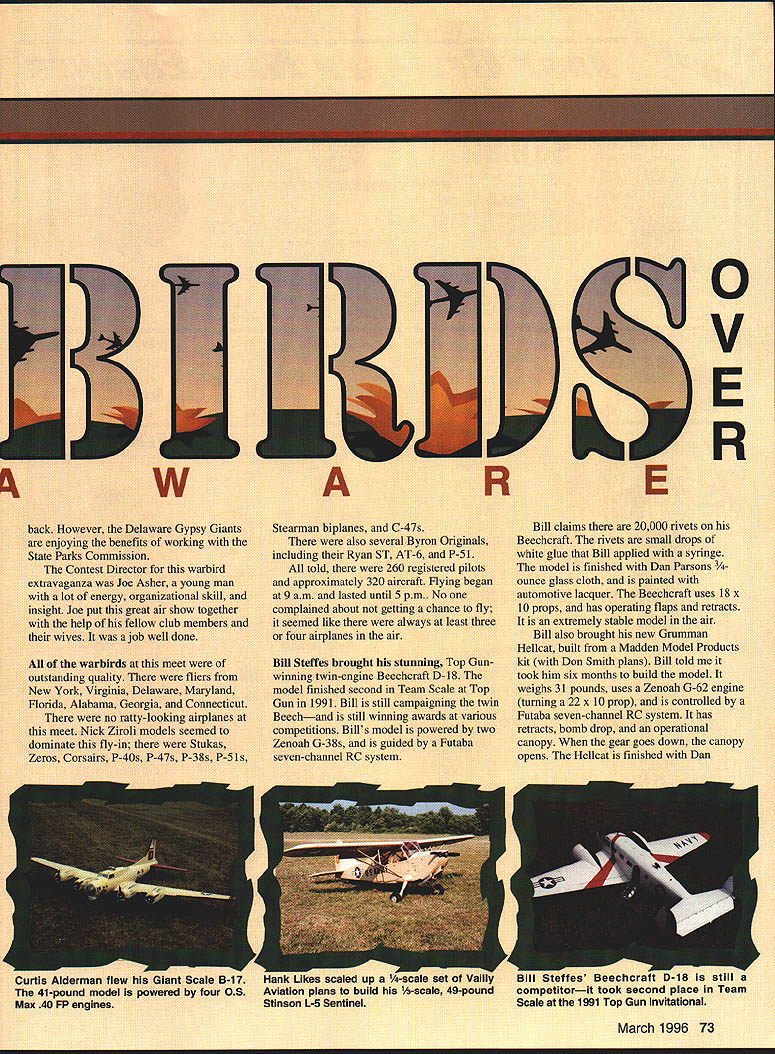
If your club is having trouble holding onto its flying site, or if your club is having trouble securing a new one, you might want to try what a lot of RC clubs are doing — work out a land deal with local government officials or your State Parks Commission.
That's what the Delaware Gypsy Giants did; they held their Gypsy Giant Fly-In and District IV Mini-Festival at Lums Pond State Park in Newark, Delaware. The Gypsy Giants are the International Miniature Aircraft Association (IMAA) branch of the Delaware Radio Control Club.
To say that their flying site is magnificent would be an understatement. It has a close-cut grass runway that is approximately 750 feet long by 200 feet wide, with clear approaches from all directions. The event had plenty of parking, food concessions, public rest rooms, a dump station for RVs, and hot water showers for those who were camping overnight.
Many complain that all our government does is tax us, without giving us anything.
There were fliers from New York, Virginia, Delaware, Maryland, Florida, Alabama, Georgia, and Connecticut. All of the warbirds at this meet were of outstanding quality. There were no ratty-looking airplanes at this meet — Nick Ziroli models seemed to dominate; there were Stukas, Zeros, Corsairs, P-40s, P-47s, P-38s, P-51s, Stearman biplanes, and C-47s. There were also several Byron Originals, including their Ryan ST, AT-6, and P-51.
All told, there were 260 registered pilots and approximately 320 aircraft. Flying began at 9 a.m. and lasted until 5 p.m. No one complained about not getting a chance to fly; it seemed like there were always at least three or four airplanes in the air.
"To say that their flying site is magnificent would be an understatement." — Wally Zober
Notable aircraft and pilots
- Bill Steffes — Beechcraft D-18 (twin-engine)
- Top Gun–winning model (second in Team Scale at Top Gun, 1991)
- Powered by two Zenoah G-38 engines; Futaba seven-channel RC
- Uses 18 x 10 props; operating flaps and retracts
- Finished with Dan Parsons 3/4-ounce glass cloth and automotive lacquer
- Bill claims there are 20,000 rivets (small drops of white glue applied with a syringe)
- Bill Steffes — Grumman Hellcat
- Built from a Madden Model Products kit with Don Smith plans
- Six months to build; weighs 31 pounds
- Zenoah G-62 engine, 22 x 10 prop; Futaba seven-channel RC
- Retracts, bomb drop, operational canopy (canopy opens when gear goes down)
- Nick Ziroli Sr. — Lockheed P-38 (Giant Scale)
- 114-inch wingspan; weighs 40 pounds
- Two Zenoah G-45 engines, three-blade 18 x 10 props
- Tru-turn spinners, Robart retracts
- Covered with light glass cloth, coated with polyester resin, painted with automotive lacquer
- Plans, cowlings, and canopies available
- John Nieszeski (Ansonia, CT) — Junkers Ju 87 Stuka (Giant Scale)
- Built from Nick Ziroli Sr.'s plans; 100-inch wingspan; 28 pounds
- Zenoah G-62 engine, 22 x 10 prop; Futaba seven-channel PCM with 12 servos
- Features flaps, dive brakes, and bomb drop
- Covered with 3/4-ounce fiberglass cloth and polyester resin; painted in Chevron paint
- John Nieszeski — PT-19
- Built from an Innovator Model Products kit by Greg Namey
- Fiberglass fuselage, foam wing cores; 86-inch wingspan; 16 pounds
- Quadra 42 engine, 18 x 10 prop; Futaba seven-channel PCM radio
- Finished with Krylon paint (blue fuselage, John Deere yellow wings)
- Greg Namey (Innovator Model Products) — PBY Catalina (Giant Scale flying boat)
- Painted black in Black Cat Squadron markings (South Pacific WW II)
- Two Quadra 52 engines, three-blade Zinger props; wingtip floats retract
- 14-foot wingspan; weighs 54 pounds
- Painted with flat black enamel; flown with an MRC Mk. VI RC system
- Hank Likes — Stinson L-5 (scaled up from 1/4-scale Valley Aviation plans)
- 1/3-scale L-5, 49 pounds; 12-foot wingspan
- Sachs .58 engine in fiberglass cowl, 24 x 12 prop
- Futaba Super Seven seven-channel PCM RC system
- Covered with Coverite; painted with water-based latex outdoor paint
- Landing gear manufactured by Likes Line
- Sal Calvagna — Me 163 Komet
- First rocket-powered fighter; jettisoned landing-gear dolly for takeoff
- Chevron paint; 82-inch wingspan
- SuperTiger 90 engine; Futaba 7 UAP radio
- Fun to fly but tricky on takeoff due to the dolly
- Sopwith Pup (pilot unspecified)
- Powered by a Zenoah G-62, 24 x 5 Zinger prop
- Futaba five-channel PCM radio; 21-pound model; flies like a kite
- David West — Corsair (detailed, from Ziroli plans)
- Sachs 4.2 engine; 93-inch wingspan
- Futaba PCM radio; 14 servos; 1,500 mA battery pack
- Features bomb drop and operational canopy
- Dan Basovitch — AT-6G
- Combination of a Chuck Gill kit and Ziroli plans
- Chrome MonoKote finish; Zenoah G-62 engine, 22 x 10 Zinger prop
- Custom exhaust, fiberglass cowling, six servos, 1,200 mA battery pack
- Ace R/C Micropro radio system
- Walter Rhuberg — P-47 (Yellow Aircraft)
- Quadra .35 engine, 18 x 6 x 10 Zinger prop
- Flies close to scale speed; finished with Dan Parsons 3/4-ounce fiberglass cloth and resin; painted with K&B paint
- Futaba six-channel FM RC system; flown by Dan Barone
- Jeff Himmelschoss — Bud Nosen P-51 (highly modified)
- 100cc Sachs engine, 24 x 14 Menzwood prop
- 100-inch wingspan; 40 pounds; foam wing cores
- Finished with automotive lacquer; vinyl graphics by Graphic World of Texas
- Futaba Super Seven RC system; eight giant-size servos
- Greg Mottas — Concept Models Fleet Biplane (1/4-scale)
- G-38 engine, Zinger 20 x 6 prop; B&B smoke system
- Covered with Solartex; painted with Hobbypoxy; flown with a Futaba RC system
- Mike Younger — Grumman Bearcat (1/4-scale)
- Finished in Blue Angels color scheme (1948/1949) with acrylic enamel
- Sachs 4.5 engine; Master Airscrew prop
- 88-inch wingspan; 35 pounds; Robart retracts
- Flown with a JR computer radio system; performed the solo Blue Angels performance
- Bob Karlsson — Grumman Wildcat
- Model designed by Bob, including landing gear and retract system
- 91-inch wingspan; 32 pounds; G-62 engine; Airtronics RC system
- Scored 96.4 points static at Top Gun
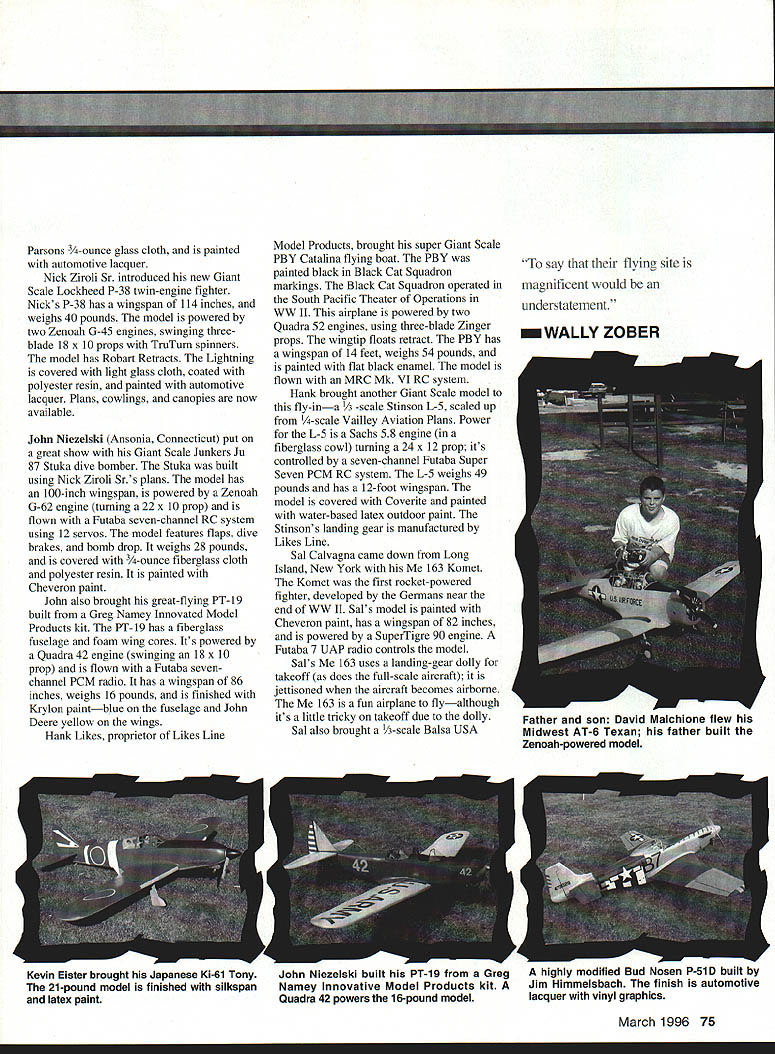
- David Malchione — Midwest AT-6
- Team effort (builder and son pilot)
- Finished with MonoKote and K&B paint; Robart retracts
- Zenoah G-62 engine; flown with a JR system
- Peter Malchione — Byron P-51 Mustang
- Byron retracts; Quadra 42 engine with Byron prop reduction and four-blade prop
- 84-inch wingspan; 28 pounds
- JR system with eight servos and 1,500 mA battery pack
- Brian Hess (Nazareth, PA) — Fokker Triplane
- Built from a Flair kit; 72-inch wingspan; 12 pounds
- Covered with 21st Century fabric; O.S. 120 four-stroke, 16 x 6 prop
- Futaba four-channel radio with six servos; flies extremely well
- Gary Stanley — Byron AT-6 (racing livery)
- Zenoah G-62 engine; 26 pounds
- Painted with PPG base coat and clearcoated
- Raced at Galveston, Texas; first in Bronze Class at 110 mph
- Kevin Eister — Japanese Ki-61 "Tony"
- Built from Radio Control Modeler plans; fixed landing gear
- 102-inch wingspan; 21 pounds
- G-38 engine, 18 x 6-10 prop; finished with silkspan and latex paint
- Flown with a Futaba radio
- Rick Folling — Stearman PT-17
- Built from Ziroli plans; 77-inch wingspan; 20 pounds
- Saito 300 twin, 20 x 10 prop; finished in 21st Century Cub Yellow
- Hand-cut US Navy markings; red bars painted with TWR-W-Swift red paint
- Futaba five-channel PCM radio with five servos
- Engine hidden behind a Williams Brothers 7/5-scale dummy engine
- Ron Crellin — Mitsubishi A6M2 Zero (large-scale)
- Latex paint with automotive clearcoat; 93-inch wingspan; 30 pounds
- Zenoah G-62 engine, 22 x 14 prop
- Robart retracts, flaps, and scale exhaust system
- Al Gaudiosi — Byron P-51D
- Quadra 52 engine, 20 x 10 Zinger prop
- 82-inch wingspan; 26 pounds
- Per Power muffler-and-engine-mount combination; Byron retracts
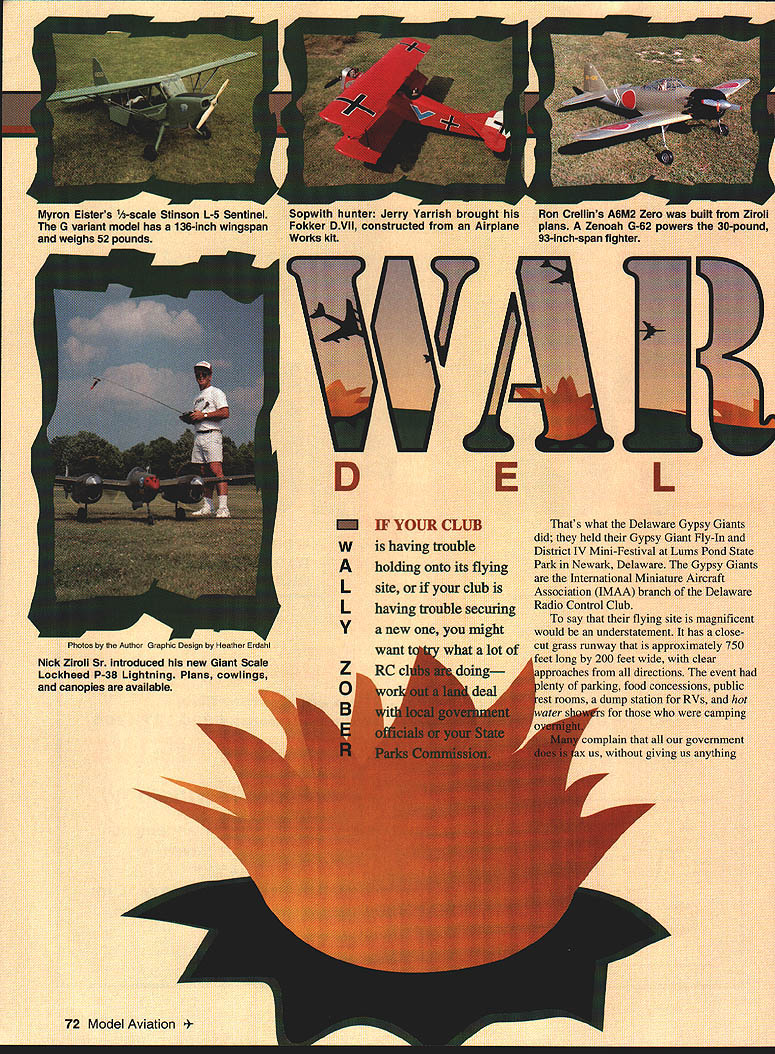
- Myron Eister — Stinson L-5G variant ("Cricket")
- Represents an airplane stationed with the Confederate Air Force at Pittsburgh, PA
- 136-inch wingspan; 52 pounds
- Hornet 70cc engine, 24 x 8 Premier Najar prop
- Covered with Super Shrink Coverite; painted with clear butyrate dope over Benjamin Moore latex exterior house paint
- Curtis Alderman — B-17 bomber
- Built from Bob Holman plans; 10½-foot wingspan; 41 pounds
- Four O.S. Max FP-40 engines; Airtronics six-channel RC system
- Likes Line electric retracts; balsawood and plywood construction
- Covered with Super Coverite; painted with Century spray paint
- Art Johnson — North American F-82 Twin Mustang
- Great-flying show-stopper; campaigned at Top Gun and other major competitions
- Dennis Richardson — Douglas R4D (Navy DC-3 version) — (accident)
- Built from Ziroli plans; 140-inch wingspan; 46 pounds
- Two Quadra 42 engines with Valley 16 x 5-12 props; smoke system; Robart retracts
- Finished with K&B paint overcoated with clear flat
- Unfortunately totaled after entering a spin too close to the ground while flying great
- John Socolof — Bucker Jungmann (aerobatic biplane)
- 1/3-scale; powered by a Zenoah G-38 engine, 20 x 6-10 prop
- Covered with Super Shrink Coverite; finished with butyrate dope
- Flown by Dean DiGiorgio; JR system
- Tony Krichenko — PT-17
- Built from Ziroli plans; covered with Solartex
- Painted with acrylic automotive lacquer and clearcoated
- Flown with a Futaba seven-channel RC system
- Ivan Goldfarb — Byron Ryan ST
- One of the best-looking airplanes at the fly-in
- G-38 engine, 18 x 8 Dynathrust prop
- 96-inch wingspan; 19 pounds; Futaba seven-channel radio with six servos
- Finished with K&B Supercoverite
- William Hoffman — Ziroli A6M2 Zero
- 96-inch wingspan; 31 pounds
- Zenoah G-62 engine, 20 x 12 prop; Futaba seven-channel radio
- Flaps and retracts; finish is automotive lacquer with a satin clearcoat
- Myron Eister — Pazmany Parasol observation airplane
- Painted with silver Hobbycote paint; 104-inch wingspan; 20 pounds
- Powered by a Super Tiger 2500; controlled by a JR system
Until next time, stay well and keep 'em flying! ♦
Transcribed from original scans by AI. Minor OCR errors may remain.

