
Warbirds Over Delaware
By Howard Smith & Edgar Fitzwater
WARBIRDS: the name conjures up pictures of Corsairs and P-51s for some, while others see World War I Sopwith Pups and triplanes.
On the second weekend of July 1993 the Delaware R/C Club and the Delaware Gypsy Giants held the first Warbirds Over Delaware Fly-In. The annual event is open to any warbird and has no model-size restrictions. It was held at the club field in Lums Pond State Park, not far from Wilmington. The field features one long runway with excellent approaches; in 1993 ten campers and motor homes arrived a day early, and 24 more arrived on Saturday.
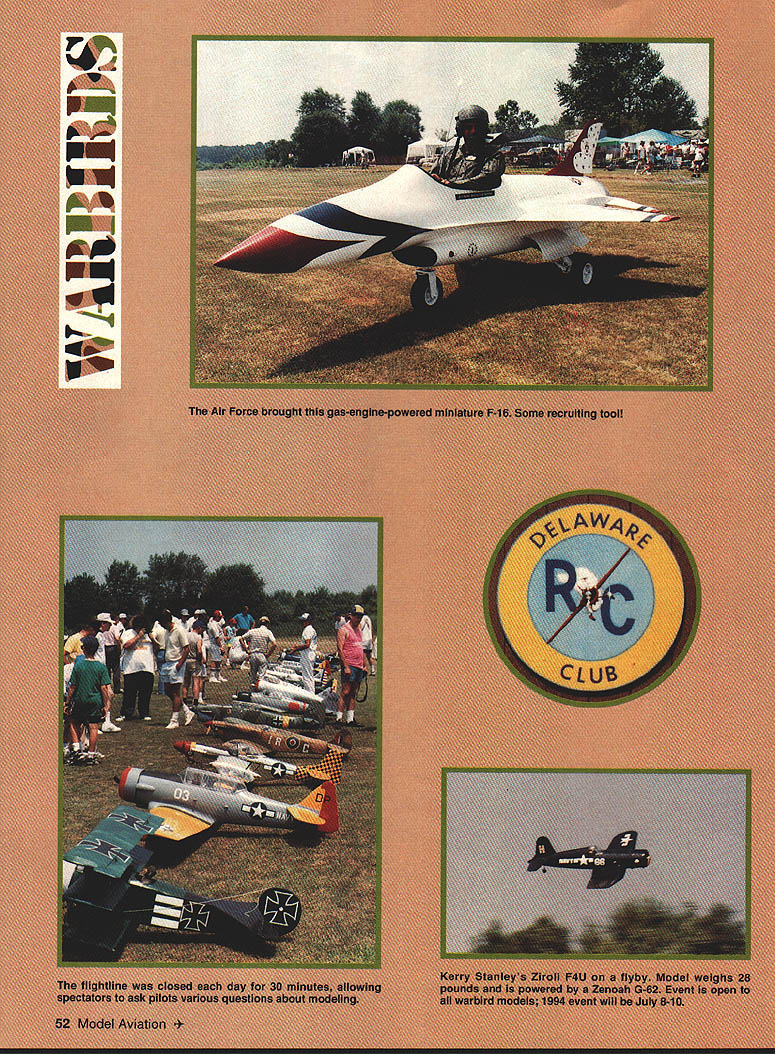
Contest directors Joe Asher and Doug Jessie organized the Fly-In as a noncompetitive event. Pilots requested a frequency pin from the impound tent; if it was available, they flew. The system is simple and works exceptionally well. The flightline was closed at noon for a one-hour public inspection, and each day the flightline was closed for 30 minutes to allow spectators to ask pilots questions about modeling.
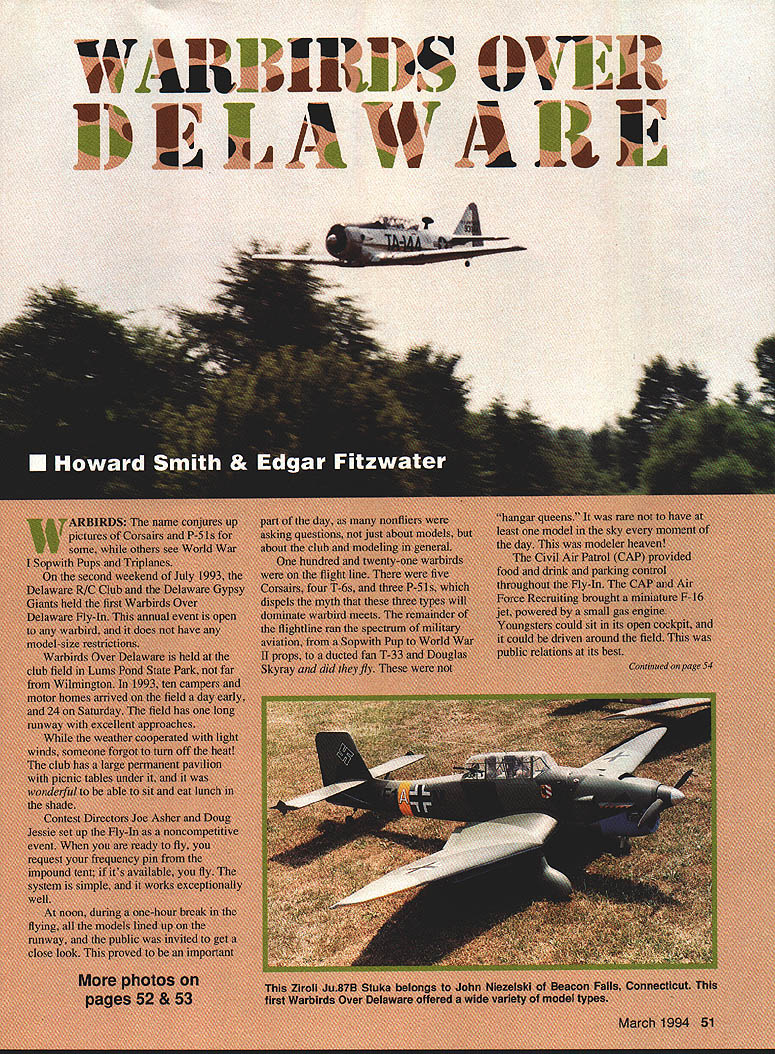
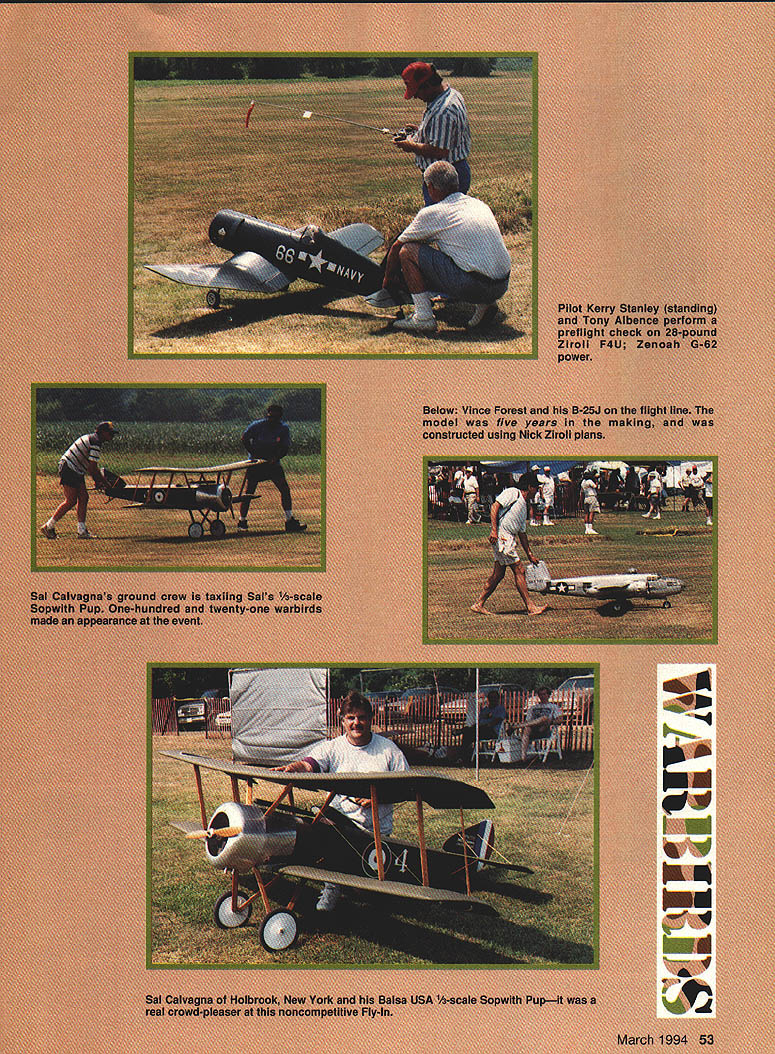
Attendance and aircraft One hundred and twenty-one warbirds were on the flight line. While there were three Corsairs, four T-6s, and three P-51s, the meet was not dominated by any single type. The flight line represented the full spectrum of military aviation, from a Sopwith Pup to World War II props, to a ducted-fan T-33 and a Douglas Skyraider. Highlights included:
- Nick Ziroli’s new P-61 Black Widow with both G-38 engines turning; he frequently made low passes.
- Kerry Stanley’s Ziroli F4U (weighing 28 pounds, powered by a Zenoah G-62) performing flybys.
- A Sopwith Tabloid built by Bryan Hess and flown by Tim Haggerty — a 1/3-scale model powered by a G-62 that put on a quiet, evocative morning flight.
- Multiple coordinated passes, including three Corsairs leading a P-47 on a low-level strafing pass.
There were few “hangar queens”; it was rare not to have at least one model in the sky at any moment. For many, those flights — especially the slow, misty-morning scene with the Sopwith Tabloid — were special moments that made the trip worthwhile.
Public relations and support The Civil Air Patrol (CAP) provided food, drink, and parking control throughout the Fly-In. The CAP and Air Force Recruiting brought a gas-engine-powered miniature F-16 that youngsters could sit in and be driven around the field — an excellent recruiting and public-relations tool.
Safety and procedures The Delaware Club’s commitment to safety was evident and well appreciated. Measures included:
- A two-foot-high safety fence along the flightline with small openings to allow models through.
- Engines started only just before taking the runway.
- Mandatory passing of the IMAA preflight checklist before flight.
- A snow fence cordoning off the flying area and pits to keep spectators at a safe distance.
Social and announcing Chris Harden organized an after-hours barbecue chicken dinner for pilots and families. Bruce Kane of Quakertown, Pennsylvania, was the voice behind the microphone all day; he combined humor with clear, informative announcements about field activity.
Visitors and scope Fliers came from AMA- and IMAA-sanctioned clubs from as far north as Connecticut and as far south as Virginia. With 121 beautiful models on the field, it was hard to single out highlights — the variety and quality of aircraft were the event’s strength.
Mark your calendar If you like warbirds, this event will highlight your summer. Bring a warbird and fly — it’s always fun to be involved, and making friends is a large part of the hobby. Warbirds Over Delaware will be back July 8–10, 1994; the Delaware RC Club and the Delaware Gypsy Giants will welcome you.
Transcribed from original scans by AI. Minor OCR errors may remain.

