
Wasserkuppe
Byron Blakeslee
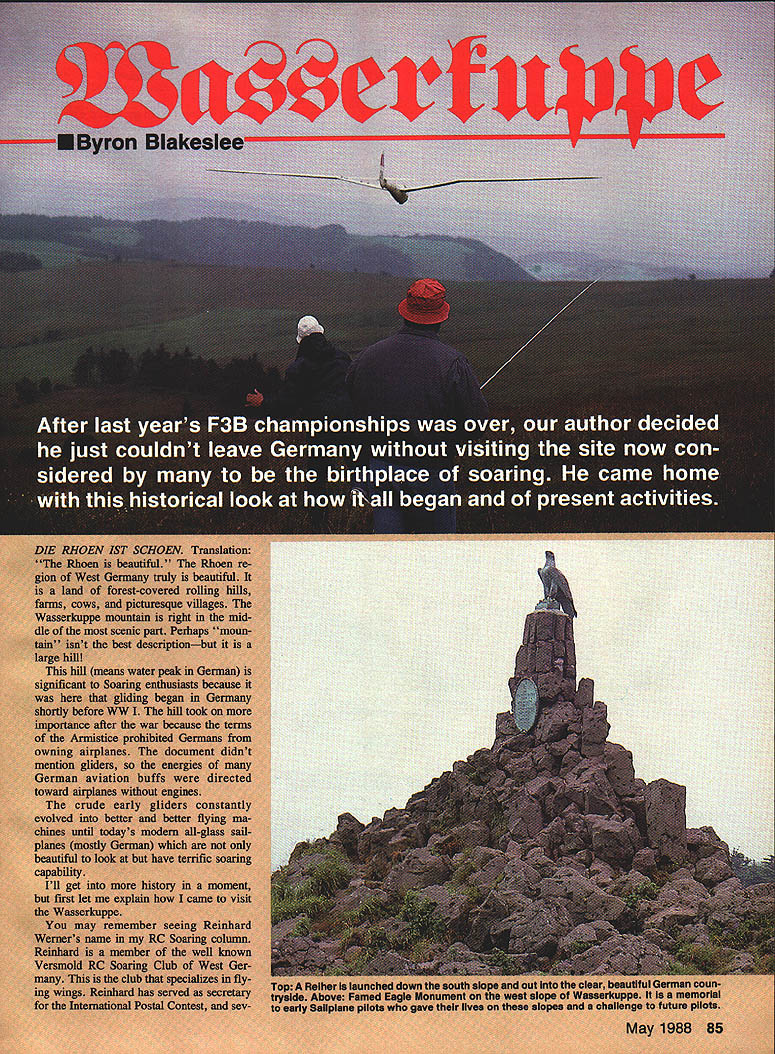
After last year's F3B championships was over, I decided I just couldn't leave Germany without visiting the site now considered by many to be the birthplace of soaring. I came home with this historical look at how it all began and of present activities.
How I came to visit
Reinhard Werner, a member of the well-known Versmold RC Soaring Club of West Germany, had suggested that a group of us get together at the Wasserkuppe following the contest. Reinhard had served as secretary for the International Postal Contest, had several photographs printed in my RC Soaring column, and helped publish the daily Competitor's Achmer News during the Worlds. His invitation sounded irresistible. Just as all Muslims must visit Mecca once in their lifetimes, all soaring enthusiasts must visit the Wasserkuppe. This is holy ground!
Reinhard painted an intriguing picture: "The Wasserkuppe isn't just your ordinary flying hill; it's the ultimate flying chaos. Models, hang gliders, and full-size soarers will all be using the same slopes under certain conditions. This is perfect for me. You will have at least one midair on a reasonably fine day—and will be shot down by somebody trying to fly on your frequency. But even better, the place is pure soaring history."
He added a memorable anecdote about the famous "Aufwindbaum" (upwind tree): a friend crashed into it; in Peter Riedel's book Start in den Wind the tree is mentioned repeatedly—over the years the crème de la crème of soaring has crashed into it. "Just imagine following in the footsteps of the pioneer pilots by crashing into such historic trees!" he said wryly.
The World Champs ended on Saturday afternoon, August 1. After the medal ceremony and an enjoyable awards banquet in Hotel Hohenzollern in Osnabrück, my wife Maxine and I set out Sunday morning on the four-hour drive south to the Wasserkuppe. Reinhard and Sean Wallbank had camped at Achmer and drove down separately.
Getting there and driving
On the autobahn
If you haven't experienced the German autobahns, they are excellent roads. The authorities "suggest" a speed limit of 130 km/h (81 mph), but it is not enforced in many places. That means you will see Mercedes, BMWs, and Porsches passing at speeds far higher than typical U.S. highway travel. Drive defensively: a small car doing 60 mph can be overtaken by much faster traffic.
One bright spot is that most trucks are not allowed on the autobahns on weekends. If it's a nice summer weekend, the roads can be crowded with cars, buses, and camper trailers—Germany seems to be on the move.
Locating the Wasserkuppe
A quick way to find the Wasserkuppe on a map of West Germany:
- Find Frankfurt am Main.
- Move about 90 km northeast to Fulda.
- From Fulda, measure roughly 25 km ESE and you'll find the Wasserkuppe.
- If your map shows Poppenhausen and Gersfeld, the hill is east of Poppenhausen and north of Gersfeld.
- You might see "950"—the Wasserkuppe's height in meters. From Frankfurt it's about a two-hour drive.
We missed the Fulda Ausfahrt and continued via Gersfeld, which turned out to be the most scenic route. Gersfeld is a charming town and a good place to look for lodging if the hill itself is socked in.
Weather and first impressions
It rained intermittently during our drive and the summit was socked in when we arrived—no flying that day. We found a nice room in a Gasthof in Gersfeld. As everyone at the F3B Worlds had been saying, it had been a very wet and cold summer across Europe; even farther from the North Sea, the weather didn't improve immediately. Perhaps the hill was named Wasserkuppe ("water peak") for a reason.
History of gliding at the Wasserkuppe
Early beginnings (1910–1922)
Gliding history at the Wasserkuppe goes back to 1910, when some high-school-age boys from Darmstadt began flying homemade gliders. The Wasserkuppe, only 950 meters above sea level, is the highest hill in the area with good slopes to the west, north, and south and a gentle slope to the east.
Early flights were simple: run down the slope into the wind and glide more or less straight down. The Darmstadt boys' best flight in 1912 lasted one minute and 52 seconds.
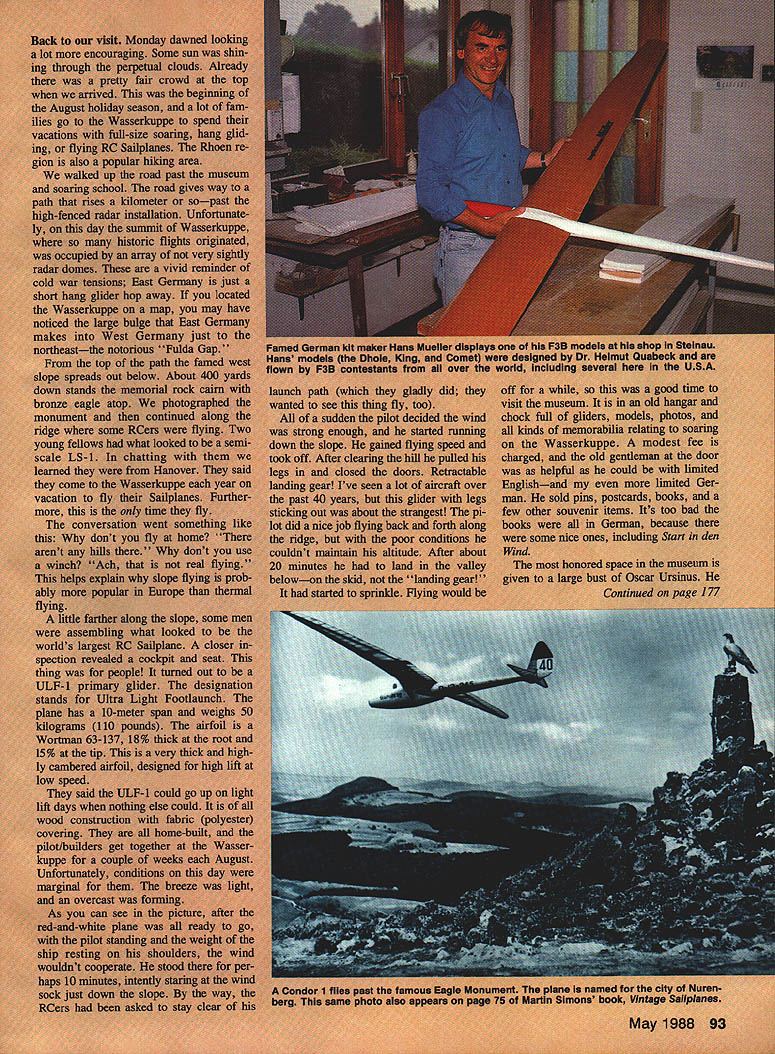
The first organized gliding meeting at the Wasserkuppe was held in 1920. The only competition was to see who could stay aloft the longest. Wolfgang Klemperer flew a Schwartz Teufel ("Black Devil") and invented the bungee launch: stout rubber arranged in a V, with people running down the slope to catapult the glider into the air. This method was used for many years.
The 1920 meet also saw the first fatality: Eugene von Loessl fell about 100 meters when his glider suffered structural failure.
In 1922 Klemperer performed the first 360 on the slopes in his Blaue Maus ("Blue Mouse") and glided nearly to Gersfeld—4.6 km in 13 minutes 3 seconds—the first cross-country glider flight and a world record. Arthur Martens later flew to Gersfeld in the Vampyr, covering 7.5 km in 15 minutes 40 seconds. The Vampyr, designed by Hanover Technical University students, is often called the first "true" sailplane: cockpit, conventional tail surfaces, a 12.6 m wing, and a 16:1 glide ratio. Later in 1922, Hentzen kept a Vampyr aloft using ridge lift for three hours and six minutes.
Innovations and records (1923–1935)
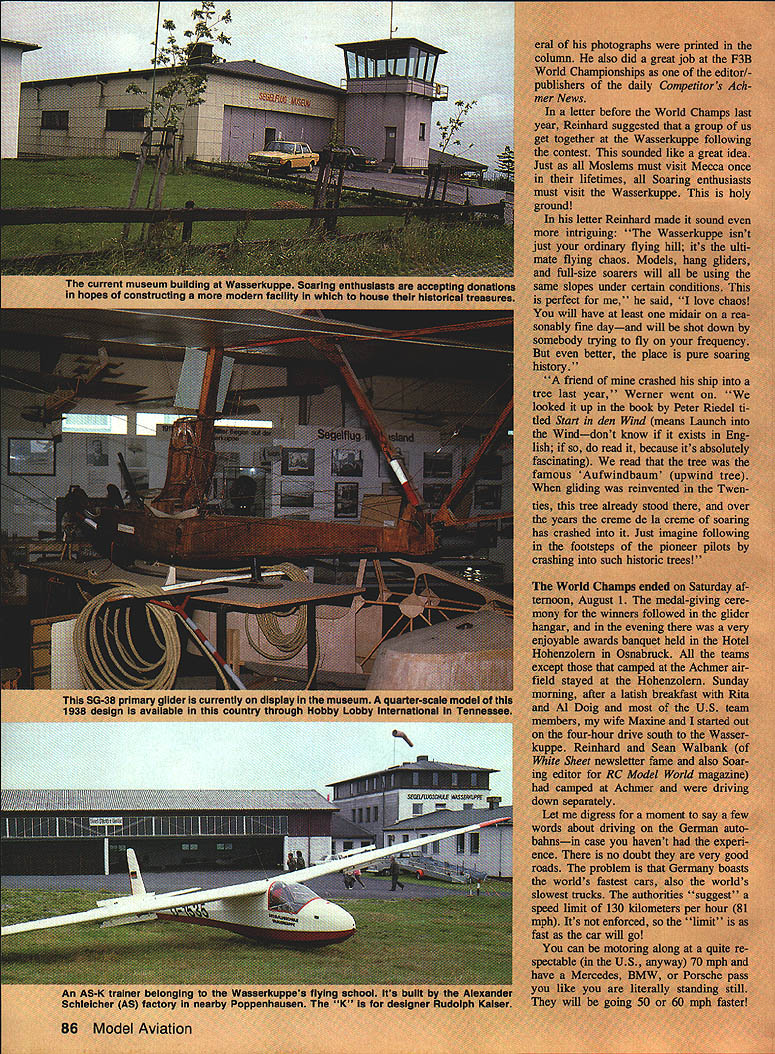
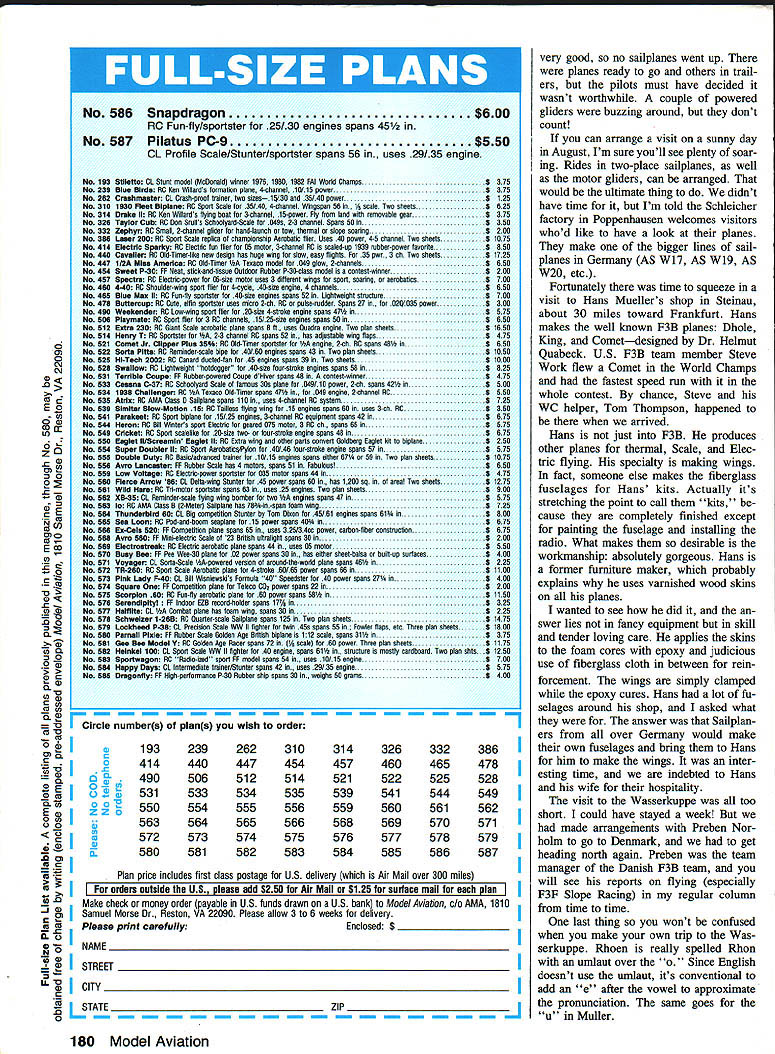
In 1923 the Eagle Monument (with a bronze eagle) was erected on the Wasserkuppe's west ridge as a memorial to the pioneers who lost their lives developing the sport. The plaque reads, in translation:
We the fallen flyers are victorious, For we have tried. People, fly on and be victorious, Because, you try.
Also in 1923, the Konsul, built by the Darmstadt Akaflug group, appeared with an 18.7 m wingspan and a wind-tunnel-developed Goettinger 535 airfoil. The Konsul set a distance record of 18.7 km. Subsequent Darmstadt designs included the Darmstadt I (1926) and Darmstadt II (1927).
In 1926 Max Kegel flew under a thunderstorm and landed 56 km away, prompting pilots to consider thermal lift as a means for distance flights. From 1928 onward, distance records were repeatedly set using thermal lift and improved gliders. In 1929 Robert Kronfeld flew 134 km in the Wien (designed by Alexander Lippisch). Lippisch's Fafnir followed, and in 1931 Gunther Groenhoff flew over 220 km from a bungee launch off the Wasserkuppe.
The 1935 Rhön meet is often considered the turning point toward modern cross-country tasks. There were 60 sailplanes present; on one day four pilots covered 504 km from the Wasserkuppe to Brunn in Czechoslovakia, each flying a different design.
While understanding of convection lift and winch launching made hills like the Wasserkuppe less essential for cross-country soaring, the Wasserkuppe has continued as a center for gliding and a place of historical and recreational significance.
The Wasserkuppe today
The atmosphere and activities
The Wasserkuppe has a holiday atmosphere. August brings families, hang gliders, full-size sailplanes, RC sailplanes, and hikers. An annual vintage sailplane rally keeps history alive and draws large crowds.
RC flying and frequency practice
Around the summit there are multiple slopes used by RC flyers. The museum shows a diagram with five separate slopes for RC flying—three within half a mile and two a bit farther. Models, scale ships, and almost anything else can be seen on the slopes.
Frequency control is informal. German RC practice is supported by better radios and stricter spacing of assigned frequencies. For many years German Rc radio allocations have included 20 aircraft frequencies in the 35 MHz band spaced 10 kHz apart (contrast with U.S. spacing at the time). Receivers have very selective front ends to avoid adjacent-channel interference. Multiplex radios, for example, are reputed to hold solid on their frequency even if another transmitter comes on the same frequency, provided the owner’s transmitter remains closer. Europeans are willing to pay more for quality gear, and RC flying is a widely respected avocation there.
The ULF‑1 and homebuilt footlaunch gliders
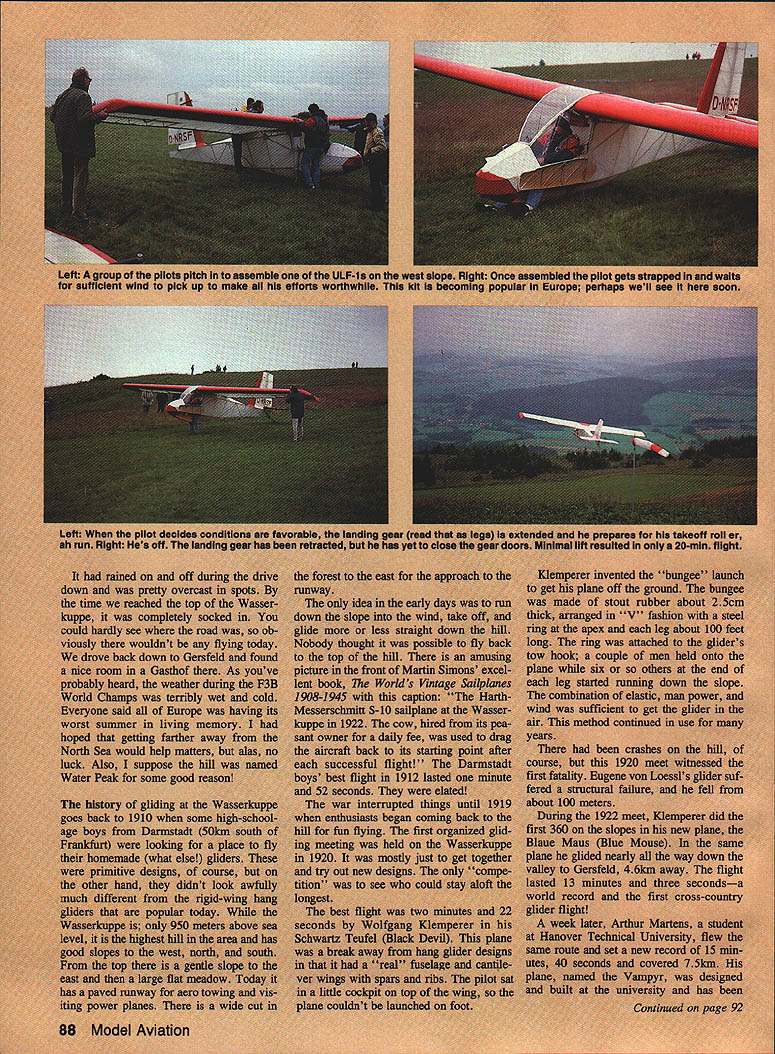
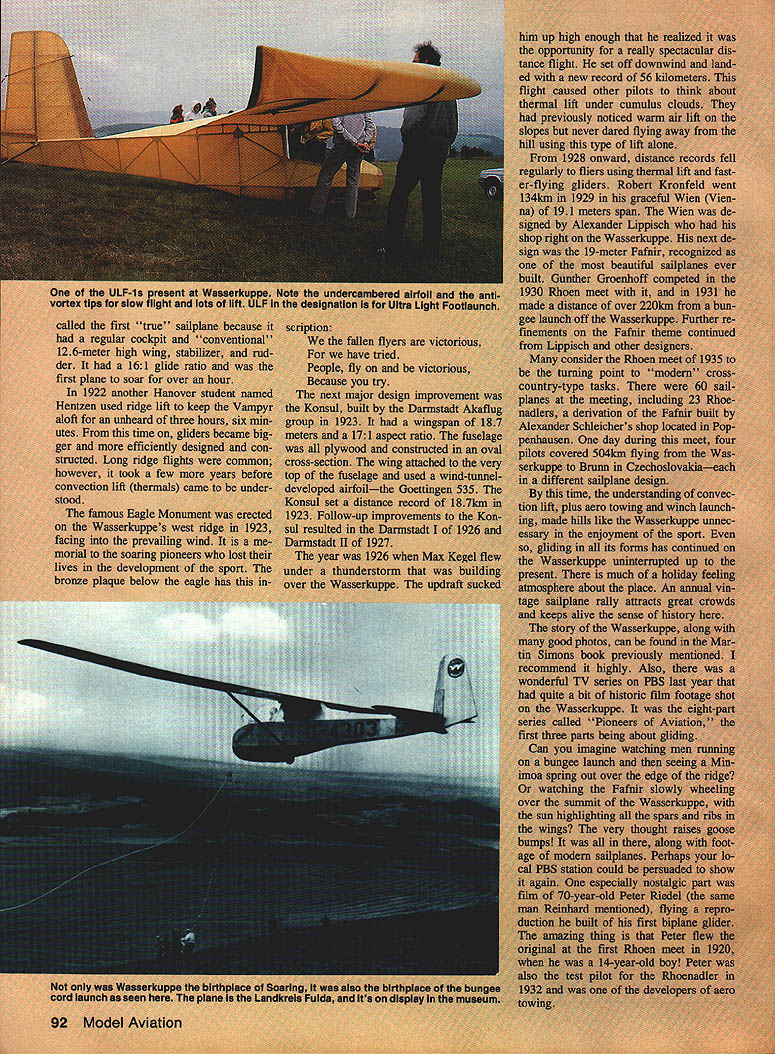
One striking sight is the ULF‑1 primary glider (Ultra Light Footlaunch). It is a home-built, all-wood, fabric-covered design with a 10 m wingspan and a weight of about 50 kg (110 lb). The airfoil is a Wortmann 63‑137—very thick and highly cambered for high lift at low speed (about 18% thick at the root, 15% at the tip). Pilots fit into a cockpit-like arrangement, brace the glider on their shoulders, run down the slope, and launch on foot.
On our visit a ULF‑1 pilot prepared for launch, ran down the slope, and took off. He retracted his legs and closed small doors—retractable landing gear on a footlaunch glider! He flew back and forth along the ridge but, with light lift and an approaching overcast, could not stay up and landed in the valley on the skid.
Full-size soaring and rides
On good days there are many opportunities for full-size soaring. Two-place sailplane rides and motor-glider rides can be arranged. We did not take a ride, but if you visit on a sunny August day you will likely see plenty of soaring. The Schleicher factory in Poppenhausen welcomes visitors and builds a well-known line of sailplanes (ASW series).
Shops, museum, and hospitality
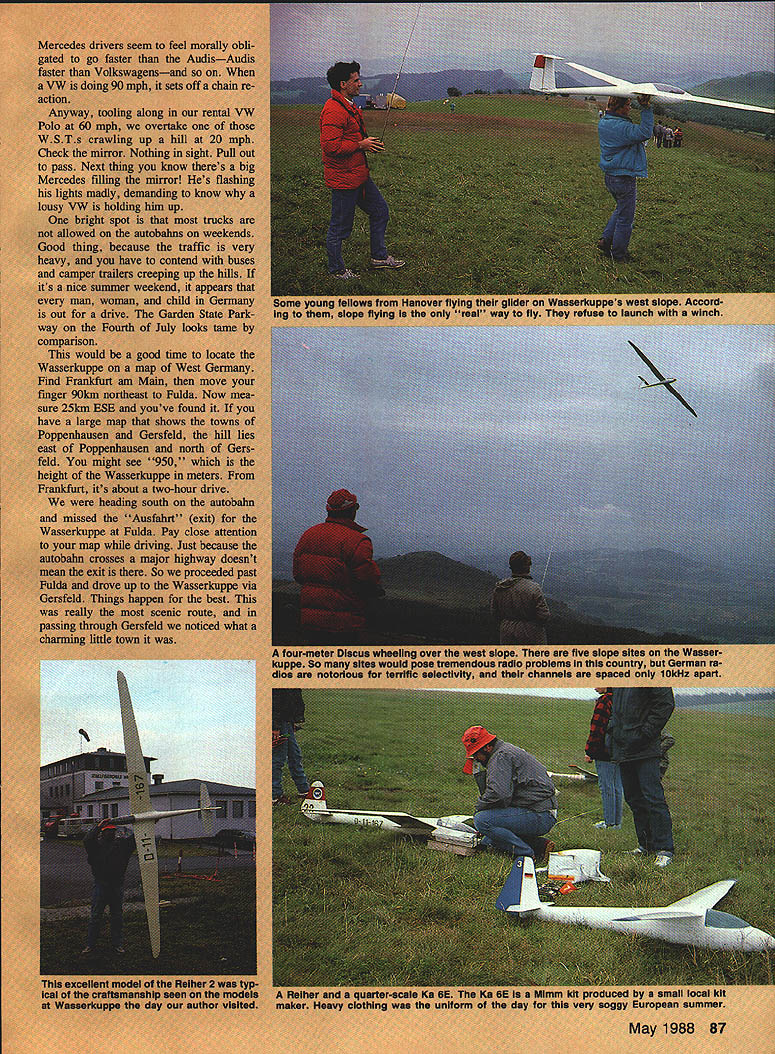
The museum, housed in an old hangar, is full of gliders, models, photos, and memorabilia. Oscar Ursinus—a founder and editor of the German flying magazine Flugsport who organized the early gliding meets—has a large bust in the most honored space. Fund raising is under way for a new, larger museum; about 20 historic gliders are currently in storage and will be displayed when the new building is completed.
Around the main parking lot is a small commercial area with souvenir shops and food stalls. One modest hotel, Peterchens Mondfahrt ("Moon Trip"), caters to visitors wanting nonstop Wasserkuppe nostalgia, but Gersfeld is a convenient nearby alternative for lodging.
Shops and craftsmen
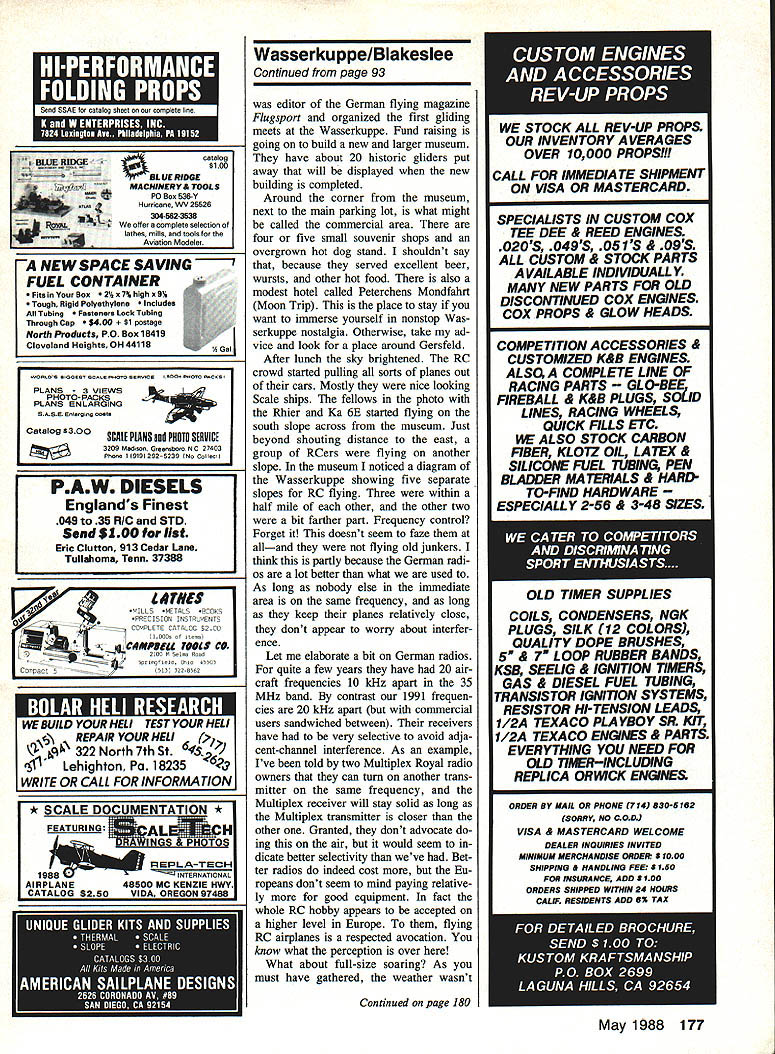
I managed to visit Hans Müller's shop in Steinau, about 30 miles toward Frankfurt. Hans makes well-known F3B planes (Dhole, King, Comet) designed by Dr. Helmut Quabeck, and his workmanship is superb. He specializes in wings and uses techniques based on skill, epoxy, and glass reinforcement rather than fancy machinery. His shop draws owners from across Germany who bring fuselages for him to produce wings. Hans and his wife were very hospitable.
Museum, media, and the pioneers
There are good books on the Wasserkuppe; I recommend Martin Simons' The World's Vintage Sailplanes 1908–1945. Peter Riedel's Start in den Wind is another fascinating source (if you can read German). PBS aired an eight-part series called "Pioneers of Aviation," with the first three parts about gliding and much historic film footage from the Wasserkuppe. One especially nostalgic segment showed 70‑year‑old Peter Riedel flying a reproduction of the biplane glider he had first flown at the Rhoen meet in 1920 when he was 14. Riedel later was test pilot for the Rhönadler in 1932 and helped develop aero towing.
Practical information and tips
- If you can arrange a visit on a sunny day in August you'll see lots of soaring activity, and flights in two-place sailplanes or motor gliders may be available.
- Schleicher's factory in Poppenhausen welcomes visitors who want to see sailplane production.
- For lodging, consider Gersfeld if you prefer townside hotels; the Peterchens Mondfahrt hotel near the summit suits those wanting to immerse themselves in Wasserkuppe nostalgia.
- The museum charges a modest fee and sells pins, postcards, and books (mostly in German).
One last note on spelling: Rhön is spelled with an umlaut over the "o." Because English does not use the umlaut, it is conventional to add an "e" after the vowel (Rhön → Rhoen) to approximate the pronunciation. The same goes for the "u" in Müller (Mueller).
Transcribed from original scans by AI. Minor OCR errors may remain.

