
Water Flying
Historically, water was used as a flying "field" only when land alternatives proved impractical or uneconomical. Early this century, long flights over water routes were serviced by seaplanes primarily because modern airports were years away.
As the network of modern airports grew along with aircraft performance, seaplanes became impractical. Today seaplanes are used mostly when "you just can't get there from here" any other way.
There's a reason for recounting this bit of history. Just as landplanes displaced seaplanes when adequate land facilities (airports) became available, now our land facilities for model flying are under pressure. We can ease this pressure by going back to the water.
I'm not advocating that we give up our land facilities. However, by flying somewhere else part of the time, such as over water, we can reduce our exposure to population pressures that are jeopardizing many of our flying sites.
For those who simply don't have access to water at all, I apologize for taking up your time. For everyone else who hasn't tried water and is looking for something different and challenging, read on.
Unlike land masses, most bodies of water are free of folks who object to noise. In fact our equipment pales into insignificance when compared to outboards and jet skis, not to mention an occasional full-size floatplane.
The key to flying from this new surface is to locate a water area of reasonable size with an agreeable shoreline—and adjust your aircraft and flying habits slightly. That's what this article is all about.
Sites
The first item on the agenda is to find a suitable water area. Some of the factors to be considered are:
- Size
- Accessibility
- Shoreline conditions
- Obtaining permission
- Water hazards
There's got to be enough water area to take off and land on easily, plus clear overruns for climb-out and landing glide path. A stock pond might work, but a football-field-size lake is more ideal. Other possibilities are river backwaters, reservoirs, gravel pits, and wide streams.
The best water site won't do you much good if you can't get to it. Ideally you should be able to park your car securely and not have to walk more than 100 yards.
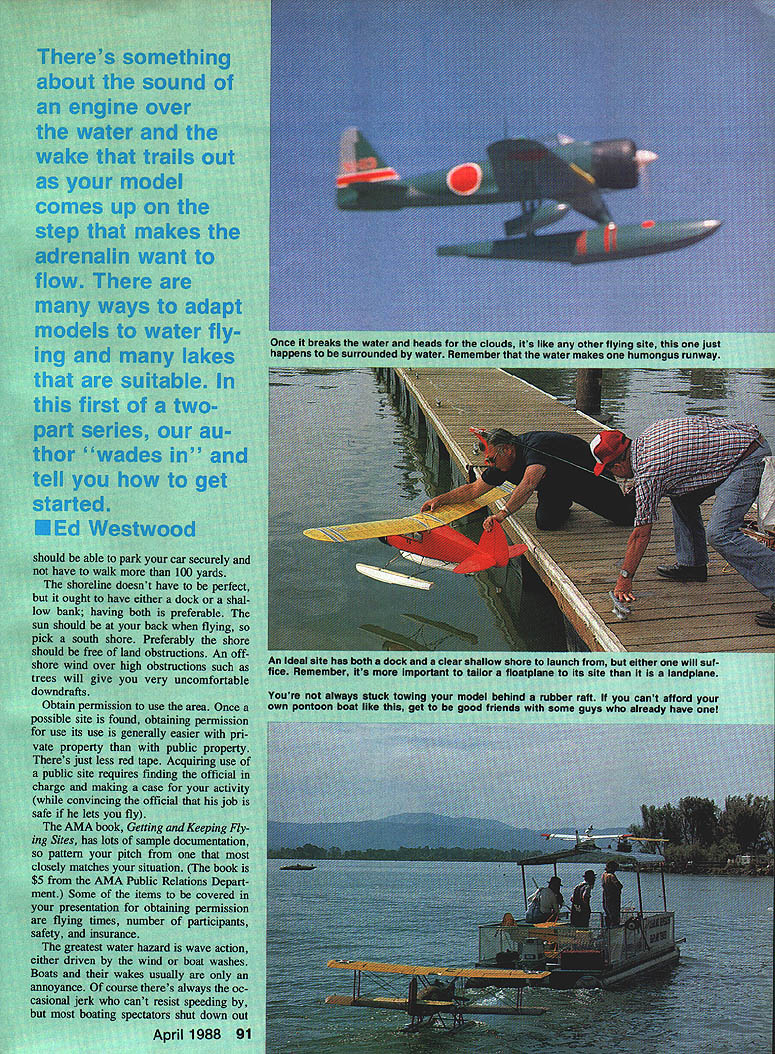
The shoreline doesn't have to be perfect, but it ought to have either a dock or a shallow bank; having both is preferable. The sun should be at your back when flying, so pick a south shore. Preferably the shore should be free of land obstructions. An offshore wind over high obstructions such as trees will give you very uncomfortable downdrafts.
Obtain permission to use the area. Once a possible site is found, obtaining permission is generally easier with private property than with public property—there's just less red tape. Acquiring use of a public site requires finding the official in charge and making a case for your activity (while convincing the official that his job is safe if he lets you fly).
The AMA book Getting and Keeping Flying Sites has lots of sample documentation, so pattern your pitch from one that most closely matches your situation. (The book is $5 from the AMA Public Relations Department.) Some of the items to be covered in your presentation for obtaining permission are:
- Flying times
- Number of participants
- Safety
- Insurance
The greatest water hazard is wave action, either driven by the wind or boat wakes. Boats and their wakes usually are only an annoyance. Of course there's always the occasional jerk who can't resist speeding by, but most boaters will stop and watch appreciatively. A light wind usually helps with takeoffs, as it reduces the length of run before takeoff.
Wave action, however, may swamp smaller models; when wave action is combined with wind, taxiing downwind becomes difficult. One hazard that occasionally gets the float flier is the shoreline. A long glide back for a splash-down is OK, but with all that water out there, overshooting and hitting something hard is unforgivable.
Ducks and geese pose an interesting dilemma. On the water they tend to ignore our seaplanes unless a collision is imminent. In the air there seems to be a curious bond between these birds and our models: they act as though the model has enough intelligence not to do something stupid. I once had to replace a prop and part of a wing leading edge after hitting a Canadian goose; the goose flew on, its confidence in my intelligence no doubt shaken. Hawks and eagles will occasionally circle nearby, but they generally tend to ignore the action below.
Water flying benefits
Water flying eases the pressure on our land-based flying field facilities. Also, floatplanes are often easier to fly than their landplane counterparts. Floatplanes are generally more stable because of the weight of the floats hanging low, and they're easier to land since the water "runway" is so immense.
Crashes on water almost always leave the model in repairable condition. A bad crash normally results in a wet airplane and a broken float or strut, possibly both. A typical accident results only in a turnover or dunk. If it is a high-wing model, it usually ends up floating on the wing and nose. More frequently than not, the radio components don't even get wet in a simple dunk.
Floatplanes really shine when used as trainers. With a reasonable trainer design, a student usually can make landings and takeoffs with just a couple of hours of practice. Of course he won't be able to put it down exactly where he wants at first, but the water is forgiving and lets you land on any part of it.
Another neat ability of floatplanes is that they can also be flown from snow. Just remove the water rudders and be prepared for a blast. The takeoff run in snow is about half of what it takes on water, and the cold air really improves the thrust from the engine/prop. Just don't forget to wear your Moon Boots.
Retrieval systems
Assuming I have you down to the water with plane in hand, how are you going to get the model back if the engine should die at a distance? Normally you taxi back to shore, but once in a while you'll have to go after it. A 12-ft aluminum car-top boat with an electric motor or small outboard engine is used most commonly for retrieval.
Here is an incident that occurred at the Pine Hollow Meet in 1986 which points to the need for safe practices when retrieving by boat. Two boys who ran the electric retrieval boat somehow got separated, and only one boy went out after a quitter. As he neared the plane he left the motor running and stepped to the bow to grab it. The boat began to overrun the plane. The boy jumped to the stern to shut off the motor; the bow lifted, and the overrunning got worse. I was standing on the shore next to the owner, and he was on the verge of total irrationality.
The lesson: with only a few fliers, the retrieval boat can be manned by one person rowing. For retrieval at larger organized activities, two occupants are necessary in the boat for balance and control. Also, many seaplanes are too cumbersome to be picked up and carried in a small boat, so standard gear carried by the boat should include a light towline with a prop loop.
Often the model will shut down just a few feet from shore. For these situations I have a long pole with a plastic can lid on the end. For distances of 50 feet or less, a light casting rod with a rubber practice weight works well.
Lastly, there is "free" retrieval. With a moderate on-shore wind, many seaplanes will not turn downwind to the shore. If so, all you have to do is shut the engine down directly upwind from where you are standing, and let the wind take over. Needless to say, you have to be able to kill your engine—something you shouldn't overlook for water flying.
Flying events
The intended purpose of full-size aircraft determines the design configuration, and the same is true for model designs. There are essentially two kinds of water flying:
- Sport — uncontrolled, anything goes.
- Fun fly competitions.
Sport seaplanes are only limited by your imagination. Some, however, are more practical than others. My hat's off to the builders of super-giant machines like the 15-ft Triple Eagle I observed at Pine Hollow. It was impressive flying but not suited to fun-fly competition. Time, space, and transportation considerations restrict the majority of us to more modest designs.
Successful fun-fly seaplanes have certain similar features even though they may look quite different. Common fun-fly competition events include:
- Slalom events: usually scheduled first in calm morning conditions to test skill in maneuvering through a series of gates, including touch-and-goes with some 360s between each landing.
- Timed flights.
- Two-minute timed flights with mandatory air maneuvers.
- Depending on wind and time constraints: limbos, bomb drops, and balloon busts.
The order and complexity of these events will vary, and this affects the designs that do best.
If you anticipate attending water meets where scale points are given, the design process is simplified. Weight, power, and perhaps slight tail geometry adjustments may be made for best performance, but otherwise the design is fixed.
The key in the design process is to establish your requirements before you start designing or making the model. Anticipated wave size determines float size, which sets overall model size. Big waves require big floats and big models. If the wind is a total unknown, maybe two models are the answer: a large model for heavy winds and a small one for light winds.
Basic seaplane configurations
There are three basic types:
- Hull (flying boat)
- The hull or flying-boat style almost always has a high wing with single or multiple engines mounted on a pylon or on the wing. Tip floats or sponsons maintain lateral balance. These models tend to have fairly high wing loadings. If the wing is mounted high as on a PBY, crosswind taxiing becomes difficult due to the downwind tip float digging in.
- Twin float
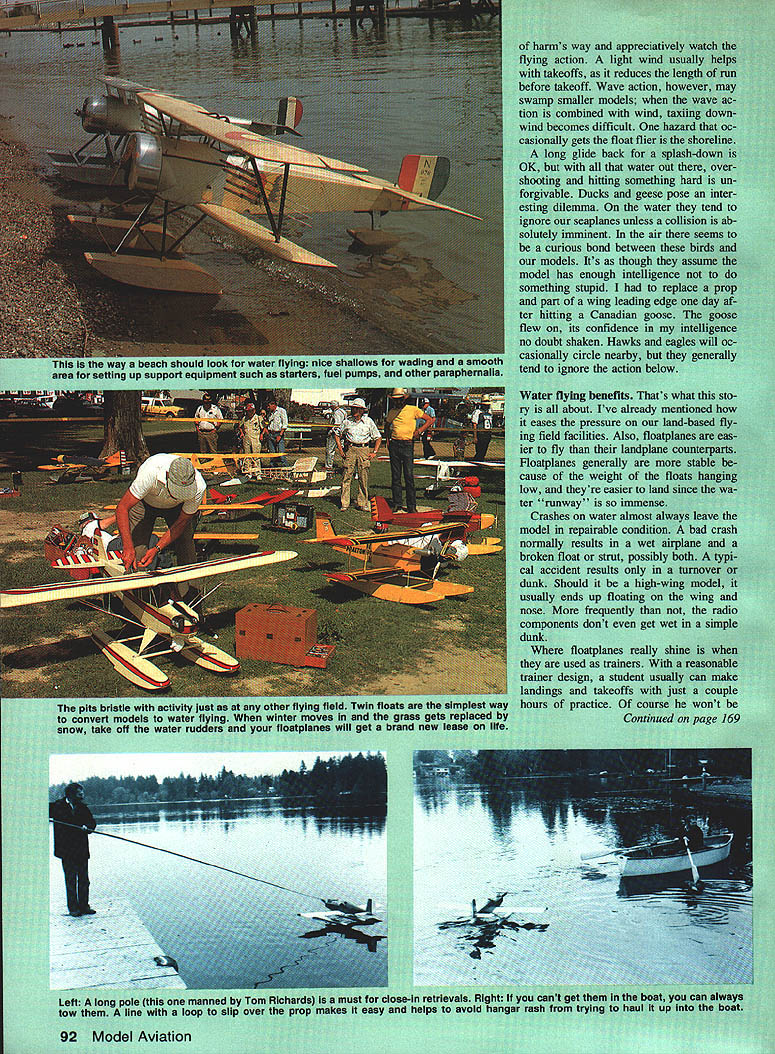
- The twin-float configuration tends to be the most popular—probably because they handle rough water the best. They also will take crosswind landings without digging in, and the twin-float model steers reasonably well in heavy water if enough water rudder is provided. The prevalence of twin-float full-scale seaplanes also influences modelers. Another reason for the popularity is that twin floats are the easiest to modify from landplane versions; just strapping on a couple of floats can get you on the water with minimal effort.
- Single float with tip stabilizers
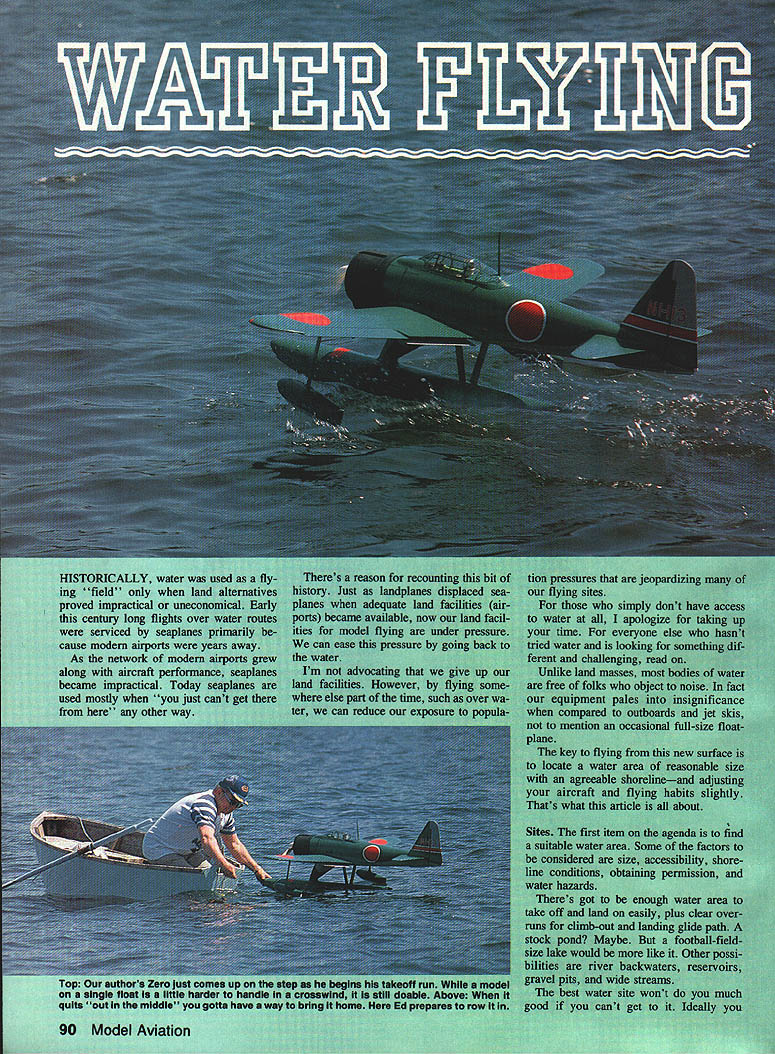
- This configuration has a single float with tip floats for stability. You won't see many models in this layout except a few for scale competitions. The single float offers very little drag reduction over twin floats, and the single-float model is tough to control in crosswinds. After saying these negative things, I still wouldn't give up my Zero for anything!
That's it for the first of this two-part presentation. Ponder the relief water has for our crowded land-based flying sites. Unlike land, most water is not owned; however, you must negotiate for access to it. Once you have acquired access, a car-top boat and a fishing pole (plus an appropriate model, of course) are about all you'll need to try out the wet "field."
Next time I'll be discussing both the mandatory and optional modifications that will make a landplane seaworthy—and four off-the-shelf kits that make very respectable seaplane conversions.
Transcribed from original scans by AI. Minor OCR errors may remain.

