
The Way It Was
Jim Noonan
WHATEVER YOUR AGE, chances are the word Old-Timer evokes a series of model aircraft from your past. Actually, the era of flying models began when your ancestors were alive, having been ushered in by an Englishman named George Cayley in 1840. The first models were experiments in heavier-than-air (mechanical) flight. When this became a reality in 1903, rapid improvement in design led to the sport of flying—and to the related activity of model flying.
Wilhelm Kress and early model flight
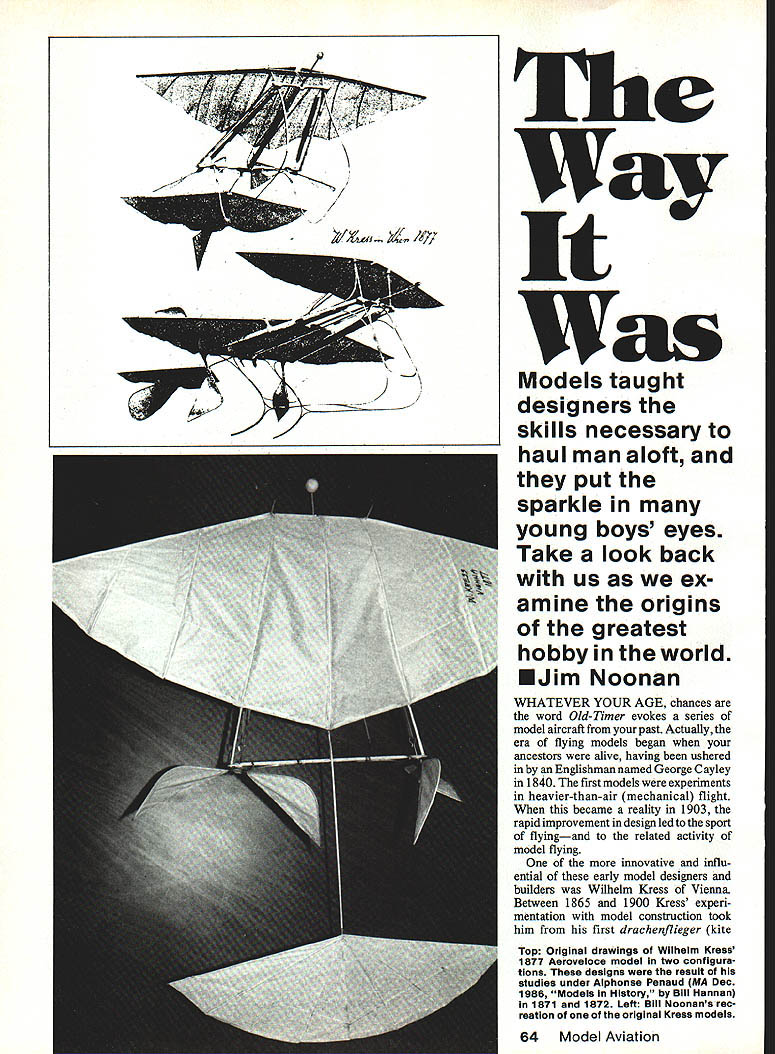
One of the more innovative and influential early model designers and builders was Wilhelm Kress of Vienna. Between 1865 and 1900, Kress' experimentation with model construction took him from his first drachenflieger (kite fliers), which he eventually equipped with his special "elastic air screws" (propellers), to the much more sophisticated, rubber-powered models called aeroveloce. Emboldened by his mastery of model flight, Kress designed and constructed a man-carrying flying boat in 1901, but that experiment was not successful.
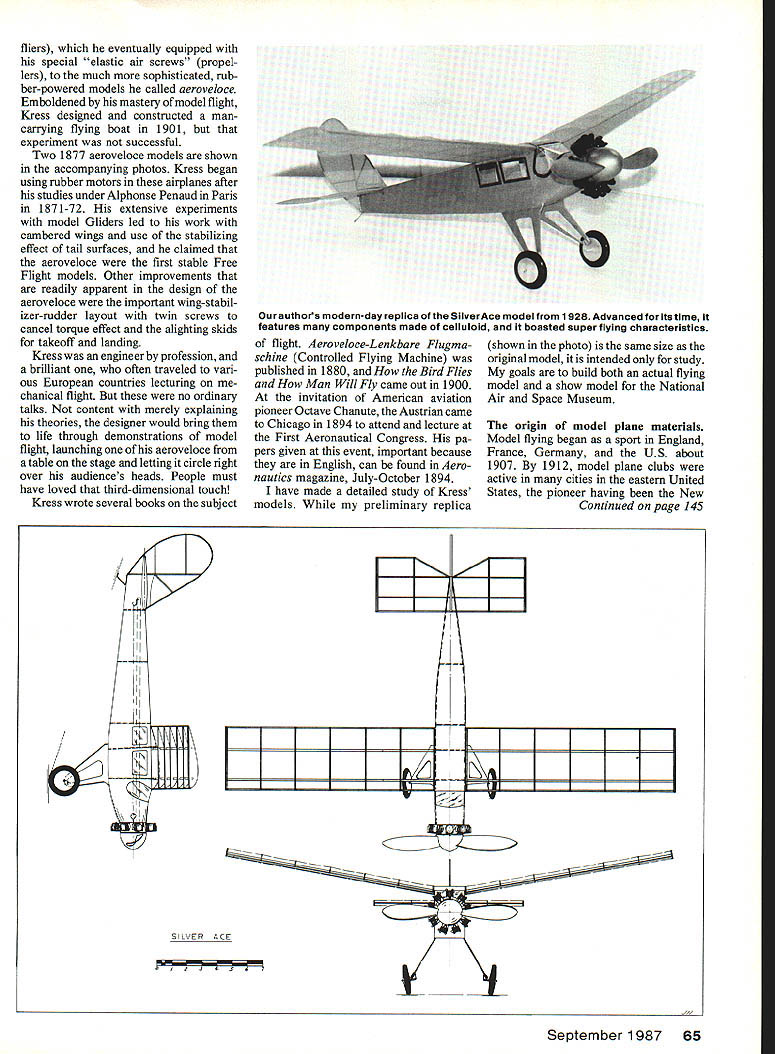
Two 1877 aeroveloce models are shown in the accompanying photos. Kress began using rubber motors in these airplanes after his studies under Alphonse Penaud in Paris in 1871–72. His extensive experiments with model gliders led to his work with cambered wings and the use of the stabilizing effect of tail surfaces, and he claimed that the aeroveloce were the first stable free-flight models. Other improvements readily apparent in the design of the aeroveloce were the important wing–stabilizer–rudder layout with twin screws to cancel torque effect, and the alighting skids for takeoff and landing.
Kress was an engineer by profession and a brilliant one, who often traveled to various European countries lecturing on mechanical flight. But these were no ordinary talks. Not content with merely explaining his theories, the designer would bring them to life through demonstrations of model flight, launching one of his aeroveloce from a table on the stage and letting it circle right over his audience's heads.
Kress wrote several books on the subject. Aeroveloce—Lenkbare Flugmaschine (Controlled Flying Machine) was published in 1880, and How the Bird Flies and How Man Will Fly came out in 1900. At the invitation of American aviation pioneer Octave Chanute, the Austrian came to Chicago in 1894 to attend and lecture at the First Aeronautical Congress. His papers from this event, important because they are in English, can be found in Aeronautics magazine, July–October 1894.
I have made a detailed study of Kress' models. While my preliminary replica (shown in the photo) is the same size as the original model, it is intended only for study. My goals are to build both an actual flying model and a show model for the National Air and Space Museum.
The origin of model plane materials
Model flying began as a sport in England, France, Germany, and the U.S. about 1907–1912. By 1912 model plane clubs were active in many cities in the eastern United States; one pioneer was the New York Model Aero Club. By 1915 clubs existed in most major cities across the country. Leading aviation magazines carried "Model Pages" documenting activities and providing a good way to exchange practical information. The advantages of balsa, tissue, and cellulose cement as modeling materials became better known. By 1930, these materials were fairly common in America.
In other countries, until exposure to balsa, tissue, and cellulose through international contact in the 1930s, modelers used whatever materials were locally available. When American model builders brought their balsa-and-tissue models in 1930 to the Wakefield International Contest in England, the British were still building models of birch, thin plywood, and silk, with walnut propellers. With the increasing international contact from the 1930s onward, American standards came to be universally adopted.
The early models were crude and heavy and produced only short flights—usually indoors. As structure became more refined, flying moved outdoors. Lightness and strength were the goals, and modelers were achieving long flights. Buoyed by their attainments, some of the more advanced modelers—those whose financial capability matched their ambition—established model supply houses.
Before balsa and tissue became staples of American modeling, spruce had been the most commonly used wood. Other popular woods included:
- white pine
- holly
- cedar
- poplar
- basswood
- red cedar
Bamboo, which came in 30-inch lengths, was a standard, all-purpose material. The best bamboo was the Tonkin variety from the interior of China.
Balsa as a modeling material was discovered on the New York City docks in 1911 by John Carisi, a prominent member of the New York Model Aero Club. It came from South America and was used to pack expensive mahogany logs shipped as deck cargo. Soft and wormy, this early balsa lacked the quality control we enjoy today, but the New York group used it for motor sticks and props. A plan for a model using balsa appeared in Aeronautics in 1913, and by 1918 Chicago modelers were using it, though it was hard to find for some time. Club leaders often purchased rough planks and had them cut to meet club needs. I remember seeing the first balsa to arrive in Milwaukee in 1928, which came only in band-sawed sheets 6 in. by 36 in. By 1930, however, a fair variety of cut balsa was available, both as stock and in packaged kits.
Model supply houses carried a variety of small hardware and parts, including:
- small gears and ball-bearing prop shafts
- aluminum-disk and wire-spoked wheels with rubber tires
- egg-beater winders
- assorted small hardware and kits for flying and scale models
Interestingly, two model-building staples—cellulose cement and "china" silk—came to the hobby via the casket manufacturing industry. "Ambroid" (1911 spelling) was the usual cement. Clear nitrate dope (known as "bamboo varnish") and banana oil were also used as dopes. "China" silk, thinner and lighter than present-day Japanese silk, was used as casket lining and became a common model covering material, simulating the rubberized laced fabric used on full-size aircraft.
A variety of tissue coverings was available, mostly imported from the Far East. These ranged from superfine silk tissue to bamboo paper for large models. Rice paper, sold as lens tissue, could be had from the drugstore, and a form of bamboo paper was sometimes obtained from the local Chinese laundry as package wrapping. Goldbeater's skin—the lining of a cow's pancreas—was another covering option. Sheets averaged 9 in. x 28 in. and sold for 25 cents. Because of its leak-proof nature, the material had long been used to make balloons (gas bags) for dirigibles.
Rubber was available in various cross-sections, both square and rectangular, sometimes in a light red but more often in black. Black "Para" rubber proved superior and became standard until about 1932, when T-56 brown rubber came on the market. Since rubber thread had many commercial uses, it was cheap and plentiful. In 1915, Percy Pierce, a well-known Philadelphia modeler, became the first supplier to deal in quantities of rubber so that clubs could order a full year's supply.
Model supply houses—whose stock also included a variety of kits for flying and scale models—were, with rare exceptions, located in the East until the late 1920s, when they began to appear in larger Midwestern cities like Chicago. Neighborhood shops as we know them today did not begin to appear until the mid-1930s. With the onset of World War I in 1917 the model supply trade slowed and remained sluggish until Lindbergh's 1927 transatlantic flight sparked a renewed popular interest in aviation. The industry reached a peak in 1941, declining again as the U.S. entered World War II.
Model magazines and organizations
Model plane pages in magazines like Aeronautics, Aerial Age, Aviation, Fly, and Flying contained the first printed accounts of model contests and drawings of winning models. Model flying had been in a boom before 1917, but it declined during the Great War when many enthusiasts became instructors, pilots, and engineers.
The boys who went off to Europe in 1917 returned as hardened men; from their soberer perspective, modeling must have seemed a childish hobby. Of those who had been club members, few chose to rejoin, and only a small number of clubs survived. Aerial Age continued to publish a "Model Page" until the magazine folded in 1923. After that, published material on models was a rarity—until Lindbergh's historic 1927 flight exploded in the headlines and ignited nationwide enthusiasm for anything that flew.
When Lindbergh touched ground in Paris, every newspaper in the land carried the banner for aviation. The daring ocean flights and the rapid development of new and better planes were minutely chronicled. Suddenly youngsters wanted models, too. With the new surge of interest, model-building articles appeared in numerous magazines as builders searched for good designs to meet unprecedented demand. Naturally, everyone wanted a model of the Spirit of St. Louis, and many plans appeared—most resembling the real thing only vaguely. Flights by such scale models were brief, creating a strong desire for long-duration "scientific" models built to bare-minimum structures.
The better twin-pushers with their large propellers, circa 1915, were resurrected, as were some primitive single-tractor models. Twin-pushers became the most popular designs of the day due to the ease with which they could be adjusted for a good flight; adjustment of single-tractors was largely unknown and good flights were often a matter of luck.
In September 1927 Bill Stout and Merrill Hamburg of Detroit founded the Airplane Model League of America (AMLA). Sponsored by The American Boy magazine, the League had nearly half a million members by 1931. Each issue of the magazine featured extensive information on model aviation, boasting new, modern, all-balsa plans and techniques. In the boom years before the Depression, top sponsorship by The American Boy and others made possible the first official National Meets in Detroit—usually three to five day meets with indoor and outdoor events capped by a grand prize-giving banquet. The Nationals attracted the best builders in the country, and the liberal exchange of ideas among expert builders resulted in rapid improvement in model design. For example, the indoor duration record rose from three minutes in 1927 to 12 minutes by 1930.
At the 1929 first National Meet in Detroit, attendees were handed a sample of a new magazine, Model Airplane News. Those first issues (the earliest I have is November 1928) were crude and irregular, probably the work of one person who knew little about models. A somewhat more professional publisher, Bernard McFadden, later acquired and transformed the magazine by hiring the late Jesse Davidson to write and draw plans for it.
The Silver Ace and mass-produced kits
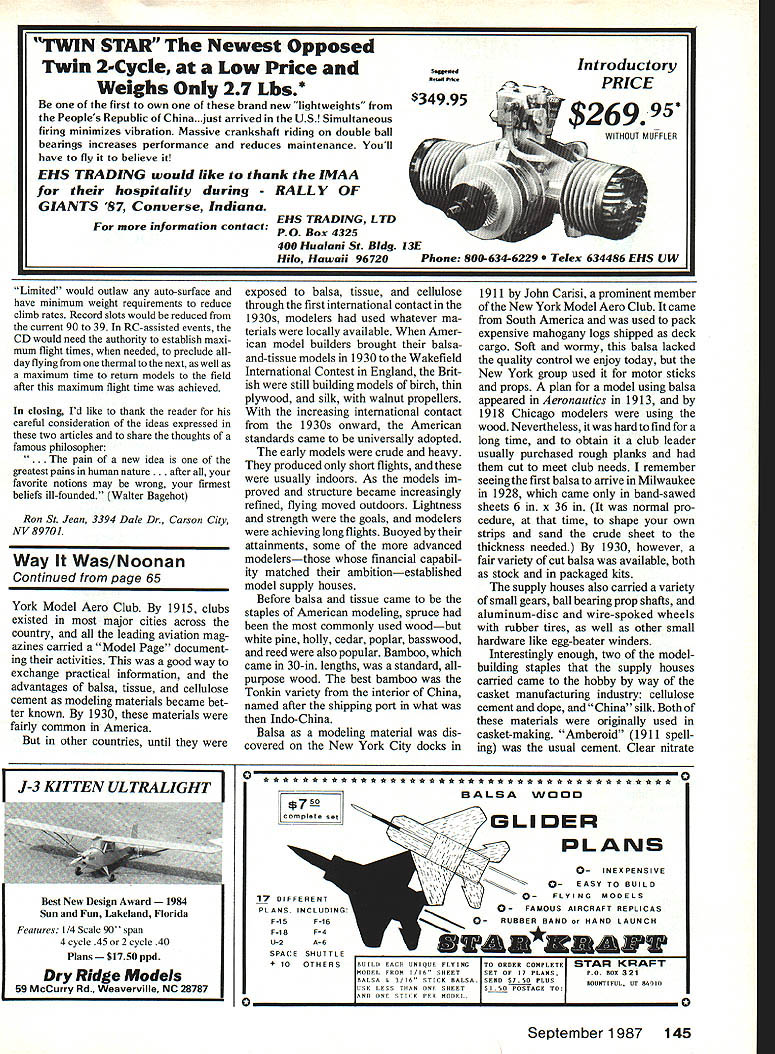
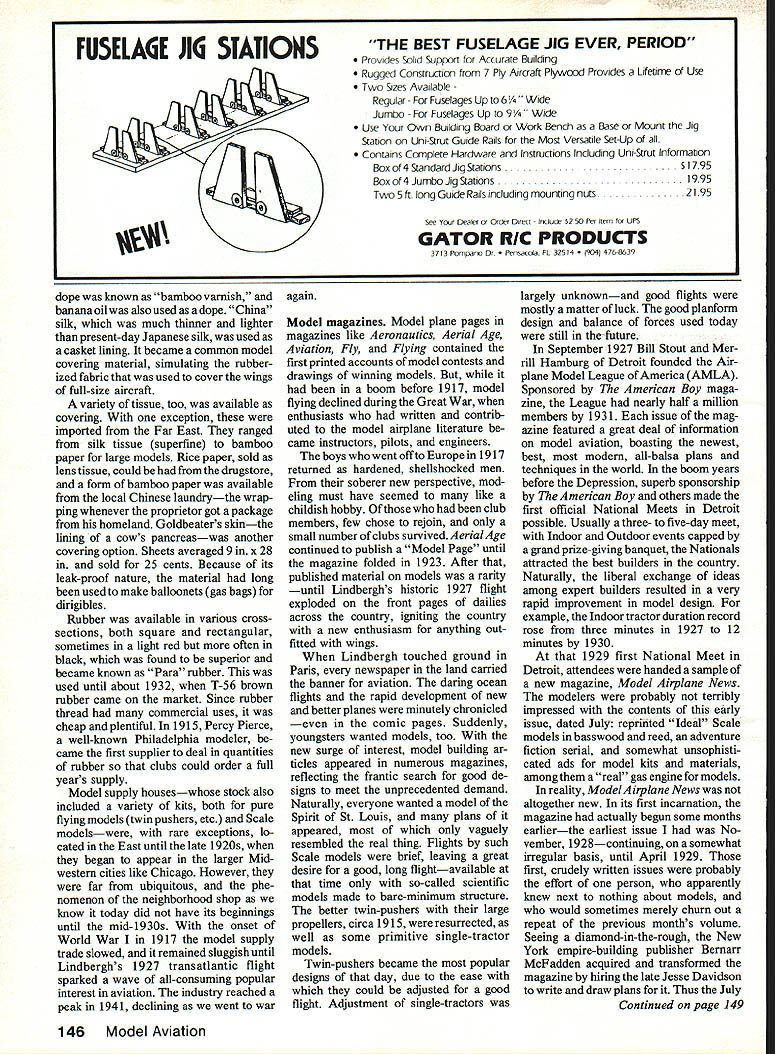
Using many concepts introduced by advanced clubs like the Illinois Model Aero Club, Shutte's Silver Ace design evolved over several years. In its 1928 version the Silver Ace was a simple yet attractive model whose realistic appearance was greatly enhanced by many parts made of molded and flat celluloid.
Celluloid parts were made in Japan from designs of the Aero Model Company. For many years—long after the Silver Ace and other makes were off the market—these designs (including features like ball-bearing shafts, wheels, carved wood propellers, etc., for which tooling existed in Japan) continued to be manufactured there and sold by U.S. firms. Depression-era prices were extremely low. Paulownia props and similar items were common; in Japan, Mr. Kitamura was the expediter of manufacturing for the American market and continued in that capacity after World War II.
Assembly of the Silver Ace models was carried out primarily by female workers, assisted by a few men who operated machines. Fuselage sides were made by shaping a block of balsa to the outline and then band-sawing it to 1/16-inch sheet thickness, finishing with sanding. Bulkheads of die-cut cardboard and sides were fitted into a jig and glued. After fitting wire parts, landing gear, and tail skid, the top and bottom were silk-covered and then doped. A final spray coat of color (initially silver, later red and other colors) finished the fuselage.
Wings and tails were made by the mile. Wing panels were identical, with holes drilled in the spar tenons on both sides so they were completely interchangeable. Balsa die-cut ribs were slipped on dowel spars, and lighter dowels formed the leading and trailing edges. The assembly was fitted onto a jig and dipped into thin Ambroid (a cellulose cement), which glued joints and prepared the surface for the China silk covering.
Wing and tail frames were slipped into sewn silk tubes, the ends gathered tight, and the whole assembly sprayed with a dope which filled the silk but did not shrink. The result: no sags or warps. The wings then had orange-colored framework lines nicely showing through the white silk.
Today, a Silver Ace owned by Mr. C. A. Vevre of Kenosha, WI sits in its original box, still intact after 59 years—convincing evidence of how durable these models could be. In 1928 I could only admire the Silver Ace from afar, but around 1965 a few celluloid parts turned up and I built one over (now in Dave Shipton's model museum in Illinois). More recently the original plane was redrawn, adapting it to present-day all-balsa methods and duplicating the celluloid parts in balsa and other materials. The model in the photo features this updated construction; the wheels are made by hand using bottoms of beer cans for hub plates.
You can obtain a copy of the full-size plan for $2.50 from: Oldtimer Models, P.O. Box 7334, Van Nuys, CA 91409.
To all Old-Timers: I have a large file of model history and often build replica models using original materials. Your comments, old photos, and drawings concerning early model aircraft (I can copy and return) are welcome.
Transcribed from original scans by AI. Minor OCR errors may remain.

