
From the We-Fly Lab: House of Balsa Pietenpol
Bob Harrah
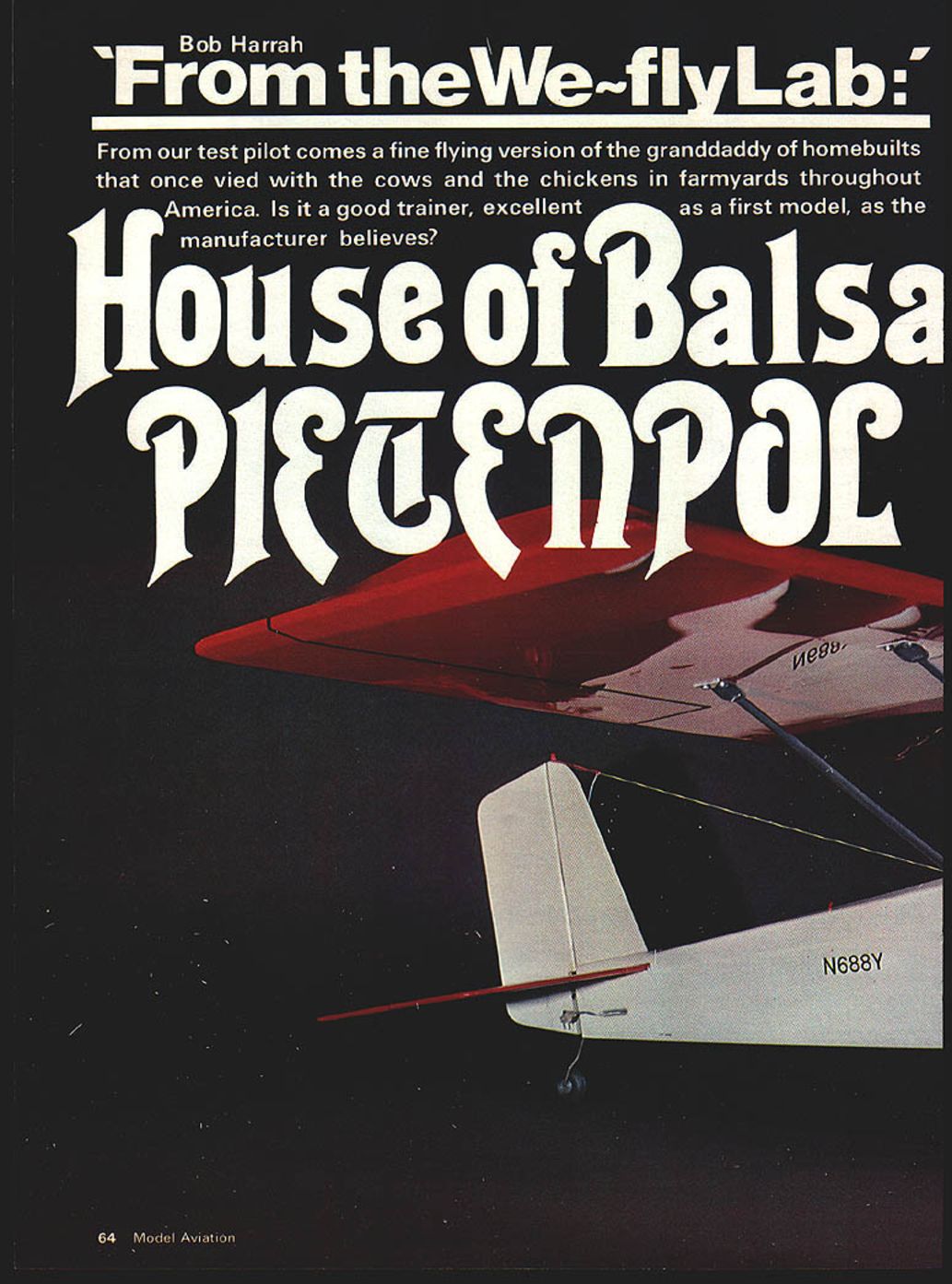
From our test pilot comes a fine flying version of the granddaddy of homebuilts that once vied with the cows and the chickens in farmyards throughout America. Is it a good trainer, excellent as a first model, as the manufacturer believes?
The great depression had started and in the early 1930s full-size, homebuilt Pietenpols were being built from plans found in Modern Mechanics magazine. During this period it became known as the Pietenpol (Pete ’n’ Paul) Air Camper, and what a time they must have had. Just imagine building your own plane in the back yard, throwing in the fishing pole and heading for that soft green meadow by the old fishing hole and doing a little camping, or better yet, getting all slicked up in your Sunday best duds and hopping over to the farmer’s daughter’s south forty, asking Pa for permission to take his little girl for a flight and a picnic beside that newly cleared land for the fall harvest. Times were tough, but a lot of credit must go to those daring men of the air who kept fun and adventure alive with their Pietenpols. For those who remember, it would have made a great movie with Jimmy Stewart and June Allyson.
Don Dombrowski and his company, House of Balsa, in their tenth year of manufacturing, have used 24 years of personal experience and talent to put out an exceptional product. In their words, "This kit captures the looks and flying style of the original. It's a high quality, easy building, stable trainer, which is excellent as a first airplane." It was the claim that it was "excellent as a first airplane" that caught the eyes of the We-Fly-Lab. Our adventure was ready-built! But this kit, from the picture on the box, the wire wheels, and the words "Stand-Off Scale" (scale stigma) were enough to ward off some of the more seasoned model builders at the old hobby shop.
This kit has been on the market for almost four years and, according to Don, some of the resultant models have been in use for three years. One modeler claims he has gone through three engines — a flying testimonial to the durability of a model from this kit. House of Balsa has a neat 1/2A version and a new biggie (1/4 scale) to be released soon. (More about this one later.)
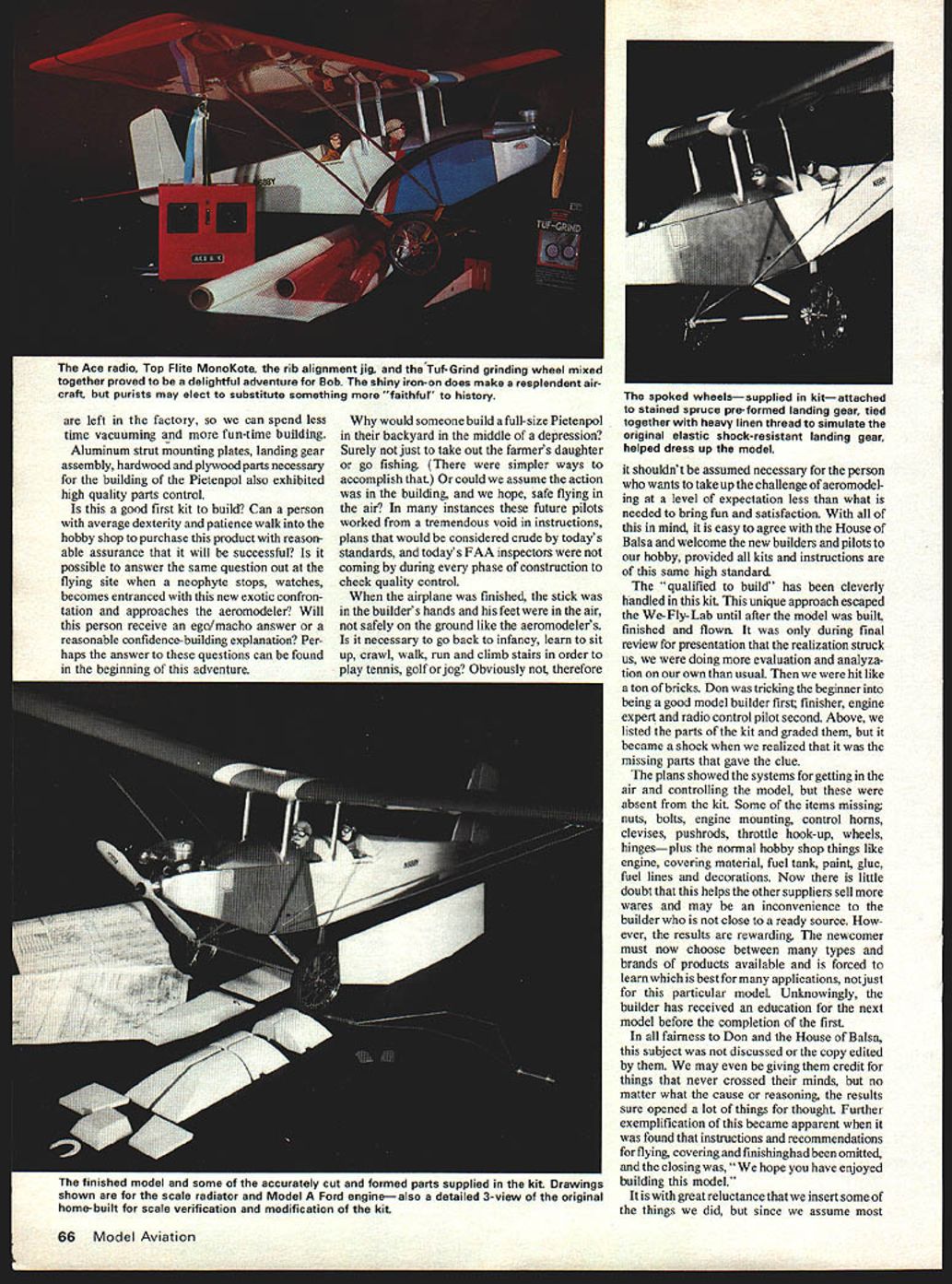
As we opened the box, the first concern was whether this is a good beginner’s kit from a building standpoint — how to fly, install radios, cover and run engines, etc., weren't considered as part of the requirements for a good kit (these responsibilities belonged to those suppliers). The first item seen is the instruction book, 26 pages displaying over 90 clear photographs, concisely captioned. Then come three sheets of highly detailed plans, the scale detailing for the Model A engine and a readable reproduction 3-view of the real thing.
The balsa wood selection is, as needed, good for each section of the plane. The cutting is accurate, even the pre-shaped large chunks, and the engine compartment side plates are already proper angle-cut for precise fit. Not only has House of Balsa supplied a kit for fast and almost errorless building, but most of the shavings and balsa dust are left in the factory, so we can spend less time vacuuming and more fun-time building. Aluminum strut mounting plates, landing gear assembly, hardwood and plywood parts necessary for the building of the Pietenpol also exhibited high quality parts control.
Is this a good first kit to build? Can a person with average dexterity and patience walk into the hobby shop to purchase this product with reasonable assurance that it will be successful? Is it possible to answer the same question out at the flying site when a neophyte stops, watches, becomes entranced with this new exotic confrontation and approaches the aeromodeler? Will this person receive an ego/macho answer or a reasonable confidence-building explanation? Perhaps the answer to these questions can be found in the beginning of this adventure.
Why would someone build a full-size Pietenpol in their backyard in the middle of a depression? Surely not just to take out the farmer’s daughter or go fishing. (There were simpler ways to accomplish that.) Or could we assume the action was in the building, and he hoped for safe flying in the air? In many instances these future pilots worked from a tremendous void in instructions, plans that would be considered crude by today's standards, and today's FAA inspectors were not coming by during every phase of construction to check quality control.
When the airplane was finished, the stick was in the builder’s hands and his feet were in the air, not safely on the ground like the aeromodeler's. Is it necessary to go back to infancy, learn to sit up, crawl, walk, run and climb stairs in order to play tennis, golf or jog? Obviously not; therefore it shouldn't be assumed necessary for the person who wants to take up the challenge of aeromodeling at a level of expectation less than what is needed to bring fun and satisfaction. With all of this in mind, it is easy to agree with House of Balsa and welcome new builders and pilots to our hobby, provided all kits and instructions are of this same high standard.
The "qualified to build" issue has been cleverly handled in this kit. This unique approach escaped the We-Fly-Lab until after the model was built, finished and flown. It was only during final review for presentation that the realization struck us. We were doing more evaluation and analysis on our own than usual. Then we were hit like a ton of bricks. Don was tricking the beginner into being a good model builder first, finisher, engine expert and radio control pilot second.
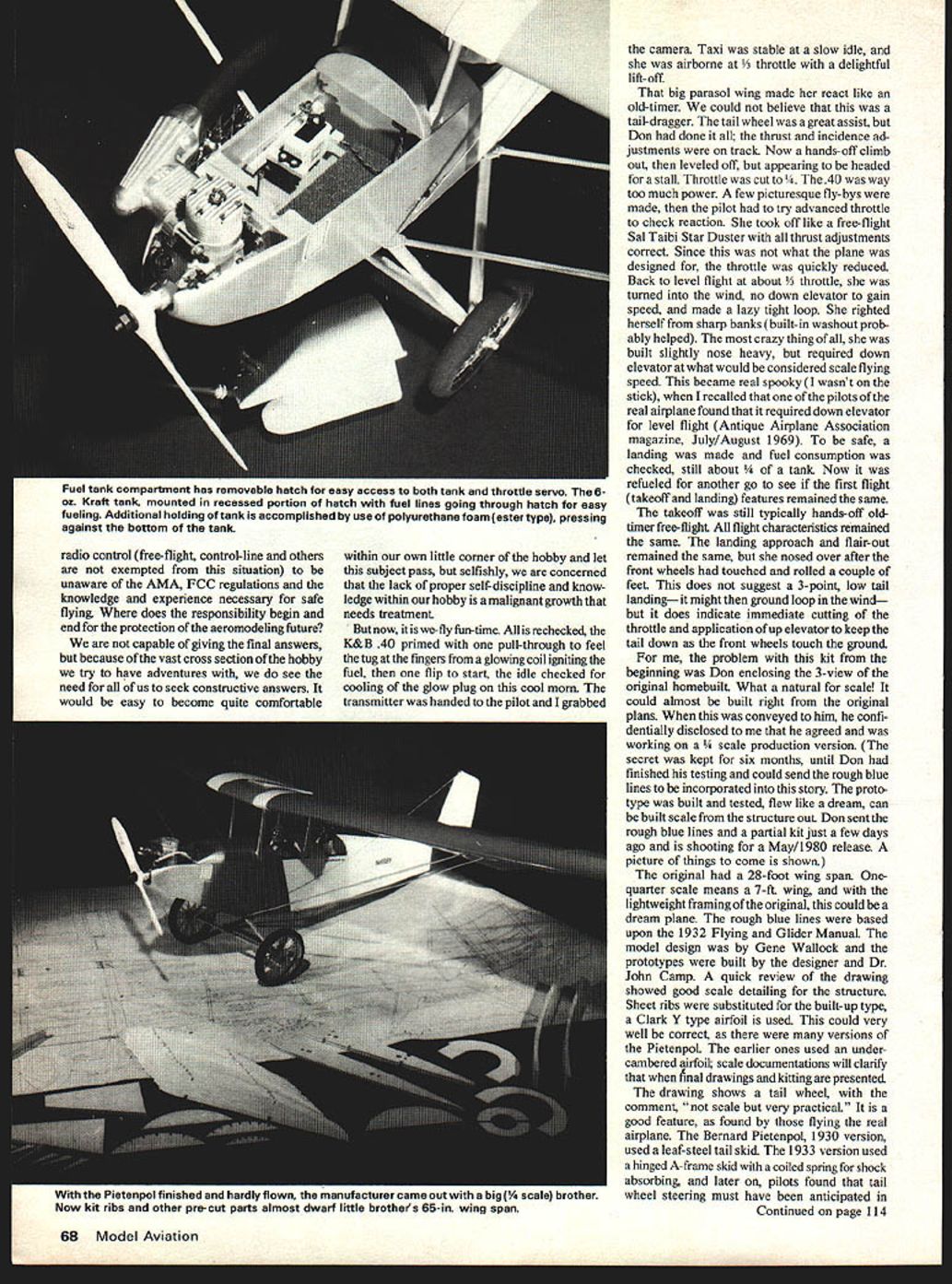
Above, we listed the parts of the kit and graded them, but it became a shock when we realized that it was the missing parts that gave the clue. The plans showed the systems for getting in the air and controlling the model, but these were absent from the kit. Some of the items missing: nuts, bolts, engine mounting, control horns, clevises, pushrods, throttle hook-up, wheels, hinges — plus the normal hobby shop things like engine, covering material, fuel tank, paint, glue, fuel lines and decorations.
Now there is little doubt that this helps the other suppliers sell more wares and may be an inconvenience to the builder who is not close to a ready source. However, the results are rewarding. The newcomer must now choose between many types and brands of products available and is forced to learn which is best for many applications, not just for this particular model. Unknowingly, the builder has received an education for the next model before the completion of the first.
In all fairness to Don and House of Balsa, this subject was not discussed or the copy edited by them. We may even be giving them credit for things that never crossed their minds, but no matter what the cause or reasoning, the results sure opened a lot of things for thought. Further exemplification of this became apparent when it was found that instructions and recommendations for flying, covering and finishing had been omitted, and the closing was, "We hope you have enjoyed building this model."
It is with great reluctance that we insert some of the things we did, but since we assume most readers of this magazine are already beyond the first model stage, we will be so bold as to infringe upon the unmentioned portions of the kit.
It is a 2- or 3-channel design for a .09 to .35 engine, weighing between 4½ to 5½ lbs., with less than a 17 oz. per sq. ft. wing loading. Experience and a study of the plans gave some insight into areas of caution. The wing and stabilizer are set at negative and zero incidence respectively. Down and right engine thrust is built in and the center of gravity (CG) is at about 28% of the wing chord. Following the plans is a must if you want the beautiful takeoff and landing characteristics that this model is capable of. Under these design parameters, being tail heavy would almost assure an instant crash.
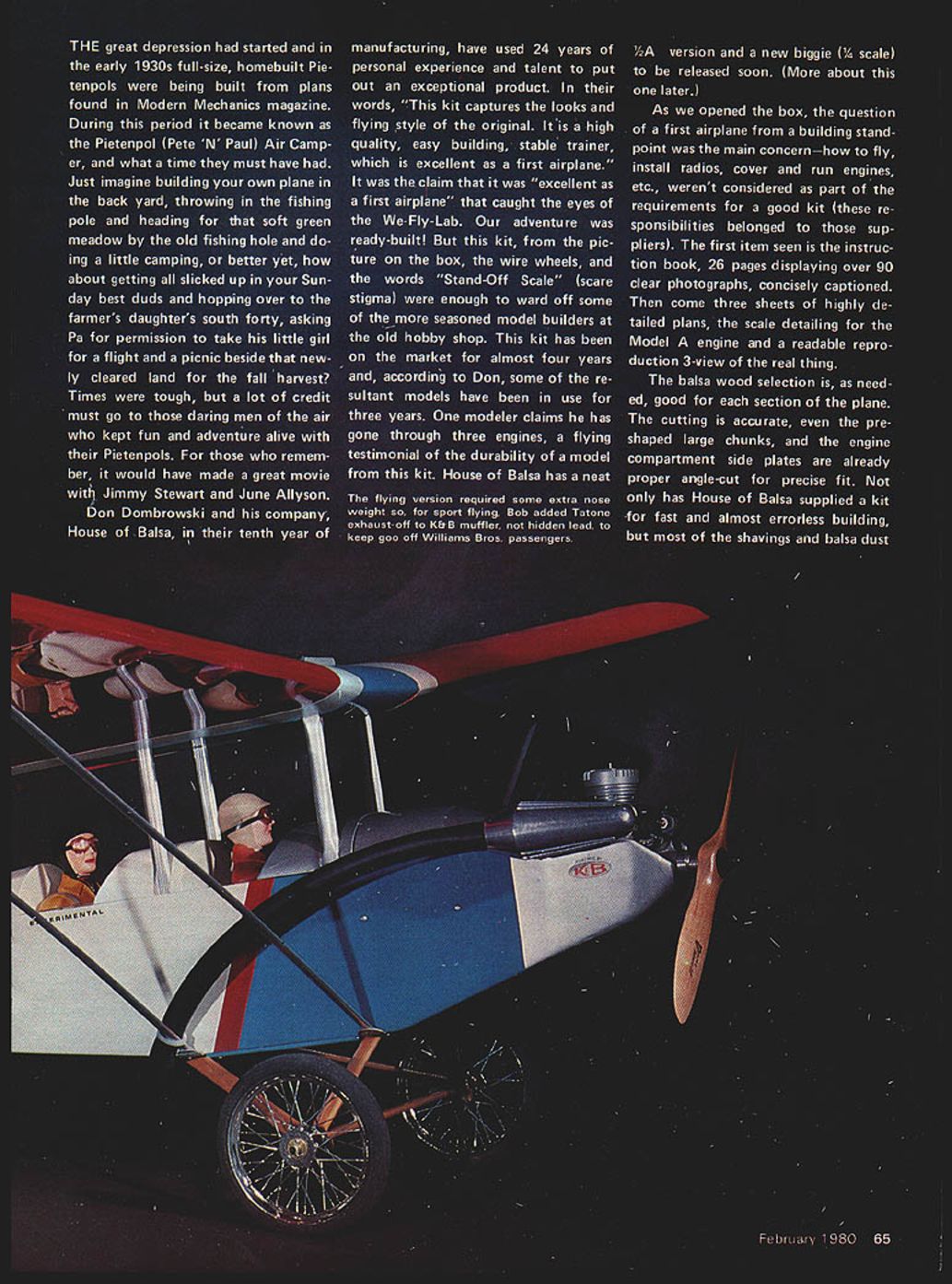
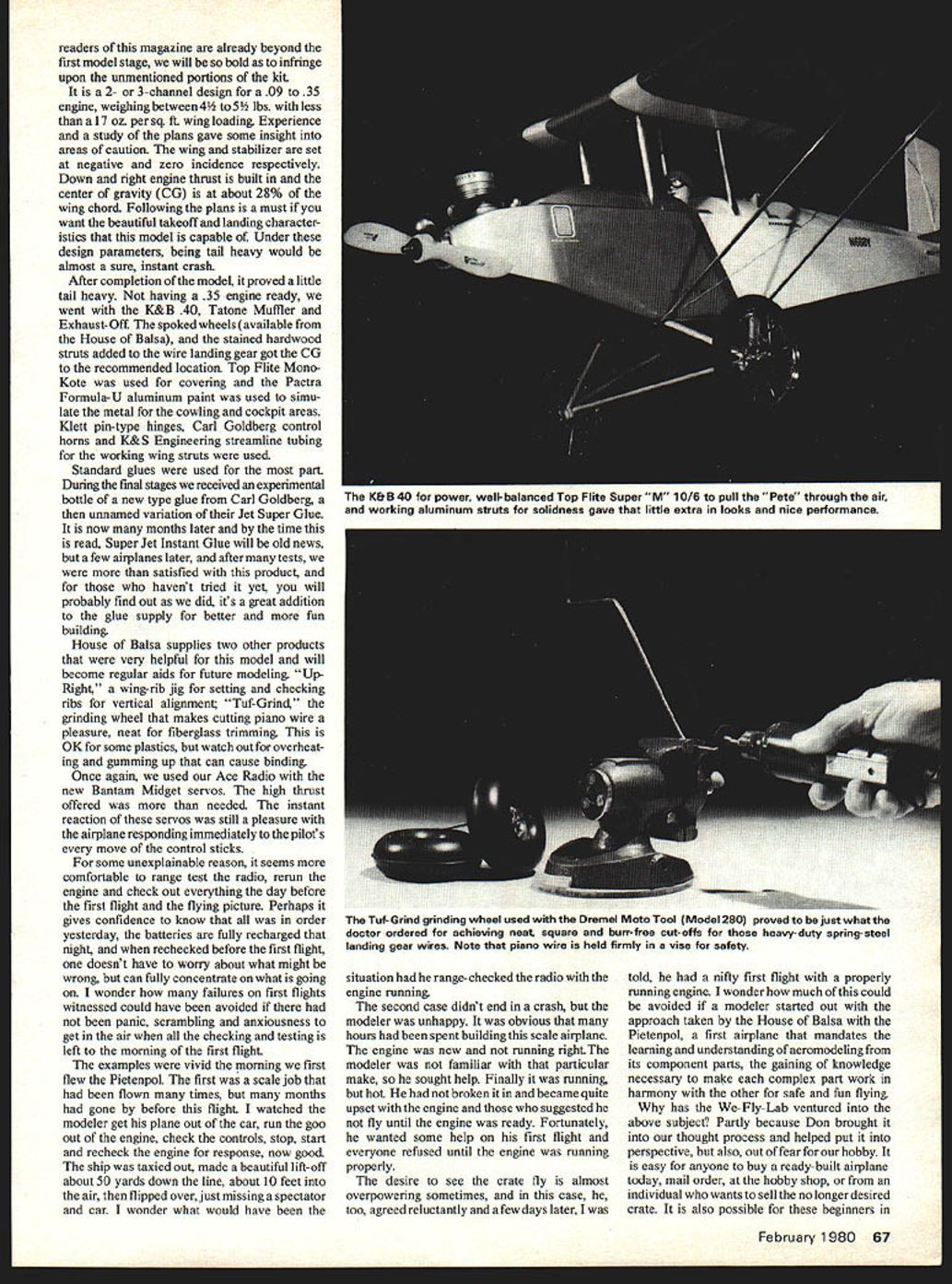
After completion of the model, it proved a little tail heavy. Not having a .35 engine ready, we went with the K&B .40, Tatone muffler and Exhaust-Off. The spoked wheels (available from House of Balsa) and the stained hardwood struts added to the wire landing gear moved the CG to the recommended location. Top Flite MonoKote was used for covering and Pactra Formula-U aluminum paint was used to simulate the metal for the cowling and cockpit areas. Klett pin-type hinges, Carl Goldberg control horns and K&S Engineering streamline tubing for the working wing struts were used.
Standard glues were used for the most part. During the final stages we received an experimental bottle of a new type glue from Carl Goldberg, a then-unnamed variation of their Jet Super Glue. It is now many months later and by the time this is read, Super Jet Instant Glue will be old news, but after many tests and a few airplanes later, we were more than satisfied with this product. For those who haven't tried it yet, you'll probably find out as we did — it's a great addition to the glue supply for better and more fun building.
House of Balsa supplies two other products that were very helpful for this model and will become regular aids for future modeling:
- "Up-Right," a wing-rib jig for setting and checking ribs for vertical alignment.
- "Tuf-Grind," the grinding wheel that makes cutting piano wire a pleasure and is neat for fiberglass trimming. This is OK for some plastics, but watch out for overheating and gumming up that can cause binding.
Once again, we used our Ace radio with the new Bantam Midget servos. The high thrust offered was more than needed. The instant reaction of these servos was still a pleasure, with the airplane responding immediately to the pilot's every move of the control sticks.
For some unexplainable reason, it seems more comfortable to range-test the radio, re-run the engine and check out everything the day before the first flight and the flying picture. Perhaps it gives confidence to know that all was in order yesterday, the batteries are fully recharged that night, and when checked before the first flight, one doesn't have to worry about what might be wrong, but can fully concentrate on what is going on. I wonder how many failures on first flights witnessed could have been avoided if there had not been panic, scrambling and anxiousness to get in the air when all the checking and testing is left to the morning of the first flight.
The examples were vivid the morning we first flew the Pietenpol. The first was a scale job that had been flown many times, but many months had gone by before this flight. I watched the modeler get his plane out of the car, run the engine, check the controls, stop, start and recheck the engine for response — now good. The ship was taxied out, made a beautiful lift-off about 50 yards down the line, about 10 feet into the air, then flipped over, just missing a spectator and car. I wonder what would have been the situation had he range-checked the radio with the engine running.
The second case didn't end in a crash, but the modeler was unhappy. It was obvious that many hours had been spent building this scale airplane. The engine was new and not running right. The modeler was not familiar with that particular make, so he sought help. Finally it was running, but hot. He had not broken it in and became quite upset with the engine and those who suggested he not fly until the engine was ready. Fortunately, he wanted some help on his first flight and everyone refused until the engine was running properly.
The desire to see the crate fly is almost overpowering sometimes, and in this case, he, too, agreed reluctantly. A few days later I was told he had a successful first flight with a properly running engine. I wonder how much of this could be avoided if a modeler started out with the approach taken by House of Balsa with the Pietenpol — a first airplane that mandates the learning and understanding of aeromodelling from its component parts, the gaining of knowledge necessary to make each complex part work in harmony with the other for safe and fun flying.
Why has the We-Fly-Lab ventured into the subject? Partly because Don brought it into our thought process and helped put it into perspective, but also out of fear for our hobby. It is easy for anyone to buy a ready-built airplane today — mail order, at the hobby shop, or from an individual who wants to sell the no longer desired crate. It is also possible for these beginners in radio control (free-flight, control-line and others are not exempted from this situation) to be unaware of the AMA and FCC regulations and the knowledge and experience necessary for safe flying. Where does the responsibility begin and end for the protection of aeromodeling's future?
We are not capable of giving the final answers, but because of the vast cross-section of the hobby we try to have adventures with, we do see the need for all of us to seek constructive answers. It would be easy to become quite comfortable within our own little corner of the hobby and let this subject pass, but selfishly, we are concerned that the lack of proper self-discipline and knowledge within our hobby is a malignant growth that needs treatment.
But now, it is we-fly-fun time. All is rechecked, the K&B .40 primed with one pull-through to feel the tug at the fingers from a glowing coil igniting the fuel, then one flip to start, the idle checked for cooling of the glow plug on this cool morn. The transmitter was handed to the pilot and I grabbed the camera. Taxi was stable at a slow idle, and she was airborne at one-third throttle with a delightful lift-off.
That big parasol wing made her react like an old-timer. We could not believe that this was a tail-dragger. The tail wheel was a great assist, but Don had done it all; the thrust and incidence adjustments were on track. Now a hands-off climb out, then leveled off, but appearing to be headed for a stall. Throttle was cut to one-quarter. The .40 was way too much power. A few picturesque fly-bys were made, then the pilot had to try advanced throttle to check reaction. She took off like a free-flight Saito Star Duster with all thrust adjustments correct. Since this was not what the plane was designed for, the throttle was quickly reduced.
Back to level flight at about three-fifths throttle, she was turned into the wind, no down elevator to gain speed, and made a lazy tight loop. She righted herself from sharp banks (built-in washout probably helped). The most crazy thing of all: she was built slightly nose heavy, but required down elevator at what would be considered scale flying speed. This became real spooky (I wasn't on the stick) when I recalled that one of the pilots of the real airplane found that it required down elevator for level flight (Antique Airplane Association, July/August 1969). To be safe, a landing was made and fuel consumption was checked — still about one-quarter of a tank. Now it was refueled for another go to see if the first flight (takeoff and landing) features remained the same.
The takeoff was still typically hands-off old-timer free-flight. All flight characteristics remained the same. The landing approach and flare-out remained the same, but she nosed over after the front wheels had touched and rolled a couple of feet. This does not suggest a 3-point, low-tail landing — it might then ground-loop in the wind — but it does indicate immediate cutting of the throttle and application of up elevator to keep the tail down as the front wheels touch the ground.
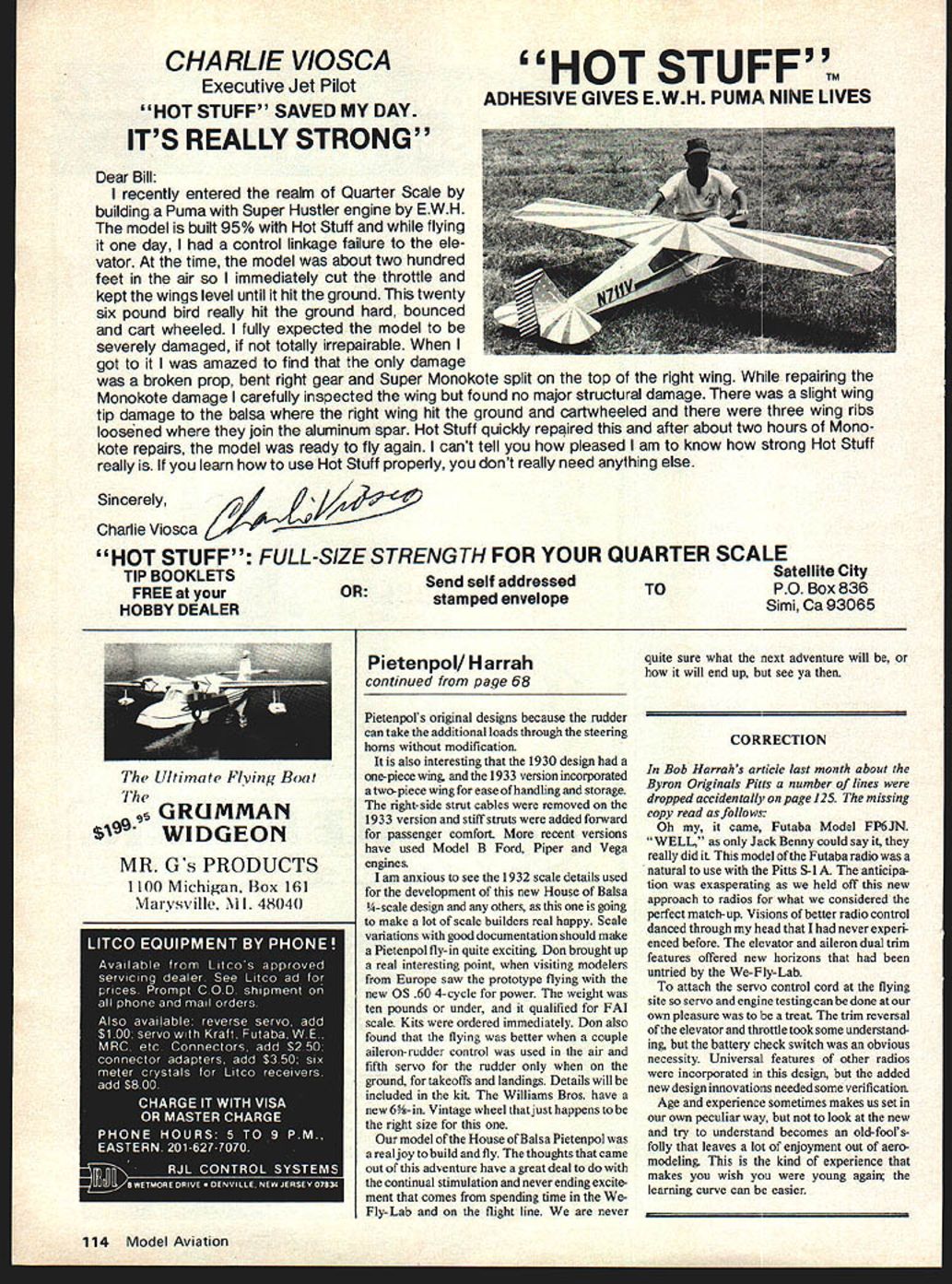
For me, the problem with this kit from the beginning was Don enclosing the 3-view of the original homebuilt. What a natural for scale! It could almost be built right from the original plans. When this was conveyed to him, he confidentially disclosed to me that he agreed and was working on a 1/4-scale production version. The secret was kept for six months, until Don had finished his testing and could send the rough blue lines to be incorporated into this story. The prototype was built and tested, flew like a dream, can be built scale from the structure out. Don sent the rough blue lines and a partial kit just a few days ago and is shooting for a May 1980 release. A picture of things to come is shown.
The original had a 28-foot wingspan. One-quarter scale means a 7-ft. wing, and with the lightweight framing of the original, this could be a dream plane. The rough blue lines were based upon the 1932 Flying and Glider Manual. The model design was by Gene Wallock and the prototypes were built by the designer and Dr. John Camp. A quick review of the drawing showed good scale detailing for the structure. Sheet ribs were substituted for the built-up type, a Clark Y type airfoil is used. This could very well be correct, as there were many versions of the Pietenpol. The earlier ones used an enclosed cantilever airfoil; scale documentation will clarify that when final drawings and kit are presented.
The drawing shows a tail wheel, with the comment, "not scale but very practical." It is a good feature, as found by those flying the real airplane. The Bernard Pietenpol 1930 version used a leaf-steel tail skid. The 1933 version used a hinged A-frame skid with a coiled spring for shock absorbing, and later on, pilots found that tail wheel steering must have been anticipated and is consistent with Pietenpol's original designs because the rudder can take the additional loads through the steering horns without modification.
It is also interesting that the 1930 design had a one-piece wing, and the 1933 version incorporated a two-piece wing for ease of handling and storage. The right-side strut cables were removed on the 1933 version and stiff struts were added forward for passenger comfort. More recent versions have used Ford Model B, Piper and Vega engines.
I am anxious to see the 1932 scale details used for the development of this new House of Balsa 1/4-scale design and any others, as this one is going to make a lot of scale builders real happy. Scale variations with good documentation should make a Pietenpol fly-in quite exciting. Don brought up a real interesting point when visiting modelers from Europe saw the prototype flying with the new OS .60 4-cycle for power. The weight was ten pounds or under, and it qualified for FAI scale. Kits were ordered immediately.
Don also found that the flying was better when a coupled aileron-rudder control was used in the air and on the ground, for takeoffs and landings. Details will be included in the kit. The Williams Bros. have a new 6½-inch vintage wheel that just happens to be the right size for this one.
Our model of the House of Balsa Pietenpol was a real joy to build and fly. The thoughts that came out of this adventure have a great deal to do with the continual stimulation and never-ending excitement that comes from spending time in the We-Fly-Lab and on the flight line. We are never quite sure what the next adventure will be, or how it will end up, but see ya then.
Transcribed from original scans by AI. Minor OCR errors may remain.

